Rent concessions are often discussed as a leasing tactic, not a financial decision. From an asset perspective, they can seem harmless as long as occupancy stays high and units remain filled. But this is where the real issue begins. The impact of concessions rarely shows up where teams expect it.
On the surface, concessions help properties move faster. Leases are signed, traffic improves, and vacancy risk feels lower. What is less visible is how these discounts quietly change the financial story of an asset. Over time, concessions reshape how revenue is earned, reported, and evaluated.
For asset managers, finance teams, and ownership groups, this matters. Asset attractiveness is not defined by occupancy alone. It is defined by revenue quality, consistency, and confidence in future performance. When concessions become routine, they weaken all three.
The challenge is that this erosion happens gradually. Effective rent declines in small increments. Reporting becomes harder to explain. Pricing decisions feel less defensible. By the time concerns surface at the ownership or investor level, concessions are already embedded in operations.
This article explains why rent concessions quietly lower asset attractiveness. We’ll break down the difference between asking rent and effective rent, explore how concessions distort performance optics, and explain why stakeholders value consistency over short-term leasing wins. The goal is clarity, not alarm, so operators can make more informed decisions about long-term value.
Effective rent vs asking rent: where value really lives
Rent discussions often start with asking rent. It is the number shown in listings, marketing materials, and tour conversations. While asking rent matters for positioning, it is not the number that determines an asset’s financial performance. That role belongs to effective rent.
What asking rent represents
Asking rent is the public price of a unit. It signals how a property is positioned in the market and how it compares to nearby communities. Asking rent is useful for attracting traffic and setting expectations, but it does not reflect what the property actually earns.
When concessions are used, asking rent often stays the same. On paper, this can make pricing appear stable or even increasing. This is why concessions can feel safe at first. The headline number does not change.
What effective rent actually measures
Effective rent reflects the real income collected after concessions are applied. Free rent, credits, and discounts all reduce the total revenue earned over the lease term. Even if asking rent remains unchanged, effective rent tells a different story.
From a financial perspective, effective rent is what matters. It drives cash flow, supports operating budgets, and feeds into valuation models. Over time, even small gaps between asking rent and effective rent can compound into meaningful revenue loss.
Why the gap matters to asset performance
The wider the gap between asking rent and effective rent, the harder it becomes to evaluate true performance. Assets may appear strong on the surface while underperforming financially. This disconnect creates confusion for asset managers and makes performance harder to defend.
Consistency is especially important at the portfolio level. When some properties rely heavily on concessions and others do not, comparisons become unreliable. Decisions about capital allocation, pricing strategy, and growth become more complex.
This is why asset teams focus on effective rent trends, not just asking rent. Effective rent reveals whether pricing is sustainable or being supported by discounts. When concessions become a long-term strategy, they blur that signal and reduce confidence in the asset’s true earning potential.
How concessions change performance optics
Concessions do more than reduce revenue. They change how performance looks and how it is interpreted by stakeholders. On the surface, reports may show strong occupancy and steady asking rents. Underneath, the financial picture is often less clear.
Occupancy looks strong, revenue tells a different story
High occupancy is usually seen as a sign of success. When concessions are used heavily, however, occupancy can stay high while revenue quality declines. Units are filled, but they are filled at a lower realized value.
This creates a mismatch between operational success and financial performance. Leasing teams may be hitting targets, while asset teams struggle to explain why income growth lags behind expectations. Over time, this disconnect becomes harder to reconcile.
Reporting becomes harder to explain
Concessions introduce complexity into reporting. Instead of straightforward rent growth stories, reports require additional context. Asset managers must explain why asking rents look healthy but effective rent does not track the same way.
Year-over-year comparisons also become less reliable. If concessions vary by season, property, or campaign, performance trends can appear uneven. This makes it harder to tell whether changes are driven by market conditions or internal decisions.
Performance optics weaken at the portfolio level
At the portfolio level, concessions blur benchmarks. Properties with similar asking rents may deliver very different revenue outcomes based on how aggressively discounts are used. This makes ranking performance and identifying best practices more difficult.
For leadership teams, this lack of clarity increases risk. Decisions around pricing, staffing, and investment rely on clean signals. When concessions distort those signals, confidence in the data declines.
Why optics matter to long-term value
Performance optics influence how assets are viewed internally and externally. Clear, consistent revenue stories build trust. Confusing or inconsistent results raise questions, even when occupancy appears strong.
This is why concessions quietly lower asset attractiveness. They do not always trigger immediate concern, but they weaken the clarity and defensibility of performance over time.
Why stakeholders care about consistency and defensibility
For asset managers, finance teams, and ownership groups, performance is not just about results. It is about how clearly those results can be explained and defended over time. Rent concessions make this harder by introducing variability into revenue that is not always easy to justify.
Ownership perspective: predictability builds confidence
Owners value predictable income. Stable, repeatable revenue allows for better planning, clearer forecasting, and stronger confidence in the asset’s performance. When concessions are used inconsistently, income becomes harder to project.
Even if occupancy remains high, ownership may question why revenue does not grow in line with market conditions. Over time, frequent explanations tied to discounts can erode confidence, especially when similar assets show cleaner performance.
Asset management perspective: defensible pricing matters
Asset managers are responsible for explaining why rents move the way they do. When concessions are part of the strategy, pricing decisions become harder to defend. Asking rent may increase, but effective rent may not follow.
This creates challenges during reviews and portfolio discussions. Asset managers must spend more time explaining adjustments rather than focusing on strategy. Clean pricing supported by consistent performance is far easier to manage and communicate.
Investor and lender perspective: clarity reduces risk
Investors and lenders evaluate assets based on risk and return. They look for consistency in income and a clear connection between market conditions and financial results. Heavy use of concessions can raise concerns about sustainability.
When revenue relies on discounts, stakeholders may question whether performance can hold without them. This uncertainty can affect underwriting assumptions and reduce confidence in future growth.
Why defensibility shapes asset attractiveness
An attractive asset tells a simple, credible story. Revenue trends make sense. Pricing decisions are clear. Performance aligns with market conditions. Concessions complicate that story.
This is why stakeholders care deeply about consistency and defensibility. Assets that rely less on rent discounts are easier to understand, easier to trust, and ultimately more attractive in the long run.
The long-term signaling problem of discounted rent
Rent concessions do more than affect revenue in the short term. They send signals to the market, to internal teams, and to future buyers. Over time, these signals shape how an asset is perceived and how confidently it can be positioned.
How discounted rent signals value to prospects
When rent is frequently discounted, prospects begin to associate the asset with deals rather than value. Instead of asking whether the community fits their needs, they focus on timing their move to secure the best offer.
This creates a subtle shift. Rent starts to feel flexible and negotiable. Even when demand improves, prospects may hesitate, expecting a better deal later. This weakens pricing power and makes it harder to hold firm on asking rent.
What discounted rent signals internally
Concessions also send signals inside the organization. When discounts consistently solve leasing challenges, teams learn to rely on them. Pricing strategy takes a back seat to short-term fixes.
Over time, this limits experimentation. Alternatives that protect revenue are less likely to be tested because concessions feel familiar and reliable. This internal signaling reinforces the cycle and makes change more difficult.
How buyers interpret a history of discounts
For future buyers, concessions raise questions. A track record of heavy discounting can suggest that demand is weaker than it appears or that pricing is not sustainable without incentives tied to rent.
Buyers focus on stabilized income and future growth potential. If revenue relies on ongoing discounts, confidence in future performance declines. Even if occupancy is strong, the perceived quality of income matters.
Why signaling matters for asset value
Assets communicate through their numbers. Rent levels, growth patterns, and consistency all tell a story. Discounted rent changes that story in ways that are hard to control.
This is why concessions quietly lower asset attractiveness. They signal uncertainty about value, weaken confidence in pricing, and make long-term performance harder to defend.
Why asset attractiveness is about clarity, not occupancy alone
Occupancy is often treated as the headline indicator of success. Full buildings signal demand, stability, and strong operations. But from an asset perspective, occupancy alone does not define attractiveness. What matters more is how clearly performance can be understood, defended, and sustained over time.
An asset with high occupancy but inconsistent revenue raises questions. If asking rents look strong while effective rent lags behind, stakeholders must dig deeper to understand why. That extra explanation introduces uncertainty, even when operations appear healthy.
Clarity is what separates strong assets from risky ones. Clear assets show alignment between pricing, income, and market conditions. Revenue trends are easy to explain. Rent growth feels intentional, not reactive. This clarity builds confidence for ownership, lenders, and future buyers.
Concessions work against that clarity. They create gaps between what a unit is marketed for and what it actually earns. Over time, those gaps make performance harder to interpret and pricing harder to defend. Even small inconsistencies can compound into larger concerns at scale.
This is why many multifamily operators are rethinking how they approach concessions altogether. Rather than relying on rent discounts to protect occupancy, they are separating value from rent and using incentives that do not alter lease pricing. This shift preserves effective rent while still supporting leasing velocity and renewals.
A deeper look at how operators are making this transition is covered in this guide on reducing concessions while maintaining occupancy, which outlines practical strategies that protect both revenue and asset optics.
The key takeaway is simple. Occupancy keeps buildings full, but clarity keeps assets attractive. Long-term value is built on revenue that is consistent, understandable, and defensible, not just units that are leased.
How this connects to modern incentive strategies
The financial challenges created by rent concessions point to a deeper issue across the residential real estate landscape. The problem is not incentives themselves. The problem is delivering value through rent, which directly weakens revenue clarity and long-term asset positioning.
Modern incentive strategies take a different approach by separating value from rent entirely. Instead of lowering lease rates to influence behavior, operators use incentives to encourage specific actions, such as earlier decisions, stronger renewals, or deeper resident engagement. Rent remains unchanged, while value is delivered in a controlled and measurable way.
This shift is especially important for asset managers and ownership teams. When incentives sit outside the lease, effective rent stays intact. Revenue trends become easier to explain, and performance looks consistent across reporting periods. Over time, this supports stronger confidence in pricing decisions and long-term growth.
From an ownership perspective, these strategies also support resident lifetime value. Incentives tied to loyalty and engagement strengthen retention without creating renewal pricing pressure. This improves predictability and helps assets grow revenue without relying on discounts.
For finance and asset leaders, the appeal is clarity. Modern incentive programs protect income quality while still giving leasing and marketing teams flexibility. When incentives are structured correctly, they support occupancy goals without weakening the asset’s financial story.
Some operators manage this approach through centralized boost platforms that allow incentives to be deployed consistently across properties while maintaining full control over cost and reporting. These tools help align teams and protect asset optics without touching rent.
The takeaway is simple. Incentives work best when they enhance value without altering price. By keeping rent clean and using incentives strategically, operators can protect occupancy today while strengthening asset attractiveness for the future.
Conclusion: protecting asset value without relying on rent discounts
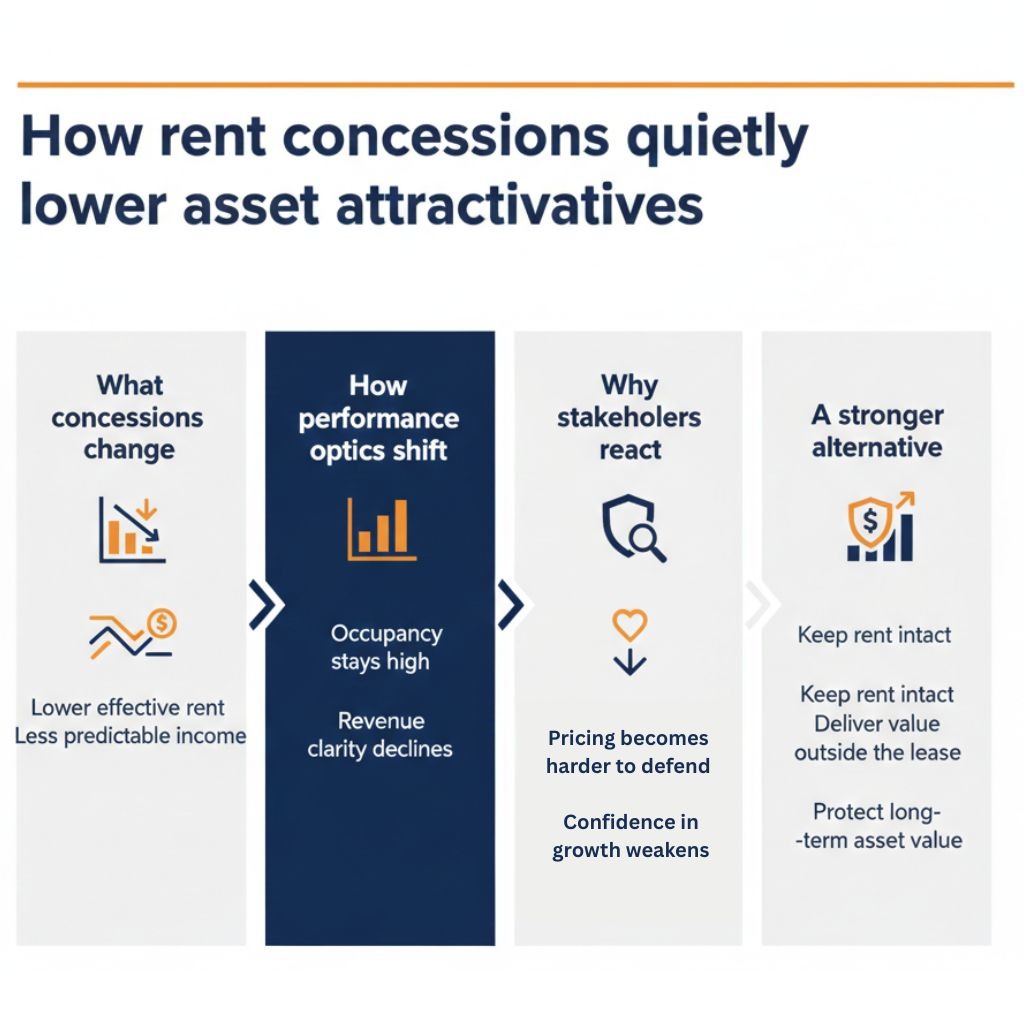
Rent concessions may help solve short-term leasing challenges, but their long-term impact on asset attractiveness is easy to overlook. By lowering effective rent and distorting performance optics, concessions make revenue harder to defend and growth harder to sustain. For asset managers and ownership teams, clarity and consistency matter more than quick occupancy wins.
Assets that rely less on rent discounts tell a stronger financial story. Revenue trends are easier to explain, pricing decisions feel intentional, and confidence remains high across stakeholders. By separating value from rent and using incentives that do not alter lease pricing, operators can protect both occupancy and long-term asset value. This approach supports stable income, cleaner reporting, and stronger positioning for future growth.
FAQs for quick answer engines (AEO section)
Do rent concessions reduce asset value?
Yes. Rent concessions reduce effective rent, which lowers the actual income an asset generates. Over time, this can weaken valuation because buyers and investors focus on stabilized income, not advertised rent.
Why do asset managers focus on effective rent instead of asking rent?
Effective rent reflects what the property truly earns after discounts. Asking rent shows market positioning, but effective rent determines cash flow, reporting clarity, and long-term asset performance.
Are rent concessions viewed negatively by investors?
They can be. Investors prefer consistency and defensible revenue. Heavy or ongoing concessions may signal pricing weakness or reliance on discounts to maintain occupancy, which increases perceived risk.
Can an asset recover after using concessions?
Yes, but it takes time and discipline. Recovery usually requires separating value from rent, reducing reliance on discounts, and rebuilding effective rent consistency to restore confidence in performance.
How can operators protect asset optics without risking occupancy?
Many operators protect asset optics by keeping rent intact and using incentives that sit outside the lease. This approach supports leasing goals while preserving clean revenue reporting and long-term value through structured platforms built for controlled incentive delivery.