Key takeaways:
- Early lease renewals improve occupancy forecasting and reduce vacancy risk.
- Structured renew-by-date incentives encourage residents to commit sooner.
- Reward ladders create urgency without using pressure tactics.
- One-time incentives protect base rent better than concessions.
- A proactive renewal strategy lowers turnover costs and stabilizes portfolio performance.
Introduction
Vacancy is expensive.
For property managers and asset teams, even one unexpected move-out can disrupt occupancy forecasts, increase turn costs, and put pressure on revenue targets.
That is why early lease renewals are not just a leasing task. They are an operational strategy.
When residents commit 60 to 120 days before their lease ends, your team gains clarity. You can plan staffing, reduce marketing spend, and minimize exposure to vacancy loss. More importantly, you shift from reacting to managing with confidence.
However, many communities still rely on repeated reminder emails or last-minute concessions. These tactics often create stress instead of commitment.
In the residential real estate industry, retention works best when residents feel valued, not pressured. A structured renewal strategy can reduce vacancy risk while strengthening resident relationships across your portfolio. You can see how retention strategies are evolving in the broader residential real estate space here
In this guide, we will cover:
- Why early lease renewals matter operationally
- The problem with “just more reminder emails”
- How renew-by-date incentives work
- How reward ladders create urgency without desperation
If your goal is to reduce vacancy risk without pushing residents away, this strategy is built for you.
Why early lease renewals matter operationally
Early lease renewals create stability.
When residents commit well before their lease expiration date, your team gains visibility. Instead of waiting and hoping, you can plan with confidence.
For property managers, this impacts four critical areas:
1. Occupancy forecasting
Early lease renewals reduce uncertainty.
If 70% of your residents renew 90 days out, you know exactly how many units may need marketing support. That level of predictability improves asset planning and investor reporting.
Without early commitments, occupancy projections become guesses.
2. Reduced marketing spend
Late renewals often trigger urgent marketing campaigns:
- Paid listings
- Digital ads
- Leasing incentives
- Broker commissions
When residents renew early, you reduce the need for emergency marketing dollars.
Early lease renewals are often far less expensive than replacing a resident.
3. Controlled turn costs
Turnover costs add up quickly:
- Cleaning
- Maintenance
- Paint
- Lost rent during vacancy
If a lease is renewed early, turn costs disappear.
Even reducing turnover by a small percentage across a portfolio can significantly improve net operating income.
4. Better staffing and scheduling
Operations teams work more efficiently when they are not reacting to last-minute move-outs.
Early lease renewals allow:
- Planned maintenance scheduling
- Balanced leasing team workloads
- Better vendor coordination
This creates a smoother experience for both residents and staff.
Operational comparison
Early lease renewals are not just about keeping units filled.
They protect revenue, reduce operational strain, and give asset teams the data they need to make smart decisions.
Communities that actively focus on retention, rather than replacement, often see measurable improvement in long-term occupancy. Many operators align renewal timing with broader retention initiatives, like increasing retention, to create a consistent strategy across the resident lifecycle.
When renewal becomes proactive instead of reactive, vacancy risk decreases naturally.
The hidden cost of waiting too long
Waiting until 30 or 60 days before lease expiration creates silent risk.
At that point, many residents have already started browsing other options. They may not have given notice yet, but they are comparing pricing, amenities, and promotions from nearby communities.
Once a resident enters comparison mode, your negotiating position weakens.
Early lease renewals prevent that shift.
What happens when renewal timing is delayed?
When renewal conversations start too late, several patterns emerge:
- Residents shop competitor properties
- Price sensitivity increases
- Negotiation becomes more aggressive
- Leasing teams rush to close renewals
- Marketing spend rises suddenly
Late engagement also forces teams into reactive behavior. Instead of presenting value, they often present discounts.
That is not a sustainable strategy.
Emotional commitment decreases over time
Residents who feel engaged and appreciated are more likely to renew early.
Residents who hear nothing until the final weeks often interpret that silence as a lack of interest. By the time renewal discussions begin, the emotional connection may already be weaker.
This is why early lease renewals should begin well before lease expiration, ideally 90 to 120 days out.
When renewal is positioned as an opportunity instead of a deadline, the tone changes.
Financial exposure increases each week
Consider the timeline:
- 120 days out → Resident still committed
- 90 days out → Resident evaluating
- 60 days out → Resident browsing
- 30 days out → Resident negotiating
The longer you wait, the more leverage shifts to the resident.
This is not about pressure. It is about timing.
Communities that integrate renewal engagement with structured resident value programs often see earlier participation. For example, when renewal messaging is supported by meaningful resident benefits, participation improves. Many property teams connect these incentives to curated programs like resident perks to reinforce ongoing value.
When residents already experience benefits during their lease term, early renewal feels like a continuation of value, not a sales conversation.
The real cost of delayed renewals
If even 10% of your community delays decisions until the final 30 days, your team may face:
- Higher marketing costs
- Increased vacancy exposure
- More negotiation concessions
- Greater operational stress
Early lease renewals reduce that exposure window.
And in residential real estate, reducing risk windows is often the difference between stable performance and unpredictable revenue.
The problem with “just more reminder emails”
When early lease renewals lag, the default response is often simple:
Send more reminders.
More emails.
More text messages.
More notices on doors.
But repetition does not create motivation.
If a resident is unsure about renewing, another reminder rarely changes that decision. In many cases, it increases frustration instead of commitment.
Why reminders alone do not work
Reminder-heavy renewal strategies fail for three main reasons:
- No added value
A reminder tells residents what to do. It does not explain why acting early benefits them. - No urgency trigger
Without a clear advantage to renewing now, residents delay the decision. - Perceived pressure
Repeated notices can feel transactional or stressful.
Early lease renewals require a behavior shift. Reminders only repeat the request.
What residents are really thinking
When residents receive another reminder, they often think:
- “I still have time.”
- “I will decide later.”
- “Maybe I should compare options first.”
That delay increases vacancy risk.
If the only message is “please renew,” there is no reason to act early.
The difference between reminding and motivating
Instead of asking again, successful communities change the message.
They move from:
“Your lease expires soon.”
To:
“Renew early and unlock a benefit.”
This subtle shift changes the conversation. It replaces pressure with opportunity.
Communities that improve early lease renewals often combine renewal timing with structured digital engagement tools that make value visible and easy to access. For example, centralized reward systems such as perk centers help operators present clear benefits in one place, reducing friction during the renewal decision.
When residents can see tangible value tied to early action, engagement increases.
Why timing plus value beats frequency
Increasing email frequency does not increase urgency.
Creating a time-sensitive advantage does.
That is why the next step in a strong early lease renewal strategy is renew-by-date incentives — a structured approach that gives residents a reason to commit before the deadline.
Renew-by-date incentives explained
Renew-by-date incentives give residents a clear reason to act early.
Instead of simply asking for a decision, you offer structured value tied to timing. The earlier a resident renews, the greater the benefit.
This approach supports early lease renewals without pressure tactics.
What is a renew-by-date incentive?
A renew-by-date incentive is a time-based reward structure.
Example:
- Renew 90+ days before expiration → $200 reward
- Renew 60–89 days before expiration → $125 reward
- Renew 30–59 days before expiration → $75 reward
- After 30 days → No incentive
The structure is simple and transparent.
Residents understand the deadline. They understand the value. And they understand that waiting reduces the reward.
Why this works
Renew-by-date incentives work because they combine:
- Clear timelines
- Visible value
- Positive reinforcement
This creates healthy urgency.
Instead of feeling chased, residents feel appreciated.
Instead of reacting at the last minute, they make a proactive decision.
Incentives vs rent discounts
It is important to separate incentives from concessions.
Concessions permanently reduce revenue.
Incentives are one-time rewards.
For example:
- A $150 one-time reward costs far less than a $100 monthly rent reduction over 12 months.
- A reward does not lower your base rent or impact future pricing.
Early lease renewals should protect revenue, not reduce it.
Making incentives easy to deliver
Operational simplicity matters.
If renewal incentives require manual tracking or physical gift cards, staff workload increases. That friction can limit adoption.
Digital delivery solves this problem.
Many property teams use structured reward programs built specifically for retention and engagement. For example, curated incentive programs like perk allow operators to deliver renewal rewards digitally, without adding administrative burden.
This ensures:
- Simple fulfillment
- Predictable budgeting
- Portfolio-wide consistency
What makes a renew-by-date program successful?
A strong structure includes:
- Clear renewal communication at 120 days
- A visible reward ladder tied to early action
- Consistent messaging across email and resident portals
- A defined incentive expiration date
- Performance tracking
When renew-by-date incentives are built into your renewal calendar, early lease renewals increase naturally.
The next step is taking this further with reward ladders — a structured system that strengthens urgency without creating desperation.
How reward ladders create urgency without desperation
Reward ladders take renew-by-date incentives one step further.
Instead of offering a single early bonus, you structure decreasing rewards over time. The value is highest at the earliest commitment point and gradually declines as the expiration date approaches.
This approach strengthens early lease renewals while keeping the tone positive and resident-focused.
What is a reward ladder?
A reward ladder is a tiered incentive structure tied to time.
Example:
- 120–90 days before expiration → Premium reward
- 89–60 days → Mid-level reward
- 59–30 days → Entry-level reward
- Under 30 days → Standard renewal terms
The message is clear:
The earlier you renew, the more value you receive.
There is no threat. No pressure. Just transparent timing.
Why reward ladders work
Reward ladders align with natural decision behavior.
Residents think in terms of gain and loss. When the highest value is available early, delaying the decision feels like losing something.
That internal motivation is more effective than repeated reminders.
Key benefits include:
- Stronger early participation
- Reduced last-minute negotiations
- More predictable occupancy
- Less need for concessions
Early lease renewals increase because the incentive structure creates built-in urgency.
The difference between urgency and desperation
Urgency says:
“Act now to receive full value.”
Desperation says:
“Please decide immediately.”
Reward ladders maintain confidence. They show that your community values commitment but does not chase it.
This preserves brand perception and long-term resident trust.
Aligning reward ladders with portfolio strategy
For asset managers overseeing multiple properties, consistency matters.
Reward ladders should be:
- Standardized across communities
- Easy to communicate
- Simple to track
- Digitally fulfilled
Platforms built for residential operators can centralize this process. Solutions like the Paylode platform allow teams to manage incentives across properties while maintaining reporting visibility.
For communities that need to amplify participation during peak renewal windows, visibility tools such as boost can increase awareness of renewal rewards without overwhelming staff.
Structured delivery reduces friction. Reduced friction improves results.
Financial perspective: ladder vs vacancy
Consider this simplified comparison:
Even at the highest tier, the reward ladder typically costs less than a single turnover event.
Across a portfolio, early lease renewals supported by reward ladders can protect hundreds of thousands of dollars annually.
When to implement reward ladders
Reward ladders are most effective when:
- Renewal rates are inconsistent
- Last-minute negotiations are common
- Concessions are increasing
- Forecasting accuracy is low
If your team regularly waits until 30 days before expiration to secure renewals, a ladder approach can reset the timeline.
Building a structured early lease renewal program
A successful early lease renewal strategy is not a one-time campaign.
It is a repeatable system.
When structured properly, early lease renewals reduce vacancy risk, protect revenue, and strengthen resident satisfaction across your portfolio.
Below is a practical framework that property managers can implement immediately.
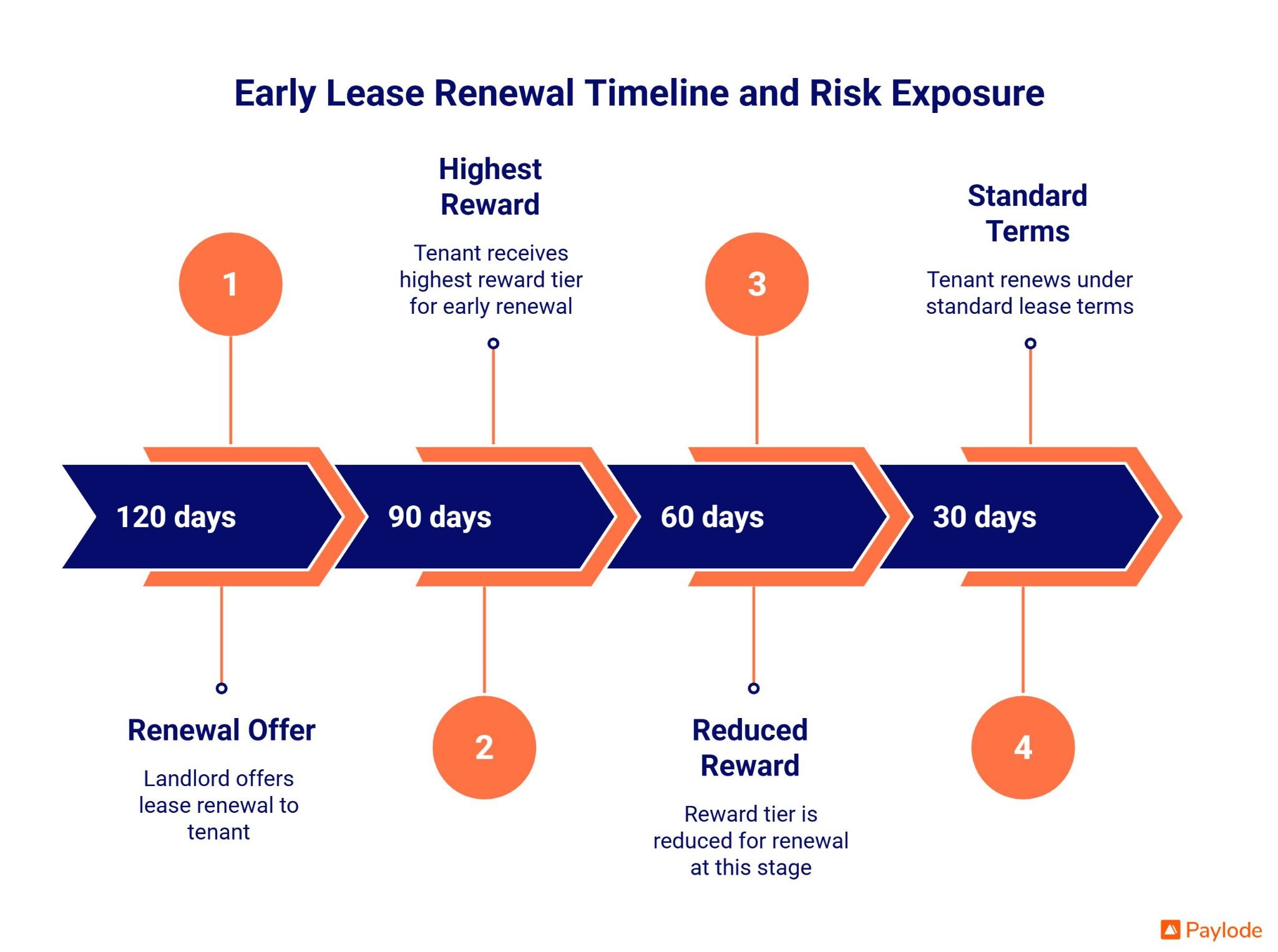
Step 1: Set a clear renewal timeline
Clarity drives action.
Establish a defined renewal schedule:
- 120 days before expiration → Initial renewal offer
- 90 days → Highest reward tier available
- 60 days → Reduced reward tier
- 30 days → Final standard offer
Communicate this timeline early and consistently.
When residents understand the structure, they are more likely to commit early.
Step 2: Attach meaningful value
Value must feel real.
Generic messaging without visible benefit will not move behavior.
Effective incentives may include:
- Digital lifestyle rewards
- Local business offers
- Experience-based benefits
- Community appreciation bonuses
The key is simplicity and relevance.
Property teams that integrate renewal rewards into broader engagement programs often see stronger participation. Many operators align early lease renewals with long-term value initiatives to ensure retention efforts support asset growth.
Renewal should feel like a continuation of value, not a negotiation event.
Step 3: Automate delivery and tracking
Manual tracking increases errors and slows adoption.
A structured digital approach allows you to:
- Deliver incentives automatically
- Track participation by property
- Monitor renewal timing trends
- Forecast occupancy earlier
Automation also ensures consistency across multiple communities.
For property managers evaluating scalable retention infrastructure, reviewing available solution options can help align budgeting with portfolio size and renewal volume.
The easier the system, the more consistent the execution.
Step 4: Keep messaging positive and resident-focused
Language matters.
Avoid urgency that feels threatening.
Instead of:
“Final reminder. Respond immediately.”
Use:
“Secure your early renewal reward today.”
Early lease renewals should feel like an opportunity, not an obligation.
Positive framing increases trust and long-term loyalty.
Step 5: Track the right performance metrics
To measure success, monitor:
- Early renewal rate (90+ days)
- Renewal participation by tier
- Incentive cost per renewal
- Vacancy gap reduction
- Turnover reduction percentage
Tie these metrics back to financial outcomes.
For example:
If your average turn cost is $3,000 and early lease renewals reduce turnover by 8%, the financial impact may exceed the total cost of incentives.
Data builds internal confidence and supports budget approval for future renewal cycles.
Financial impact: early lease renewals vs vacancy cost
Early lease renewals are not just a retention tactic. They are a financial protection strategy.
Let’s look at a simplified example.
Assumptions:
- Average monthly rent: $1,850
- Average turn cost: $2,800
- Average vacancy gap: 25 days
Cost of one non-renewal
- Lost rent (25 days): ~$1,540
- Turn cost: $2,800
- Total impact: ~$4,340
Now compare that to:
- Early renewal reward: $150–$250
Even at the highest reward tier, the cost of incentivizing early lease renewals is significantly lower than the cost of one vacancy event.
Across a 300-unit community, even a small increase in early renewals can protect tens of thousands of dollars annually.
For asset managers, that stability compounds across the portfolio.
Portfolio-level modeling example
Estimates based on reduced turn and vacancy exposure.
Early lease renewals reduce revenue volatility. And revenue stability supports stronger asset performance.
Frequently asked questions
When should early lease renewal offers begin?
Ideally, 90 to 120 days before lease expiration. This provides enough time for residents to commit while reducing the risk of late-stage negotiation.
Do early lease renewals reduce concessions?
Yes. When residents renew early through structured incentives, there is less need for last-minute rent discounts. Incentives are one-time rewards and protect base rent.
How expensive are renewal incentives?
Most renewal rewards cost far less than a single turnover event. In nearly every modeled scenario, early lease renewals are more cost-effective than vacancy.
Can this work across large portfolios?
Yes. Standardized reward ladders and digital delivery systems allow consistent execution across multiple properties without increasing administrative workload.
Will residents expect rewards every year?
When structured properly, incentives are tied to timing, not entitlement. The value decreases over time, which reinforces early action rather than expectation.
Conclusion: Reduce vacancy risk without pressure tactics
Early lease renewals give property managers control.
Instead of reacting to late notices and rising marketing costs, you create a predictable system that rewards commitment and protects revenue.
Renew-by-date incentives and reward ladders:
- Improve occupancy forecasting
- Reduce turnover costs
- Limit concessions
- Strengthen resident relationships
- Stabilize portfolio performance
The key is structure.
When renewal timing is clear, incentives are meaningful, and delivery is simple, residents respond earlier. That early commitment reduces vacancy exposure without pressure tactics.
If your team is ready to implement a scalable early lease renewal strategy, explore how the Paylode platform supports digital reward delivery, portfolio tracking, and automated engagement
You can also schedule a walkthrough to see how structured renewal incentives fit your portfolio strategy
Early commitment should feel rewarding.
When early lease renewals are built into your operations, vacancy risk becomes manageable — not unpredictable.