Advertising costs are rising across multifamily marketing channels. ILS fees increase year after year. Paid social and search campaigns require constant budget adjustments. Yet occupancy pressure remains.
Many marketing and operations leaders are now asking a smarter question: how can we grow leases without increasing ad spend?
The answer often sits inside the community itself.
Well-structured referral programs for multifamily: how to drive leases without more ad spend are becoming one of the most efficient growth strategies in residential real estate. Instead of paying to attract cold traffic, operators activate satisfied residents to bring in qualified prospects.
Referrals convert faster because they are built on trust. They reduce comparison shopping. And they lower cost per lease.
For residential real estate operators focused on long-term revenue stability, referral strategies are gaining attention as a performance channel, not just a bonus perk. Communities that align referral programs with broader resident engagement strategies—such as those outlined in Paylode’s residential real estate solutions —are seeing measurable improvements in both leasing efficiency and retention.
This guide will explain:
- Why referrals convert better than paid traffic
- Why most multifamily referral programs fail
- What makes referrals actually work
- How to structure reward ladders that drive participation
If your goal is growth without expanding marketing budgets, referral programs for multifamily offer a practical and scalable path forward.
Why referrals convert better than paid traffic
Paid advertising brings attention. Referrals bring trust.
That difference alone explains why referral programs for multifamily: how to drive leases without more ad spend consistently outperform traditional paid channels in conversion efficiency.
Trust shortens the decision cycle
When a prospect tours after seeing a paid ad, they are still evaluating options. They compare pricing, amenities, and reviews.
When a prospect tours because a friend lives there and recommended the community, the decision process changes. Trust already exists. The property has social proof.
That built-in credibility reduces friction and speeds up the lease decision.
Referrals lower cost per lease
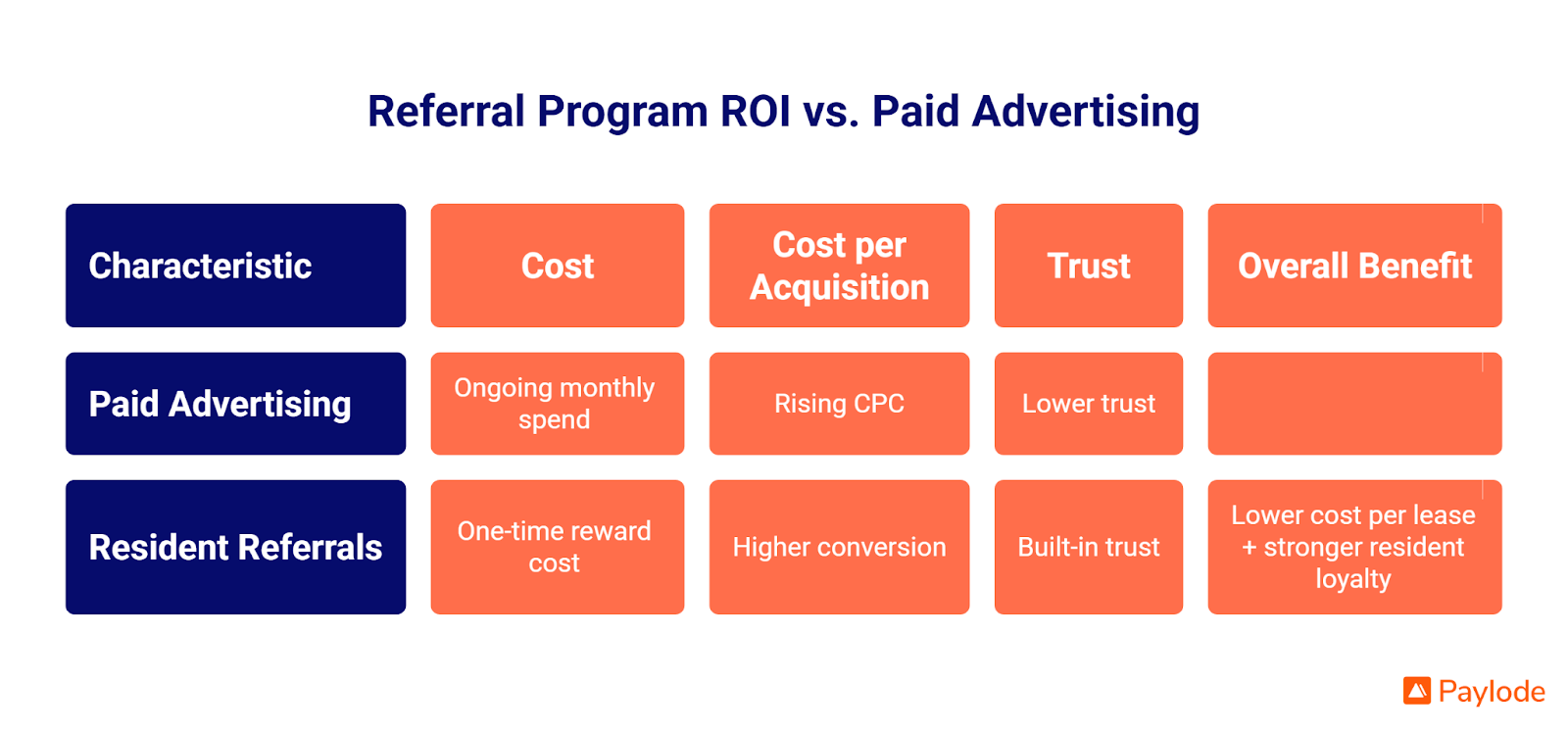
Consider a simplified comparison:
Paid traffic requires constant budget input. Referral rewards are paid only when a lease is signed.
This means referral programs create variable, performance-based costs instead of fixed marketing expenses.
Higher intent, better fit
Referral prospects are often:
- In the same life stage as the referrer
- Looking in the same neighborhood
- Similar income range
- Interested in comparable floorplans
This natural alignment improves qualification quality. Leasing teams spend less time filtering unqualified leads.
Referrals support both marketing and operations goals
Unlike paid ads, referrals also strengthen resident engagement. When residents feel rewarded for bringing in friends, they become more connected to the community.
Programs built within structured systems, such as the Paylode platform, allow operators to track participation, reward distribution, and performance across properties in a consistent way.
The result is clear: referral programs for multifamily drive leases with stronger conversion rates and lower acquisition costs than most paid traffic strategies — making them one of the most efficient growth levers available today.
Why most multifamily referral programs fail
If referral programs are so effective, why do many communities see low participation?
The issue is rarely demanded. It is designed.
Understanding these common mistakes is essential when building referral programs for multifamily: how to drive leases without more ad spend.
1. Poor timing
Many properties introduce referral programs only at move-in. Residents are overwhelmed with paperwork, moving logistics, and utility setup.
That is not the ideal moment to ask for referrals.
The best timing is when residents are satisfied:
- After a positive maintenance experience
- Around renewal conversations
- Following a community event
- 30–60 days after move-in
Referral programs must be ongoing, not one-time announcements.
2. Complicated process
If residents must:
- Fill out paper forms
- Email screenshots
- Wait weeks for confirmation
- Follow up repeatedly
Participation drops quickly.
Simplicity drives results. Clear instructions and digital tracking eliminate confusion. Platforms that centralize reward management, like Paylode’s growth tool - Boost, allow operators to run campaigns consistently without manual tracking.
When the process feels easy, residents are more likely to participate.
3. Weak or unclear rewards
A $50 reward for bringing in a qualified lease often feels too small. Delayed or confusing payouts reduce trust.
Rewards must feel meaningful and immediate. Digital delivery improves satisfaction and reinforces credibility.
4. No promotion strategy
Many communities quietly list referral details in lease documents. That is not enough.
Successful programs promote consistently:
- Email reminders
- Resident portal banners
- Leasing office signage
- Renewal conversations
Without visibility, even strong referral programs fail.
The lesson is clear. Referral programs for multifamily succeed when timing is strategic, the process is simple, and rewards feel valuable. Without those elements, even the best intentions fall flat.
What makes referral programs work
Once common mistakes are removed, referral programs become one of the most reliable growth tools in multifamily housing.
To fully execute referral programs for multifamily: how to drive leases without more ad spend, three elements must be present: timing, simplicity, and meaningful rewards.
1. Timing at peak satisfaction moments
The best time to ask for a referral is when residents are happy.
High-impact moments include:
- After a five-star maintenance experience
- During a successful renewal conversation
- After a community event
- When residents post positive reviews
When residents feel good about where they live, they are more likely to recommend it.
Referral requests should be consistent and visible year-round, not seasonal.
2. Simplicity in submission and tracking
Residents should be able to:
- Submit a referral in seconds
- Receive confirmation instantly
- Track reward status clearly
The easier the process, the higher the participation rate.
Structured reward systems like Paylode’s Perks solution allow communities to deliver digital rewards quickly and transparently. When residents trust that rewards are real and timely, participation increases.
3. Meaningful and immediate rewards
Rewards should feel valuable relative to effort.
Strong examples include:
- $300–$500 per successful lease
- Split rewards (both residents receive $300–$500)
- Tiered bonuses for multiple referrals
The key is clarity. Residents should know exactly what they earn and when.
4. Ongoing visibility and reinforcement
Referral programs must be promoted consistently:
- Inside resident portals
- In follow-up emails
- During renewal discussions
- On community signage
When referrals are part of the culture of the community, participation grows naturally.
Communities that implement these principles see measurable improvements in cost per lease and leasing efficiency. Instead of increasing paid marketing budgets, they activate satisfied residents as growth partners.
This is the practical foundation of referral programs for multifamily: how to drive leases without more ad spend in a sustainable and scalable way.
Example referral reward ladders
A flat reward can work. But tiered structures often drive stronger engagement.
When designing referral programs for multifamily, how to drive leases without more ad spend, reward ladders encourage repeat participation and increase lifetime referral value per resident.
Below are practical models property managers can implement.
Simple tier model
This approach keeps the structure easy to understand.
- 1 successful lease → $300 reward
- 2 successful leases → $750 total rewards
- 3 successful leases → $1,200 total rewards
The jump between tiers motivates residents to refer more than once.
Split incentive model
Split rewards create shared motivation.
Example:
- Referring resident receives $500
- New resident receives $500
This reduces friction because both parties benefit. It also strengthens early community connection.
Split models work especially well in high-demand urban properties.
Gamified ladder model
For larger communities or portfolio-wide campaigns, gamified tiers can increase excitement.
This structure creates momentum and encourages residents to actively promote the community within their network.
Operators managing multiple properties can coordinate these campaigns across locations using centralized systems, such as Paylode’s platform tools, to ensure consistency and visibility.
Key principles for reward ladders
- Keep rules simple
- Communicate clearly
- Deliver rewards quickly
- Track participation transparently
When reward ladders are structured correctly, they transform passive residents into active advocates.
That is the core strategy behind referral programs for multifamily: how to drive leases without more ad spend — by turning existing residents into your most efficient acquisition channel.
Operational framework: launching a referral program step-by-step
A successful program requires structure. Below is a practical framework marketing and operations teams can use to implement referral programs for multifamily: how to drive leases without more ad spend across one property or an entire portfolio.
Step 1: Define the reward structure
Start with clear financial math.
Compare:
- Average cost per lease from paid channels
- Proposed referral reward amount
If your paid acquisition cost is $1,800 per lease, a $500–$800 referral reward can significantly reduce overall marketing spend while maintaining performance.
Keep the structure simple. Residents should immediately understand what they earn.
Step 2: Choose a consistent delivery system
Manual tracking leads to errors and delays. Delayed rewards reduce trust and participation.
Digital reward delivery improves transparency and speed. Programs integrated into broader resident engagement strategies — like Paylode’s resident perks solutions — help ensure rewards are tracked, delivered, and reported consistently.
Consistency builds credibility.
Step 3: Train the leasing team
Your leasing staff should:
- Mention referrals during tours
- Reinforce the program during renewal conversations
- Send follow-up reminders after positive interactions
When referral messaging becomes part of everyday conversations, participation increases naturally.
Step 4: Promote consistently
Referral programs fail when they are invisible.
Promotion should appear in:
- Resident portals
- Email campaigns
- Community signage
- Event materials
Ongoing visibility keeps the program active in residents’ minds.
Step 5: Track performance and optimize
Measure:
- Referral participation rate
- Conversion rate
- Cost per lease
- Marketing spend reduction
Referral data should inform future strategy.
Communities that connect referral efforts with broader retention strategies — such as programs designed to increase retention —often see compounding benefits over time.
The goal is not just more leases. It is a more efficient growth.
When implemented with structure and visibility, referral programs for multifamily become a dependable channel for driving occupancy without expanding advertising budgets.
Measuring success: KPIs that matter
To evaluate referral programs for multifamily: how to drive leases without more ad spend, marketing and operations teams should track performance with clear, simple metrics.
Below is a structured KPI table for ongoing reporting.
How to interpret these KPIs
- If cost per lease from referrals is lower than paid advertising, efficiency improves.
- If conversion rates are high but participation is low, increase promotion.
- If referring residents renew at higher rates, the program supports long-term value.
Referral programs often strengthen both acquisition and loyalty. When aligned with broader resident engagement strategies that increase long-term value, such as initiatives designed to raise customer LTV, the impact compounds over time.
Tracking these KPIs consistently ensures referral programs for multifamily remain performance-driven and scalable — not just promotional add-ons.
Conclusion: grow occupancy without growing ad spend
Advertising budgets will continue to fluctuate. Platform fees will continue to rise. But one growth channel remains within your control — your residents.
When structured correctly, referral programs for multifamily: how to drive leases without more ad spend offer a scalable way to reduce acquisition costs while maintaining strong leasing performance.
Referrals convert better because they are built on trust. They cost less because rewards are paid only when a lease is signed. And they strengthen retention because residents feel recognized and valued.
The difference between an average referral program and a high-performing one comes down to:
- Strategic timing
- Simple submission processes
- Meaningful rewards
- Consistent promotion
- Clear tracking
When these elements are aligned, referral programs shift from being a side initiative to becoming a dependable growth engine.
If your goal is to increase occupancy while improving marketing efficiency, now is the time to activate the residents already living in your community.
Frequently asked questions
Below are clear answers to common questions about referral programs for multifamily: how to drive leases without more ad spend.
How much should a multifamily referral reward be?
The reward should be lower than your average cost per lease from paid advertising.
For example, if your paid cost per lease is $1,800, a $500–$800 referral reward often creates strong participation while reducing total acquisition costs.
The key is perceived value, not matching paid spend dollar for dollar.
Should both residents receive a reward?
In many cases, yes.
Split rewards reduce friction. When both the referring resident and the new resident benefit, participation increases and the move-in experience feels positive for both parties.
This structure works especially well in competitive urban markets.
Do referral programs work during lease-up?
Yes. Lease-up communities can benefit significantly from referral programs.
Time-based referral bonuses create urgency. For example, offering a limited-time bonus for referrals within the first 90 days of opening can accelerate early occupancy.
How do you prevent referral abuse?
Clear guidelines prevent misuse.
Best practices include:
- Requiring the referral to be submitted before application approval
- Verifying lease execution before reward delivery
- Using digital tracking systems
Structured systems reduce manual errors and increase transparency.
Can referral programs improve retention?
Yes.
Residents who refer friends often feel more invested in the community. When referral programs are part of a broader engagement strategy—such as initiatives designed to increase retention — communities often see stronger renewal performance over time.
Referral programs are not just acquisition tools. They are community-building strategies.