Every year, millions of households move to a new home. During this time, customers review many essential services such as internet, mobile plans, and TV providers.
For telecom companies, this moment represents one of the highest-risk periods for customer churn. Even satisfied customers may cancel service simply because transferring it feels difficult or unclear.
This is why telecom churn during moves has become an important focus for retention and customer experience teams. When customers relocate, they often compare providers, explore local options, or respond to promotional offers from competitors.
The challenge is not always dissatisfaction with the service. In many cases, customers switch simply because the process of staying with their current provider feels complicated.
Moving already involves many tasks:
- Packing belongings
- Setting up utilities
- Updating addresses
- Scheduling installations
If transferring telecom service adds more effort, customers may choose a provider that promises faster or easier setup.
For telecom, ISP, and MVNO providers, this situation creates both a risk and an opportunity. Providers that simplify the relocation experience can significantly reduce churn and improve long-term retention.
For example, telecom providers that focus on engagement and value-driven incentives can improve customer relationships and strengthen loyalty. Strategies designed to increase customer lifetime value, such as those outlined in Paylode’s guide on how telecom companies can increase customer lifetime value, help providers build stronger long-term customer relationships.
Understanding why customers churn during moves is the first step toward solving the problem. The next step is identifying the specific triggers that cause customers to leave during relocation.
Key takeaway
Customer relocation is one of the most common causes of telecom churn. Providers that simplify service transfers, communicate early, and offer meaningful engagement incentives can significantly improve retention and reduce move-related cancellations.
Why customer moves trigger telecom churn
Customer relocation creates a natural moment for service reevaluation. Even when customers are satisfied with their current provider, moving to a new home often leads them to reconsider their telecom options.
This is one of the main reasons telecom churn during moves remains a significant challenge for retention teams. During relocation, customers are already making many decisions about services, utilities, and subscriptions.
Several factors make this moment especially risky for telecom providers.
Service disruption concerns
Connectivity is essential for work, communication, and entertainment. When customers move, they want internet and mobile services to work immediately in their new home.
If customers believe switching providers will deliver faster installation, they may cancel their current service and choose a competitor.
Location-based availability uncertainty
Customers often assume their current provider may not operate in their new area.
Instead of verifying service availability, many customers quickly sign up with another provider recommended by neighbors, property managers, or online searches.
For providers operating across telecom, broadband, and digital connectivity markets, ensuring service continuity across regions is critical. This is especially relevant for companies operating in the Telecom and MVNO industry, where network partnerships and coverage models can vary across locations.
Competitive offers targeting movers
Relocation periods are actively targeted by telecom marketing campaigns.
Customers who search for internet or mobile services during a move often see promotions such as:
- Free installation
- Discounted monthly plans
- Gift cards or sign-up rewards
These offers can easily attract customers who are already reconsidering their services.
Decision overload during relocation
Moving is one of the most stressful life events for many households. Customers must manage multiple tasks within a short period of time.
Because of this, telecom decisions are rarely researched deeply during relocation. Instead, customers choose the provider that appears simplest and fastest to activate.
If staying with the current provider requires multiple steps, scheduling calls, or unclear instructions, customers may choose a new provider even if they were previously satisfied.
Understanding these triggers is essential for telecom companies that want to reduce churn during relocation. The next challenge is addressing the friction that often appears in the service transfer process.
The hidden friction in telecom service transfers
For many telecom providers, transferring service to a new address should be a simple process. However, the customer experience often feels more complicated than expected.
This friction is one of the biggest contributors to telecom churn during moves. When the transfer process feels confusing or time-consuming, customers may decide that switching providers is easier.
Small obstacles during relocation can quickly lead to cancellation.
Multiple steps create unnecessary effort
Many customers must complete several actions to transfer telecom services to a new home.
These steps may include:
- Contacting customer support
- Confirming service availability at the new address
- Scheduling technician installation
- Updating billing information
- Returning or replacing equipment
When these steps are not clearly organized, customers feel frustrated.
In contrast, customers prefer a process that allows them to manage everything online in just a few minutes.
Unclear instructions create uncertainty
Customers often do not know how the move process works.
Common questions include:
- When should I schedule my service transfer?
- Will my current plan continue at the new address?
- Do I need new equipment?
- Will there be installation fees?
If providers do not clearly answer these questions, customers begin searching for alternatives.
Clear communication and simple instructions can significantly reduce cancellation during relocation.
Long installation timelines push customers to competitors
Speed matters when customers move into a new home. Most households expect internet service to work immediately after they move in.
If installation requires waiting several days, customers may switch to a competitor offering faster activation.
This is especially common in the ISP industry, where multiple providers may operate within the same neighborhood and offer different installation timelines.
Lack of digital self-service options
Many customers prefer to manage their services online rather than calling support teams.
If telecom providers require phone calls or complex scheduling processes, customers may perceive the experience as outdated.
Providing self-service options allows customers to:
- Check service availability instantly
- Schedule installation online
- Update their address quickly
- Track their service transfer progress
When telecom providers remove these points of friction, customers are far more likely to stay.
Understanding the barriers in the service transfer experience helps providers improve retention. However, another important challenge exists: many customers never start the transfer process in the first place.
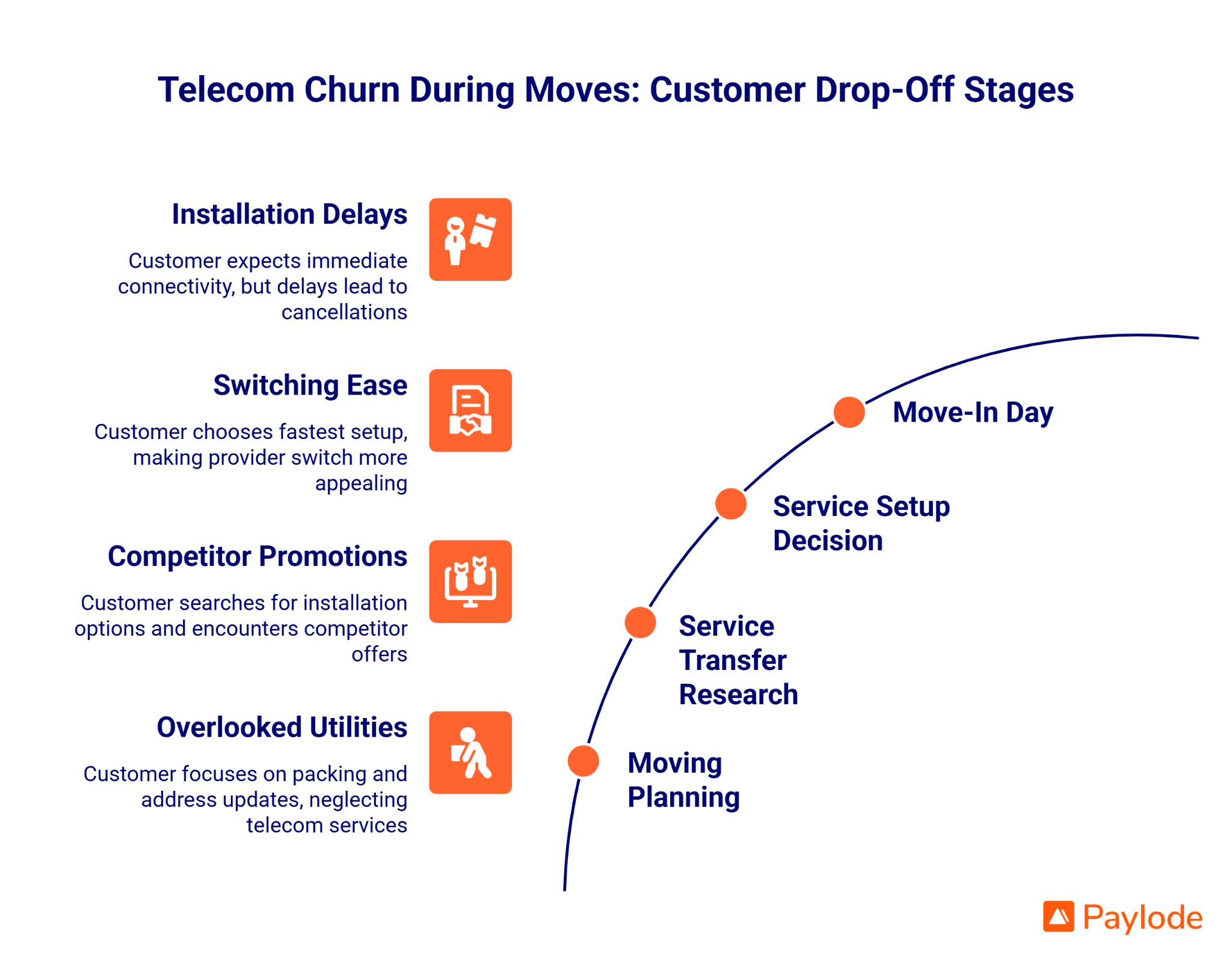
Why customers don’t proactively reschedule telecom services
Many telecom customers intend to keep their current provider when they move. However, a large number never schedule a service transfer in advance.
This behavior plays a major role in telecom churn during moves. By the time customers begin looking for internet or mobile service at their new address, they may already be considering other providers.
Understanding why customers delay the process can help telecom retention teams design better solutions.
Moving timelines are unpredictable
Relocation plans often change quickly.
Customers may confirm their moving date only a few weeks or days before the move. Because of this uncertainty, telecom services are rarely scheduled early.
Most households focus first on urgent tasks such as:
- Packing and organizing belongings
- Coordinating movers
- Finalizing lease or home purchase details
- Setting up utilities
Telecom services often become a last-minute decision.
Customers are unaware of the transfer option
Many people do not realize they can simply transfer their existing telecom service to a new address.
Instead, they assume the process requires canceling the current service and starting a new account.
This misunderstanding increases churn risk because customers may explore other providers while researching new service options.
Lack of proactive communication from providers
In many cases, telecom companies wait for customers to initiate the move process.
Without reminders or guidance, customers may not think about transferring service until after the move.
Proactive communication can make a major difference. For example, when providers send reminders about managing billing or updating service preferences, customers are more likely to stay engaged.
Encouraging customers to simplify their billing experience—such as transitioning to digital billing options like paperless statements through the switch to paperless billing program—can also create stronger ongoing engagement with the provider.
Customers prioritize immediate connectivity
When customers move into a new home, they want internet and mobile connectivity immediately.
If scheduling a transfer appears complicated or slow, customers may choose a new provider offering faster activation.
At that point, the customer relationship is already at risk.
This is why telecom providers must make the relocation experience simple, clear, and proactive. When customers understand how easy it is to keep their existing service, they are far more likely to stay.
However, when customers do leave during a move, the financial impact for telecom companies can be significant.
The real cost of churn during moves
When a customer leaves during relocation, telecom providers lose more than just a single subscription. The long-term impact of telecom churn during moves can significantly affect revenue, acquisition costs, and growth strategy.
Because relocation events occur frequently across the United States, even a small percentage of move-related churn can result in large financial losses for telecom, ISP, and MVNO providers.
Understanding the true cost of this churn helps retention and CX teams prioritize solutions.
Lost recurring revenue
Telecom services are built on recurring monthly revenue. When a customer cancels service during a move, that predictable income disappears immediately.
Over time, the financial impact grows because the provider also loses:
- Future subscription revenue
- Potential service upgrades
- Cross-sell opportunities such as mobile, TV, or home security
A single churn event can represent several years of lost revenue.
Higher customer acquisition costs
Replacing a lost customer is expensive. Telecom companies must invest in marketing campaigns, promotions, and installation incentives to acquire new subscribers.
Typical acquisition expenses may include:
- Paid advertising
- Promotional discounts
- Installation offers
- Sales commissions
In many cases, acquiring a new customer costs significantly more than retaining an existing one.
Increased pressure on retention teams
When relocation churn increases, retention teams must work harder to maintain subscriber growth.
They often introduce promotions, bill credits, or discounts to keep customers from leaving. However, these incentives can reduce overall revenue if used too frequently.
Instead of relying only on discounts, telecom companies are increasingly focusing on engagement strategies designed to strengthen long-term relationships and improve retention outcomes.
Approaches that focus on delivering additional value—such as personalized experiences and lifestyle benefits—can help providers improve engagement and ultimately increase customer lifetime value.
Competitive advantage for rival providers
When a customer switches providers during a move, competitors gain an opportunity to build a long-term relationship.
Once a customer establishes service with a new telecom provider, they are less likely to switch again in the near future.
This means relocation churn does not just affect short-term revenue. It can also strengthen the market position of competing providers.
Because of these risks, telecom companies must rethink how they approach the relocation experience. Instead of treating moves as a service transfer task, providers should treat them as a critical customer experience moment.
The most effective strategy is to make staying with the provider the easiest and most convenient option.
Making staying the easiest option for customers
Reducing telecom churn during moves starts with one simple principle: staying with the current provider should be easier than switching.
Customers relocating to a new home already manage many responsibilities. If telecom service transfers require extra effort, customers may choose a competitor that promises faster activation.
Telecom providers that simplify the relocation experience can significantly improve retention.
Offer simple service transfer options
Customers should be able to transfer their telecom service quickly and easily.
An effective transfer process should allow customers to:
- Check service availability at the new address
- Schedule installation online
- Update their address in minutes
- Receive confirmation instantly
When the process is clear and simple, customers are far more likely to remain with their current provider.
Provide proactive relocation support
Many customers do not plan their telecom transfer until the last moment. Providers can reduce churn by guiding customers through the relocation process earlier.
Helpful support may include:
- Email reminders about service transfers
- Simple instructions for moving services
- Clear timelines for installation
These communications reassure customers that staying with their provider will be a smooth experience.
Deliver value instead of discounts
Traditional retention strategies often rely on discounts or bill credits. However, these approaches reduce revenue and can train customers to expect lower prices.
Instead, telecom companies are increasingly focusing on delivering meaningful value that keeps customers engaged.
For example, providers can offer lifestyle rewards, partner benefits, or entertainment perks that enhance the customer experience without lowering base pricing. Programs like Paylode Perks, which offer curated lifestyle rewards for telecom customers, help providers strengthen loyalty while maintaining stable pricing.
Make the customer journey digital-first
Modern telecom customers expect to manage their services online.
Providing digital tools that allow customers to handle relocation independently helps eliminate friction. Self-service options can allow customers to:
- Transfer services instantly
- Track installation appointments
- Manage billing preferences
- Explore additional services
When the entire relocation process can be completed quickly online, customers are far less likely to explore competitor offers.
By simplifying the move experience and offering meaningful value, telecom providers can significantly reduce churn during relocation.
Another effective strategy is to use engagement programs that guide customers throughout the move journey.
Best practices for telecom providers to reduce move-related churn
Reducing telecom churn during moves requires a proactive strategy. Instead of reacting after customers cancel, telecom providers should focus on improving the relocation experience before churn happens.
Retention and CX teams can reduce move-related churn by simplifying processes and creating stronger engagement during relocation.
Simplify the service transfer process
Customers should be able to transfer their service in just a few minutes.
A simple move workflow may include:
- Instant address availability checks
- Self-service move scheduling
- Automated installation confirmation
- Clear equipment instructions
When customers can complete the process online quickly, they are far less likely to switch providers.
Communicate with customers early
Many customers do not realize they need to schedule service transfers in advance.
Telecom providers should guide customers through the relocation process using timely communication such as:
- Move preparation reminders
- Installation scheduling prompts
- Equipment setup instructions
These communications help customers feel confident about keeping their service.
Encourage early scheduling
Customers who schedule service transfers earlier are less likely to switch providers.
Providers can motivate early scheduling by offering small incentives such as:
- entertainment perks
- partner rewards
- lifestyle benefits
These incentives help make staying with the current provider more attractive.
Use customer signals to identify relocation risk
Telecom providers can identify potential movers using signals such as:
- address update requests
- billing information changes
- contract renewal periods
When these signals appear, retention teams can proactively guide customers through the move process.
Solutions that support lifecycle engagement—such as Paylode’s platform for customer engagement and retention—allow telecom providers to deliver personalized rewards and experiences designed to improve retention outcomes.
By focusing on simplicity, proactive communication, and meaningful engagement, telecom companies can significantly reduce churn during relocation.
How telecom providers can turn moves into retention opportunities
Many telecom providers see relocation as a churn risk. However, with the right strategy, moving can become an opportunity to strengthen the customer relationship.
When customers move, they are already thinking about connectivity, home services, and digital experiences. This makes relocation a natural moment for telecom companies to introduce improvements and additional value.
Instead of reacting to telecom churn during moves, providers can design experiences that encourage customers to stay and deepen their engagement.
Introduce service upgrades during relocation
A new home often creates new connectivity needs. Customers may require faster internet speeds, stronger Wi-Fi coverage, or additional devices.
Telecom providers can use the move experience to introduce upgrades such as:
- Higher-speed internet plans
- Whole-home Wi-Fi solutions
- Mobile and broadband bundles
- Streaming and entertainment services
When these options are presented at the right moment, customers are more likely to upgrade instead of switching providers.
Create a positive relocation experience
Relocation can be stressful for customers. Providers that simplify the process can create a memorable experience that builds long-term loyalty.
A smooth relocation experience may include:
- easy online move scheduling
- clear installation timelines
- helpful equipment setup guidance
- responsive customer support
When customers feel supported during their move, they are far more likely to continue their relationship with the provider.
Offer lifestyle rewards that add everyday value
Customers increasingly expect more value from their telecom providers than just connectivity.
Offering curated lifestyle rewards can strengthen engagement during relocation. Benefits such as entertainment offers, shopping discounts, or travel perks can make the experience feel rewarding.
Engagement platforms like Paylode Boost, which helps companies deliver personalized reward campaigns that drive customer engagement, allow telecom providers to guide customers through the move journey while reinforcing loyalty.
Build long-term relationships beyond connectivity
The telecom industry is becoming more experience-driven. Customers remain loyal to providers that deliver value across multiple aspects of their daily lives.
When providers combine simple service transfers, personalized engagement, and meaningful rewards, relocation can become a moment that strengthens the customer relationship instead of ending it.
By shifting the focus from reactive retention to proactive engagement, telecom companies can transform relocation into a powerful loyalty opportunity.
Conclusion: simplifying the move experience reduces telecom churn
Customer relocation will always be a critical moment in the telecom customer lifecycle. When people move homes, they naturally review the services they use every day, including internet, mobile, and entertainment providers.
For telecom companies, this is why telecom churn during moves remains one of the most important retention challenges. In many cases, customers do not switch providers because they are unhappy. They switch because transferring service feels complicated or unclear.
Telecom providers that remove friction from the relocation process can dramatically improve retention outcomes. When customers can easily transfer service, schedule installation, and receive proactive support, staying becomes the simplest decision.
The most successful telecom, ISP, and MVNO companies are now shifting their focus toward:
- Simplifying service transfer experiences
- Communicating with customers earlier in the move journey
- Delivering meaningful value beyond discounts
- Using engagement programs to strengthen customer relationships
Modern retention strategies are no longer only about pricing. They focus on delivering a better customer experience that makes loyalty feel natural and rewarding.
Platforms designed for telecom customer engagement, such as the Paylode platform, help providers create value-driven experiences that strengthen retention and improve long-term customer relationships.
Telecom providers looking to improve retention strategies and reduce relocation churn can explore flexible engagement solutions and reward programs through Paylode’s platform and pricing options.
FAQs
Why do telecom customers switch providers during moves?
Customers often switch because transferring service feels complicated. If competitors offer faster installation or simpler signup options, customers may change providers.
How can telecom companies reduce churn during relocation?
Providers can reduce churn by simplifying service transfers, offering proactive communication, and providing incentives for early scheduling.
Why is the move experience important for telecom retention?
Moving is a major life transition. Customers want services to work immediately in their new home. A smooth transition encourages them to stay with their current provider.
Do rewards help telecom customer retention?
Yes. Rewards and perks create additional value that strengthens customer relationships and encourages customers to stay with their provider.