When customers move homes, they often rethink the services they use every day. Internet, mobile, and TV providers are among the first to be reviewed.
For telecom companies, this moment is usually seen as a churn risk. Customers may cancel their existing service and choose a new provider that seems easier to set up in their new location.
However, this perspective misses a bigger opportunity.
Relocation is not just a risk—it is a key moment to improve telecom retention during moves. Customers are already making decisions, which means they are open to guidance, support, and better experiences.
If staying with the current provider feels simple and valuable, most customers will not switch.
The challenge is that many telecom providers treat relocation as a basic service request rather than a customer experience moment.
Customers are often left to figure out:
- How to transfer their service
- When to schedule installation
- What will change in their plan
This creates confusion and increases the likelihood of switching.
On the other hand, providers that guide customers through the move process, reduce friction, and offer meaningful value can turn this moment into a loyalty opportunity.
For example, telecom providers that focus on engagement strategies designed to increase customer lifetime value through better customer experiences can strengthen relationships during key lifecycle moments like relocation.
Instead of reacting to churn, telecom providers can use relocation as a proactive retention strategy.
The next step is understanding why moves are such an important lifecycle event in telecom.
Moves as a lifecycle event in telecom
Relocation is one of the most important moments in the customer lifecycle. It is not just a change of address—it is a moment of decision.
For telecom providers, this is where telecom retention during moves becomes critical. Customers are actively reviewing their services and deciding what to keep, upgrade, or replace.
Why moves trigger decision-making
When customers move, their needs often change.
They may:
- Need faster internet for a larger home
- Require better coverage in a new area
- Consider bundling services for convenience
This creates a natural opportunity to reassess their telecom provider.
A high-intent moment for customers
Unlike regular months where behavior is stable, relocation creates urgency.
Customers are actively:
- Searching for providers
- Comparing installation timelines
- Evaluating pricing and offers
This makes the move journey one of the highest-intent phases in the customer lifecycle.
A chance to influence customer choice
Because customers are already making decisions, telecom providers have a unique opportunity to guide them.
Instead of waiting for cancellation requests, providers can:
- Offer clear service transfer options
- Provide helpful guidance
- Highlight additional value
When done correctly, this reduces the likelihood of switching.
Expanding the relationship during relocation
A move is also a moment to strengthen the relationship.
Telecom providers can:
- Introduce upgraded plans
- Offer bundled services
- Deliver additional benefits
Providers operating across telecom, ISP, and broadband markets can use this moment to position themselves as a long-term partner, not just a service provider.
Understanding relocation as a lifecycle event shifts the strategy from reactive support to proactive engagement.
However, many telecom providers still fail to take advantage of this opportunity.
Why telecom providers miss this opportunity
Even though relocation is a high-intent moment, many telecom providers fail to use it effectively. Instead of treating it as a chance to strengthen relationships, they handle it as a routine service request.
This gap is one of the main reasons telecom retention during moves remains a challenge.
A reactive approach to relocation
Most telecom providers wait for customers to initiate the process.
Customers are expected to:
- Contact support
- Ask about service availability
- Schedule installation
By the time this happens, many customers have already explored other providers.
Complex and unclear processes
The relocation process is often not simple.
Customers may face:
- Multiple steps to transfer service
- Unclear timelines for installation
- Limited visibility into what will happen next
This complexity increases frustration and makes switching providers feel easier.
Lack of proactive communication
Telecom providers rarely reach out to customers before the move.
Without reminders or guidance, customers may not even consider transferring their service. Instead, they start fresh with a new provider.
Simple actions like sending early reminders or clear instructions can significantly improve retention.
No added value during the move journey
Relocation is a stressful time. Customers are managing multiple tasks and decisions.
However, most telecom providers do not offer additional support or benefits during this period.
Without added value, the provider becomes just another utility rather than a helpful partner.
Missed opportunity to build loyalty
Because of these gaps, telecom providers miss the chance to create a positive and memorable experience.
Customers who face friction during a move are more likely to:
- Switch providers
- Choose faster or simpler options
- Forget their previous experience
This turns a high-value opportunity into a churn event.
To change this, telecom providers need to rethink how they design the move experience and focus on creating a structured, branded journey.
Branded move experiences: turning service transfer into a loyalty moment
To improve telecom retention during moves, providers need to go beyond basic service transfers and create a guided, branded experience.
A move is already a complex process for customers. When telecom providers simplify and support this journey, they can turn a stressful moment into a positive one.
What is a branded move experience?
A branded move experience is a structured journey designed to help customers before, during, and after relocation.
Instead of leaving customers to figure things out, the provider offers clear guidance at every step.
This may include:
- Step-by-step move instructions
- Easy service transfer options
- Clear installation timelines
- Ongoing updates and reminders
The goal is to make the experience feel organized and supportive.
Why branded experiences matter
Customers remember how easy or difficult a process feels.
If moving their telecom service is simple, they are more likely to stay. If it feels confusing, they are more likely to switch.
A branded experience helps:
- Reduce uncertainty
- Build trust
- Improve customer satisfaction
This directly impacts retention.
Creating consistency across the move journey
A strong move experience should feel consistent across all touchpoints.
This includes:
- Website or app experience
- Email and SMS communication
- Customer support interactions
When everything works together, customers feel guided instead of overwhelmed.
Turning service into a relationship moment
Most telecom interactions are transactional. Customers pay their bill and expect the service to work.
Relocation is different. It is a moment where providers can show support and create a stronger connection.
By delivering a smooth and helpful move experience, telecom providers can position themselves as a reliable partner during an important life event.
Supporting engagement during relocation
Branded experiences can also include engagement elements such as rewards, reminders, and helpful resources.
Platforms like Paylode help telecom providers design customer engagement journeys that add value during key lifecycle moments like relocation.
By focusing on experience rather than just service transfer, telecom providers can turn moves into a meaningful retention opportunity.
Reducing friction with simple move checklists
One of the simplest ways to improve telecom retention during moves is to reduce confusion. Customers managing a move already have a long list of tasks, and telecom service should not add to that complexity.
Clear, structured checklists can make the entire process easier.
Why checklists improve the move experience
Customers prefer clear guidance when handling multiple responsibilities.
A checklist helps by:
- Breaking the process into simple steps
- Reducing uncertainty
- Saving time during decision-making
When customers know exactly what to do, they are less likely to delay or switch providers.
What a telecom move checklist should include
A well-designed checklist should guide customers from start to finish.
Key steps may include:
- Confirm service availability at the new address
- Schedule service transfer or installation
- Review or upgrade the current plan
- Update billing preferences and contact details
- Set up or return equipment if needed
Providing this information upfront makes the process predictable and manageable.
Making checklists easy to access
Checklists should be available where customers already engage with the provider.
This may include:
- Mobile apps
- Customer portals
- Email reminders
Easy access ensures customers can follow the process without searching for information.
Reducing friction in billing and account setup
Billing is often overlooked during relocation, but it can create unnecessary friction.
Encouraging customers to simplify their billing setup—such as enrolling in paperless billing through the switch to paperless option—can reduce administrative effort and improve the overall experience.
Turning guidance into action
A checklist is not just information—it is a tool that drives action.
When customers follow a clear process, they are more likely to:
- Complete service transfer on time
- Avoid last-minute issues
- Stay with their current provider
By reducing friction and guiding customers step by step, telecom providers can make staying the easiest choice during a move.
Rewarding completion, not just intent
Most telecom retention strategies focus on stopping customers from leaving at the last moment. However, this reactive approach often comes too late.
A more effective strategy is to guide customers through the move journey and reward them for completing key actions. This approach plays a major role in improving telecom retention during moves.
Why intent is not enough
Customers may intend to stay with their provider, but intention alone does not guarantee action.
During a move, delays and distractions are common. If customers do not complete steps like scheduling service transfer or installation, they may end up switching providers.
Focusing only on intent ignores the real challenge—getting customers to follow through.
The power of action-based rewards
Rewarding customers for completing tasks encourages progress and engagement.
Examples of actions to reward include:
- Scheduling a service transfer early
- Confirming installation appointments
- Completing setup at the new address
- Activating services successfully
These small milestones help move customers toward a successful transition.
Making the move experience more engaging
Rewards add a sense of progress and value to the relocation journey.
Instead of viewing the move process as a task, customers begin to see it as a guided experience with benefits along the way.
Examples of rewards may include:
- Entertainment subscriptions
- Shopping discounts
- Lifestyle offers
These benefits make staying with the provider feel more rewarding.
Encouraging timely action
When customers are rewarded for early actions, they are more likely to plan.
This helps telecom providers:
- Reduce last-minute service requests
- Improve installation scheduling
- Ensure smoother transitions
Early engagement reduces the risk of churn.
Shifting from reactive to proactive retention
Rewarding completion changes the role of the telecom provider.
Instead of reacting to churn signals, providers actively guide customers through the move journey and support them at every step.
Engagement solutions such as Paylode Boost allow telecom providers to design targeted campaigns that encourage customer action and improve retention outcomes during relocation.
By focusing on completed actions rather than intent, telecom providers can create a more reliable and effective retention strategy.
Best practices to improve telecom retention during moves
Improving telecom retention during moves requires a combination of simplicity, timing, and value. Telecom providers that focus on the customer experience during relocation can significantly reduce churn and build stronger relationships.
Simplify every step of the move journey
Customers are more likely to stay when the process feels easy.
Telecom providers should:
- Minimize the number of steps required
- Offer clear instructions at each stage
- Provide self-service options for faster completion
A simple process reduces friction and improves customer confidence.
Communicate early and consistently
Timing plays a critical role in retention.
Providers should guide customers before they begin exploring alternatives. This can include:
- Move preparation reminders
- Installation scheduling prompts
- Follow-up messages after key actions
Consistent communication keeps customers engaged throughout the journey.
Deliver value beyond connectivity
Customers expect more than just service during a move.
Offering additional value—such as rewards, perks, or helpful resources—can make the experience more positive.
Programs like Paylode Perks, which provide curated lifestyle benefits, help telecom providers deliver meaningful value without reducing pricing.
Use data to identify relocation signals
Telecom providers can detect when customers are likely to move.
Common signals include:
- Address updates
- Changes in billing information
- Lifecycle milestones
Acting on these signals early allows providers to guide customers before churn risk increases.
Focus on completion, not just communication
Sending reminders is not enough. Providers should encourage customers to take action.
This includes:
- Scheduling service transfers
- Confirming installations
- Completing setup
Rewarding these actions ensures customers move smoothly through the process.
Build a consistent digital experience
Customers expect to manage everything online.
Telecom providers should ensure that:
- Service transfers can be completed digitally
- Updates are easy to track
- Support is accessible when needed
A strong digital experience reduces effort and increases satisfaction.
By applying these best practices, telecom providers can transform relocation into a structured and positive experience that improves retention outcomes.
How telecom providers can operationalize move-based retention
Turning relocation into a scalable strategy requires more than good intent. Telecom providers need structured processes, aligned teams, and the right tools to consistently improve telecom retention during moves.
Align retention and operations teams
Relocation touches multiple functions within a telecom organization.
These include:
- Customer support
- Field operations
- Marketing and retention teams
When these teams work together, the move experience becomes more coordinated and efficient. Clear ownership of each stage helps reduce delays and confusion.
Build digital-first move workflows
Customers expect to manage their move online without unnecessary steps.
Telecom providers should offer:
- Self-service move scheduling
- Instant service availability checks
- Real-time appointment tracking
A digital-first approach reduces effort and ensures a smoother experience.
Standardize the move journey
Consistency is key to delivering a reliable experience.
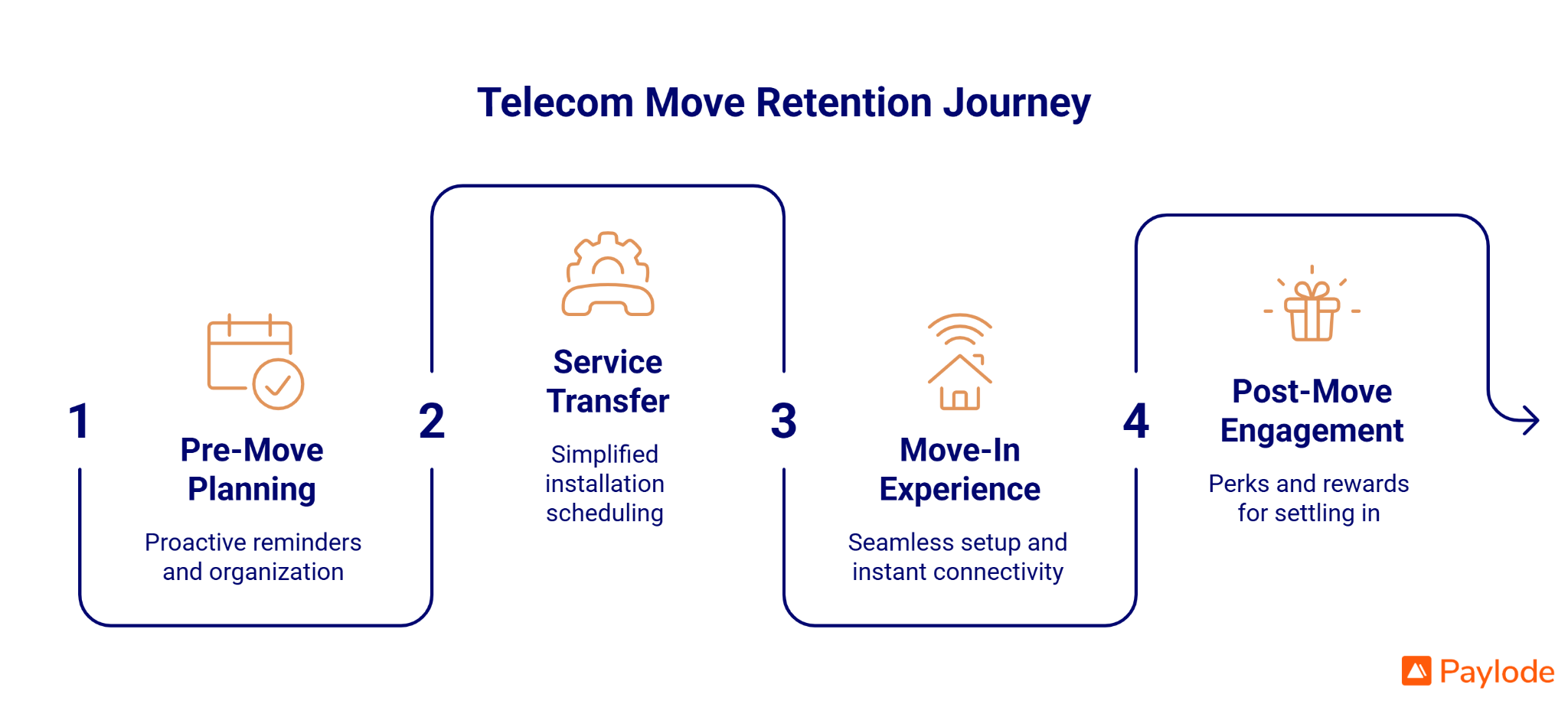
Providers can create a standardized journey that includes:
- Pre-move communication
- Guided service transfer
- Installation support
- Post-move engagement
This ensures every customer receives the same level of support.
Measure the right performance metrics
To improve results, telecom providers must track performance across the move journey.
Key metrics include:
- Service transfer completion rates
- Installation success rates
- Customer engagement during the move
- Retention after relocation
These insights help identify gaps and improve processes over time.
Leverage engagement platforms for scale
Managing communication, rewards, and personalization manually is difficult at scale.
Platforms like the Paylode platform enable telecom providers to automate engagement, deliver personalized experiences, and manage rewards efficiently throughout the customer lifecycle.
Continuously optimize the experience
Customer expectations evolve, and so should the move experience.
Telecom providers should regularly:
- Review customer feedback
- Analyze performance data
- Refine communication and workflows
Continuous improvement ensures the strategy remains effective over time.
By operationalizing move-based retention, telecom providers can move from reactive churn management to a proactive, scalable approach that strengthens customer relationships.
Conclusion: from churn risk to retention opportunity
Customer relocation does not have to lead to churn. When handled correctly, it can become one of the most valuable moments to strengthen customer relationships.
The key to improving telecom retention during moves is to shift from a reactive approach to a proactive, experience-driven strategy. Instead of waiting for customers to cancel, telecom providers can guide them through the move journey, reduce friction, and deliver meaningful value.
Providers that succeed focus on:
- Simplifying the service transfer process
- Communicating early and clearly
- Rewarding customer actions during the move
- Creating a consistent and supportive experience
When staying with the provider feels easy and rewarding, customers are far more likely to remain loyal.
Relocation is not just a service change. It is a moment where telecom brands can show reliability, build trust, and create lasting connections.
Providers who treat moves as an opportunity—not just a risk—will be the ones to win long-term customer loyalty.
FAQs
Why do telecom customers churn during moves?
Customers often churn because the service transfer process feels complicated or unclear. If switching providers seems faster or easier, they may choose a competitor instead of staying.
How can telecom providers improve retention during relocation?
Telecom providers can improve telecom retention during moves by simplifying service transfers, communicating early, and guiding customers through each step of the move process.
What is a move-based retention strategy?
A move-based retention strategy focuses on engaging customers during relocation by reducing friction, providing support, and offering value to encourage them to stay with their provider.
Do rewards help reduce churn during moves?
Yes. Rewards encourage customers to complete key actions such as scheduling service transfer and installation, which improves engagement and reduces churn.
Why is relocation considered a lifecycle opportunity?
Relocation is a high-intention moment when customers reassess their service options. Telecom providers can use this opportunity to strengthen relationships and improve long-term loyalty.