Every property manager who has worked in real estate knows the calendar works against them in student housing specifically. A resident signs a lease in the fall, settles into a routine by winter, and starts thinking about summer plans, internships, or graduation long before the renewal conversation ever comes up. By the time a property team sends a renewal notice, many students have already mentally checked out of the building and moved on to their next chapter. This is exactly why student housing rewards have become such a practical tool for operators who want to influence that decision earlier and more effectively.
Unlike conventional multifamily housing, where a resident might stay in the same unit for several years, student housing turns over on an academic schedule. Leases are shorter, decision windows are compressed, and the people making the renewal decision are often juggling exams, jobs, and family input at the same time. A rewards program that only shows up once a year, buried in a renewal email, rarely has enough time to change anyone's mind. Property managers who succeed in this space tend to build engagement into daily life, starting from move-in day and continuing through every semester, so that by the time renewal season arrives, staying already feels like the obvious choice.
What makes student housing renewals different from conventional multifamily housing?
Traditional residential real estate communities often rely on long resident tenure, gradual trust-building, and word-of-mouth referrals within a neighborhood. Student housing operates on a much tighter clock. A typical academic lease runs nine to twelve months, and many residents have never rented an apartment before arriving on campus. That inexperience cuts both ways: it means students are forming their very first impressions of what renting should feel like, but it also means they are more price-sensitive and more easily swayed by a competing property down the street offering a better move-in deal.
Because the decision window is so short, property managers cannot rely on the slow accumulation of goodwill that works in traditional apartment communities. Instead, they need a structured way to demonstrate value early and often. This is where a well-designed rewards strategy earns its keep. Rather than waiting for a single renewal conversation in February or March, operators can use perks and incentives throughout the year to reinforce the idea that this community delivers more than just a place to sleep between classes.
Why do student housing rewards influence a lease renewal decision?
Rent alone rarely wins a renewal battle in a competitive college market, especially when several properties are all quoting similar square footage and similar monthly rates. What actually shifts a student's decision is the sense that a property understands their day-to-day life and makes it easier. A rewards program built around local restaurant discounts, textbook and school supply deals, streaming service credits, or move-in bundles speaks directly to a student budget in a way that a generic marketing email never will.
There is also a psychological factor at play. Students who feel appreciated by their property team, rather than treated as another line item on a rent roll, are more likely to see renewal as a low-effort decision. A resident perks program gives operators a consistent way to show that appreciation throughout the lease term instead of saving it all for a single renewal push. When residents already associate the community with savings and convenience, the renewal conversation becomes a formality rather than a negotiation.
Property managers who track this closely tend to notice that rewards participation correlates with renewal intent. Students who redeem perks regularly are engaging with the brand on a recurring basis, which naturally keeps the property top of mind when lease decisions come around. That ongoing engagement is far more valuable than a single well-timed discount offered right before a lease expires.
How can property managers structure a student housing rewards program?
Building an effective program does not require reinventing the wheel each semester. Most successful student housing rewards programs follow a similar structure: a centralized perks hub where residents can browse and redeem offers, a mix of national and local partner deals, and a small set of targeted campaigns tied to specific actions the property wants to encourage.
A perk centers approach works well here because it gives residents one consistent place to check for new offers, whether they are logging in through a resident portal, a mobile app, or a QR code posted in the leasing office. Rather than scattering promotions across flyers, emails, and social posts, a centralized hub keeps everything organized and searchable, which matters when the audience is a generation that expects app-like convenience from every service they use.
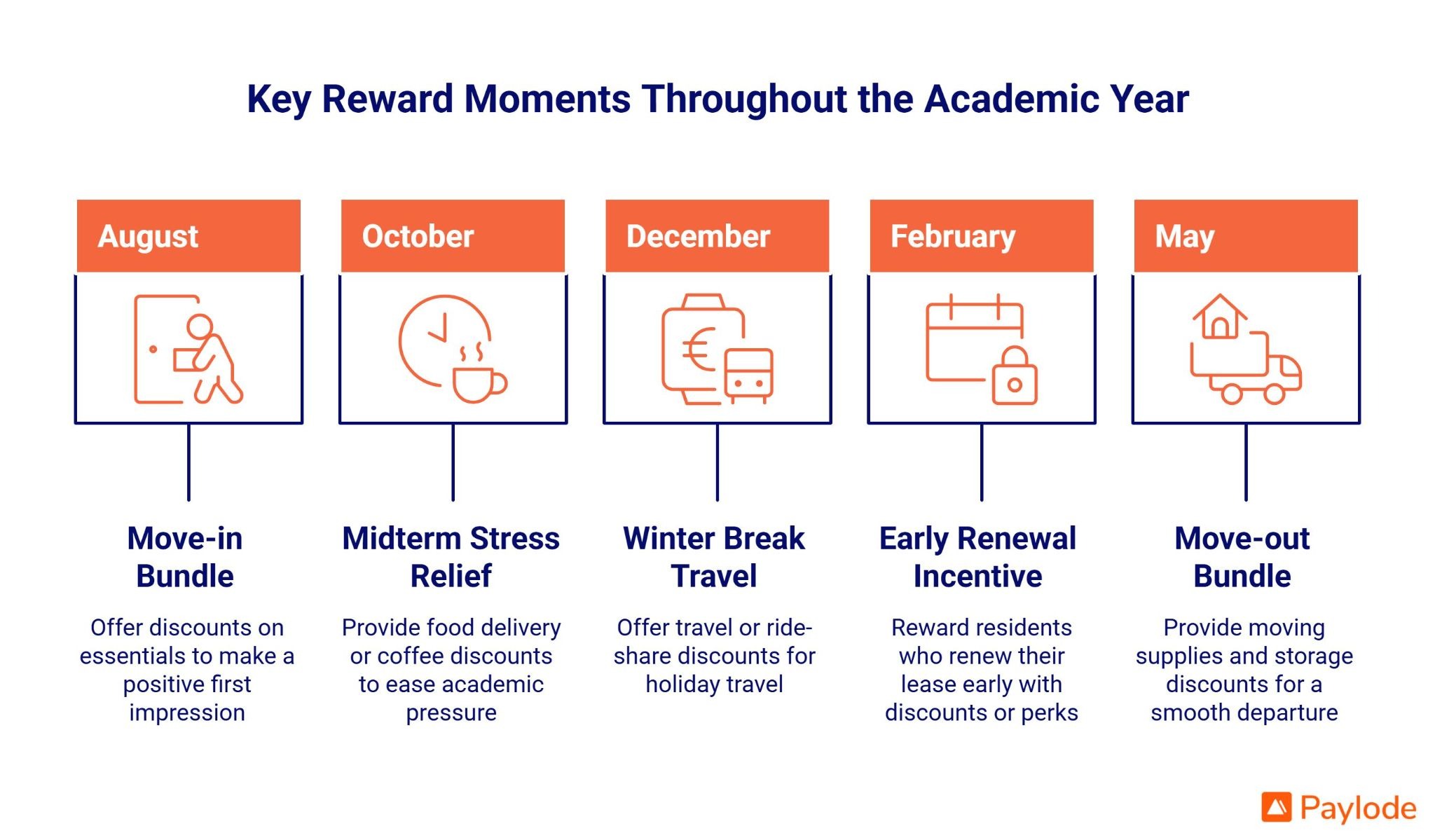
From there, property teams can layer in seasonal campaigns. A back-to-school bundle in August, a midterm stress-relief promotion in October, and a renewal-season push in February all give the program a natural rhythm that matches the academic calendar. Each campaign should feel purposeful rather than random, tied to a moment in the student experience where a small reward genuinely helps.
Paylode's broader platform approach brings these pieces together, letting operators manage perks, campaigns, and reporting without needing a separate tool for each function. That consolidation matters for lean property teams who are already stretched across leasing, maintenance requests, and resident communication.
What perks resonate most with student renters?
Not every reward lands the same way with a college-age audience. Perks tied to everyday spending categories tend to outperform generic gift cards because they feel immediately useful. Food delivery credits, ride-share discounts, textbook and school supply savings, and streaming subscriptions are consistently popular because they map directly onto how students already spend their money.
Local partnerships also carry more weight in a college town than they might in a typical suburban apartment complex. A discount at the coffee shop two blocks from campus or a deal with a nearby gym feels personal in a way that a national chain offer sometimes does not. Property managers who take the time to build relationships with local businesses near their community often find that these hyper-local perks drive the highest redemption rates, because students see them as insider knowledge rather than generic marketing.
Financial-behavior incentives round out a strong program. Rewarding residents for paying rent on time, opting into autopay, or signing their renewal early gives the property a way to influence the exact behaviors that matter most for occupancy and cash flow, while giving students a tangible reason to follow through.
How can property managers use perks to encourage on-time payments and renewals?
Late rent payments and last-minute renewal decisions create real operational strain for student housing teams, particularly during the compressed weeks around finals and move-out. A targeted incentive campaign can nudge residents toward the behaviors that keep a property running smoothly. Offering a small reward for enrolling in automatic payments reduces the administrative burden of chasing down late rent, while also giving students one less bill to remember during a busy semester.
The same logic applies to renewal timing. Instead of waiting until the last possible week to secure a signature, property managers can use a Boost-style campaign to reward students who commit early, whether that means a discount on next semester's rent or a bonus perk added to their account. Paylode's Boost tools are built specifically for this kind of behavior-driven incentive, letting operators set a clear action, such as signing a renewal by a certain date, and attach a reward that makes taking that action worthwhile. Early commitments give leasing teams more lead time to plan for turnover in units that will not renew, which reduces the scramble that typically happens in the final weeks before a new academic year.
Paperless billing incentives fit into this same category. Encouraging residents to switch to paperless statements cuts down on printing and mailing costs while giving students a faster, more mobile-friendly way to manage their account, which matches how most of them already prefer to handle money.
How does a rewards program support long-term resident retention in student housing?
Retention in student housing looks different than in conventional apartment communities, since most residents will eventually graduate or transfer regardless of how satisfied they are. Even so, the same underlying principles that drive retention elsewhere still apply within a shorter time horizon. A student who feels genuinely valued during their first year is more likely to renew for a second year, refer a friend or sibling to the same property, and leave a positive review that shapes how future prospects perceive the community.
Word of mouth carries enormous weight in a college market where students compare notes constantly about which properties treat residents well. A rewards program that consistently delivers value gives current residents a reason to talk positively about their experience, which lowers marketing costs for filling next year's vacancies. Retention in this context is not just about keeping the same student for another year; it is about building a reputation that makes leasing easier every single cycle.
How can property managers measure the ROI of a student housing rewards program?
Any investment in a rewards program needs to justify itself against turnover costs, marketing spend, and vacancy loss, and student housing typically faces higher turnover pressure than other residential categories simply because of the academic calendar. Property managers should track renewal rate changes among residents who actively engage with perks compared to those who do not, since this comparison often reveals the clearest signal of program impact.
Redemption data also tells a useful story about resident engagement. A property team that sees consistent perk usage throughout the semester, rather than a single spike during move-in week, is building the kind of ongoing relationship that supports renewal decisions later. Tracking which categories of perks get the most redemptions helps operators refine their offer mix over time instead of guessing at what residents actually want.
Ultimately, the goal is to raise customer lifetime value even within the shorter tenure window that student housing allows. A resident who renews for a second year, refers a roommate, and engages consistently with the property's perks program delivers meaningfully more value than one who leaves after a single lease term. Framing the program around lifetime value, rather than a single renewal event, helps property teams justify the investment to ownership and make the case for expanding the program in future years.
Frequently asked questions about student housing rewards
What is a student housing rewards program?
A student housing rewards program gives residents access to discounts, perks, and incentives tied to their lease, covering categories like food delivery, local businesses, streaming services, and move-in essentials, all designed to increase satisfaction and encourage renewal.
How early should a property team launch its rewards program?
Most operators see the strongest results when the program launches at move-in, since this establishes engagement habits from day one rather than trying to build interest right before renewal season.
Do student housing rewards actually increase renewal rates?
While results vary by property, operators generally find that residents who actively redeem perks throughout the year are more likely to renew, since consistent engagement keeps the community top of mind when the renewal decision arrives.
What perks work best for a college-age audience?
Everyday spending categories such as food delivery, ride-share, textbooks, and streaming subscriptions tend to perform best, along with local business discounts specific to the surrounding college town.
Making renewal the easy choice
Student housing will always run on a tighter clock than conventional multifamily communities, but that compressed timeline is exactly why an intentional rewards strategy matters so much. Property managers who build engagement from move-in day, reward the behaviors that matter most, and keep perks relevant to an actual student budget put themselves in a much stronger position when renewal season arrives. Instead of scrambling to convince residents to stay, the goal becomes making that decision feel obvious well before the lease is even up for discussion.
Explore Paylode's perks offering to see how a structured rewards program can fit into your student housing community, review pricing plans to find the right fit for your portfolio, or book a demo to see how other student housing operators are using rewards to drive renewals before graduation season hits.