Net effective rent (NER) is the average monthly rent a resident actually pays after concessions. Take the total rent due over the lease, subtract the value of free rent and other rent credits, and divide by the number of months in the lease. A $2,000 apartment with one month free on a 12-month lease has a net effective rent of $1,833.
Asking rent is the number on the listing. Net effective rent is the number the unit earns. With concessions on 39.8% of rental listings in July 2026, according to Zillow's July 2026 rental report, the gap between the two has become one of the most important numbers in a leasing report.
What is the net effective rent formula?
The formula has three inputs: the monthly asking rent, the lease term in months, and the total value of the concession.
Net effective rent = (monthly rent x lease months, minus concession value) / lease months
When the concession is quoted in weeks, convert it to dollars first. Annual rent divided by 52 gives the weekly rent, and the weekly rent multiplied by the number of free weeks gives the concession value. Six free weeks on a $2,000 apartment is worth $2,769.
Net effective rent examples
The five illustrative examples below cover the concessions operators use most. Each row applies the formula above.
The third row shows why operators often pair free rent with a longer lease. The same free month spread over 13 months produces a smaller effective discount than it does over 12.
Net effective rent calculator
Enter the monthly asking rent, the lease term and the concession. The calculator returns the total concession value, the net effective rent, the effective discount and the increase the resident will see at renewal if asking rent stays the same.
Should waived fees count toward net effective rent?
Practice varies. Many operators calculate net effective rent from rent concessions only, since application, administration and amenity fees are not rent. Others fold waived fees in to show the full move-in incentive. The cleanest approach is to report both: net effective rent based on rent concessions, and a separate total cost of move-in incentives that includes waived fees.
Gift cards and perks sit outside the formula. A gift card sent after a resident signs a lease or enrolls in autopay leaves the rent roll and the net effective rent unchanged. Track it as a cost per completed action instead.
Why does net effective rent matter in 2026?
Concessions are at levels not seen in more than a decade. RealPage Market Analytics reports that 15.8% of stabilized apartment units offered a concession in July 2026, the highest July reading since 2011, with an average discount of 11.1%. RealPage equates that discount to nearly six weeks free on a 12-month lease, which is the second row in the examples table.
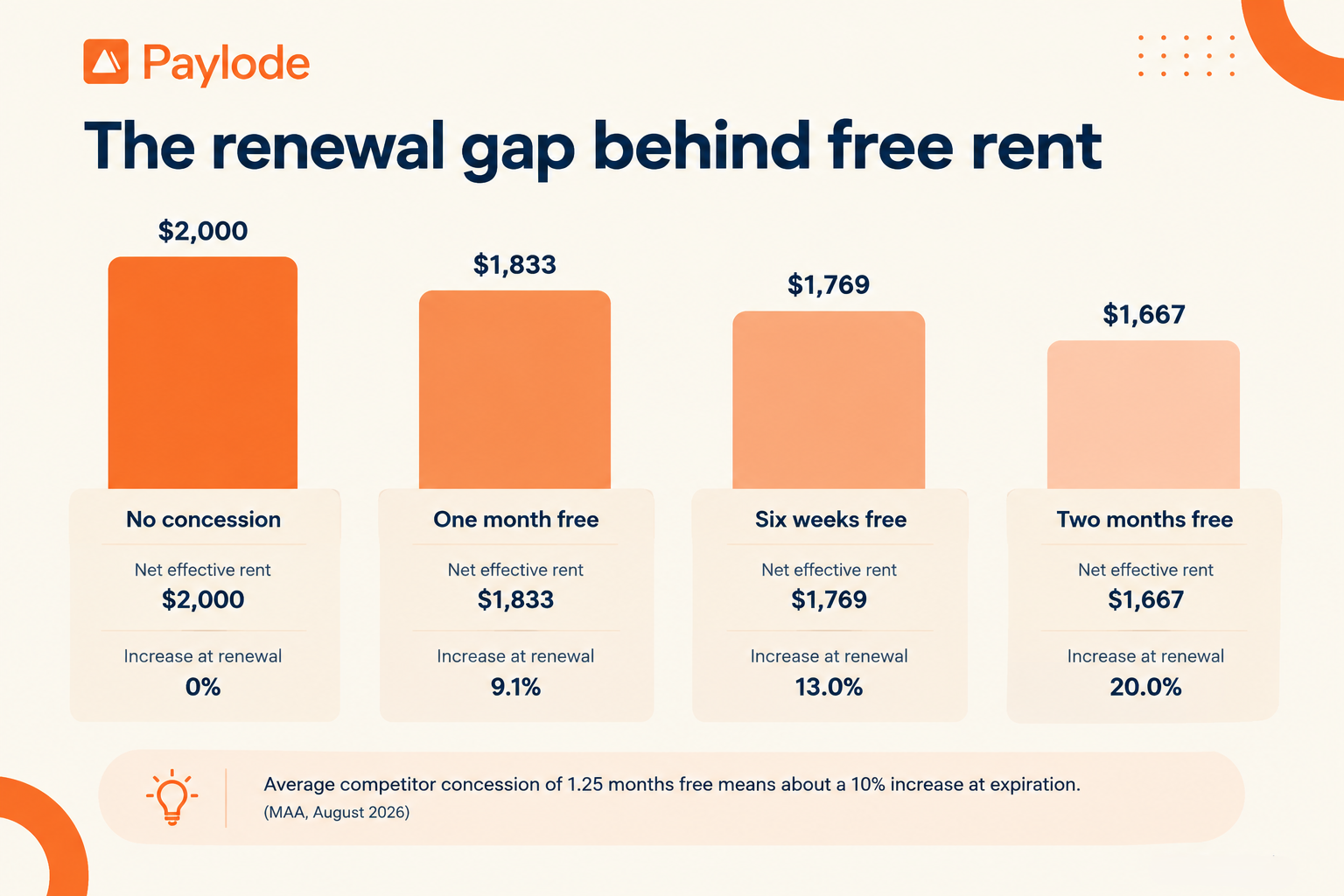
The cost does not end at signing. In its August 2026 capital markets update, Mid-America Apartment Communities (MAA) estimated that the average competitor concession of 1.25 months free translates into a rent increase of about 10% when the concession expires, and that lease-up competitors offering two to three months free face increases of about 16% to 24%. Those increases are the renewal gap, and net effective rent is how you see it coming.
How do you report net effective rent across a portfolio?
Unit-level net effective rent is easy. Portfolio reporting needs one more rule: weight every lease by its term. Add up the total rent due on all new leases signed in the period, subtract the total value of their concessions, and divide by the total number of lease months. A simple average of each lease's net effective rent gives a three-month lease the same weight as a fifteen-month lease.
Report three numbers side by side for each property and each month: average asking rent, weighted net effective rent, and the effective discount between them. Split them by new leases and renewals, since concessions are usually concentrated on new leases. Then compare the effective discount with the local market. RealPage publishes national and market-level concession usage and average discounts each month, which gives regional teams an outside benchmark for their own numbers.
Finally, keep move-in incentives that are not rent, such as waived fees, gift cards and perks, in their own line. That line shows how much of the leasing budget sits outside the rent roll, and it is the line that targeted rewards should grow as blanket concessions shrink.
How does net effective rent affect renewals?
Renewal offers are usually priced from asking rent. A resident who paid a lower effective rent therefore sees a larger increase than the change in asking rent. The illustrative table below assumes asking rent stays flat at $2,000 on a 12-month lease.
The pattern lines up with MAA's estimates. The deeper the concession at signing, the harder the renewal conversation, which is why the renewal plan should be set the day the concession is approved.
How can operators protect net effective rent?
Large portfolios use four habits to keep net effective rent from sliding:
- Track net effective rent by unit and by lease, alongside asking rent, so leasing reports show what each unit actually earns.
- Prefer longer lease terms when a concession is unavoidable, since the same free month produces a smaller effective discount over 13 or 15 months.
- Put an end date on every special and review it monthly against net effective rent and occupancy.
- Use targeted rewards for specific actions, such as signing within a set window or renewing by an early deadline, so the incentive does not touch the rent roll.
Gift cards are a familiar tool for the last point. The Incentive Research Foundation reports that gift cards account for at least 43% of all incentives in North America in its Industry Outlook for 2025. FirstKey Homes offered a gift card through Paylode Boost to the first 60 residents who enrolled in autopay and recorded a 25% increase in autopay enrollments in the first campaign period, as documented in the FirstKey Homes case study. Paylode's guide on how gift cards and perks can replace rent discounts covers the economics in more detail.
See how Paylode Boost sends a gift card when a lease is signed or a renewal is completed.
How is commercial net effective rent different?
Office, retail and industrial leases use the same idea, but the math usually covers more items, such as tenant improvement allowances and longer free-rent periods, and it is often quoted per square foot per year. This guide and the calculator above are built for residential leases.
Frequently asked questions
Is net effective rent the same as effective rent?
In residential leasing the terms are used interchangeably. Both describe the average monthly rent after concessions.
How do you calculate net effective rent with free weeks?
Divide the annual rent by 52 to get the weekly rent, multiply by the number of free weeks to get the concession value, subtract it from the total rent due, and divide by the number of months in the lease.
Does net effective rent include waived fees?
Usually not, because fees are not rent. Report waived fees as a separate move-in incentive cost so the two numbers stay comparable across properties.
Why do landlords advertise asking rent?
Advertising asking rent keeps the headline rent intact for renewals and market comparisons, while the concession closes the lease. The trade-off shows up at renewal, as the table above illustrates.
Do gift cards lower net effective rent?
No. A gift card is a one-time incentive delivered after an action and does not change the rent due under the lease.
Keep the rent roll intact
Net effective rent tells you what each concession really costs, and the renewal gap tells you when that cost comes due. Book a demo with Paylode to replace part of your concession budget with rewards tied to signed leases, move-in and move-out tasks and early renewals. More on the platform for multifamily, single-family rental and student housing operators is on Paylode's residential real estate page.