For years, telecom providers have relied on discounts to retain customers. When churn risk increases, the most common response has been to offer bill credits.
While this approach delivers short-term results, it does not always build long-term loyalty. Customers may stay for a lower price, but they are just as likely to leave when another provider offers a better deal.
This is where the conversation around perks vs bill credits becomes important. Telecom, ISP, and MVNO providers are beginning to rethink how they approach retention and customer loyalty.
Today’s customers expect more than savings. They want value, relevance, and experiences that feel rewarding. A lower bill may reduce cost, but it does not always strengthen the relationship between the customer and the brand.
In competitive telecom markets, where pricing and plans often look similar, customer experience plays a bigger role in retention. Providers that focus only on discounts may struggle to stand out.
On the other hand, value-driven strategies such as personalized perks allow telecom companies to offer benefits that customers actually use and enjoy. This creates a stronger connection and encourages long-term engagement.
For example, telecom providers that focus on engagement strategies designed to raise customer lifetime value can create more sustainable retention outcomes without reducing their base pricing.
Understanding the difference between these two approaches is essential for telecom loyalty and marketing teams. The next step is to look at how bill credits work and why they have been widely used in the industry.
What are bill credits in telecom retention?
Bill credits are one of the most commonly used tools in telecom retention strategies. They work by reducing a customer’s monthly bill for a specific period of time.
In the discussion of perks vs bill credits, bill credits represent the traditional approach. They are simple, familiar, and widely used across telecom, ISP, and MVNO providers.
How bill credits work
Bill credits are applied directly to the customer’s account.
They are typically:
- Offered when a customer is about to cancel
- Applied for a limited number of months
- Used during contract renewals or service issues
For example, a provider may offer a $10 monthly credit for six months to encourage a customer to stay.
Why telecom providers rely on bill credits
Bill credits are easy to implement and deliver immediate results.
They:
- Lower the customer’s cost instantly
- Require no additional setup or partnerships
- Fit directly into existing billing systems
Because of this, they have become a default retention tactic across the telecom industry.
The limitations of bill credits
While bill credits can reduce churn in the short term, they come with clear drawbacks.
- They reduce revenue over time
- They do not create a meaningful customer experience
- They encourage customers to negotiate for better pricing
- They are easy for competitors to match
Most importantly, bill credits do not build a strong emotional connection with customers. They solve a price problem, but not a loyalty problem.
As telecom providers look for more sustainable retention strategies, many are exploring alternatives that focus on delivering value rather than reducing price.
The next step is understanding how personalized perks work and why they are becoming more important in modern telecom loyalty strategies.
What are personalized perks in telecom?
Personalized perks are value-based benefits offered to customers based on their preferences, behavior, or lifestyle. Instead of lowering the bill, these perks add meaningful value to the customer experience.
In the comparison of perks vs bill credits, personalized perks represent a more modern approach to telecom retention. They focus on creating engagement rather than reducing price.
What personalized perks look like
Telecom providers can offer a wide range of benefits that customers can use in their daily lives.
Common examples include:
- Streaming and entertainment subscriptions
- Dining and retail discounts
- Travel and lifestyle offers
- Shopping rewards and partner deals
These perks go beyond connectivity and make the telecom service feel more valuable.
Why perks feel like real value
Unlike bill credits, perks are not seen as a price adjustment. Customers perceive them as something extra they receive for being a customer.
This creates a different experience.
- Bill credits feel like savings
- Perks feel like rewards
That distinction plays a major role in building long-term loyalty.
The role of personalization
Not all customers value the same benefits. Personalization ensures that perks are relevant and useful.
For example:
- A family may prefer entertainment perks
- A frequent traveler may value travel discounts
- A young professional may engage with shopping offers
When perks align with customer interests, they are more likely to be used and appreciated.
How telecom providers deliver perks at scale
Delivering personalized perks requires the ability to manage offers, partners, and customer targeting.
Platforms like Paylode’s perks solution help telecom providers offer curated reward experiences that are easy to manage and scale, while keeping customers engaged throughout their lifecycle.
By shifting from price reduction to value creation, personalized perks help telecom companies build stronger relationships with their customers.
To fully understand their impact, it is important to compare how perks and bill credits differ in driving loyalty outcomes.
Perks vs bill credits: key differences that impact loyalty
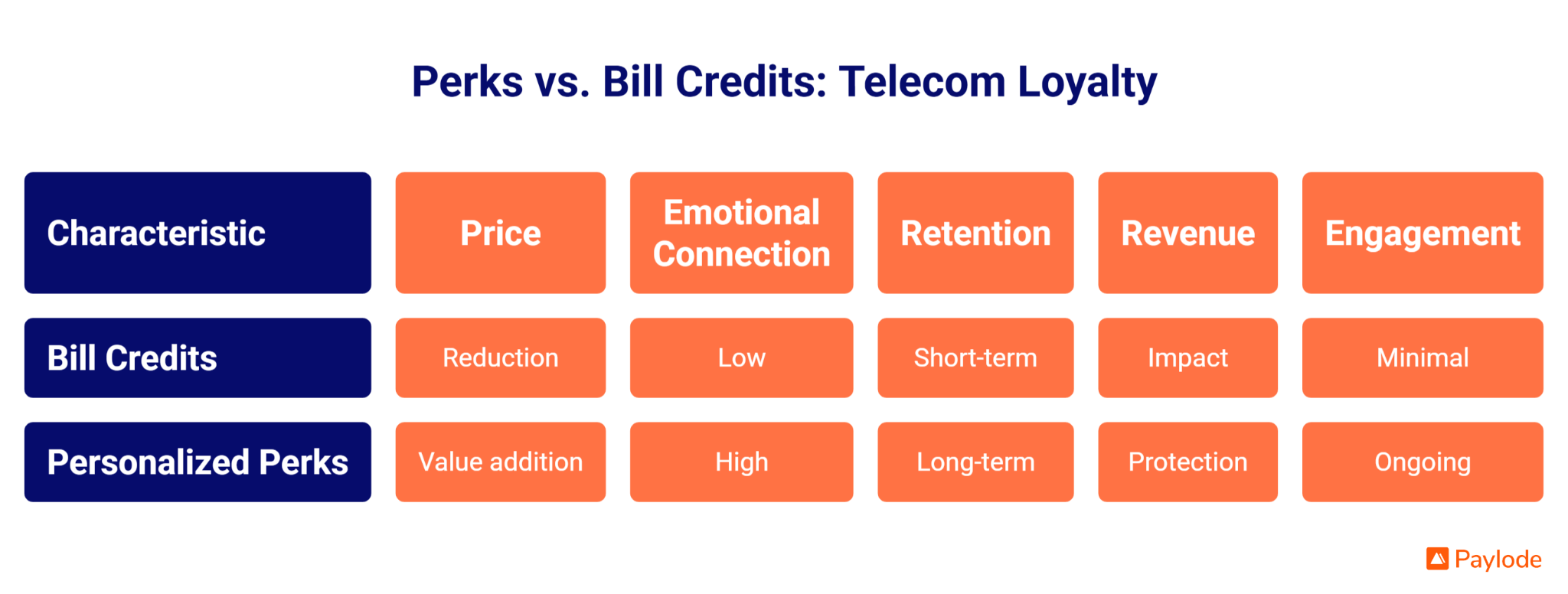
Understanding the difference between perks vs bill credits is essential for telecom providers looking to improve retention and customer experience.
Both approaches aim to reduce churn, but they work in very different ways. One focuses on lowering cost, while the other focuses on increasing value.
Transactional vs experience-driven retention
Bill credits are transactional. They reduce the price a customer pays, which can temporarily prevent cancellation.
Personalized perks are experience-driven. They create ongoing value that customers can see and use in their daily lives.
- Bill credits solve a pricing concern
- Perks enhance the overall customer experience
This difference directly impacts how customers perceive the brand.
Short-term vs long-term impact
Bill credits are typically limited to a short period. Once the discount ends, the original price returns.
This can lead to repeated churn risk if customers expect ongoing discounts.
Perks, on the other hand, provide continuous value.
- Customers engage with perks regularly
- Benefits can be refreshed over time
- The relationship stays active beyond billing cycles
This creates a more stable and long-term retention effect.
Impact on revenue and pricing
Bill credits reduce the amount customers pay, which directly impacts revenue.
Over time, frequent use of discounts can weaken a pricing strategy and reduce profitability.
Perks allow telecom providers to maintain their pricing while still offering added value.
This helps providers:
- Protect revenue
- Maintain consistent pricing
- Deliver additional benefits without lowering base plans
Customer perception and brand value
Customers notice the difference between a discount and a reward.
- Discounts can feel like negotiation
- Perks feel like appreciation
When customers feel valued, they are more likely to stay loyal.
For telecom, ISP, and MVNO providers competing in crowded markets, this difference can play a key role in brand differentiation.
Engagement beyond the bill
Bill credits are only visible on the monthly bill. Once applied, they do not create ongoing interaction.
Perks create multiple touchpoints throughout the month.
Customers engage with:
- Offers
- rewards
- partner experiences
This ongoing interaction strengthens the relationship between the customer and the provider.
To better understand why this difference matters, it is important to look at how emotional and transactional retention impact customer loyalty.
Emotional vs transactional retention
At the core of the perks vs bill credits debate is one key difference: how customers feel about their provider.
Retention is not only about keeping customers from leaving. It is also about building a relationship that makes them want to stay.
What is transactional retention?
Transactional retention is driven by price.
Bill credits fall into this category because they reduce the customer’s monthly cost. The relationship becomes focused on savings rather than experience.
In this model:
- Customers stay because it is cheaper
- Loyalty depends on continued discounts
- Competitors can easily win customers with better offers
This creates a cycle where customers expect ongoing price reductions.
What is emotional retention?
Emotional retention is built on value and experience.
Personalized perks help create this type of retention by offering benefits that customers enjoy and use regularly.
In this model:
- Customers feel recognized and rewarded
- Loyalty is based on experience, not just price
- Switching providers feels like losing value
This creates a stronger and more stable relationship.
Why emotional retention matters in telecom
Telecom services are often similar across providers. Pricing, plans, and speeds can be comparable.
This makes it difficult to stand out based on product alone.
Emotional retention becomes a key differentiator because it focuses on how customers feel about the brand.
- Do they feel valued?
- Do they receive meaningful benefits?
- Do they engage with the provider beyond billing?
Personalized engagement strategies—such as those enabled by platforms designed to deliver customer rewards and experiences—help telecom providers move beyond transactional relationships and build stronger loyalty.
The risk of relying only on discounts
When telecom providers depend heavily on bill credits, they risk creating a price-driven customer base.
These customers are more likely to:
- Switch for a better deal
- Request repeated discounts
- Show low long-term engagement
This makes retention more expensive and less predictable.
How perks shift the relationship
Perks change the conversation from “how much do I pay” to “what value do I receive.”
This shift is critical in building long-term loyalty.
Customers who regularly engage with perks are more likely to stay because they see ongoing benefits that go beyond price.
To fully unlock this value, telecom providers need to deliver perks in a way that feels relevant and personalized.
Why perks feel like value, not price cuts
One of the biggest differences in the perks vs bill credits comparison is how customers perceive value.
Both approaches aim to improve retention, but they create very different experiences. Bill credits reduce cost, while perks add something extra to the customer’s life.
That difference changes how customers think about their telecom provider.
Customers see perks as a benefit, not a discount
When a customer receives a bill credit, the experience is tied to price.
It feels like:
- A temporary adjustment
- A response to a complaint
- A negotiation outcome
In contrast, perks feel like a benefit the customer earns by being part of the brand.
This makes the experience more positive and memorable.
Perks create visible, usable value
Bill credits appear once on a monthly bill. After that, there is little interaction.
Perks, however, are something customers can actively use.
They can:
- Redeem offers
- Access rewards
- Enjoy partner benefits
This creates repeated engagement, which strengthens the relationship over time.
Value extends beyond the telecom service
Telecom services are essential, but they are often invisible. Customers only notice them when something goes wrong.
Perks bring value into everyday life.
For example:
- Entertainment benefits customers use weekly
- Dining offers used with friends or family
- Shopping rewards tied to daily purchases
This extends the brand’s presence beyond connectivity.
Perks reduce price sensitivity
When customers only focus on price, they are more likely to switch providers for a better deal.
Perks help shift that focus.
Instead of asking, “Is this the cheapest option?” customers begin asking, “What value do I get here?”
This reduces the likelihood of switching based only on pricing.
Building a stronger perception of the brand
Perks help telecom providers position themselves as more than just a utility.
They become part of the customer’s lifestyle.
For telecom, ISP, and MVNO companies, this is a powerful advantage. It allows them to stand out in a market where services often look similar.
By delivering value that customers can see and use, perks create a stronger emotional connection and a more lasting impression.
To make perks truly effective, telecom providers must ensure they are relevant to each customer. This is where data-driven targeting plays a critical role.
Data-driven targeting in personalized perks
Personalization is what makes perks effective. Without it, perks can feel generic and may not drive meaningful engagement.
In the context of perks vs bill credits, this is a key advantage. Bill credits are the same for everyone, but perks can be tailored to individual customer needs.
How telecom providers use data for personalization
Telecom providers already have access to valuable customer insights. These insights can be used to deliver more relevant perks.
Common data signals include:
- Usage patterns (data, streaming, roaming)
- Customer lifecycle stage
- Location and demographics
- Engagement history
Using this data, providers can match customers with perks they are more likely to use.
Why relevance drives engagement
Customers engage more when the offer feels relevant to their lifestyle.
For example:
- A frequent traveler may engage with travel discounts
- A family may use entertainment or shopping perks
- A young professional may prefer dining or retail offers
When perks align with real needs, they are not ignored—they are used.
Moving from one-size-fits-all to personalized experiences
Bill credits follow a one-size-fits-all model.
Every customer receives the same type of discount, regardless of their preferences.
Perks allow telecom providers to move toward personalized experiences where:
- Offers are tailored
- Communication is targeted
- Engagement feels intentional
This shift improves both customer satisfaction and retention.
Delivering personalization at scale
Managing personalized perks manually can be complex. Telecom providers need systems that can automate targeting and delivery.
Solutions built for telecom engagement—such as those offered on Paylode’s platform—enable providers to deliver relevant perks to the right customers at the right time, without operational complexity.
The impact on retention
When customers receive perks that match their interests, they are more likely to:
- Engage regularly
- See ongoing value
- Stay with the provider longer
This is where perks outperform discounts. They create continuous interaction instead of a one-time price adjustment.
To understand the full impact of this shift, telecom providers must also look at how success is measured.
Measuring engagement vs pure savings
To fully understand the impact of perks vs bill credits, telecom providers need to rethink how they measure success.
Traditional retention strategies focus heavily on cost savings. However, modern loyalty strategies look at engagement, behavior, and long-term value.
How bill credits are typically measured
Bill credits are evaluated based on short-term financial impact.
Common metrics include:
- Cost of discounts offered
- Immediate churn reduction
- Revenue impact during the credit period
While these metrics are useful, they only show part of the picture. They do not reflect how customers feel or engage with the brand.
How perks are measured differently
Personalized perks shift the focus from cost to engagement.
Key metrics include:
- Redemption rates (how often perks are used)
- Engagement frequency (how often customers interact)
- Retention over time
- Customer satisfaction and feedback
These metrics provide deeper insight into customer behavior.
Why engagement is a stronger indicator of loyalty
Engagement shows whether customers are actively interacting with the brand.
A customer who regularly uses perks is more likely to:
- Stay longer
- Explore additional services
- Recommend the provider to others
This makes engagement a stronger signal of long-term loyalty than short-term savings.
Moving beyond one-time retention
Bill credits are often reactive. They are used when a customer is about to leave.
Perks, on the other hand, support continuous engagement.
This allows telecom providers to:
- Build relationships before churn risk appears
- Maintain ongoing interaction
- Create consistent value throughout the customer lifecycle
Linking engagement to long-term value
When engagement increases, customer lifetime value also improves.
Customers who feel connected to the brand are more likely to:
- Renew services
- Upgrade plans
- Stay beyond contract periods
Telecom providers looking to strengthen long-term retention can benefit from strategies focused on increasing customer lifetime value through engagement programs, which align customer experience with measurable business outcomes.
By shifting from cost-focused metrics to engagement-driven insights, telecom providers can better understand what truly drives loyalty.
When to use bill credits vs personalized perks
In the discussion of perks vs bill credits, it is important to recognize that both approaches can be useful when applied in the right context.
The goal is not to replace one completely, but to use each strategy where it delivers the most value.
When bill credits make sense
Bill credits are effective in situations where immediate action is required.
They work best when:
- A customer is about to cancel
- Price sensitivity is the main concern
- Quick retention is needed
In these cases, a short-term discount can prevent churn and provide time to re-engage the customer.
However, relying only on bill credits can create long-term challenges if customers begin to expect ongoing discounts.
When personalized perks are more effective
Personalized perks are better suited for building long-term loyalty.
They work best when telecom providers want to:
- Increase customer engagement
- Differentiate their brand
- Deliver ongoing value beyond pricing
Perks help create a stronger relationship by giving customers something they can use regularly.
The advantage of a balanced approach
The most effective telecom retention strategies combine both approaches.
For example:
- Use bill credits selectively for high-risk churn situations
- Use personalized perks to maintain ongoing engagement
This approach allows telecom providers to address short-term risk while building long-term loyalty.
Moving toward value-driven retention
Telecom providers are gradually shifting away from discount-heavy strategies toward value-driven engagement.
This shift helps:
- Protect revenue
- Improve customer experience
- Reduce dependency on pricing competition
Platforms designed for telecom engagement, such as Paylode’s Boost solution, enable providers to deliver targeted campaigns that combine timing, personalization, and value to improve retention outcomes.
By using the right strategy at the right time, telecom companies can create a more sustainable and effective approach to retention.
How telecom companies can transition to perks-based retention
Shifting from discounts to value-driven strategies requires a structured approach. Telecom providers cannot move away from bill credits overnight, but they can gradually build a stronger, perks-based retention model.
In the context of perks vs bill credits, this transition helps providers reduce dependency on price while improving long-term customer engagement.
Start by identifying key customer segments
Not all customers behave the same way. Some are highly price-sensitive, while others value experience and convenience.
Telecom providers should begin by segmenting customers based on:
- Usage patterns
- Lifecycle stage
- Engagement behavior
- Churn risk signals
This helps determine where perks can have the greatest impact.
Introduce perks alongside existing strategies
Instead of removing bill credits immediately, providers can introduce perks as an additional layer of value.
For example:
- Offer perks during onboarding
- Provide rewards at renewal moments
- Introduce benefits during service upgrades
This allows customers to experience value beyond price.
Communicate value clearly to customers
Customers need to understand what they are receiving.
Telecom providers should highlight:
- What perks are available
- How to access them
- How often can they be used
Clear communication increases awareness and engagement.
Use digital channels to deliver perks
Customers prefer simple, digital experiences.
Providing easy access to perks through apps, portals, or email ensures that customers can discover and use benefits without friction.
A seamless experience increases the likelihood of regular engagement.
Track engagement and optimize continuously
The success of perks depends on how customers interact with them.
Telecom providers should monitor:
- Redemption rates
- Usage frequency
- Customer feedback
These insights help refine the program and improve results over time.
Scale with the right engagement platform
Managing personalized perks at scale requires the right tools.
Platforms like Paylode’s customer engagement solutions enable telecom providers to deliver targeted rewards, automate campaigns, and manage partnerships efficiently.
This makes it easier to transition from discount-based retention to a more sustainable, value-driven model.
By gradually introducing perks, improving communication, and using data to guide decisions, telecom providers can build stronger customer relationships and reduce long-term churn.
Conclusion: What actually builds loyalty in telecom
The comparison of perks vs bill credits highlights a clear shift in how telecom providers approach customer retention.
Bill credits can reduce churn in the short term, but they do not create lasting relationships. Customers who stay only for a discount are more likely to leave when a better offer appears.
Personalized perks take a different approach. They focus on delivering value that customers can see, use, and enjoy in their daily lives. This creates stronger engagement and builds a deeper connection with the brand.
For telecom, ISP, and MVNO providers, the path to long-term loyalty is not about lowering prices. It is about improving the customer experience.
Providers that succeed in retention today are those that:
- Deliver meaningful value beyond the core service
- Use data to personalize customer experiences
- Focus on engagement instead of short-term savings
By shifting toward value-driven strategies, telecom companies can reduce churn, protect revenue, and build stronger relationships with their customers.
The future of retention is not about discounts. It is about creating experiences that customers do not want to leave.
What is the difference between perks and bill credits in telecom?
Bill credits reduce the customer’s monthly bill for a limited time. Personalized perks provide additional benefits such as rewards, entertainment, or lifestyle offers. In the comparison of perks vs bill credits, perks focus on value, while bill credits focus on price reduction.
Which is better for telecom customer loyalty?
Personalized perks are more effective for long-term loyalty because they create ongoing engagement and emotional connection. Bill credits are useful for short-term retention but do not build lasting relationships.
Why do bill credits fail to build long-term retention?
Bill credits are temporary and price-driven. Once the discount ends, customers may leave if they find a better offer. They do not create engagement or strengthen the customer experience.
How do personalized perks improve customer engagement?
Perks encourage customers to interact with the brand regularly through rewards and benefits they can use. This ongoing engagement increases satisfaction and reduces the likelihood of churn.
Can telecom providers use both perks and bill credits?
Yes. A balanced approach works best. Telecom providers can use bill credits for immediate churn risk and personalized perks for long-term engagement and loyalty.