
Telecom providers have spent years competing on price. Discounts, bill credits, and promotional offers have become standard tools to retain customers and reduce churn.
At first, this approach delivers results. Lower prices attract attention and can prevent customers from leaving. But over time, it creates a bigger problem.
This is where many telecom loyalty programs begin to lose their effectiveness.
When every provider offers similar discounts, price stops being a differentiator. Customers start comparing only on cost, and loyalty becomes tied to the lowest offer rather than the best experience.
This creates a cycle:
- Competitors introduce lower prices
- Providers respond with more discounts
- Customers expect continuous price reductions
Over time, this leads to shrinking margins and weaker brand value.
More importantly, it shifts the focus away from building meaningful customer relationships.
Customers who stay only for price are more likely to leave when a better deal appears. This makes retention unpredictable and expensive.
For telecom, ISP, and MVNO providers, this situation is often described as a “race to the bottom.”
The challenge is not just about pricing. It is about how loyalty is defined.
Instead of relying on discounts, telecom providers need to rethink how they build loyalty—focusing on value, experience, and engagement.
For example, providers that adopt strategies designed to raise customer lifetime value through engagement and rewards can create stronger, more sustainable retention outcomes without reducing pricing.
The key question is no longer how to offer better discounts, but how to build loyalty that does not depend on price.
What is the race to the bottom in telecom?
The “race to the bottom” in telecom refers to ongoing price competition where providers continuously lower prices to retain or attract customers.
At first, this may seem like a necessary strategy. However, over time, it creates a cycle that is difficult to break.
This directly impacts how telecom loyalty programs are designed and perceived.
How the race to the bottom begins
The cycle usually starts when one provider introduces a lower-priced offer.
Competitors respond by:
- Matching or lowering their prices
- Offering additional discounts
- Adding short-term promotions
Customers quickly notice these changes and begin to compare providers based on price alone.
Why has it become difficult to escape
Once customers are conditioned to expect discounts, their behavior changes.
They may:
- Delay decisions until an offer appears
- Switch providers for small price differences
- Negotiate for better deals during renewals
This makes price the primary factor in retention.
The impact on telecom loyalty programs
As price competition increases, loyalty programs begin to shift away from engagement and toward cost reduction.
This leads to:
- Increased reliance on discounts
- Reduced the effectiveness of rewards
- Limited differentiation between providers
Instead of building loyalty, programs become tools for short-term retention.
The long-term business impact
The race to the bottom does not just affect pricing. It impacts overall business performance.
Telecom providers may experience:
- Shrinking margins
- Higher retention costs
- Lower perceived brand value
Over time, it becomes harder to create sustainable growth.
Why this model is unsustainable
Price competition can continue only for so long before it affects profitability.
Telecom providers need a different approach—one that focuses on delivering value instead of reducing price.
To understand why price-based strategies lose effectiveness, it is important to look at how customers respond to repeated discounts.
Discount fatigue: why customers stop responding to price cuts
Discounts can be effective in the beginning. They attract attention, create urgency, and can temporarily reduce churn.
However, over time, their impact starts to decline. Customers become used to seeing offers, and the same incentives no longer feel valuable.
This is known as discount fatigue—and it is a growing challenge for telecom loyalty programs.
What is discount fatigue?
Discount fatigue happens when customers are repeatedly exposed to price reductions and stop reacting to them.
What once felt like a benefit becomes expected.
Instead of creating excitement, discounts become part of the normal experience.
How customer behavior changes
As discount fatigue sets in, customer behavior begins to shift.
Customers may:
- Wait for offers before making decisions
- Ignore smaller discounts
- Compare providers only on price
- Switch even after receiving incentives
This makes retention strategies less effective.
Why discounts lose their impact
The more frequently discounts are used, the less meaningful they become.
Customers start to question:
- Is this the best offer I can get?
- Will there be a better deal later?
This creates hesitation and reduces conversion.
The effect on loyalty
When loyalty is tied to price, it becomes fragile.
Customers are not loyal to the brand—they are loyal to the lowest cost.
This weakens the role of loyalty programs and makes long-term retention difficult.
Increasing pressure on telecom providers
As discounts lose effectiveness, providers often respond by offering even more aggressive promotions.
This leads to:
- Higher retention costs
- Lower profitability
- Continued reliance on price competition
The cycle continues without solving the core problem.
Moving beyond discount-driven strategies
To break this cycle, telecom providers need to move away from price-based incentives and focus on delivering value in other ways.
This means building loyalty through experience, engagement, and relevance rather than repeated discounts.
Understanding the limits of price-based loyalty is the next step in creating a more sustainable strategy.
The limits of price-based loyalty
Price can attract customers, but it rarely keeps them for long.
When loyalty is built only on cost, it becomes unstable. Customers stay as long as the price feels right—and leave as soon as a better offer appears.
This is one of the biggest limitations of traditional telecom loyalty programs.
Customers stay for price, not for the brand
When discounts are the main retention tool, customers do not build a strong connection with the provider.
Their decision is simple:
- Stay if the price is low
- Leave if a cheaper option is available
This creates a transactional relationship rather than a loyal one.
No meaningful differentiation
In price-driven markets, providers begin to look similar.
If every telecom company offers comparable plans and discounts, customers have little reason to prefer one over another.
This makes it harder for loyalty programs to stand out.
Continuous pressure on margins
Frequent discounts reduce revenue over time.
As providers try to compete, they often:
- Increase promotional spending
- Extend discount periods
- Offer larger incentives
This creates financial pressure without improving long-term retention.
Limited customer engagement
Price-based strategies do not create ongoing interaction.
Customers typically engage only when:
- Paying their bill
- Receiving a discount
- Considering switching
There is little opportunity to build a deeper relationship.
Loyalty becomes short-term
When loyalty depends on price, it does not last.
Customers may stay temporarily, but their commitment is weak. This leads to repeated churn cycles and higher retention costs.
The need for a new approach
To build stronger and more sustainable loyalty, telecom providers need to move beyond price.
They need to create value that customers recognize and engage with regularly.
This shift requires focusing on experience rather than discounts.
Differentiation through experience, not price
As price becomes less effective, experience becomes the new way to stand out.
Telecom providers that move beyond discounts can create stronger and more lasting relationships. This is where modern telecom loyalty programs begin to shift from cost-based retention to value-driven engagement.
Why experience matters more than price
Customers interact with telecom services every day, but most of those interactions are invisible.
When everything works, customers do not think about their provider. When something goes wrong, they notice immediately.
Experience helps change this dynamic.
It allows providers to:
- Add visible value beyond connectivity
- Create positive interactions outside billing cycles
- Build a stronger connection with customers
Moving from utility to everyday value
Telecom services are often seen as utilities.
To differentiate, providers need to become part of the customer’s daily life.
This can include:
- Offering benefits that customers use regularly
- Providing helpful tools and features
- Creating simple and smooth interactions
When customers see value beyond the core service, loyalty becomes stronger.
Creating a consistent customer journey
Experience is not just about one moment. It is about how every interaction feels.
A strong experience includes:
- Easy onboarding
- Simple account management
- Clear communication
- Ongoing engagement
Consistency builds trust and reduces friction.
Building differentiation without lowering prices
Experience allows telecom providers to stand out without competing on price.
Instead of asking, “Are we the cheapest?” providers can focus on:
- “Are we the easiest to use?”
- “Do we offer the most value?”
- “Do customers enjoy staying with us?”
This shift reduces dependency on discounts.
Strengthening long-term loyalty
When customers have a positive experience, they are more likely to stay.
They are also more likely to:
- Upgrade services
- Explore additional offerings
- Recommend the provider
This creates long-term value for both the customer and the business.
The role of engagement platforms
Delivering consistent experiences at scale requires the right tools.
Platforms like the Paylode platform help telecom providers create personalized engagement, deliver rewards, and manage customer journeys effectively.
By focusing on experience instead of price, telecom providers can build loyalty that is more stable, more meaningful, and more sustainable.
The role of perks in modern telecom loyalty programs
As telecom providers move away from price-based strategies, perks are becoming a key part of building meaningful customer relationships.
Unlike discounts, perks add value without lowering the price. This makes them a powerful tool in modern telecom loyalty programs.
What perks offer to customers
Perks are benefits that customers can use in their daily lives.
They may include:
- Entertainment subscriptions
- Dining and shopping offers
- Travel and lifestyle benefits
These are not tied to the bill. They are tied to the customer’s experience.
Why perks feel more valuable than discounts
Discounts reduce cost, but perks add something extra.
Customers often perceive perks as:
- A reward for being a customer
- A benefit they can actively use
- An added advantage that goes beyond service
This creates a more positive perception.
Increasing engagement beyond billing
Most telecom interactions happen once a month during billing.
Perks create more frequent touchpoints.
Customers engage when they:
- Explore available benefits
- Redeem offers
- Use rewards in real life
This keeps the relationship active.
Supporting differentiation in competitive markets
In markets where pricing and plans are similar, perks help telecom providers stand out.
They offer something competitors may not match easily—ongoing value.
This strengthens brand positioning without relying on price.
Aligning perks with customer preferences
Not all customers value the same benefits.
Personalization allows telecom providers to offer perks that match customer interests.
For example:
- Families may prefer entertainment
- Professionals may use travel benefits
- Younger customers may engage with shopping offers
Relevant perks increase usage and satisfaction.
Delivering perks at scale
Managing perks programs manually can be complex.
Solutions like Paylode’s perks platform enable telecom providers to deliver curated rewards, manage partnerships, and create consistent engagement across the customer lifecycle.
Moving from price to value
Perks help shift the focus from “how much does it cost” to “what value do I receive.”
This change is critical in building long-term loyalty.
Customers who see ongoing value are less likely to switch, even in competitive pricing environments.
Perks as brand reinforcement
Loyalty programs are not just retention tools. They are an extension of the brand.
When designed well, telecom loyalty programs can reinforce how customers perceive the company. Perks play a key role in shaping that perception.
Moving beyond a utility brand
Telecom providers are often seen as utilities—essential but not emotional.
Perks help change that.
By offering benefits that customers use in their daily lives, providers become part of everyday experiences, not just a service in the background.
Creating a consistent brand experience
Every interaction with a perk is also an interaction with the brand.
This creates multiple touchpoints where customers:
- Discover benefits
- Engage with offers
- Associate positive experiences with the provider
Over time, this builds a stronger brand connection.
Reinforcing value without lowering price
Discounts can reduce how customers perceive value.
Perks, on the other hand, reinforce value without changing pricing.
They communicate:
- “You are getting more” instead of “you are paying less.”
This helps maintain brand positioning and pricing integrity.
Building emotional connection
Customers are more likely to remember experiences than price reductions.
When perks are used in meaningful moments - such as dining out, entertainment, or travel—they create positive associations with the brand.
This strengthens emotional connection.
Supporting long-term loyalty
Brand reinforcement through perks leads to more stable loyalty.
Customers who feel connected to a brand are less likely to switch for small price differences.
This reduces dependency on discounts and improves retention outcomes.
Aligning perks with brand identity
Perks should reflect what the brand stands for.
For example:
- A premium brand may offer exclusive experiences
- A family-focused provider may offer entertainment and shopping benefits
- A digital-first provider may focus on convenience and access
Alignment ensures consistency across all touchpoints.
Strengthening brand differentiation
In competitive telecom markets, differentiation is often limited.
Perks create a unique layer of value that competitors may not easily replicate.
This helps telecom providers stand out without entering price competition.
By reinforcing the brand through everyday value, perks turn loyalty programs into a strategic asset rather than a cost center.
Sustainable retention models for telecom
To move away from the race to the bottom, telecom providers need retention strategies that are stable over time. This means shifting from short-term discounts to long-term value creation.
Modern telecom loyalty programs are evolving to support this shift.
What makes a retention model sustainable
A sustainable retention model focuses on consistency, value, and efficiency.
It should:
- Deliver ongoing value to customers
- Reduce reliance on repeated discounts
- Support long-term engagement
This creates a stronger foundation for retention.
Moving from reactive to proactive retention
Traditional strategies react to churn signals.
Sustainable models focus on engaging customers before churn risk appears.
This includes:
- Regular communication
- Continuous value through perks
- Encouraging meaningful actions
Proactive engagement reduces the need for last-minute incentives.
Balancing cost and customer experience
Sustainability is not only about retention—it is also about cost control.
Telecom providers need to:
- Avoid excessive discounting
- Invest in value-driven benefits
- Align spending with engagement outcomes
This helps maintain profitability while improving customer satisfaction.
Building long-term customer relationships
Sustainable retention models focus on relationships rather than transactions.
Customers are more likely to stay when they:
- Feel recognized
- Receive consistent value
- Engage regularly with the brand
This reduces churn and increases lifetime value.
Leveraging data for smarter decisions
Data plays an important role in sustainability.
Telecom providers can use customer insights to:
- Personalize experiences
- Target the right segments
- Optimize loyalty strategies
This improves both efficiency and effectiveness.
Scaling retention with the right approach
To implement sustainable models, telecom providers need structured systems.
This includes:
- Clear customer journeys
- Defined engagement strategies
- Tools to manage rewards and communication
Platforms designed for telecom engagement help providers scale these efforts without increasing complexity.
Creating a future-ready loyalty strategy
Sustainable retention models prepare telecom providers for long-term growth.
Instead of competing on price, they compete on value, experience, and consistency.
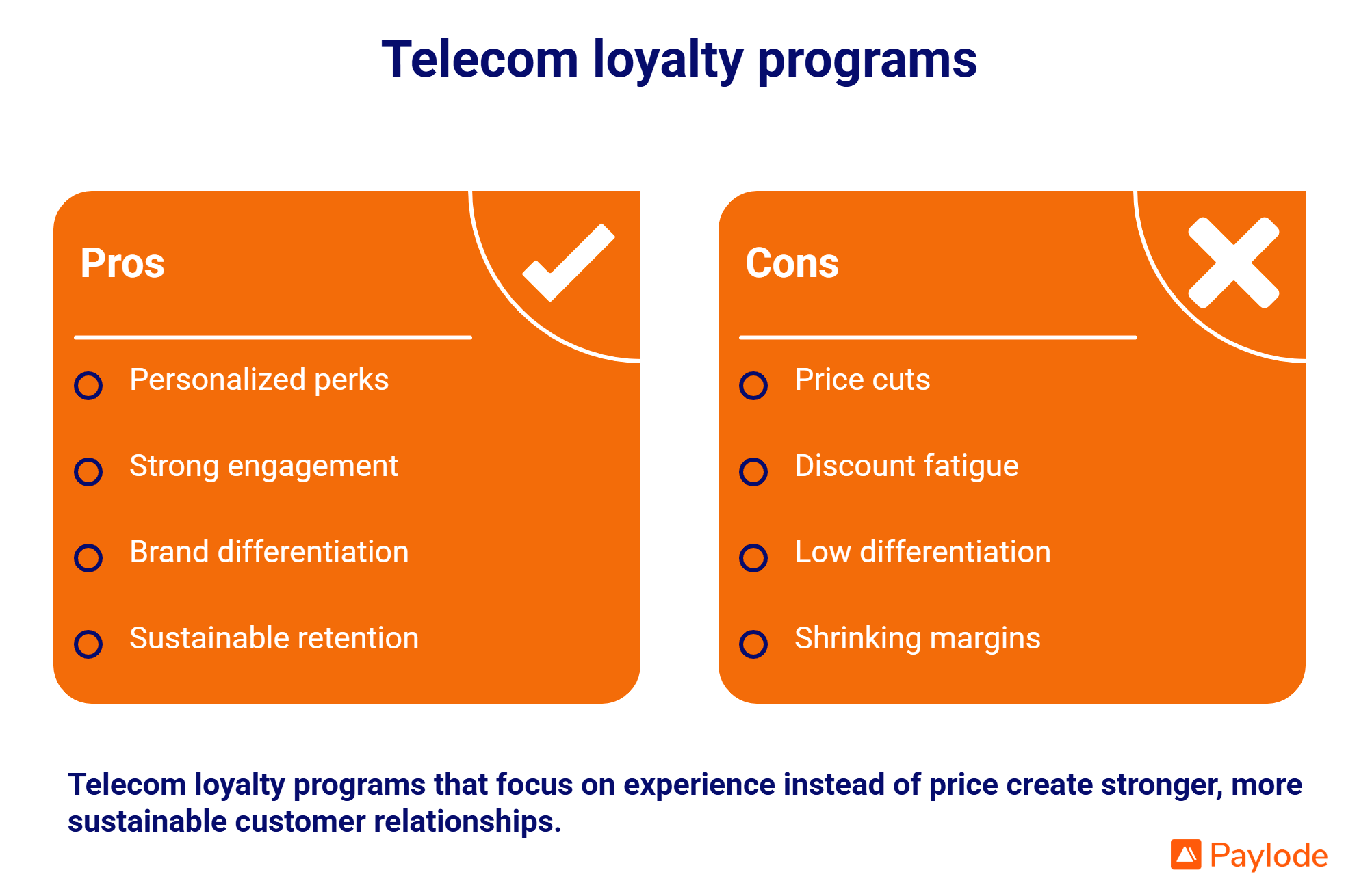
This approach strengthens loyalty, protects margins, and creates a more resilient business model.
How telecom providers can transition away from price-based loyalty
Moving away from discount-driven strategies requires a clear and structured approach. Telecom providers cannot eliminate price-based incentives overnight, but they can gradually shift toward more sustainable models.
This transition is essential for strengthening telecom loyalty programs and avoiding long-term dependency on discounts.
Step 1: Assess current reliance on discounts
The first step is understanding how much the current strategy depends on pricing.
Telecom providers should evaluate:
- Frequency of discounts offered
- Impact on retention outcomes
- Cost of incentives over time
This helps identify areas where change is needed.
Step 2: Introduce value-driven benefits
Instead of removing discounts immediately, providers can begin adding value-based elements.
This may include:
- Lifestyle perks
- Partner offers
- Experience-based rewards
These benefits shift customer focus from price to value.
Step 3: Prioritize customer experience improvements
Improving experience is key to reducing price sensitivity.
Telecom providers should focus on:
- Simplifying processes
- Enhancing digital journeys
- Providing clear communication
A better experience reduces the need for incentives.
Step 4: personalize engagement
Not all customers respond to the same offers.
Using customer insights, providers can deliver:
- Relevant perks
- Targeted communication
- Customized experiences
Personalization increases engagement and satisfaction.
Step 5: measure engagement, not just cost
Traditional metrics focus on discount spend.
Modern strategies should track:
- Customer engagement
- Perk usage
- Retention over time
This provides a clearer view of program effectiveness.
Step 6: scale with the right platform
Managing value-driven loyalty strategies requires the right tools.
Solutions like Paylode Boost help telecom providers deliver targeted campaigns, manage rewards, and drive engagement at scale without increasing complexity.
Building a gradual transition
The shift from price-based to experience-driven loyalty should be gradual.
By combining discounts with value-driven benefits, telecom providers can:
- Reduce dependency on pricing
- Improve customer perception
- Strengthen long-term retention
This approach creates a smoother transition while maintaining performance.
Conclusion: Winning loyalty without lowering prices
The race to the bottom is not a sustainable strategy for telecom providers. Competing on price alone leads to shrinking margins, weaker differentiation, and unstable customer relationships.
To build stronger and more lasting loyalty, telecom loyalty programs must shift their focus from discounts to value.
Providers that succeed in this shift prioritize:
- Experience over price
- Engagement over short-term incentives
- Long-term relationships over quick wins
By offering meaningful benefits, improving customer experience, and reinforcing brand value, telecom providers can create loyalty that does not depend on constant discounts.
This approach not only improves retention but also protects revenue and strengthens brand positioning.
The future of telecom loyalty is not about being the cheapest option. It is about being the most valuable and consistent choice for customers.
FAQs
What is the race to the bottom in telecom?
The race to the bottom refers to continuous price competition where telecom providers lower prices to retain customers. This reduces margins and makes it harder to differentiate between providers.
Why do discounts stop working in telecom loyalty programs?
Discounts lose impact over time because customers get used to them. This leads to discount fatigue, where customers expect offers and are less influenced by them.
How can telecom loyalty programs avoid price competition?
Telecom loyalty programs can avoid price competition by focusing on customer experience, offering personalized perks, and creating ongoing engagement instead of relying on discounts.
What role do perks play in telecom loyalty?
Perks provide added value that customers can use in their daily lives. They help build emotional connection, increase engagement, and strengthen brand loyalty without reducing pricing.
What is a sustainable telecom retention strategy?
A sustainable retention strategy focuses on delivering consistent value, improving customer experience, and reducing dependency on discounts while maintaining long-term customer relationships.


