Choosing a senior living community is rarely a decision made lightly. Residents and their families weigh comfort, safety, healthcare access, and a sense of belonging long before they weigh amenities like a fitness center or a dining plan. Once that decision is made, the property team's job shifts from winning the sale to proving, month after month, that the choice was the right one. This is where senior living resident rewards have started to play a bigger role than many property managers expect, turning everyday moments into reasons for residents to feel genuinely cared for rather than simply housed.
Unlike a typical apartment community where a resident might rarely interact with property staff outside of maintenance requests, senior living communities are built around daily engagement. Dining rooms, activity calendars, transportation services, and wellness programs already put staff in regular contact with residents. A well-designed rewards program builds directly on that existing relationship, giving property managers another tool to reinforce satisfaction and make renewal or continued residency an easy, comfortable decision rather than something residents or their families need to reconsider each year.
What makes senior living communities different from conventional multifamily housing?
Traditional residential real estate properties generally serve residents who are independent, mobile, and primarily focused on price, location, and unit quality. Senior living communities serve a very different population, one that often values consistency, personal attention, and a sense of community over square footage or finishes. Many residents move in during a significant life transition, whether that means downsizing from a family home, recovering from a health event, or losing a spouse, and the emotional weight of that transition shapes how they experience their new community from day one.
Because the stakes feel higher for both the resident and the adult children often involved in the decision, property managers cannot rely purely on unit amenities to differentiate their community. Trust, warmth, and a demonstrated commitment to resident wellbeing matter far more here than in a standard apartment search. Senior living resident rewards give operators a structured way to express that commitment consistently, rather than leaving it to chance or to the goodwill of individual staff members on any given day.
Why do senior living resident rewards influence satisfaction and retention?
Older residents, much like renters in any other segment of real estate, respond strongly to feeling valued rather than simply billed each month. A rewards program built around practical, relevant perks such as discounts on pharmacy deliveries, transportation services, or local dining options sends a clear signal that the community understands their daily needs. That signal matters enormously in a sector where trust is the primary currency and where a single negative experience can outweigh months of good service in a family's mind.
There is also a strong emotional component at play. Many residents in senior living communities are managing a fixed income, and a rewards program that reduces everyday costs can meaningfully ease financial stress without requiring the community to lower its base rates. A resident perks program gives property managers a way to deliver that value consistently, month after month, rather than relying on occasional gestures like a holiday gift basket or a one-time discount that residents quickly forget.
Property managers who have implemented structured rewards programs often notice a shift in how residents talk about their community, both with family members and with prospective residents touring the property. When people feel their community goes out of its way to make daily life easier and more affordable, that sentiment tends to spread through word of mouth, which remains one of the most powerful drivers of new move-ins in senior living.
How can property managers structure a senior living resident rewards program?
Building a rewards program for an older population requires a different approach than one designed for young professionals or students. Simplicity matters enormously. Residents should be able to understand and access their perks without navigating a complicated app or remembering a login they rarely use. A perk centers approach that centralizes offers in one easy-to-find location, whether through a printed community newsletter, a front-desk kiosk, or a simple digital portal, tends to perform far better than a program that assumes every resident is comfortable with technology.
Staff involvement also plays a bigger role in senior living than in conventional apartment communities. Front desk teams, activity directors, and dining staff often become the face of the rewards program, helping residents understand what is available and encouraging participation during everyday interactions. Property managers who train their teams to mention relevant perks naturally, such as a pharmacy delivery discount during a conversation about medication pickup, tend to see far higher engagement than those who rely solely on printed materials or digital notifications.
Paylode's broader platform approach supports this kind of layered rollout, letting property teams manage perks and track engagement without adding another complicated system for already busy staff to learn. That simplicity matters just as much for the team delivering the program as it does for the residents receiving it.
What perks resonate most with senior living residents?
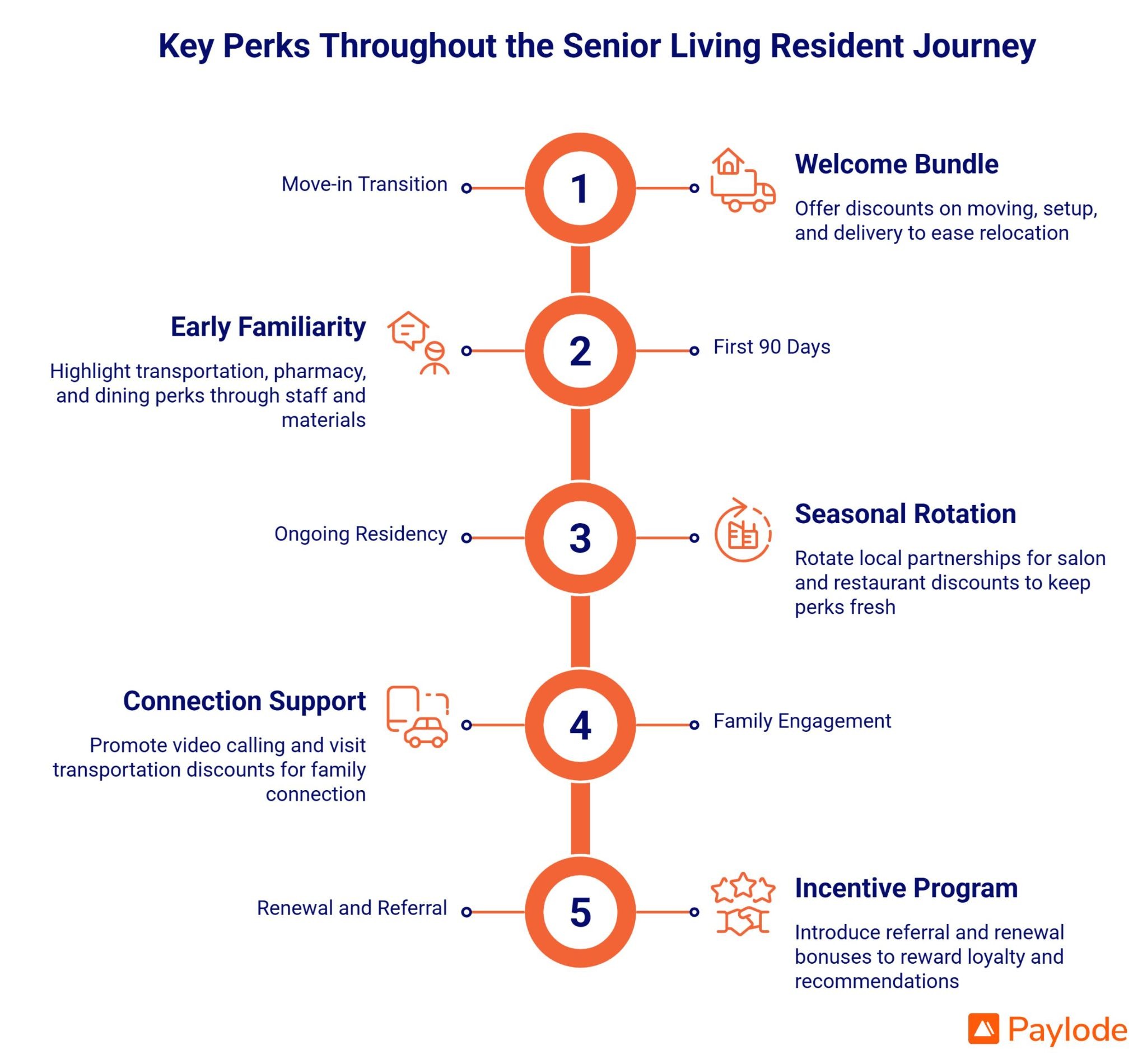
Perks that reduce friction in daily life tend to perform best in this population. Transportation discounts, pharmacy and grocery delivery savings, and local dining offers address needs that come up constantly, regardless of a resident's mobility level or health status. Unlike younger renters who might prioritize streaming services or ride-share credits, senior residents generally respond best to perks tied to health, convenience, and staying connected with family and community.
Local partnerships carry particular weight in senior living, much as they do in other community-driven segments of housing. A discount with a nearby pharmacy, a local hair salon, or a favorite regional restaurant chain feels personal and relevant in a way that a generic national offer often does not. Property managers who invest time in building these local relationships tend to find that residents notice and appreciate the effort, since it shows the community understands the specific area residents already know and trust.
Perks that support family connection also perform well. Discounts on video calling services, photo printing, or transportation for family visits help residents stay engaged with loved ones, which directly supports the emotional wellbeing that senior living communities are increasingly expected to prioritize alongside physical care.
How can property managers use rewards to encourage smooth financial operations?
Senior living communities face many of the same operational pressures as other residential properties, including the need to encourage timely payments and reduce administrative overhead. Offering a modest incentive for enrolling in automatic payments can reduce the burden on both residents and their family members who often manage finances on a resident's behalf, while giving the property more predictable cash flow.
Paperless billing offers a similar opportunity. Encouraging residents or their designated family members to switch to paperless statements simplifies recordkeeping and reduces mailing costs, while making it easier for adult children who often handle billing remotely to stay on top of a parent's account. Framing this shift as a rewards-eligible action, rather than simply a policy change, tends to improve adoption without creating friction for residents who may be hesitant about changing established habits.
For actions the community wants to encourage more assertively, such as early lease renewal or referring a new resident, Paylode's Boost tools give property managers a way to attach a clear incentive to a specific behavior. A referral bonus or a renewal-season perk can make a meaningful difference in a sector where new move-ins are often driven by personal recommendations from current residents and their families rather than traditional advertising.
How does a rewards program support long-term retention in senior living?
Retention in senior living carries a different weight than in conventional apartment communities, since a resident's decision to stay reflects not just satisfaction with the unit itself but comfort with the entire care and community experience. A consistent retention strategy that includes resident rewards helps reinforce, on a regular basis, that the community remains a good fit as residents' needs evolve over time.
Family involvement makes retention in this sector particularly sensitive to perceived value. Adult children who help manage a parent's care often reassess whether a community remains the right choice, especially as costs rise or health needs change. A rewards program that visibly reduces everyday expenses and demonstrates ongoing attentiveness gives families a concrete reason to stay confident in their decision, rather than exploring other communities during a moment of uncertainty.
Retention in senior living also protects something harder to quantify: the sense of continuity that matters enormously to older residents. Moving communities later in life is disruptive and stressful in a way that moving apartments rarely is for younger renters. Property managers who use rewards to reinforce satisfaction consistently are not just protecting occupancy numbers; they are helping residents avoid an unnecessary and often difficult transition.
How can property managers measure the ROI of a senior living resident rewards program?
Justifying a rewards program to ownership requires clear metrics tied to business outcomes. Property managers should track occupancy and renewal trends among residents who actively engage with perks compared to those who do not, since this comparison often reveals whether the program is meaningfully influencing satisfaction rather than simply adding a nice-to-have benefit.
Referral tracking matters just as much in this sector as renewal tracking. Because word of mouth drives so many new move-ins in senior living, property managers should monitor whether rewards-engaged residents and families are more likely to refer friends or acquaintances to the community. A program that demonstrably increases referrals delivers value well beyond the direct cost savings residents experience.
Ultimately, the goal is to raise customer lifetime value across what is often a longer and more relationship-driven tenure than in conventional multifamily housing. A resident who stays longer, refers new move-ins, and reports higher satisfaction in family surveys represents significant value that a well-structured rewards program can directly influence. Framing the investment around lifetime value, rather than a single renewal decision, helps property teams build a stronger case for expanding the program across their portfolio.
Frequently asked questions about senior living resident rewards
What are senior living resident rewards? Senior living resident rewards are perks and discounts offered to residents, covering categories like transportation, pharmacy delivery, dining, and local services, designed to ease daily life and reinforce satisfaction with the community.
Are resident rewards programs difficult for older residents to use? Not when designed with simplicity in mind. Programs that centralize offers in an easy-to-find location and involve staff in promoting perks tend to see the strongest participation among older residents.
Do resident rewards actually improve retention in senior living? Many property managers report that residents who engage regularly with perks show stronger satisfaction and are more likely to remain in the community, since consistent value reinforces confidence in the original decision to move in.
What perks work best for senior living residents? Perks tied to transportation, pharmacy and grocery delivery, local dining, and family connection tend to perform best, since they address needs that come up regularly regardless of a resident's mobility or health status.
Making resident wellbeing the foundation of retention
Senior living communities compete on far more than unit amenities, and property managers who recognize that trust, consistency, and daily convenience drive resident satisfaction put themselves in a stronger position for the long term. A thoughtfully structured rewards program gives operators a practical way to reinforce that commitment every single day, not just during the sales tour or the annual renewal conversation. As families increasingly weigh how well a community supports both physical and emotional wellbeing, resident rewards offer a clear, measurable way to demonstrate that commitment consistently.
Explore Paylode's perks offering to see how a structured rewards program can fit into your senior living community, review pricing plans to find the right fit for your portfolio, or book a demo to see how other senior living operators are using resident rewards to strengthen satisfaction and retention.