Key takeaway
Short-term concessions may boost occupancy, but they can quietly erode revenue and pricing power. Protect base rent, tie incentives to measurable resident behaviors, and prioritize retention-focused rewards to strengthen long-term NOI and asset value.
Why “easy” leasing incentives feel like a win
In competitive markets, “easy” leasing incentives can feel like the fastest path to occupancy. One month free. Reduced deposits. Gift cards at move-in.
Traffic increases. Applications rise. Leasing teams feel momentum.
But senior operators understand something deeper: what fills units quickly does not always protect long-term revenue.
The hidden cost of “easy” leasing incentives often shows up later—through lower effective rent, renewal resistance, and reduced pricing power. The impact is rarely immediate. It builds slowly across quarters, then years.
For real estate property managers overseeing stabilized portfolios, this is not just a leasing decision. It is an asset value decision.
In the residential rental market, revenue durability matters more than short-term optics. That is especially true across the broader residential real estate industry, where long-term performance drives valuation.
This article will explore:
- Why short-term leasing wins can create long-term damage
- How concessions build operational drag
- Why incentives should be reversible and measurable
- What senior operators can implement instead
If your team is relying on recurring concessions to maintain occupancy, it may be time to reconsider the strategy.
The psychology behind “free rent” and why it works
“First month free” is powerful because it reduces friction at the exact moment a renter is making a decision.
It simplifies the math.
Instead of focusing on total lease value, prospects focus on immediate savings. That short-term gain often outweighs long-term cost in the renter’s mind.
Why concessions convert quickly
Leasing incentives typically drive:
- A sense of urgency
- Perceived savings
- Lower upfront financial pressure
- Faster decision-making
From a leasing perspective, this feels effective. Conversions increase. Tour-to-lease ratios improve. Occupancy stabilizes.
But here is where the hidden cost of “easy” leasing incentives begins.
The incentive shifts the decision criteria from value to price.
When price becomes the primary driver, loyalty weakens.
Short-term occupancy gains vs long-term revenue damage
At first, concessions appear to solve the problem.
Vacancy drops. Units move. The pipeline looks healthier.
However, senior operators should ask a different question:
What is happening to effective rent and future renewals?
The financial tradeoff most teams overlook
When you offer one month free on a 12-month lease, you reduce collected revenue by roughly 8.3%.
That discount is baked into the lease from day one.
Unlike a temporary marketing expense, it cannot be recovered later.
If market conditions improve mid-year, you cannot retroactively raise that revenue.
This is the structural problem behind the hidden cost of “easy” leasing incentives. They reduce revenue permanently, not temporarily.
The compounding effect across a portfolio
Consider this simplified example:
That is a $2,004 annual difference per unit.
Across 250 units, that equals:
$501,000 in reduced annual revenue.
And that does not include:
- Renewal negotiation time
- Increased turnover risk
- Additional marketing required next cycle
When evaluated at scale, the hidden cost of “easy” leasing incentives becomes a portfolio-level financial issue.
The perception shift problem
There is another risk that does not appear in spreadsheets.
When your property regularly advertises discounts, you condition the market to expect them.
Prospects delay decisions, waiting for promotions.
Renewing residents compare their offer to what new residents received.
Online reviews mention “deals” instead of community value.
This changes positioning.
It is difficult to maintain premium branding while relying on ongoing concessions.
Senior operators should ask:
Are we building value—or training the market to expect discounts?
Operational debt created by concessions
The financial hit from discounts is visible.
What is less visible—but equally damaging—is operational strain.
This is where the hidden cost of “easy” leasing incentives becomes harder to measure.
Concessions do not just reduce rent. They create complexity.
Over time, that complexity slows teams down and weakens consistency.
1. Pricing distortion
When base rent and collected rent are different, clarity disappears.
Your reported rent may show $2,100.
Your effective rent may be $1,925.
This affects:
- Forecasting accuracy
- Competitive benchmarking
- Revenue planning
- Investor reporting
If your leasing strategy depends on constant concessions, your pricing becomes harder to interpret.
That makes long-term planning less reliable.
2. Renewal resistance
Residents who moved in with discounts often anchor to their effective rent.
When renewal time arrives, they compare:
- What they paid
- What new residents are paying
- What nearby communities are offering
This leads to:
- Longer renewal conversations
- Higher negotiation pressure
- Increased turnover risk
Instead of focusing on resident experience, teams spend more time defending pricing.
That time has a cost.
3. Increased turnover exposure
Price-sensitive renters are more likely to leave for a better deal.
If your acquisition strategy is built around concessions, your retention profile shifts.
Higher turnover leads to:
- More make-ready costs
- More vacancy days
- More marketing spend
- More staff workload
Even small improvements in retention can offset large marketing budgets.
That is why many operators focus on strategies designed to increase retention rather than relying on recurring rent discounts.
Retention is more stable than acquisition.
4. Staff fatigue and inconsistent messaging
When concessions change frequently, leasing teams must constantly adjust messaging.
One week it is “six weeks free.”
Next week, it is a “reduced deposit.”
The following month, it is a “gift card bonus.”
This creates:
- Confusion for prospects
- Inconsistent communication
- Training challenges
- Reduced confidence at the leasing desk
Over time, this weakens team effectiveness.
A strong leasing strategy should simplify communication, not complicate it.
Why concessions are difficult to reverse
Starting a concession program is easy.
Stopping it is not.
Once renters expect discounts:
- Removing them feels like a rent increase
- Traffic may temporarily slow
- Leasing teams may feel pressure to reintroduce them
This creates dependency.
And dependency is the core risk behind the hidden cost of “easy” leasing incentives.
If an incentive cannot be paused without destabilizing occupancy, it is not strategic—it is reactive.
Senior operators should aim for incentive structures that are:
- Flexible
- Measurable
- Behavior-driven
- Easy to scale up or down
Incentives should be reversible and measurable
Not all incentives are harmful.
The real issue is structure.
The hidden cost of “easy” leasing incentives appears when incentives are:
- Permanent revenue reductions
- Not tied to resident behavior
- Difficult to stop
- Impossible to measure clearly
Senior property managers need incentives that protect pricing while still driving action.
That requires a shift from discounting rent to rewarding behavior.
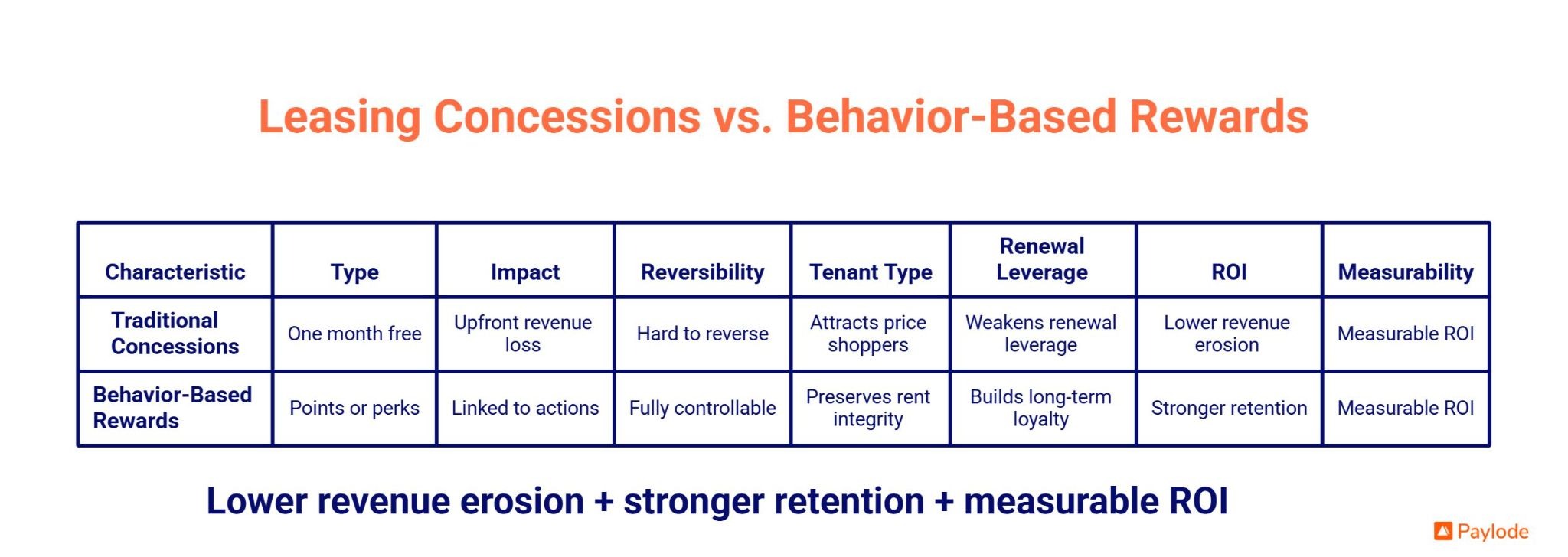
The difference between concessions and behavior-based rewards
Concessions reduce your base rent.
Behavior-based rewards preserve your base rent and encourage actions that improve performance.
Here is the difference:
Instead of offering one month free, operators can reward actions such as:
- Enrolling in auto-pay
- Renewing early
- Referring a friend
- Switching to paperless billing
- Participating in community programs
For example, encouraging residents to enroll in automatic payments improves on-time collections without reducing rent.
Likewise, structured resident perks can increase satisfaction and perceived value without touching base pricing.
These strategies align incentives with operational goals.
Why behavior-based incentives protect asset value
Asset value depends on revenue durability.
Discounted rent lowers your valuation baseline.
Behavior-based rewards protect it.
When incentives are tied to action:
- You only pay when value is created
- You can measure impact
- You can adjust or pause programs
- You preserve pricing integrity
That flexibility is critical in changing markets.
Instead of reducing revenue permanently, you control incentive spend in real time.
This removes the structural risk embedded in the hidden cost of “easy” leasing incentives.
The operator mindset shift
The real shift is mental.
From:
“Lower price to increase occupancy.”
To:
“Reward behavior to improve performance.”
That difference seems small.
But financially, it is significant.
In the next section, we will outline a clear framework senior operators can use to evaluate and redesign their incentive strategy.
A smarter framework for leasing incentives
If the hidden cost of “easy” leasing incentives is long-term revenue erosion, the solution must protect long-term value.
Senior property managers should evaluate incentives using four clear filters:
- Does this protect base rent?
- Is it tied to a measurable behavior?
- Can it be paused or adjusted easily?
- Does it improve retention or cash flow?
If the answer to any of these is no, the incentive may be creating more risk than value.
Step 1: Protect base rent at all costs
Base rent anchors your asset valuation.
Once you reduce it through concessions, you:
- Lower effective revenue
- Weaken renewal leverage
- Signal discount positioning
Instead of reducing rent, maintain your pricing and build value around it.
This preserves pricing integrity and strengthens long-term NOI.
Step 2: Attach incentives to behaviors that improve operations
Incentives should directly improve property performance.
Examples include:
- Rewarding early renewals
- Incentivizing referrals
- Encouraging digital engagement
- Promoting paperless billing
For instance, programs that encourage residents to switch to paperless reduce administrative costs.
Referral-driven rewards reduce marketing spend while improving lease quality.
These actions strengthen operations instead of weakening revenue.
Step 3: Make every incentive measurable
Every incentive should have a clear return metric.
Track:
- Cost per lease influenced
- Renewal rate improvement
- Delinquency reduction
- Referral conversion rate
If the incentive cost is not clearly tied to performance, it becomes an expense rather than a strategy.
One reason the hidden cost of “easy” leasing incentives grows unnoticed is that concessions are rarely tied to measurable long-term outcomes.
Step 4: Centralize incentive management
Scattered gift cards and manual reward programs do not scale across portfolios.
Senior operators benefit from structured systems that:
- Standardize incentives
- Track engagement
- Report measurable ROI
- Maintain pricing discipline
A centralized rewards strategy allows operators to drive performance without compromising rent integrity.
You can explore how a portfolio-wide approach works through Paylode’s platform, which helps operators manage incentives in a controlled and measurable way.
For properties looking to create consistent value messaging, structured reward systems like Perks provide residents with ongoing benefits—without discounting rent.
And for operators focused on activating engagement across communities, Boost supports scalable participation strategies tied to measurable outcomes.
Financial comparison: concessions vs structured rewards
Let’s compare long-term impact over three years:
While concessions may increase lease velocity, structured rewards improve revenue durability.
That distinction is critical in today’s capital environment.
Why senior operators are shifting strategies
Market cycles fluctuate.
Interest rates move.
Operating expenses rise.
In this environment, long-term cash flow consistency matters more than short-term occupancy spikes.
The hidden cost of “easy” leasing incentives becomes especially clear when:
- Capital costs increase
- Investors demand stable returns
- Turnover expenses climb
- Market rents stabilize
Senior operators are increasingly choosing strategies that strengthen retention and lifetime value instead of temporary occupancy boosts.
Real-world scenario: two properties, two different outcomes
To understand the hidden cost of “easy” leasing incentives, let’s compare two stabilized multifamily communities in similar submarkets.
Both properties face moderate competitive pressure.
Both need to maintain 94–96% occupancy.
Both operate around a $2,000 average rent.
But their strategies differ.
Property A: concession-driven strategy
This property offers:
- One month free on 12-month leases
- Occasional move-in bonuses
- Seasonal discount campaigns
Short-term result:
- Increased leasing velocity
- Strong tour-to-lease conversion
- Occupancy stabilized quickly
Year-one impact:
- Effective rent reduced by ~8%
- Renewal resistance increased
- More price negotiations
Year-two impact:
- Residents expect similar incentives
- Competitors match discounts
- Renewal rates soften
Leasing remains active—but pricing power weakens.
This is how the hidden cost of “easy” leasing incentives compounds quietly.
Property B: behavior-based incentive strategy
This property maintains full market rent.
Instead of discounts, it implements:
- Renewal rewards tied to early commitment
- Referral incentives
- Points for on-time payments
- Digital engagement incentives
Residents receive value—but rent remains intact.
Programs are structured through a centralized system designed for portfolio-wide management across the real estate industry.
Short-term result:
- Slightly slower initial lease velocity
- Stronger messaging around community value
Year-one impact:
- Stable effective rent
- Higher renewal conversations
- Reduced delinquency
Year-two impact:
- Increased resident engagement
- Stronger referral flow
- More predictable cash flow
The difference is not occupancy.
It is revenue durability.
The long-term retention advantage
Residents who move in because of a discount often leave for a better one.
Residents who feel rewarded for participation, referrals, and loyalty develop a stronger connection.
When incentives support long-term engagement rather than short-term pricing, operators often see improvement in programs designed to raise customer LTV.
Lifetime value grows when:
- Turnover declines
- Renewal rates improve
- Residents refer others
- Delinquency drops
Retention stability is far more valuable than temporary occupancy spikes.
A simple test for senior operators
If you removed concessions tomorrow, what would happen?
- Would occupancy fall sharply?
- Would traffic drop significantly?
- Would leasing teams feel unprepared?
If the answer is yes, your strategy may be dependent rather than strategic.
That dependency is the core warning sign behind the hidden cost of “easy” leasing incentives.
Conclusion: choosing incentives that protect long-term asset value
Leasing incentives are not the problem.
Unstructured, recurring concessions are.
The hidden cost of “easy” leasing incentives becomes clear over time:
- Lower effective rent
- Weakened renewal leverage
- Higher turnover exposure
- Reduced pricing power
- Portfolio-level revenue erosion
In contrast, structured, behavior-based incentives:
- Preserve base rent
- Improve retention
- Encourage engagement
- Remain measurable and adjustable
For senior property managers, the objective is not simply to fill units.
It is to protect revenue durability, strengthen resident relationships, and support long-term valuation.
Occupancy without pricing power is fragile.
Retention with rent integrity is resilient.
If your portfolio relies heavily on recurring concessions, it may be time to redesign your approach.
A centralized, measurable rewards strategy can help you:
- Standardize incentives across properties
- Tie rewards to performance-driving behaviors
- Track ROI clearly
- Protect rent integrity
You can explore how this works in practice through Paylode’s structured plans, or take the next step and book a demo to see how behavior-based rewards can replace concessions without sacrificing occupancy.
Frequently asked questions
Are leasing concessions always harmful?
Not always. In lease-up situations or distressed markets, temporary concessions may be necessary. The risk arises when they become a long-term dependency rather than a short-term tactic.
Why are concessions difficult to reverse?
Once renters expect discounts, removing them feels like a price increase. This creates resistance at renewal and can impact traffic if not managed carefully.
How do behavior-based rewards improve retention?
Rewards tied to actions such as renewals, referrals, and auto-pay enrollment create engagement without reducing base rent. This strengthens resident loyalty while preserving revenue.
What is the biggest risk behind the hidden cost of “easy” leasing incentives?
The biggest risk is permanent revenue reduction combined with weakened pricing power. Over time, this impacts NOI and asset valuation more than most operators initially expect.