Across the U.S. multifamily market, concessions have become the default response to leasing pressure. When traffic slows or renewals feel uncertain, offering free rent or discounts often seems like the fastest way to protect occupancy. For many teams, it feels less risky than changing strategy.
But that short-term fix comes with a long-term cost. As more operators rely on concessions, effective rent declines, reporting becomes harder to explain, and asset value takes a quiet hit. Over time, the gap between what a unit should earn and what it actually earns keeps growing.
This is why more operators are actively looking to reduce apartment concessions without creating new leasing risk. The goal is not to remove incentives altogether. It is to stop using rent as the incentive.
Today’s multifamily leaders are rethinking how value is offered to prospects and residents. Instead of cutting rent, they are shifting toward multifamily rent incentives that sit outside the lease. These incentives are funded from marketing budgets, designed to drive specific actions, and structured to protect rent integrity.
This approach creates a clear alternative to rent discounts. It allows leasing teams to stay competitive, marketing teams to improve conversion, and asset managers to maintain clean revenue optics. Most importantly, it supports occupancy without resetting the perceived value of the asset.
In this guide, we’ll break down why concessions became so common, where they fall short, and how property management incentives and resident rewards can deliver the same results with better financial outcomes. The focus is practical, proven, and designed for operators who care about both performance today and value tomorrow.
What concessions are and why they’re everywhere
Concessions are one of the most common tools used in multifamily leasing today. They are often introduced as short-term offers, but in many markets, they have become a standard part of pricing strategy. As operators look to reduce apartment concessions, it helps to first understand what they include and why teams rely on them so heavily.
What qualifies as a concession
In simple terms, a concession is any rent-based offer that lowers the total amount a resident pays over the lease term. These offers are tied directly to rent and show up in effective rent calculations.
The most common examples include:
- Free rent
A free week or month applied at move-in or spread across the lease term. - Look-and-lease specials
Limited-time rent credits offered if a prospect signs quickly after touring. - Renewal discounts
Reduced rent or one-time credits offered to keep an existing resident from moving out.
While these offers are often grouped with multifamily rent incentives, they differ in one important way. Concessions change the financial value of the lease itself, not just the experience around it.
Why property teams rely on concessions
Concessions did not become widespread by accident. They are popular because they make life easier for busy property teams.
They are:
- Easy to explain
Prospects immediately understand free rent or a discount. - Easy to approve
Many operators already have predefined concession rules. - Easy to track in the short term
Leasing activity often increases quickly after a concession is launched.
From a day-to-day standpoint, concessions feel practical. They give leasing teams a clear answer when asked how to boost conversions or protect occupancy.
The operational reality on site
Leasing teams operate under constant pressure to meet weekly and monthly goals. When traffic slows or move-ins fall behind, there is rarely time to test new ideas or wait for long-term strategies to work.
In that environment, concessions become the fastest answer. They require no new systems, no training, and no change in process. A discount can be turned on immediately and adjusted just as quickly.
This dynamic is especially common across the residential real estate industry, where competitive properties often mirror each other’s pricing moves instead of differentiating on value.
Understanding why concessions are everywhere makes it easier to see why replacing them feels risky. The next step is recognizing what those concessions quietly cost beyond the initial lease.
Why concessions hurt effective rent and asset optics
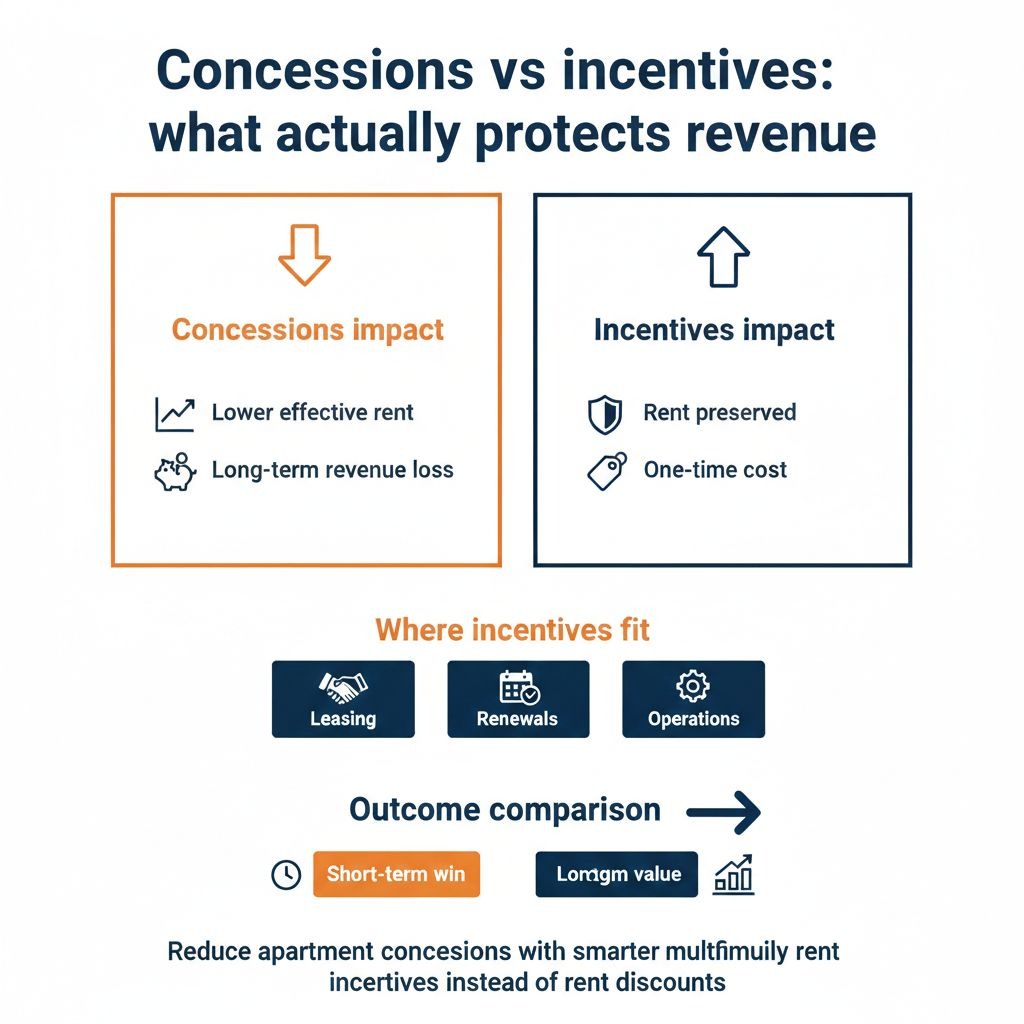
At first glance, concessions appear harmless. Occupancy improves, leasing reports look stronger, and short-term goals are met. The real impact shows up later, in how revenue is measured, explained, and valued. This is where the difference between resident rewards vs concessions becomes impossible to ignore.
The difference between market rent and effective rent
Market rent is the advertised price of a unit. Effective rent is what the property actually earns after concessions are applied. When a unit is listed at $2,000 but includes one month free on a 12-month lease, the effective rent drops immediately.
Over time, that gap adds up. Even if occupancy stays high, the property is collecting less income than market pricing suggests. This creates a quiet erosion of revenue that does not always show up in weekly leasing reports but becomes very visible at the asset level.
How concessions distort reporting
Concessions also complicate performance reporting. On paper, rents may appear stable or even increasing, while effective rent tells a different story. This disconnect makes it harder to explain results clearly and confidently.
When concessions are used frequently:
- Revenue reports require more explanation.
- Comparisons between properties become less accurate.
- Performance trends look inconsistent.
In contrast, resident rewards that sit outside the lease do not change rent figures. This is a key distinction when comparing resident rewards vs concessions, especially for teams responsible for long-term reporting and planning.
How different stakeholders are affected
Ownership: lower realized income
Owners ultimately care about cash flow. Concessions reduce the actual dollars collected, even when units are technically leased. Over time, this limits reinvestment, flexibility, and overall return.
Asset management: weaker rent comps
Asset managers rely on clean rent data to benchmark performance. Heavy concession use weakens rent comps and makes it harder to justify pricing decisions across a portfolio.
Investors: unclear performance signals
Investors want clarity. When effective rent lags behind market rent, it becomes harder to tell whether performance issues are operational, market-driven, or artificially masked by discounts.
Future buyers: reduced perceived value
During valuation or sale, concessions raise questions. Buyers focus on stabilized income, not promotional pricing. A history of aggressive rent discounts can reduce confidence in the asset’s long-term earning potential.
Why does this create a long-term problem
Concessions are effective at solving today’s vacancy problem. They create urgency, close deals, and prevent short-term loss. But they also reset expectations. Prospects learn to wait for discounts. Residents expect incentives tied to rent.
This is the core issue. Concessions trade future value for immediate relief. Over time, they make revenue harder to grow and assets harder to position.
The key takeaway is simple: concessions fix occupancy today but weaken valuation tomorrow. Understanding this cost is what drives operators to explore resident rewards that protect rent while still motivating action.
Why incentives are not the same as rent discounts
Incentives and rent discounts are often grouped together, but they function very differently. Understanding this distinction is essential for operators searching for alternatives to rent discounts that do not compromise long-term value. While both aim to influence leasing and renewal decisions, only one protects the integrity of rent.
The core distinction between discounts and incentives
A rent discount permanently changes the financial value of a lease. Once a lower rent or free period is applied, the effective rent drops and becomes part of the property’s revenue story. That reduced value follows the lease through its full term and often influences future pricing expectations.
Incentives work differently. They are delivered outside the lease and do not alter the rent itself. The advertised and contracted rent remains intact, while the incentive adds perceived value to the overall experience. This difference allows property management incentives to motivate action without reshaping pricing benchmarks.
A simple way to compare the two
The easiest way to think about the difference is this:
- Discounts lower the price
The value of the unit goes down, and revenue is reduced. - Incentives add benefits
The price stays the same, but the experience feels more valuable.
This distinction matters because residents anchor their expectations to rent. Once rent is discounted, it becomes harder to raise it without resistance. Incentives, on the other hand, can be adjusted, replaced, or removed without changing the lease value.
Common examples of incentives used in multifamily
Incentives can take many forms, but the most effective ones are targeted and intentional.
- One-time rewards
Offered after a lease is signed or a renewal is completed, creating a clear action-reward connection. - Behavior-based perks
Designed to encourage actions like on-time payments or digital engagement, without touching rent. - Time-bound offers
Available for a limited period to create urgency without long-term revenue impact.
These approaches are increasingly used in resident-focused programs that reward engagement and loyalty rather than lowering price. One example is structured resident perk programs that support leasing and retention goals without affecting rent integrity.
For operators focused on sustainable growth, incentives offer flexibility that rent discounts cannot. They provide a way to stay competitive, motivate decisions, and protect asset value at the same time.
How marketing-budget rewards work in multifamily
As operators search for better multifamily rent incentives, many are shifting their focus away from rent and toward how their marketing dollars are used. Instead of spending more to attract traffic or discounting rent to close deals, marketing-budget rewards repurpose existing spend to drive specific outcomes.
What marketing-budget rewards are
Marketing-budget rewards are non-rent incentives funded from the same budgets already used for advertising, promotions, and leasing campaigns. Rather than pushing all value through rent, these rewards are attached to actions that matter most to the business.
They are designed to influence behavior, not pricing. The lease amount stays the same, while the reward adds value at the right moment in the decision process. This makes them a practical option for operators who want incentives without compromising rent integrity.
Because they sit outside the lease, marketing-budget rewards remain flexible. They can be adjusted by market, campaign, or season without rewriting pricing strategies or resetting expectations.
How marketing-budget rewards work in practice
The structure of these rewards is simple and intentional.
First, a clear action is defined. This could be applying within a certain timeframe, signing a lease by a target date, or completing a renewal early. The action aligns directly with a leasing, retention, or operational goal.
Next, the prospect or resident completes that action. There is no change to the advertised rent or lease terms during this step.
Finally, the reward is triggered. It is delivered after the action is completed, reinforcing the behavior while keeping rent unchanged. This sequence is what separates marketing-budget rewards from concessions and makes them a sustainable alternative.
Common examples used by multifamily operators
Marketing-budget rewards can support multiple stages of the resident lifecycle.
- Apply-and-sign bonuses
Offered after a lease is fully executed, these rewards help convert interested prospects without lowering rent. - Renewal thank-you rewards
Used to acknowledge loyalty and encourage early renewal decisions, without setting a precedent for rent discounts. - Paperless billing incentives
Rewards tied to digital adoption help reduce administrative workload while improving the resident experience.
Many operators manage and distribute these offers through centralized reward systems that organize rewards and ensure consistent delivery across properties. Purpose-built platforms make it easier to control costs, track performance, and maintain a consistent resident experience.
Paperless billing incentives are a strong example of how rewards can support both financial and operational goals. By encouraging residents to switch to digital processes, operators reduce manual work while offering value that does not affect rent.
Why this approach works
Marketing-budget rewards shift incentives from being price-driven to being action-driven. Instead of lowering rent for everyone, value is offered only when a desired outcome is achieved. This keeps spending efficient and aligned with performance.
For multifamily teams, this approach delivers flexibility, clearer reporting, and better long-term results. Most importantly, it proves that incentives can influence decisions without eroding rent or asset value.
Where this fits across leasing, marketing, and asset teams
For property management incentives to work at scale, they must support every team involved in revenue and resident experience. Marketing-budget rewards are most effective when they align leasing execution, marketing strategy, and asset-level goals rather than operating as a standalone tactic.
How incentives support leasing teams
Leasing teams are on the front line of performance. They need tools that help them create urgency and close leases without weakening pricing. Marketing-budget rewards give them a clear, confident alternative to rent cuts.
Instead of negotiating discounts, leasing agents can offer a defined reward tied to a specific action. This keeps the conversation focused on value rather than price. It also removes the pressure to “give up” rent to win a lease, which helps teams stay aligned with pricing strategy.
Because rewards are standardized and pre-approved, leasing teams can act quickly without waiting for special approvals. This speed is critical in competitive markets where decisions are made fast.
How incentives strengthen marketing performance
From a marketing perspective, incentives turn spend into measurable outcomes. Instead of paying for impressions or clicks alone, rewards are linked to actions such as applications, leases, or renewals.
This approach improves attribution. Marketing teams can clearly see which campaigns drive real results and which offers influence behavior. Over time, this data supports better budget allocation and smarter campaign planning.
By using incentives as part of the funnel, marketing leaders gain more control over performance without increasing overall spend. Every reward is intentional, trackable, and tied to a business goal.
How incentives support asset management goals
Asset managers care about long-term value, not just short-term occupancy. Marketing-budget rewards support this by keeping rent intact and protecting effective rent metrics.
Because incentives do not change lease pricing, reporting remains clean. Rent growth trends are easier to explain, and comparisons across properties remain accurate. This clarity matters when communicating with ownership, lenders, and investors.
Incentives also support resident lifetime value by encouraging behaviors that increase retention and reduce churn. When rewards are aligned with loyalty and engagement, they contribute to stronger long-term performance rather than one-time wins.
Why alignment matters
When leasing, marketing, and asset teams use the same incentive framework, decisions become easier and more consistent. Everyone works toward the same outcomes without pulling against pricing strategy.
This alignment is what allows property management incentives to replace concessions effectively. They deliver urgency for leasing, clarity for marketing, and stability for asset management, all without sacrificing rent or long-term value.
Examples of concession replacement campaigns
Replacing concessions does not mean removing incentives altogether. It means choosing incentives that protect rent while still influencing decisions. The following examples show how alternatives to rent discounts can deliver strong results across leasing, retention, and operations. Each one highlights the practical difference between resident rewards vs concessions.
Example 1: Lease-up without free rent
Target: New prospects
Incentive: Limited-time reward after move-in
Outcome: Faster decision cycles
During lease-up or high-competition periods, free rent is often the first lever pulled. Instead of reducing rent, some operators offer a limited-time reward delivered after move-in. The advertised rent remains unchanged, and the incentive is tied to a clear action.
This approach creates urgency without discounting the unit. Prospects still feel they are receiving extra value, but the property avoids lowering effective rent. Because the reward is time-bound, it encourages faster decisions rather than prolonged negotiations.
Leasing teams benefit as well. They can confidently present a strong offer without explaining complex rent math or setting expectations for future discounts. The result is quicker conversions and cleaner pricing.
Example 2: Renewal without discounts
Target: Existing residents
Incentive: Loyalty-based reward
Outcome: Higher renewal rates
Renewals are one of the most common areas where concessions quietly erode revenue. Offering a renewal discount may prevent a move-out, but it also trains residents to expect a lower price every year.
A loyalty-based reward shifts the conversation. Instead of lowering rent, residents receive a thank-you reward for staying. This reinforces the relationship without changing the lease value.
From the resident’s perspective, the reward feels personal and earned. From the operator’s perspective, rent remains intact, and renewal decisions happen earlier and with less friction. Over time, this approach supports retention while preserving long-term revenue.
Example 3: Operational behavior incentives
Target: Residents
Incentive: Reward for autopay or paperless billing
Outcome: Lower administrative costs
Not all incentives need to focus directly on leasing or renewals. Some of the most effective resident rewards influence behaviors that reduce operational workload and cost.
Encouraging residents to enroll in autopay or digital billing is a strong example. Instead of mandating change or offering rent credits, operators can provide a small reward after enrollment. The incentive motivates action, while the benefit continues long after the reward is delivered.
This approach improves cash flow reliability, reduces manual processing, and lowers administrative effort. It also enhances the resident experience by making payments simpler and more predictable. Programs that reward enrollment in automatic payments have shown strong adoption without impacting rent.
Why these campaigns work
Each of these campaigns shares the same structure. The incentive is tied to a specific action, delivered after completion, and kept separate from rent. This is the key difference between resident rewards and concessions.
Concessions reduce price for everyone who qualifies. Rewards create value only when the desired outcome is achieved. That shift allows operators to stay competitive, protect pricing, and improve performance at the same time.
Together, these examples show that replacing concessions is not about doing less. It is about doing something smarter.
Measuring success beyond occupancy alone
Occupancy is often treated as the ultimate performance metric in multifamily. If units are full, the strategy is assumed to be working. But when concessions are heavily used, occupancy alone can be misleading. To truly reduce apartment concessions without increasing risk, operators need to evaluate success through a broader lens.
Why occupancy is not enough
Concessions can keep occupancy high while quietly weakening revenue quality. A leased unit does not always mean a profitable unit. When rent is reduced to fill space, the short-term win may come at the expense of long-term value.
That is why leading operators look beyond vacancy rates and focus on how revenue is generated, not just whether units are filled.
Metrics that matter more than ever
Conversion rate
Tracking how many prospects turn into leases shows whether incentives are driving real decisions. When incentives replace rent discounts, strong conversion rates signal that value is being communicated effectively without lowering price.
Time to lease
How quickly a unit moves from available to leased matters. Incentives tied to urgency can shorten decision cycles without changing rent, helping teams compete without concessions.
Renewal acceptance
High renewal acceptance indicates that residents see value beyond price. When renewals are supported by rewards instead of discounts, acceptance becomes a sign of satisfaction rather than price sensitivity.
Effective rent stability
Stable effective rent is one of the clearest signs that concessions are under control. When incentives sit outside the lease, market rent and effective rent stay aligned, making performance easier to manage and explain.
NOI presentation
Net operating income is where all decisions eventually show up. Clean, consistent NOI supported by stable rent tells a stronger story to ownership, lenders, and future buyers than high occupancy driven by discounts.
The shift in mindset
Measuring success this way requires a mindset shift. Instead of asking, “Are we full?” the better question becomes, “Are we earning what these units are worth?”
This is where incentives outperform concessions. They allow teams to influence behavior while protecting the quality of revenue. Over time, this leads to clearer reporting, stronger confidence in performance, and assets that are easier to value.
The key message is simple: occupancy is important, but it is not the only metric that matters. When quality of revenue improves, occupancy becomes more sustainable and far less dependent on rent giveaways.
Conclusion: a smarter way to protect rent and occupancy
Concessions became common because they are familiar and fast. When leasing pressure rises, discounting rent feels like the safest move. But over time, that approach quietly weakens effective rent, complicates reporting, and reduces long-term asset value. What solves today’s vacancy problem often creates tomorrow’s valuation challenge.
Incentives offer a smarter path forward. Unlike rent discounts, they create flexibility without damaging pricing. By separating value from rent, operators can motivate decisions, reward loyalty, and influence behavior while keeping lease rates intact. This shift protects revenue quality and makes performance easier to explain across the portfolio.
Marketing-budget rewards take this one step further. They align leasing, marketing, and asset teams around shared goals instead of competing priorities. Leasing teams gain urgency tools they can use confidently. Marketing teams connect spend directly to outcomes. Asset teams preserve clean rent data and stronger NOI optics. Everyone works from the same playbook, without relying on rent cuts.
The result is not fewer incentives, but better ones. Incentives that are intentional, measurable, and tied to real actions. For multifamily operators focused on sustainable growth, this approach delivers occupancy without sacrificing value.
Frequently asked questions about replacing rent concessions
As more operators move away from rent-based discounts, similar questions come up across leasing, marketing, and asset teams. Below are clear, practical answers to the most common concerns about replacing concessions with incentives.
Can incentives really replace free rent?
Yes, incentives can replace free rent when they are structured correctly. Free rent works because it creates urgency and perceived value. Incentives achieve the same effect without changing the lease price. When rewards are tied to a clear action, such as signing within a set timeframe or completing a renewal early, they influence decisions just as effectively.
The key difference is timing. Incentives are delivered after the action is completed, which protects rent while still giving prospects and residents a reason to act now.
Do incentives work in soft markets?
Incentives are especially useful in soft markets. When demand is uneven, cutting rent often becomes a race to the bottom. Incentives offer a way to stay competitive without matching every discount in the market.
Because incentives can be adjusted quickly, operators can respond to market conditions without resetting pricing expectations. This flexibility makes them a safer long-term option when conditions are uncertain.
How do rewards affect renewals?
Rewards support renewals by reinforcing loyalty rather than price sensitivity. When residents renew because of a discount, they are more likely to expect another one the following year. When they renew because they feel valued, the relationship is stronger.
Incentives framed as a thank-you or loyalty reward help maintain rent integrity while still encouraging residents to stay. Over time, this leads to more predictable renewal behavior and less pressure on pricing.
Are incentives harder to manage than concessions?
Incentives may feel more complex at first, but they are often easier to manage in the long run. Concessions require constant adjustments to pricing, approvals, and reporting. They also create complications when comparing performance across properties.
Incentives are typically standardized and automated. Once the structure is in place, they reduce manual effort and create clearer visibility into what is driving results.
What budgets should incentives come from?
Most incentives are funded from existing marketing budgets, not operating income. Instead of spending more on ads or relying on rent discounts, operators redirect a portion of their marketing spend toward rewards tied to measurable outcomes.
This approach keeps costs predictable and ensures that incentives are only paid when a desired action occurs. For many teams, this makes incentives easier to justify and track than ongoing rent reductions.