Resident expectations have changed. Daily experiences with retail, banking, and subscription brands have reshaped what people expect from where they live. Convenience, ongoing value, and simple digital access are now part of the baseline.
Because of this shift, perks and rewards are no longer optional add-ons. Many residents now see them as an integral part of the living experience itself. They expect benefits that feel useful, consistent, and easy to access throughout their lease.
For property managers, delivering on these expectations is difficult. While the intent is there, most teams struggle to roll out perks consistently across multiple properties. This challenge is common across the residential real estate industry, especially as portfolios grow.
At the core, perks pain points in residential real estate are not strategic. They are operational. The issue is not a lack of willingness to offer perks, but a lack of scalable systems that make perks easy to manage, repeat, and maintain over time.
Why perks matter more than ever in residential real estate
Perks now play a direct role in how residents judge their living experience. They influence satisfaction, renewals, and even online reviews that shape future leasing decisions.
In competitive markets, visible perks help communities stand out. They give prospects a clear reason to choose one property over another, even when floor plans and pricing look similar.
Perks also help properties compete without cutting rent. Instead of short-term discounts, communities can offer ongoing value that residents actually use. This approach supports stronger renewals and long-term resident relationships.
When done right, perks contribute to higher lifetime value by keeping residents engaged beyond move-in, as outlined in Paylode’s approach to raising customer LTV.
At the same time, perks pain points in residential real estate often prevent teams from fully realizing this value. The importance of perks is clear, but delivering them consistently, at scale, remains the real challenge.
What property managers mean by “perks” today
When property managers talk about perks today, they mean more than occasional giveaways. Modern perks are designed to support residents in their everyday lives.
These perks often include:
- Every day discounts and savings that residents can use regularly
- Access to local and national brand offers
- Lifestyle benefits such as food, fitness, and essential services
- Digital-first access that is easy to find and use
What matters most is consistency. Today’s perks are not seasonal gifts or one-time rewards. They are always available and built into the resident experience.
To be effective, perks must work year-round, across locations, and for all residents. When they do not, perks pain points in residential real estate begin to surface, making it harder for property teams to deliver value at scale.
The real perks pain points in residential real estates
Perks are widely seen as valuable, but scaling them across portfolios remains difficult. The issue is not whether perks work. The issue is how hard they are to manage at scale. These perks pain points in residential real estate show up most clearly in day-to-day operations.
Fragmented property portfolios
Most residential portfolios are not uniform. Properties differ by location, ownership structure, and operating systems. What works for one community may not work for another.
Because of this fragmentation, there is no single perks model that fits every asset. Some properties rely on local vendors. Others try national offers. Many end up with a mix that is hard to manage.
As portfolios grow, this lack of consistency becomes a major challenge. Teams struggle to offer the same level of value across communities, which leads to uneven resident experiences.
Manual vendor coordination
Many perks programs depend on local partnerships. While these offers can be attractive, they require constant effort to maintain.
Property teams must:
- Reach out to vendors regularly
- Track changing deals and expiration dates
- Adjust offers by market
Over time, this manual coordination takes a toll. Deals change or fall through. Offers vary from one location to another. Staff time is stretched thin, especially when perks are not part of anyone’s core role.
This hands-on approach is one of the most common perks pain points in residential real estate, especially for growing portfolios.
Budget uncertainty and lack of ROI clarity
Another challenge is cost control. Many perks programs start small, but expenses grow quickly as they expand.
Property managers often struggle to:
- Predict costs across multiple properties
- Plan budgets with confidence
- Explain the long-term value of perks
Because it is hard to tie perks directly to renewals or retention, they are often viewed as optional. During budget reviews, perks are frequently the first thing cut, even when residents value them.
Without clear cost structures and measurable impact, perks become difficult to defend.
Lack of resident engagement data
Many property teams do not know which perks residents actually use. There is little visibility into what works and what does not.
Common gaps include:
- No data on perk usage
- No insight into resident preferences
- No clear way to measure engagement
As a result, decisions are based on assumptions. Teams continue offering perks without knowing their real impact. This lack of insight makes it harder to improve programs or justify continued investment.
Data gaps are a major driver of perks pain points in residential real estate, especially when leadership asks for results.
Operational burden on on-site teams
On-site teams already manage leasing, maintenance, renewals, and resident communication. Adding perks to that list often creates more work without clear ownership.
Common issues include:
- No defined owner for perks programs
- Inconsistent execution across properties
- Confusion about who manages updates and issues
When perks are added on top of existing responsibilities, they tend to suffer. Execution varies by property, and residents notice the inconsistency.
Over time, this operational burden leads to burnout and uneven results. What starts as a good idea becomes difficult to sustain.
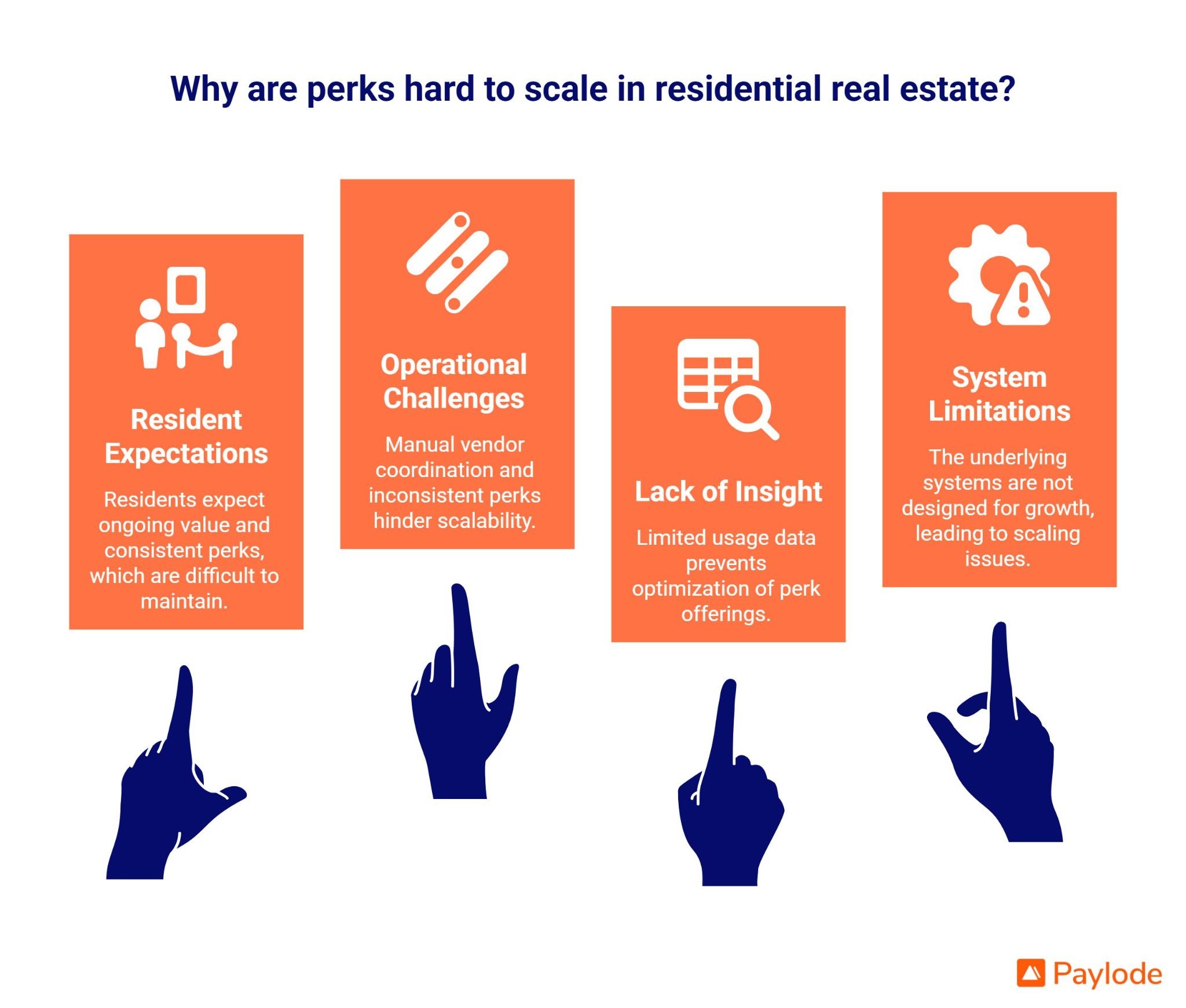
Taken together, these challenges explain why perks are hard to scale. Perks pain points in residential real estate are not caused by a lack of interest. They are caused by fragmented systems, manual work, unclear costs, limited data, and overloaded teams.
Why traditional perk programs fail to scale
Traditional perk programs were built for smaller operations. They often work in a single building, but they break down as portfolios grow. This gap explains many perks pain points in residential real estate today.
Spreadsheet-based tracking
Many perk programs still rely on spreadsheets to track vendors, offers, and timelines. This approach quickly becomes hard to manage.
Spreadsheets:
- Are manual and time-consuming to update
- Do not scale well across properties
- Offer little visibility into what residents actually use
As portfolios expand, tracking perks this way leads to errors, delays, and missed opportunities.
Printed flyers and email-only promotions
Older programs often depend on printed flyers or email blasts to promote perks. These methods have limited reach and fade quickly.
Common issues include:
- Flyers that go unnoticed or become outdated
- Emails that are ignored or lost
- No easy way to refresh or personalize offers
These channels make it hard to keep perks visible and relevant over time.
One-off gift cards or events
Gift cards and special events are popular because they are easy to launch. However, they rarely create lasting value.
These approaches:
- Provide short-term impact only
- Do not support ongoing engagement
- Are difficult to repeat across locations
What works once does not scale across multiple communities or leases.
Lack of automation and personalization
Traditional perk programs depend heavily on manual effort. There is little automation and almost no personalization.
Without automation:
- Staff spend time managing small tasks
- Offers remain generic
- Programs feel disconnected from resident needs
This manual approach adds work without improving results, a core driver of perks pain points in residential real estate.
Traditional perk programs were not designed for modern residential portfolios. They may work for one building, but they do not scale across multiple properties.
As expectations rise and portfolios grow, these older methods struggle to keep up. The result is inconsistent delivery, higher effort, and limited long-term impact.
The hidden costs of unscalable perks programs
Unscalable perks programs often look manageable on the surface. Over time, they create hidden costs that impact both operations and brand perception. These perks pain points in residential real estate tend to show up gradually, which makes them harder to address early.
Wasted staff time
When perks are managed manually, staff spend time on tasks that do not scale. This includes tracking offers, coordinating vendors, and responding to resident questions.
That time is taken away from core responsibilities like leasing, renewals, and resident service. As portfolios grow, the workload increases, but the value delivered does not keep pace.
Inconsistent resident experience
Unscalable programs often lead to uneven execution. One property may offer strong perks, while another offers very little.
Residents notice these differences. Inconsistency creates confusion and weakens trust, especially for brands that manage multiple communities. Over time, this becomes a visible part of the resident experience.
Missed retention opportunities
Perks are meant to support engagement and retention. When programs are hard to manage, they are not used consistently or promoted effectively.
As a result:
- Residents may not know perks exist
- Benefits feel disconnected from daily living
- Renewal conversations lack meaningful value points
These gaps reduce the impact that perks could have on long-term retention.
Poor perception of brand value
When perks are inconsistent or outdated, they can hurt brand perception. Residents may see the program as an afterthought rather than a benefit.
This weakens how the brand is viewed across properties. Instead of reinforcing value, unscalable perks programs can create doubt about the overall experience.
The leadership takeaway
From a leadership perspective, the issue is not whether perks work. The real issue is how they are delivered.
Perks pain points in residential real estate exist because many programs are not built to scale. They rely on manual effort, vary by location, and lack structure. Perks fail not due to lack of intent, but because the systems behind them cannot support growth.
What scalable perks actually require
Solving perks pain points in residential real estate does not require more effort or bigger teams. It requires systems that are built to scale from the start. The focus should be on structure, consistency, and ease of use.
Centralized management across properties
Scalable perks must be managed from one place. Property teams need a single view across all communities, not separate programs for each location.
Centralized control helps ensure consistency, reduces manual work, and makes it easier to maintain the same standard of value across portfolios. This is why many operators look toward solutions like centralized perk hubs, such as Paylode’s perk centers, to simplify oversight.
Pre-negotiated national and local offers
Scalable perks rely on offers that are already in place. Pre-negotiated national and local benefits remove the need for constant vendor outreach.
This approach:
- Saves staff time
- Reduces market-by-market differences
- Keeps perks active and relevant
It also helps ensure residents across locations receive comparable value.
Automated onboarding and access
Residents should not need instructions to use perks. Access must be automatic and easy from day one.
Automation allows residents to discover and use perks without staff involvement. This removes friction and improves participation across the portfolio.
Built-in tracking and reporting
Scalable perks require visibility. Property teams need to know which perks are being used and where engagement is happening.
Built-in tracking helps teams move away from assumptions and make informed decisions. It also makes it easier to show impact over time.
Minimal effort for on-site teams
On-site teams already manage many priorities. Scalable perks should not add to their workload.
When perks require little day-to-day effort, they are more likely to be delivered consistently. This is a key reason operators turn to structured resident engagement models, like those outlined in Paylode’s approach to resident perks
How modern platforms remove perks pain points
Addressing perks pain points in residential real estate requires a shift from manual programs to systems designed for scale. Modern platforms focus on simplicity, consistency, and visibility—without adding work for property teams.
Plug-and-play perk ecosystems
Modern platforms offer plug-and-play perk ecosystems that are ready to use. Property teams do not need to build programs from scratch or manage complex setups.
By using a centralized platform like the Paylode platform, communities can activate perks quickly and manage them from one place. This removes the friction that often slows adoption.
Consistent experience for every resident
A key advantage of modern platforms is consistency. Every resident, across every property, has access to the same level of value.
This consistency:
- Strengthens trust in the brand
- Reduces confusion across communities
- Supports a more predictable resident experience
It ensures perks feel like part of living at the property, not an afterthought.
No vendor chasing or manual updates
Modern platforms remove the need for constant vendor coordination. Offers are maintained and updated within the system.
With solutions like Paylode Perks, property teams no longer need to chase vendors or refresh deals manually. This saves time and reduces errors.
Clear reporting and engagement insights
Visibility is critical to long-term success. Modern platforms provide clear insight into what residents actually use.
Built-in tools, such as Paylode’s Boost, help teams understand engagement and adjust programs based on real data. This replaces guesswork with informed decisions.
Together, these capabilities show how modern platforms remove perks pain points in residential real estate. The focus shifts from managing perks to delivering value—consistently and at scale.
What property managers should look for before investing in perks
Before investing in perks, property managers and owners should step back and assess whether a program will truly work at scale. Many perks pain points in residential real estate come from choosing solutions that sound appealing but fail in daily operations.
Use the checklist below to guide decision-making:
Can it scale across all properties?
A perks program should work just as well for one building as it does for a full portfolio. If it requires different setups or rules for each property, it will be hard to maintain over time.
Is it easy for residents to access?
Perks only matter if residents can find and use them. Access should be simple, digital, and available without extra steps. If residents need reminders or instructions, engagement will drop.
Does it reduce workload for staff?
Property teams already manage leasing, renewals, and service requests. A perks program should remove work, not add to it. If staff must track offers or answer frequent questions, the system will not last.
Can leadership track usage and value?
Decision-makers need visibility. Without clear insight into usage and impact, perks are hard to justify during budget reviews. Tracking should be built in, not manual.
Does it integrate with existing processes?
The best perks fit into how teams already work. If a program requires new workflows or separate tools, it increases friction and risk.
When perks meet these criteria, they move from being a nice idea to a reliable part of the resident experience. This is how property teams avoid common perks pain points in residential real estate and invest with confidence.
Conclusion: Turning perks from a burden into a growth tool
Perks are no longer optional in residential real estate. Residents expect added value as part of everyday living, not as occasional extras. Communities that ignore this shift risk falling behind in competitive markets.
The real issue is not interest. Most property managers want to offer perks. The challenge is scale. Without the right systems, perks become hard to manage, uneven across properties, and difficult to justify over time. This is where perks pain points in residential real estate begin to surface.
Modern, centralized platforms change that dynamic. They remove manual work, bring consistency across portfolios, and provide clear insight into what residents actually use. When perks are easy to manage, they stop being a burden and start supporting retention, satisfaction, and long-term value.
Instead of cutting perks during budget reviews, property teams can treat them as a growth tool—one that strengthens the resident experience while keeping operations under control.
If you are ready to simplify how perks work across your communities, explore Paylode’s flexible plans or take the next step and book a demo to see how scalable perks can support your portfolio.
Making perks easier is often the first step toward making them work.
FAQs
Why do most perk programs fail in residential real estate?
Most perk programs fail because they are not built to scale. They rely on manual work, local coordination, and inconsistent execution, which leads to common perks pain points in residential real estate as portfolios grow.
Are perks worth the investment for property owners?
Yes, when they are delivered through scalable systems. Well-managed perks support satisfaction and renewals, making them more effective than short-term discounts and easier to justify over time.
How do scalable perks impact resident retention?
Scalable perks provide consistent value throughout the lease. When residents regularly use benefits they find useful, they are more likely to renew and stay longer.
What is the biggest operational challenge with perks today?
The biggest challenge is scaling management. Without centralized systems, perks add work for staff, lack visibility, and become difficult to sustain across multiple properties.