In the telecom industry, retention is often treated as a success metric. Lower churn rates signal stability. Renewal numbers look strong. Quarterly reports appear healthy.
But there is a deeper question growth and finance leaders must ask:
At what cost are we retaining customers?
Discount-driven retention in telecom has quietly become the default strategy across wireless carriers, ISPs, and MVNO providers. When a customer threatens to leave, the fastest solution is a recurring discount. A $10 credit. A 15% loyalty adjustment. A six-month promotional extension.
The churn problem seems solved.
The margin problem begins.
According to the Federal Communications Commission (FCC), competition in the U.S. wireless and broadband markets has intensified over the past decade, with increased price-based competition among providers (Source: FCC Communications Marketplace Reports). As pricing pressure rises, discounting becomes an easy response.
However, revenue growth without margin protection is not sustainable.
When telecom operators rely heavily on discounts to retain subscribers:
- ARPU begins to decline.
- Customers learn to expect price reductions.
- Retention becomes a negotiation instead of a relationship.
- Long-term profitability weakens.
This blog will examine the true financial impact of discount-driven retention in telecom, including:
- How ARPU erosion compounds over time
- Why discount dependency creates structural risk
- How discounts attract price-sensitive churners
- The long-term margin consequences for telecom, ISP, and MVNO operators
Retention should protect enterprise value.
If it consistently reduces realized revenue, it deserves closer scrutiny.
Why discount-driven retention became the default strategy in telecom
Discount-driven retention in telecom did not become common by accident. It evolved as a fast, measurable response to rising competition and aggressive pricing strategies.
In the U.S. wireless and broadband markets, price comparison is simple. Customers can review plans, switch providers, and port numbers with minimal friction. That environment creates pressure on growth and support teams to “save” accounts quickly.
Discounts became the easiest lever to pull.
Immediate churn relief is tempting
When a customer signals cancellation, offering a monthly credit often produces instant results. The customer stays. The churn metric improves. The save rate increases.
From an operational perspective, this approach appears efficient:
- No product changes required
- No system redesign needed
- No experience improvement necessary
- Immediate reporting impact
But what is operationally simple is not always financially sustainable.
Competitive intensity reinforces discount behavior
Telecom operators, ISPs, and MVNO providers compete in a price-sensitive landscape. Promotional pricing is common. Introductory offers are aggressive.
According to industry data from Statista, average monthly wireless revenue per user in the United States has gradually declined over the past decade despite steady subscriber growth (Source: Statista, U.S. wireless ARPU trends). While multiple factors contribute to this trend, promotional pressure and recurring discounts play a role.
When one provider lowers prices, others respond.
Over time, discounting shifts from a tactical retention tool to a structural habit.
The “save desk” cycle
In many telecom organizations, frontline support teams are empowered to offer credits to prevent cancellations. While this protects short-term churn metrics, it creates an unintended pattern:
- Customers threaten to leave.
- Discounts are offered.
- Customers learn that price negotiations work.
- Future renewal conversations begin with price pressure.
This cycle reinforces discount-driven retention in telecom as the norm rather than the exception.
Short-term KPIs vs long-term value
Quarterly churn targets are visible. Margin erosion is slower and less obvious.
This misalignment creates a dangerous incentive structure:
- Retention teams optimize for immediate saves.
- Finance teams manage shrinking margins.
- Growth teams rely on new acquisitions to offset revenue leakage.
The result is a retention strategy that improves surface-level performance but quietly compresses long-term enterprise value.
Discounts feel like control.
In reality, they may be a signal that deeper value drivers are being overlooked.
ARPU erosion: The first financial warning sign
If you want to understand the real cost of discount-driven retention in telecom, start with one metric:
ARPU — average revenue per user.
ARPU measures how much revenue each active subscriber generates over a given period, typically monthly. For telecom, ISP, and MVNO operators, ARPU is a core financial indicator because it reflects pricing power, product mix, and customer value.
When ARPU declines while subscriber count remains stable, something important is happening.
Why ARPU matters to growth and finance leaders
ARPU directly affects:
- Revenue predictability
- Margin structure
- Investment capacity
- Valuation multiples
According to CTIA’s annual wireless industry survey, U.S. wireless ARPU has experienced gradual pressure over time due to competition and pricing dynamics (Source: CTIA Annual Wireless Industry Survey). While data usage has increased, pricing compression offsets part of that growth.
Recurring retention discounts accelerate that compression.
How discount-driven retention erodes ARPU
At first glance, a $10 monthly credit seems manageable. But when applied across thousands of subscribers, the effect compounds quickly.
Below is an illustrative example:
Illustrative numbers.
The difference between $70 and $59.50 may appear small. Across 50,000 subscribers receiving a $10.50 monthly discount, the annual revenue impact equals:
$10.50 × 12 months × 50,000 users = $6.3 million annually (Illustrative number).
That is not a rounding error. That is a structural revenue shift.
The compounding effect over time
The challenge with discount-driven retention in telecom is duration.
Many retention credits are:
- Recurring rather than one-time
- Extended beyond original terms
- Reapplied at renewal
When discounts persist for multiple years, ARPU erosion compounds.
If a subscriber remains discounted for three years, the cumulative revenue impact triples. Meanwhile, operational costs, network investments, and customer support expenses do not decline proportionally.
ARPU decline masks itself in subscriber growth
Growth teams may point to rising subscriber counts as proof of success. But if net revenue per user is declining, total growth may rely heavily on adding new customers to offset discounted revenue from retained ones.
This creates a treadmill effect:
- More acquisitions required
- Higher marketing spend
- Increased cost to sustain flat revenue
ARPU erosion is often the first measurable financial signal that discount-driven retention in telecom is weakening long-term profitability.
The next question is more concerning:
What happens when customers begin to expect discounts as part of the renewal process?
Discount dependency: When retention becomes structurally risky
Once discount-driven retention in telecom becomes routine, it changes customer behavior.
What begins as a reactive save tactic slowly turns into an expectation. Customers learn that pricing is flexible. They learn that threatening to leave triggers an offer.
Over time, discounts stop being an exception. They become part of the renewal script.
How discount dependency forms
Discount dependency develops in three stages:
- Reactive discounts
A customer calls to cancel. A credit is offered. The account is saved. - Pattern recognition
Customers realize that expressing dissatisfaction leads to price reductions. - Negotiation culture
Renewal conversations begin with price pressure rather than service value.
This pattern shifts retention away from value and toward price bargaining.
Warning signs leadership should monitor
Growth and finance leaders should watch for these indicators:
- A high percentage of retained customers receiving recurring credits
- Increasing average discount size year over year
- Rising retention budget despite stable churn rates
- Support teams defaulting to discounts without exploring other options
If 60–70% of retained customers receive price reductions (Illustrative range), the organization may already be dependent on discounts to maintain churn metrics.
The financial impact of dependency
Discount dependency increases structural risk because:
- Revenue becomes unpredictable
- Margin forecasting becomes less accurate
- Renewal periods become volatile
- Customer lifetime value declines
In highly competitive segments like broadband and wireless, especially within the Telecom and MVNO industry, price competition is common. However, sustained reliance on discounts compresses margins over time. Leaders in the Telecom & MVNO industry must balance churn control with long-term revenue protection.
When discount-driven retention in telecom dominates renewal strategy, pricing power weakens.
And when pricing power weakens, enterprise value follows.
Why dependency is hard to reverse
Once customers expect recurring credits, removing them can trigger backlash:
- Increased churn at renewal
- Higher call volumes
- Social media complaints
- Negative brand perception
This makes leadership hesitant to reduce discounting, even when financial data signals the need for change.
Discount dependency creates a retention trap:
You must keep discounting to avoid short-term churn spikes, even if it harms long-term margin stability.
The deeper issue is not just revenue erosion.
It is customer quality.
Why discounts attract price-sensitive churners
Not all retained customers create equal long-term value.
One of the most overlooked consequences of discount-driven retention in telecom is customer mix distortion. When discounts become the primary retention lever, they disproportionately retain customers who prioritize price above all else.
That creates risk.
Price-sensitive customers behave differently
Price-sensitive subscribers typically:
- Compare plans frequently
- Monitor competitor promotions
- Switch providers when lower prices appear
- Engage only when financial incentives are present
In highly competitive markets like wireless and broadband, switching costs are relatively low. Number portability and online onboarding reduce friction.
When retention relies on discounts, you are signaling to customers that price is negotiable.
That message spreads quickly.
Discounts train churn behavior
Over time, customers learn a pattern:
- Promotional rate expires.
- Monthly bill increases.
- Customer threatens to cancel.
- Retention credit is offered.
This cycle does not build loyalty. It builds strategy.
Customers who respond to recurring discounts are statistically more likely to repeat the same behavior at the next renewal cycle (Observed pattern across subscription industries; industry trend commentary, illustrative insight).
In other words, discount-driven retention in telecom can delay churn without preventing it.
The lifetime value problem
Customer lifetime value depends on:
- Tenure
- Plan stability
- Upsell adoption
- Cross-sell participation
- Referral behavior
Price-driven customers tend to:
- Stay shorter periods
- Upgrade less frequently
- Resist add-ons
- Refer less often
While they may accept a discount today, they remain highly sensitive to future price changes.
This creates a retention illusion:
Churn decreases temporarily, but long-term value does not increase proportionally.
Illustrative financial example
Assume two retained customers:
- Customer A receives a $15 recurring monthly discount.
- Customer B receives no discount but stays due to perceived service value.
If Customer A churns within 18 months while Customer B remains for 36 months, the discounted customer may generate significantly lower lifetime revenue despite being “saved.”
Retention should extend value, not just postpone exit.
The quality vs quantity dilemma
Telecom, ISP, and MVNO operators often measure retention success by:
- Save rate
- Churn reduction percentage
- Number of retained accounts
But fewer leaders measure:
- Margin-adjusted retention
- Discount-adjusted lifetime value
- Behavioral engagement after renewal
When discount-driven retention in telecom dominates strategy, the organization may retain volume while weakening revenue quality.
The real risk is not just losing customers.
It is retaining the wrong ones.
The long-term margin impact on telecom operators
Revenue tells part of the story.
Margin tells the truth.
Discount-driven retention in telecom does not only reduce ARPU. It compresses operating margin in ways that are often underestimated during quarterly reporting cycles.
Revenue retained is not the same as profit protected
When a customer is “saved” with a recurring discount, gross revenue remains on the books. But the realized revenue per account declines.
At the same time:
- Network operating costs remain stable.
- Customer service costs do not decrease.
- Infrastructure investments continue.
- Spectrum and compliance expenses remain fixed.
In other words, the cost base does not shrink proportionally when revenue per user declines.
Illustrative financial model
Assume:
- 100,000 active subscribers
- 40% receive a $15 monthly retention discount
- Discount duration: 12 months
Revenue impact:
$15 × 12 months × 40,000 users = $7.2 million annually
Illustrative number.
Now consider this in margin terms.
If operating margin is 30%, a $7.2 million revenue reduction may translate into more than $2 million in lost operating profit (Illustrative estimate based on margin ratio).
That capital could otherwise support:
- Network upgrades
- Customer experience improvements
- Marketing efficiency programs
- Debt reduction
Discounts protect churn metrics, but they restrict strategic flexibility.
EBITDA and valuation implications
Telecom valuations often rely on EBITDA (Earnings Before Interest, Taxes, Depreciation, and Amortization) performance. When recurring discounts suppress realized revenue, EBITDA growth slows even if subscriber counts increase.
Investors and boards look for:
- ARPU stability
- Margin expansion
- Predictable cash flow
If discount-driven retention in telecom becomes systemic, it may create long-term pressure on:
- Earnings forecasts
- Capital allocation
- Enterprise value multiples
This is especially critical in segments with thinner margins, such as regional broadband providers and competitive ISPs. Leaders in the ISP industry face pricing pressure while managing high infrastructure costs. Margin leakage from recurring discounts can significantly affect sustainability.
The acquisition treadmill effect
When ARPU declines and margins compress, growth teams often compensate by accelerating customer acquisition.
That creates a cycle:
- Higher marketing spend
- Greater acquisition cost per user
- More promotional pricing
- Continued margin pressure
Instead of strengthening financial performance, discount-driven retention in telecom can increase dependency on volume growth to offset revenue dilution.
The organization works harder to maintain the same level of profitability.
The silent compounding problem
The most dangerous aspect of discounting is that it compounds quietly.
A single $10 credit feels minor.
Across thousands of subscribers over multiple years, it becomes structural revenue compression.
By the time leadership recognizes the full financial impact, discount dependency may already be embedded in renewal processes.
Retention should preserve revenue integrity.
When it systematically reduces realized revenue, it demands strategic reevaluation.
Price retention vs value retention: A smarter framework for telecom leaders
Not all retention strategies are equal.
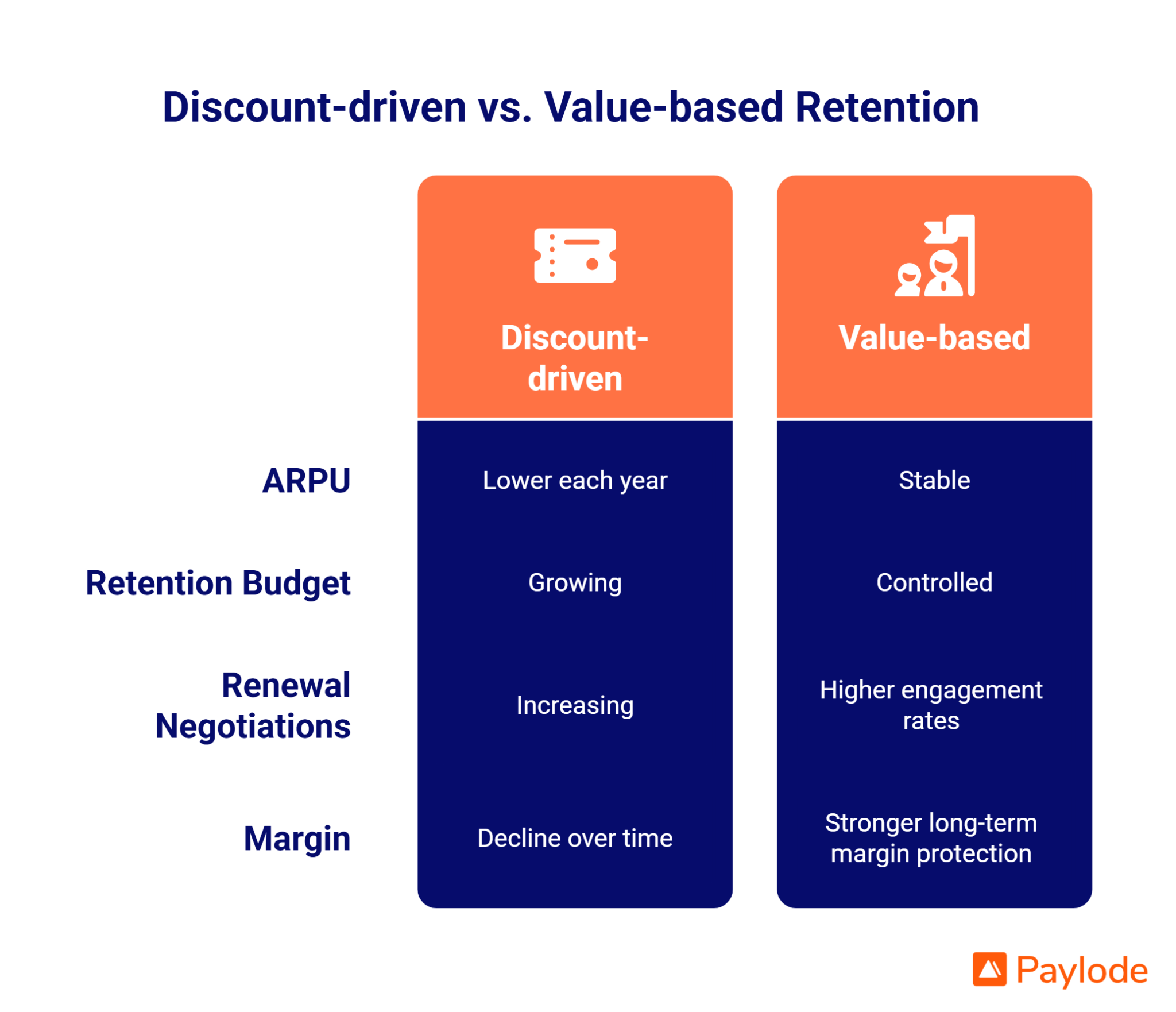
Price retention reduces what customers pay.
Value retention increases what customers perceive.
Discount-driven retention in telecom focuses on lowering the bill. Value-driven retention focuses on strengthening the relationship.
The financial outcomes are very different.
Comparing price-based and value-based retention
Conceptual comparison.
Price-based retention asks, “How much do we need to reduce the bill to keep this customer?”
Value-based retention asks, “What can we offer that increases perceived benefit without permanently lowering price?”
That distinction matters.
What value retention looks like in practice
Instead of recurring discounts, telecom, ISP, and MVNO operators can focus on:
- Behavioral incentives (e.g., autopay enrollment, paperless billing)
- Tenure-based rewards
- Partner-funded perks
- Experience enhancements
- Milestone recognition
For example, incentivizing customers to enroll in autopay can improve payment reliability and reduce administrative costs. Programs tied to behaviors like this align retention with financial efficiency. You can explore structured engagement models through use cases like automatic payments.
This approach shifts retention from reactive discounting to proactive engagement.
Protecting ARPU while improving engagement
The goal is not to eliminate incentives.
The goal is to control how incentives affect realized revenue.
Recurring discounts permanently lower ARPU.
Structured, non-cash-value rewards preserve base pricing while enhancing perceived value.
This distinction allows growth and finance teams to collaborate instead of operating in tension.
Moving beyond discount-driven retention in telecom
Retention strategy should answer three leadership questions:
- Does this approach protect ARPU?
- Does it strengthen long-term margin?
- Does it improve customer quality over time?
If the answer to these questions is no, the strategy may be optimizing the wrong metric.
Discounts feel effective because they are immediate.
Value-driven retention works because it is sustainable.
xecutive retention audit: How to evaluate your current strategy
If discount-driven retention in telecom has become standard practice, the most important step is not immediate removal.
It is structured evaluation.
Growth, finance, and operations leaders should assess whether retention strategy is strengthening enterprise value or gradually reducing it.
Below is a practical audit framework.
1. Discount exposure analysis
Start with visibility.
Ask:
- What percentage of retained customers receive recurring discounts?
- What is the average monthly discount amount?
- What is the average duration of those discounts?
- How many discounts extend beyond original promotional terms?
If more than half of retained customers receive ongoing credits (Illustrative threshold), retention may already be structurally dependent on price reductions.
2. ARPU stability review
Analyze:
- ARPU trends over the past 12–24 months
- ARPU for discounted vs non-discounted cohorts
- Revenue per retained user compared to new acquisitions
If churn is improving while ARPU is declining, discount-driven retention in telecom may be masking underlying revenue leakage.
Retention success should not come at the cost of revenue quality.
3. Margin-adjusted retention metric
Instead of measuring only save rate, calculate:
Margin-adjusted retention value (Illustrative framework):
Net retained revenue
– Discount cost
= Realized retained revenue
Compare that figure to the cost of acquiring a new customer.
In some cases, excessive discounting may approach or exceed acquisition cost, especially when marketing spend is optimized.
4. Behavioral engagement indicators
Review whether retained customers:
- Enroll in autopay
- Switch to paperless billing
- Upgrade plans
- Adopt add-on services
If discounted customers show low engagement in these areas, long-term lifetime value may be limited.
Retention without engagement often leads to future churn cycles.
5. Renewal conversation analysis
Evaluate support data:
- How often does renewal start with price objections?
- What percentage of saves occur only after discount offers?
- Are retention scripts focused primarily on pricing?
If renewal conversations consistently begin with pricing pressure, discount dependency may already be influencing customer expectations.
Strategic shift: From reactive discounts to structured value
A financially sustainable retention model in telecom, ISP, and MVNO segments should aim to:
- Protect base pricing
- Tie incentives to positive behaviors
- Improve payment reliability
- Increase engagement
- Strengthen customer lifetime value
For example, programs that encourage behaviors such as switching to digital billing can improve operational efficiency while reinforcing engagement. Structured engagement strategies like switching to paperless billing can align retention with cost reduction instead of margin erosion.
Similarly, retention strategies should ultimately focus on increasing overall customer value rather than simply reducing churn metrics. Approaches designed to raise customer lifetime value shift the conversation from price relief to long-term revenue growth.
The objective is not to eliminate incentives.
It is to design incentives that strengthen financial performance.
Retention is a strategic function.
When discount-driven retention in telecom dominates renewal practices, leadership must ask whether short-term churn improvement is worth long-term margin compression.
Conclusion: Retention should protect value, not dilute it
Discount-driven retention in telecom appears effective on the surface. Churn declines. Save rates improve. Quarterly metrics look stable.
But the financial story is deeper.
Recurring discounts reduce ARPU.
They attract price-sensitive churners.
They create renewal negotiation cycles.
They compress margin over time.
When scaled across thousands of subscribers, even small monthly credits translate into millions in lost annual revenue (Illustrative impact based on earlier examples). For telecom, ISP, and MVNO operators operating in competitive markets, that erosion directly affects profitability, investment capacity, and long-term enterprise value.
Retention should not rely on permanent price reductions.
It should focus on strengthening engagement, improving payment behavior, and increasing customer lifetime value without weakening base pricing.
The strategic shift is clear:
- Move from reactive discounts to structured incentives.
- Align retention with financial outcomes.
- Protect ARPU while improving customer experience.
For telecom leaders looking to modernize retention without sacrificing margin, exploring structured engagement models through the Paylode platform can provide a more sustainable alternative. Learn how the Paylode platform supports retention strategies designed to protect revenue integrity.
You can also explore how curated reward ecosystems through Paylode Perks create perceived value without lowering core pricing.
For operators focused on targeted engagement campaigns, tools like Paylode Boost can help drive customer actions tied to measurable outcomes.
To understand pricing options and implementation models, review available plans, or schedule a strategy discussion by booking a demo.
Retention should strengthen your financial foundation.
If it steadily reduces realized revenue, it deserves redesign.
Frequently asked questions (FAQs)
1. What is discount-driven retention in telecom?
Discount-driven retention in telecom refers to the practice of offering recurring price reductions or bill credits to prevent customers from canceling service. While it may reduce short-term churn, it can erode ARPU and compress margins over time.
2. How do discounts impact ARPU?
Recurring discounts directly reduce average revenue per user (ARPU). Even small monthly credits, when applied across large subscriber bases, can result in significant annual revenue loss (Illustrative financial impact shown earlier).
3. Why do discounts attract price-sensitive churners?
Discounts signal that pricing is negotiable. Price-sensitive customers are more likely to threaten cancellation to receive better offers and may switch providers when a lower price appears elsewhere.
4. Is discount-driven retention sustainable for MVNOs and ISPs?
For MVNOs and ISPs operating with tighter margins, sustained discounting can create financial strain. Protecting base pricing while improving engagement often produces more stable long-term results.
5. How can telecom operators reduce churn without lowering prices?
Operators can focus on:
- Behavioral incentives
- Autopay and digital billing enrollment
- Tenure recognition
- Structured reward programs
- Customer engagement campaigns
These approaches aim to improve loyalty without permanently reducing revenue per user.
6. What metric should leadership monitor beyond churn?
In addition to churn rate, leaders should monitor:
- ARPU trends
- Margin-adjusted retention value
- Lifetime value growth
- Discount exposure percentage
Retention success should be measured by financial strength, not just subscriber volume.