Telecom churn reduction has become harder than ever. Competition is intense, switching is simple, and customers expect smooth digital experiences. Yet many providers still rely on last-minute discounts to stop cancellations.
The problem? Discounts protect the savings, but they damage long-term value. When customers learn that threatening to leave leads to a bill credit, retention becomes a negotiation instead of a relationship.
For Telecom, ISP, and MVNO providers, this creates three risks:
- Lower average revenue per user
- Customers are trained to demand offers
- Short-term retention with long-term instability
Today’s smarter telecom churn reduction strategies focus on experience, timing, and behavior — not price cuts. Instead of asking, “How much should we discount?” the better question is, “How do we make staying easier than leaving?”
One of the biggest opportunities lies in a predictable moment: when customers move.
Why telecom customers churn during moves — and how to stop it
Customer moves are one of the most predictable churn triggers in telecom churn reduction. When people change homes, they naturally review their service providers. If the transfer process feels difficult, switching becomes the easier option.
For Telecom, ISP, and MVNO providers, relocation is not just an address update. It is a critical retention moment.
Moves are a natural cancellation trigger
When customers move, several things happen at once:
- They compare providers in the new location
- Competitors target them with introductory offers
- They question contract terms and pricing
- They look for the fastest setup option
If your brand is not visible or easy to transfer, churn increases — even among satisfied customers.
Research across the telecom industry consistently shows that relocation-based churn is often operational, not emotional. Customers are not angry. They are simply choosing convenience.
Friction during service transfer increases churn
Service transfer friction is one of the biggest silent drivers of churn.
Common issues include:
- Long hold times to reschedule installation
- Confusing online forms
- Unclear eligibility at the new address
- Delays in service activation
If staying requires multiple steps, customers may cancel instead.
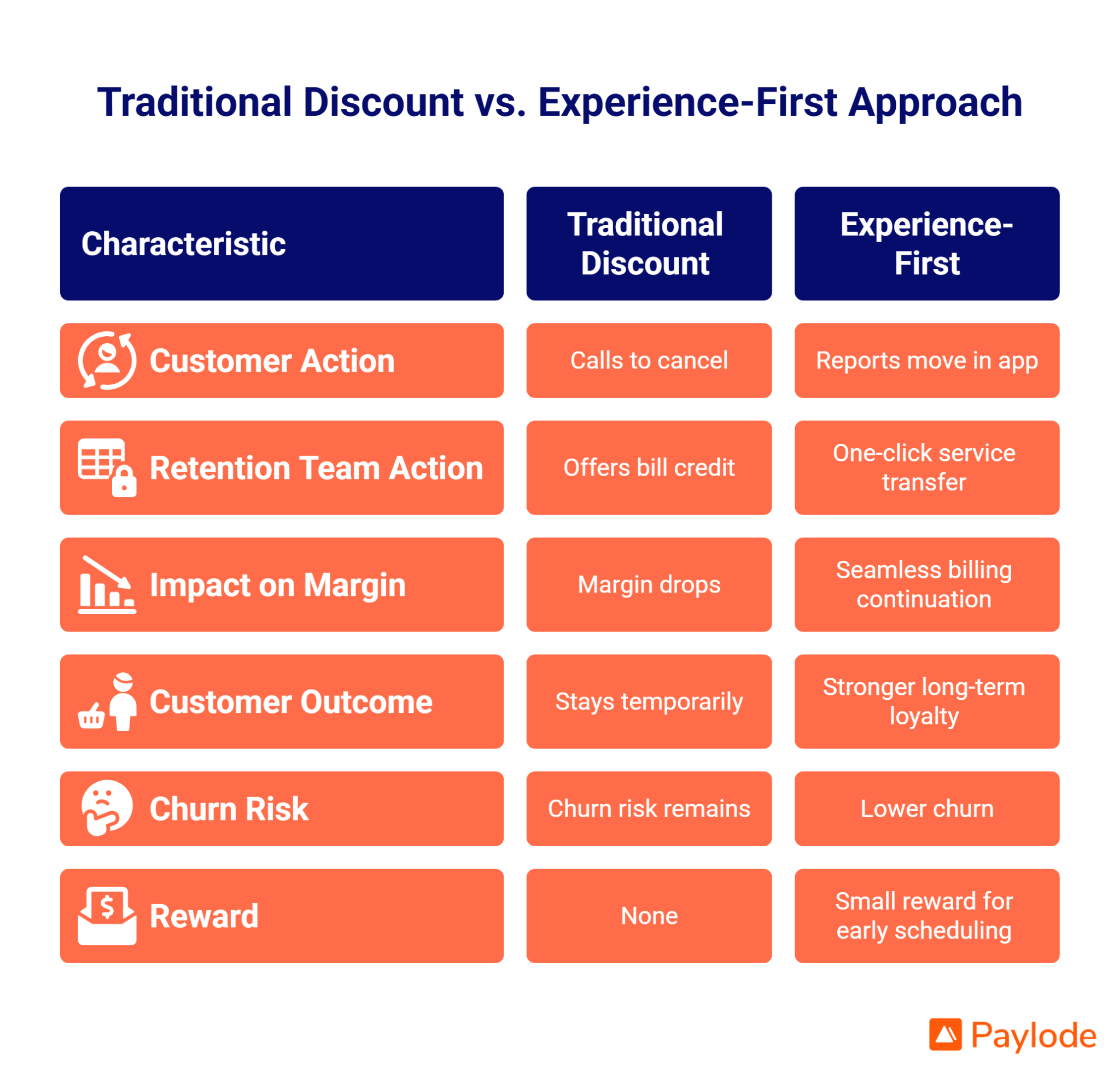
A simple comparison shows the difference:
In telecom churn reduction, convenience often matters more than price.
Why customers don’t proactively reschedule
Many customers do not notify their provider early. They assume cancellation is easier than transfer. Some believe they will face delays, fees, or downtime.
Without a positive reason to stay, the default action becomes “cancel and shop around.”
This is where proactive retention design changes the outcome.
Making “staying” the easiest option
The goal is simple: remove friction and add value — without lowering price.
Telecom providers can:
- Offer one-click move scheduling inside the app
- Send proactive reminders when address changes are detected
- Provide instant digital confirmation
- Keep billing uninterrupted
- Reward confirmed transfer actions
Instead of offering a discount at the cancellation stage, reward the behavior that prevents churn in the first place.
This approach supports long-term telecom churn reduction because it protects revenue while improving customer experience.
The hidden cost of discount-based retention
Discounts feel like a quick win. A customer calls to cancel, the retention team applies a credit, and the save rate improves.
But in telecom churn reduction, discounts often create long-term problems.
Discounts reduce revenue without fixing the root cause
When customers receive a discount to stay:
- Revenue per user decreases
- The core service experience remains unchanged
- The next churn trigger is still waiting
If the move process was difficult, a $20 credit does not make it easier next time. It only delays the decision.
Discounts train customer behavior
Over time, customers learn that threatening to cancel leads to rewards. This creates a cycle:
- Customer shops at competitors
- Calls to cancel
- Receives discount
- Repeats next year
This pattern weakens pricing power and increases pressure on margins across Telecom, ISP, and MVNO providers.
Short-term saves vs long-term value
Here’s how discount-based retention compares with experience-based telecom churn reduction:
The most effective telecom churn reduction strategies reward behaviors that increase stability. For example, encouraging customers to enroll in automatic payments strengthens retention while protecting revenue. You can see how this works in practice through Paylode’s automatic payments retention strategy.
Instead of lowering prices, reward actions that reduce churn risk before cancellation happens.
In modern telecom churn reduction, the goal is not to win a negotiation. It is to design an experience where customers never feel the need to leave.
Behavior-based rewards: A smarter telecom retention strategy
The strongest telecom churn reduction strategies do not wait for a cancellation call. They reward behaviors that make customers more likely to stay.
Instead of discounting the bill, leading Telecom, ISP, and MVNO providers encourage actions that improve engagement and stability.
What are behavior-based rewards?
Behavior-based rewards give customers value when they complete actions that reduce churn risk.
Examples include:
- Scheduling a service transfer early
- Enrolling in autopay
- Switching to paperless billing
- Referring a friend
- Upgrading equipment
These actions strengthen the relationship. They also protect revenue.
Why this approach works
Customers respond positively to recognition. A small reward feels different from a discount.
A discount says, “We need to lower the price.”
A reward says, “We value your loyalty.”
For example, encouraging customers to switch to digital billing reduces operational cost and improves engagement. This supports retention while protecting margins. You can see how this works through a structured switch to a paperless engagement strategy.
Similarly, rewarding long-term engagement helps increase customer lifetime value without reducing price. Here’s how a customer LTV growth strategy supports telecom churn reduction.
From reactive saves to proactive retention
Traditional model:
Customer calls → retention team offers discount → margin drops.
Modern model:
Customer completes valuable action → receives reward → loyalty strengthens → churn risk decreases.
Behavior-based rewards create habit. Habits reduce churn.
For Telecom, ISP, and MVNO leaders, this shift protects ARPU while improving customer experience.
Turning customer moves into retention opportunities
The most effective telecom churn reduction strategies are simple. Remove friction. Reward the right behavior. Protect revenue.
A simple framework for telecom churn reduction
Telecom, ISP, and MVNO leaders can apply this structured approach:
Step 1: Identify predictable churn moments
Moves, contract renewals, billing issues, and service upgrades are key risk points.
Step 2: Remove friction
- Simplify digital scheduling
- Offer instant confirmations
- Reduce call center dependency
Step 3: Reward retention-driving behaviors
- Early move scheduling
- Autopay enrollment
- Paperless billing
- Referrals
This is where structured rewards programs create measurable impact. Providers in the telecom and MVNO space are increasingly using engagement-driven retention models like those outlined for the telecom industry.
Step 4: Automate the experience
Rewards and confirmations should happen instantly. The less manual intervention required, the more scalable the program becomes.
Step 5: Track retention lift and revenue protection
Measure:
- Churn rate during relocation
- Discount spend reduction
- Increase in customer lifetime value
- Adoption of engagement behaviors
When done correctly, telecom churn reduction improves without cutting price.
Conclusion: Retention is a design decision, not a discount decision
Discounts create temporary saves. Experience creates loyalty.
Customer moves are predictable. Friction is preventable. Behavior can be influenced.
Telecom, ISP, and MVNO providers that shift from reactive discounts to proactive rewards protect revenue while improving customer experience.
FAQs
Why do telecom customers churn when they move?
Relocation is a natural review moment. If service transfer feels complex or uncertain, customers often switch providers for convenience.
How can telecom companies reduce churn without discounts?
By removing friction during key lifecycle moments and rewarding behaviors such as early move scheduling, autopay enrollment, and digital billing adoption.
Are discounts effective for long-term retention?
Discounts may reduce churn temporarily, but they lower revenue and can train customers to negotiate pricing repeatedly.
What behaviors reduce telecom churn risk?
Autopay, paperless billing, referrals, and proactive service transfers all increase engagement and reduce cancellation likelihood.
How can ISP and MVNO providers compete without price wars?
By improving customer experience, simplifying digital processes, and using structured rewards instead of discounts.