Loyalty and rewards programs have become increasingly common across residential real estate. As property operators search for ways to improve resident retention, payment consistency, and engagement, many have turned to familiar loyalty models borrowed from retail, airlines, and financial services. Among these, points-based reward programs are often the first option considered.
On paper, points-based programs seem logical. Residents earn points for actions like paying rent on time, renewing leases, or engaging with community activities. Over time, those points can be redeemed for rewards. However, what works well in consumer-driven industries does not always translate to housing. In practice, points-based reward programs fail in residential real estate because they are misaligned with renter behavior, timelines, and the realities of property management operations.
Rent is not discretionary spending. Residents interact with property management on a monthly cadence, not daily or weekly. They value simplicity, immediate savings, and appreciation—not abstract point balances that take months to accumulate. As a result, many points-based programs suffer from low engagement, poor redemption rates, and minimal impact on the outcomes property operators actually care about.
Across the residential real estate industry, operators are beginning to recognize that loyalty in housing works differently. Resident engagement must be immediate, practical, and effortless. Programs that rely on delayed gratification and complex redemption rules struggle to influence payment behavior, renewals, or long-term loyalty.
This article explores why points-based reward programs fail in residential real estate, the operational and psychological gaps they create, and what modern property operators are doing instead. We’ll break down where points-based models fall short—and why instant, behavior-driven, merchant-funded rewards are proving far more effective for today’s rental communities.
1. Why residential real estate adopted points-based reward programs
Points-based loyalty programs have been widely successful in consumer-facing industries for decades. Airlines, credit cards, retail brands, and hospitality companies have trained customers to associate points with value, status, and long-term benefits. As resident retention and engagement became more important in housing, it was natural for residential real estate operators to look toward these familiar models for inspiration.
The origins of points-based loyalty in consumer industries are rooted in high-frequency transactions. Customers earn points through daily or weekly spending, quickly seeing progress toward rewards. This frequent interaction keeps programs top of mind and reinforces habitual engagement. When property operators evaluated these models, many assumed the same mechanics would translate to residential communities.
This led to property operators trying to replicate points-based models in housing. Rent payments, lease renewals, and community engagement activities were mapped to point accumulation. The belief was that if residents earned points for responsible behavior, engagement would increase and retention would follow.
At the core of this approach were assumptions around “points = engagement.” Points were seen as a universal motivator—easy to track, flexible to deploy, and familiar to residents. On paper, points offered a way to gamify renting without reducing rent or introducing direct discounts.
However, early interest quickly diverged from long-term performance. While initial program launches often generated curiosity, participation dropped over time. Residents interacted with the program less frequently than expected, point balances grew slowly, and redemption rates remained low. Unlike retail or travel, residential real estate lacks the transaction frequency needed to sustain a points-based model.
As a result, many operators discovered that what works in consumer loyalty does not automatically work in housing. The structural differences between renting and retail spending began to expose the limitations of points-based reward programs in residential real estate.
2. How points-based reward programs are supposed to work
Points-based reward programs are built around a simple concept: residents earn points for specific actions, accumulate those points over time, and eventually redeem them for rewards. In theory, this structure is meant to encourage ongoing engagement and reinforce positive behavior without offering direct discounts on rent.
In a typical residential setup, residents are awarded points for actions such as paying rent on time, renewing a lease, enrolling in autopay, or participating in community activities. Each action carries a predefined point value, and residents can view their balance through a portal or app. The expectation is that, as points accumulate, residents will feel motivated to continue engaging in order to unlock rewards.
Redemption is usually tied to thresholds. Residents must reach a minimum number of points before they can exchange them for gift cards, merchandise, or experiences. This accumulation-and-redemption cycle is designed to promote long-term participation and keep residents invested in the program over the course of their lease.
From an operator’s perspective, points-based programs appear attractive because they offer flexibility. Points can be assigned to almost any behavior, rewards can be adjusted over time, and the perceived cost of points feels lower than direct financial incentives. On planning decks and vendor demos, these programs promise measurable engagement, loyalty, and retention.
However, this model assumes frequent interaction and sustained motivation. In industries like retail or travel, customers earn points multiple times per week or even daily, reinforcing the value of the program. In residential real estate, most interactions—especially rent payments—happen once a month. This fundamental difference makes the points-based model far less effective in practice.
As the next sections will show, the way points-based programs are designed to work often clashes with how residents actually live, pay rent, and make housing decisions. This gap between theory and reality is at the heart of why points-based reward programs struggle in residential real estate.
3. Why points-based reward programs fail in residential real estate
While points-based reward programs may look effective in theory, they consistently underperform once deployed in residential communities. The core reason is misalignment—between how points-based systems are designed and how renters actually behave, engage, and make decisions. Below are the primary reasons points-based reward programs fail in residential real estate.
3.1 Renters don’t perceive points as real value
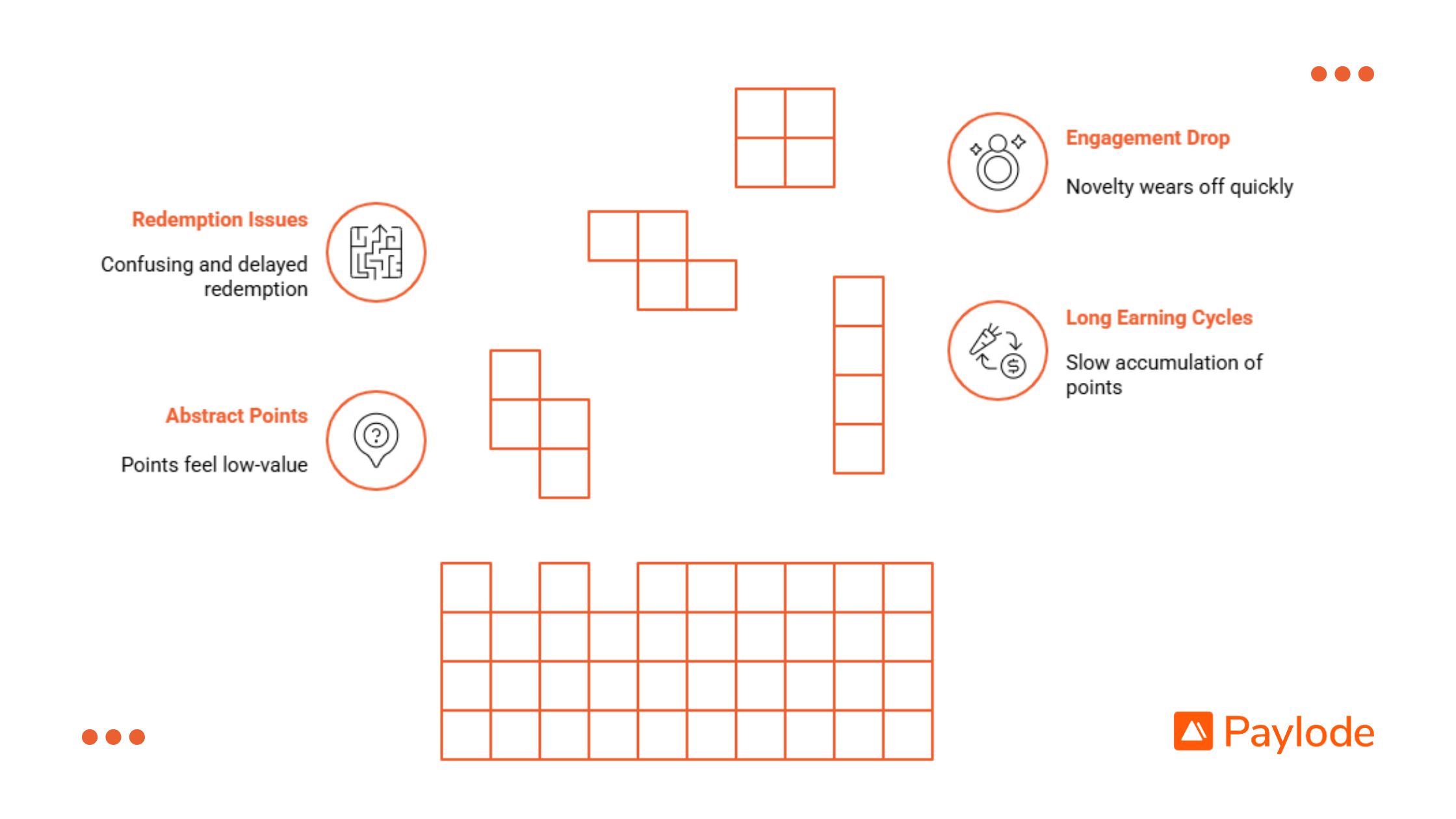
For most residents, points feel abstract. A point balance does not translate into immediate savings or tangible benefit, especially when compared to real-world expenses like groceries, dining, or utilities. When rewards are disconnected from daily life, they lose motivational power.
Unlike retail discounts or cash-equivalent perks, points require mental conversion: How many points do I need? What can I redeem them for? When will I actually benefit? This cognitive friction reduces perceived value and weakens engagement.
3.2 Long earning cycles don’t match renter behavior
Residential real estate operates on a monthly cadence. Rent is paid once per month, renewals happen once per year, and meaningful engagement moments are relatively infrequent. Points-based programs depend on frequent interactions to remain motivating—something residential living simply does not provide.
As a result:
- Points accumulate slowly
- Progress feels minimal
- Residents lose interest after the initial novelty
Without frequent reinforcement, points fail to influence ongoing behavior.
3.3 Delayed gratification weakens motivation
Points-based systems rely on delayed rewards. Residents must wait months—or longer—before earning enough points to redeem anything meaningful. This delay significantly reduces motivation, especially when the desired behavior (paying rent) is a fixed obligation rather than a discretionary action.
Immediate value is far more effective in reinforcing behavior. When rewards are delayed, the emotional connection between action and benefit disappears.
3.4 Redemption friction kills participation
Even when residents accumulate enough points, redemption often introduces new barriers. Common issues include:
- Minimum redemption thresholds that feel unreachable
- Limited or unappealing reward catalogs
- Complicated redemption steps
- Delays between redemption and fulfillment
Each additional step reduces the likelihood that residents will follow through, leading to low redemption rates and disengagement.
3.5 Points fail to influence the behaviors that matter most
The behaviors property operators care most about—on-time payments, renewals, autopay adoption—require strong motivation. Points rarely provide enough perceived value to influence these decisions, especially when compared to the financial and emotional weight of housing choices.
As a result, points-based programs often exist in the background, failing to meaningfully impact operational KPIs.
Taken together, these factors explain why points-based reward programs struggle in residential real estate. They lack immediacy, relevance, and behavioral alignment—making them ineffective at driving the outcomes property managers actually need.
4. Points-based rewards create engagement fatigue
Even when points-based reward programs launch with enthusiasm, engagement tends to decline quickly. What starts as a novel feature often becomes background noise for residents, ultimately failing to sustain attention or influence behavior. This pattern—known as engagement fatigue—is one of the clearest signals that points-based reward programs are poorly suited for residential real estate.
At the core of this fatigue is low visibility. Because residents interact with property management systems infrequently, point balances are rarely top of mind. Without regular reminders or meaningful progress, residents forget that the program exists. Over time, the effort required to check a point balance feels greater than the perceived benefit of doing so.
Another contributor to engagement fatigue is slow momentum. Points-based systems depend on the psychological satisfaction of progress. In residential settings, progress is minimal month over month. A single rent payment may earn only a small number of points, creating a sense that rewards are always far away. When residents don’t feel closer to a tangible benefit, motivation drops rapidly.
Low redemption rates further accelerate disengagement. Many residents accumulate points but never redeem them. When rewards go unused, the program fails to reinforce positive behavior, and residents stop associating points with value. In some cases, residents are unaware that redemption is even possible, highlighting how invisible these programs can become after launch.
Points-based programs also struggle to maintain relevance over time. Once the initial announcement passes, there are few natural moments to reintroduce or reinforce the program. Unlike retail environments—where promotions, sales, and purchases create frequent engagement—residential real estate lacks built-in touchpoints to keep points programs active and exciting.
As engagement fades, points-based programs stop influencing behavior altogether. Residents revert to their default habits, and the program becomes a passive feature rather than an active driver of outcomes. For property managers, this means ongoing administrative overhead without meaningful returns.
Engagement fatigue is not a minor flaw—it is a structural issue. Without immediacy, relevance, and frequent reinforcement, points-based reward programs lose their ability to motivate residents, making them ineffective tools for long-term engagement in residential real estate.
5. Points-based programs fail to influence critical property behaviors
The ultimate goal of any reward program in residential real estate is to influence behaviors that improve property performance. These include paying rent on time, renewing leases, adopting digital tools, and engaging constructively with management. Unfortunately, points-based reward programs consistently fail to move the needle on these outcomes in any meaningful way.
5.1 Weak impact on on-time rent payments
On-time rent payment is one of the most important behaviors for property operators, yet points rarely provide enough motivation to influence it. Rent is a fixed, high-priority obligation, and the consequence of missing a payment is immediate. In contrast, the reward offered through points is delayed and often perceived as insignificant.
When residents compare the effort and importance of paying rent to the distant possibility of redeeming points months later, points lose their motivational power. As a result, points-based programs have little impact on improving payment consistency.
5.2 Limited influence on lease renewals
Lease renewal decisions are driven by a combination of financial considerations, trust, convenience, and overall living experience. Points-based rewards typically play no meaningful role in this decision-making process.
A small points balance rarely outweighs factors such as rent increases, maintenance experience, or community satisfaction. Because points feel disconnected from real value, they fail to create the emotional loyalty needed to influence renewal behavior.
5.3 Poor adoption of autopay and digital tools
Property managers often use reward programs to encourage behaviors like autopay enrollment, paperless billing, or portal usage. However, points-based incentives lack urgency. Residents see no immediate benefit to changing their behavior, especially when the reward is abstract and delayed.
Without a clear “why now,” residents postpone adoption indefinitely. This results in low participation rates and missed opportunities to streamline operations.
5.4 Inability to reinforce consistent behavior over time
Points-based programs typically reward actions in isolation rather than reinforcing consistency. For example, paying rent on time for one month may earn points, but there is little reinforcement for maintaining that behavior month after month.
Without streak-based or immediate reinforcement, points fail to create habits. As a result, the program does not support long-term behavioral change.
Points-based reward programs struggle because they do not align reward timing, value, or emotional impact with the behaviors property managers care most about. Without immediacy or relevance, points become passive metrics rather than active motivators—leaving critical operational behaviors unchanged.
6. Operational challenges created by points-based programs
Beyond low resident engagement, points-based reward programs introduce significant operational challenges for property managers and onsite teams. What is often marketed as a simple loyalty solution can quickly become an administrative burden—one that delivers limited value in return.
One of the most common issues is manual tracking and reconciliation. Points must be calculated accurately, assigned to the correct resident accounts, and updated consistently. When systems fail to sync perfectly with payment platforms or property management software, discrepancies arise. These inconsistencies create confusion and require staff intervention to resolve.
Another challenge is the increase in resident support tickets and disputes. Residents frequently question missing points, incorrect balances, or unclear redemption rules. Each inquiry requires time to investigate, explain, and resolve—adding to the workload of already stretched onsite teams. Instead of simplifying operations, points-based programs often introduce new sources of friction.
Points-based programs also place an unexpected burden on staff communication. Property managers and leasing teams are often expected to explain how points work, how many are earned, when they can be redeemed, and why certain actions did or did not qualify. Because point systems tend to be complex, staff training becomes ongoing rather than one-time.
Scalability is another major issue. What might be manageable at a single property becomes increasingly difficult across multiple communities. Maintaining consistency in point values, reward catalogs, and redemption policies across a portfolio requires constant oversight. Any inconsistency can lead to perceptions of unfairness, further eroding trust.
Finally, points-based programs rarely integrate cleanly into existing workflows. Instead of running quietly in the background, they demand attention, monitoring, and explanation. This contradicts the goal of modern property management, which prioritizes automation, simplicity, and efficiency.
Rather than reducing operational strain, points-based reward programs often increase complexity—making them poorly suited for residential real estate environments where efficiency and clarity are critical.
7. Financial inefficiencies of points-based reward programs
In addition to operational challenges, points-based reward programs introduce financial inefficiencies that make them difficult to justify over the long term. While points may appear inexpensive on the surface, the hidden costs and weak ROI often outweigh any perceived benefits—especially in residential real estate, where margins are closely monitored.
One major issue is the reliance on operator-funded rewards. In many points-based models, property operators ultimately pay for gift cards, merchandise, or experiences once points are redeemed. This creates a direct expense that scales with participation, even though participation and behavioral impact remain low. Over time, these costs become unpredictable and difficult to manage across a portfolio.
Points-based programs also create accounting and liability complexity. Unredeemed points still represent a future obligation. Tracking point balances, expiration policies, and outstanding liabilities adds another layer of financial oversight. For larger operators, this can introduce reporting challenges and compliance considerations that were never part of the original program intent.
Another inefficiency is the poor correlation between points and measurable outcomes. Many operators find that despite investing in rewards, there is little to no improvement in on-time payment rates, renewals, or overall retention. When points fail to influence the behaviors that drive revenue stability, the program becomes a cost center rather than a performance lever.
Low redemption rates further distort ROI. While unredeemed points may appear to save money in the short term, they signal disengagement rather than success. A reward that is never used delivers no behavioral reinforcement, meaning the program fails to justify its operational and administrative costs.
Points-based programs can also divert budget away from more effective strategies. Funds allocated to maintaining point systems, catalogs, and fulfillment could instead support automation, resident experience improvements, or retention-focused initiatives with clearer returns.
Ultimately, the financial inefficiencies of points-based reward programs stem from a mismatch between cost and impact. Without delivering measurable improvements in retention or payment behavior, these programs struggle to prove value—making them an unsustainable choice for residential real estate operators focused on long-term performance.
8. Why points-based rewards don’t align with resident psychology
At the heart of why points-based reward programs fail in residential real estate is a fundamental mismatch with how residents think about housing, money, and value. Loyalty in residential living is driven by very different psychological factors than loyalty in retail or travel, and points-based systems are poorly suited to these dynamics.
First, rent is a necessity, not discretionary spending. In consumer industries, points are earned through optional purchases—shopping, dining, or travel—where rewards feel like a bonus for spending. Rent, however, is a fixed obligation. Residents do not feel rewarded for paying rent; they feel responsible. When points are attached to a mandatory expense, they lose their emotional impact.
Second, residents prioritize immediate savings and convenience over future rewards. Monthly budgets are real and tangible. A reward that helps reduce everyday expenses today—such as savings on food, utilities, or essentials—feels far more valuable than points that may or may not convert into something useful months later. Points-based programs delay gratification in a context where immediacy matters most.
Another psychological gap is emotional loyalty versus transactional gamification. Housing decisions are deeply personal. Residents stay because they feel comfortable, respected, and supported—not because they are accumulating points. Gamification tactics that work in shopping apps often feel trivial or out of place in a living environment, weakening their influence.
Points-based rewards also fail to create a clear cause-and-effect relationship. When rewards are delayed, residents do not emotionally connect their action (paying rent on time) with the benefit. Immediate reinforcement is essential for habit formation, and points-based programs break that feedback loop.
Finally, complexity erodes trust. Residents want clarity and transparency. When rewards require calculations, thresholds, and redemption rules, skepticism grows. If the value isn’t obvious, residents disengage entirely.
In short, resident psychology favors simplicity, immediacy, and real-world value. Points-based reward programs ignore these principles, which is why they struggle to influence behavior and loyalty in residential real estate.
9. The alternative: Why “pointless” reward models perform better
As property operators move away from points-based systems, a different approach is gaining traction—“pointless” reward models. These programs remove point accumulation entirely and replace it with instant, behavior-driven rewards that residents can use immediately. This shift directly addresses the structural and psychological flaws that cause points-based reward programs to fail in residential real estate.
9.1 Instant, everyday value over delayed points
Pointless reward models focus on delivering value at the moment a desired behavior occurs. When a resident pays rent on time or enrolls in autopay, the reward is delivered immediately—no waiting, no thresholds, no conversion math.
Instant rewards:
- Reinforce behavior in real time
- Feel tangible and relevant to daily life
- Maintain resident attention and engagement
This immediacy aligns with how residents manage monthly budgets and perceive value.
9.2 Behavior-triggered rewards instead of accumulation
Rather than asking residents to “earn toward” something, pointless models reward the action itself. The connection between cause and effect is clear and immediate.
Examples include:
- On-time rent payment → instant perk
- Autopay enrollment → immediate benefit
- Consistent payment streaks → higher-value rewards
This structure builds habits more effectively than slow point accumulation because residents experience the benefit right when the behavior occurs.
9.3 Merchant-funded rewards vs. operator-funded points
Another key advantage of pointless reward models is funding. Instead of relying on operator-funded gift cards or rent credits, these programs use merchant-funded perks that residents can redeem for everyday savings.
Merchant-funded rewards:
- Deliver real value residents actually use
- Scale without increasing operating expenses
- Protect NOI while improving engagement
Solutions like Paylode Perks provide access to everyday discounts across dining, retail, wellness, and essentials—making rewards feel practical rather than promotional.
By removing points entirely, pointless reward models eliminate redemption friction, improve engagement, and align rewards with resident psychology. This is why they consistently outperform points-based programs in residential real estate—driving better behavior, higher satisfaction, and stronger long-term results.
10. How automation outperforms points-based reward logic
Automation is the differentiator that turns modern reward programs into reliable performance drivers. While points-based systems depend on balances, thresholds, and manual reconciliation, automated reward models focus on real-time behavior and immediate outcomes—making them far more effective in residential real estate.
First, behavior-based triggers replace balance tracking. Automation links rewards directly to actions that matter—such as paying rent on time or enrolling in autopay—without requiring residents to monitor points or progress. When the action occurs, the reward is delivered automatically. This clarity eliminates confusion and keeps the incentive tightly aligned with the behavior.
Second, automation removes manual administration. Points-based programs often require staff to audit balances, resolve disputes, and explain redemption rules. Automated systems handle tracking, eligibility, fulfillment, and notifications in the background. This reduces staff workload and prevents the errors and delays that erode resident trust.
Third, automation ensures fairness and consistency. Every resident is evaluated against the same rules, every time. This uniformity is critical in multi-property portfolios where manual oversight is impractical. Consistent execution builds credibility and prevents perceptions of favoritism that commonly arise with manual programs.
Fourth, automation supports portfolio-wide scalability. Points-based programs struggle to scale because they introduce operational complexity at each property. Automated reward workflows, by contrast, can be deployed once and applied across communities with centralized controls and reporting—making them viable for operators of any size.
Platforms like Paylode Boost exemplify this approach by enabling property teams to design behavior-triggered workflows that run continuously without manual intervention. The result is a reward system that is predictable, efficient, and aligned with real operational goals.
In residential real estate, where simplicity and reliability are essential, automation consistently outperforms points-based logic—transforming rewards from a novelty into a measurable driver of performance.
11. Points-based vs. modern rewards: Real-world comparison
When evaluated side by side, the differences between points-based reward programs and modern, behavior-driven reward models become clear. While points-based systems promise engagement in theory, modern reward programs consistently deliver stronger results in practice—particularly in residential real estate environments.
Below is a practical comparison of how these two approaches perform across key dimensions.
12. When points-based reward programs make sense—and when they don’t
Points-based reward programs are not inherently flawed. They work well in specific industries where customer behavior, transaction frequency, and reward expectations align with how points systems are designed. The problem arises when these models are applied to residential real estate without considering those fundamental differences.
In high-frequency consumer industries such as retail, airlines, hospitality, and credit cards, points-based programs perform effectively. Customers earn points through frequent purchases or usage, see their balances grow quickly, and remain engaged because rewards feel attainable. These industries also benefit from discretionary spending, where rewards feel like a bonus rather than an afterthought.
Residential real estate operates under entirely different conditions. Rent is paid monthly, not daily. Engagement moments are limited, and housing decisions carry emotional and financial weight that far exceeds typical consumer purchases. In this context, points-based programs struggle to remain visible, motivating, or relevant.
Points-based reward programs may appear to make sense when:
- The goal is light engagement rather than behavioral change
- The operator is testing loyalty concepts in a small pilot
- There is no expectation of measurable impact on payments or retention
However, they do not make sense when the objective is to influence outcomes that matter to property performance. Points fail when operators need to:
- Improve on-time rent payments
- Increase autopay and digital adoption
- Reduce delinquency and follow-ups
- Strengthen resident retention
- Scale programs across multiple properties
Residential loyalty requires immediacy, simplicity, and practical value. Programs must reinforce behavior at the moment it occurs and deliver benefits residents can use right away. Delayed gratification, abstract value, and complex redemption rules undermine effectiveness in a housing context.
For property operators evaluating reward strategies, the decision is less about whether loyalty programs work and more about which type of loyalty program fits residential living. The evidence increasingly shows that while points-based programs belong in transactional industries, modern, behavior-driven reward models are far better suited for residential real estate.
13. How Paylode replaces points-based rewards
As residential operators move away from points-based reward programs, the focus shifts to solutions that are immediate, practical, and operationally efficient. Paylode is designed specifically to replace points-based models with a modern rewards framework that aligns with renter behavior and property management realities.
Instead of asking residents to accumulate abstract points over time, Paylode delivers instant value tied directly to meaningful actions—without adding cost or complexity for operators.
13.1 Everyday merchant-funded perks instead of points
Paylode replaces points with everyday, merchant-funded perks that residents can use immediately. These rewards are relevant to daily life, including savings on dining, retail, wellness, and essential services.
Because perks are funded by merchants:
- Operators avoid the cost of gift cards or rent credits
- Rewards scale across portfolios without budget impact
- Residents perceive higher real-world value
This model eliminates the delayed gratification and low perceived value that cause points-based programs to fail.
13.2 Automated behavior-driven incentives
Paylode rewards behaviors, not balances. When residents complete a desired action—such as paying rent on time or enrolling in autopay—the reward is triggered automatically.
Behavior-driven incentives:
- Reinforce actions at the moment they occur
- Create a clear cause-and-effect relationship
- Build habits more effectively than accumulation models
Automation ensures rewards are delivered consistently and without manual oversight, making the program easy to manage at scale.
13.3 Portfolio-wide scalability and consistency
Points-based programs often break down as portfolios grow. Paylode is built for scale, allowing operators to deploy the same reward logic across all communities while maintaining centralized visibility and control.
With Paylode, operators gain:
- Consistent reward experiences across properties
- Centralized analytics and performance insights
- White-label deployment that aligns with property branding
By replacing points with instant, merchant-funded, automated rewards, Paylode provides a solution that fits the realities of residential real estate. It turns rewards from a low-engagement novelty into a measurable driver of payment consistency, retention, and resident satisfaction.
Conclusion
Points-based reward programs were never designed for residential real estate. While they perform well in high-frequency, discretionary spending environments, they fail to deliver meaningful results in housing—where interactions are infrequent, decisions are emotionally driven, and value must be immediate and practical. As this article has shown, points-based reward programs fail in residential real estate because they rely on delayed gratification, abstract value, and operational complexity that does not align with renter behavior or property management realities.
Residents do not want to track balances, wait months to redeem rewards, or navigate confusing redemption rules. Property managers do not want additional administrative overhead, resident disputes, or programs that show little correlation to retention or payment performance. Points-based models create friction on both sides, ultimately becoming invisible and ineffective.
Modern residential loyalty requires a different approach—one built on instant reinforcement, everyday value, and automation. Behavior-driven, merchant-funded reward models eliminate the barriers that cause points-based programs to fail. They deliver immediate appreciation to residents, protect NOI for operators, and scale effortlessly across portfolios.
As the residential real estate industry continues to prioritize retention, operational efficiency, and resident experience, the shift away from points is inevitable. The future of rewards in housing is not about accumulation—it’s about relevance, simplicity, and real-world value delivered at the right moment.
FAQs
Why do points-based reward programs fail in residential real estate?
Points-based programs fail because rent is a monthly obligation, not discretionary spending. Points accumulate too slowly, feel abstract, and are often difficult to redeem, resulting in low engagement and minimal impact on resident behavior or retention.
Do renters care about loyalty points?
Most renters do not find points motivating in a housing context. They value immediate savings, convenience, and appreciation far more than delayed rewards that require accumulation and redemption effort.
Are points-based reward programs expensive for property operators?
Yes. Many points-based programs rely on operator-funded rewards and introduce hidden costs, administrative overhead, and accounting complexity—often without delivering measurable ROI.
What works better than points for resident engagement?
Instant, behavior-driven rewards that provide everyday value work significantly better. Merchant-funded perks delivered immediately after actions like on-time rent payments are far more effective.
How do merchant-funded rewards compare to points?
Merchant-funded rewards offer higher perceived value to residents while costing operators nothing. Unlike points, they are immediate, practical, and easy to scale.
Can reward programs improve retention without using points?
Yes. Modern, automated reward programs that focus on appreciation and real-world value consistently outperform points-based systems when it comes to retention, payment consistency, and resident satisfaction.