Property managers today are expected to do far more than collect rent and handle maintenance requests. They are responsible for resident satisfaction, retention, payment consistency, digital adoption, and overall community performance—often with limited staff and growing operational pressure. As expectations rise, traditional management tactics alone are no longer enough to deliver consistent results.
This shift has led many operators to rethink how they influence resident behavior and engagement. One emerging solution is the reward program for property managers, designed to motivate positive actions through incentives rather than enforcement. Instead of relying solely on reminders, penalties, or rent concessions, reward programs encourage behaviors like on-time payments, autopay adoption, and lease renewals by offering residents meaningful value.
In the residential real estate industry, reward programs are becoming an important part of modern property management strategies. They align with broader goals such as reducing turnover, improving payment reliability, and creating a better living experience—without increasing operational costs. When powered by automation and merchant-funded perks, these programs scale easily and integrate naturally into daily workflows.
This article explores how a reward program for property managers works, why it matters in today’s rental landscape, the types of reward programs available, and best practices for implementation. We’ll also examine how the right reward strategy can simplify operations, improve resident relationships, and support long-term property performance.
1. Why property managers need reward programs today
Property managers operate at the intersection of resident experience and asset performance. They are expected to maintain occupancy, ensure timely rent collection, reduce complaints, and support renewals—all while managing lean teams and rising operational complexity. In this environment, a well-designed reward program for property managers is no longer optional; it has become a practical tool for influencing outcomes without adding friction.
One of the primary reasons reward programs are gaining traction is the growing cost of turnover. Every move-out triggers vacancy loss, marketing spend, unit turns, and staff time. Property managers are under pressure to retain residents longer, yet traditional incentives like rent discounts directly impact revenue. Reward programs offer an alternative by reinforcing loyalty and positive behavior without reducing rent, aligning closely with modern property management priorities.
Another challenge is payment consistency. Late rent creates administrative overhead and strained resident relationships. Penalties and reminders alone are reactive and often damage trust. Reward programs flip this dynamic by encouraging on-time payments through positive reinforcement. When residents know they will receive value for paying on time or enrolling in autopay, compliance improves organically—making the property manager’s role easier and more predictable.
Staff capacity is also a major factor. Onsite teams are frequently understaffed, and manual processes drain time that could be spent on service or leasing. Reward programs powered by automation reduce the need for follow-ups, manual tracking, and incentive fulfillment. This supports property managers by simplifying workflows rather than adding new responsibilities.
Resident expectations have also evolved. Renters are accustomed to rewards and perks in other industries, from banking to retail. When housing feels purely transactional, it creates a gap in perceived value. Reward programs help property managers meet these expectations by delivering ongoing appreciation and engagement, improving satisfaction without overextending teams.
Finally, competition between communities has intensified. Amenities and pricing are often similar, making experience the differentiator. A reward program gives property managers a tangible way to enhance that experience, positioning the community as resident-centric and forward-thinking.
Together, these pressures explain why reward programs are becoming essential for property managers. They provide a scalable way to influence behavior, improve retention, and support daily operations—without increasing cost or complexity.
2. What is a reward program for property managers?
A reward program for property managers is a structured system designed to incentivize positive resident behaviors that directly support smoother operations, higher retention, and stronger financial performance. Unlike traditional enforcement-based approaches, these programs use rewards to influence outcomes—making it easier for property managers to achieve key goals without increasing workload or operational friction.
Modern reward programs are automated, behavior-driven, and built to scale across communities, aligning with the realities of today’s property management environment.
2.1 Definition of a reward program in the property management context
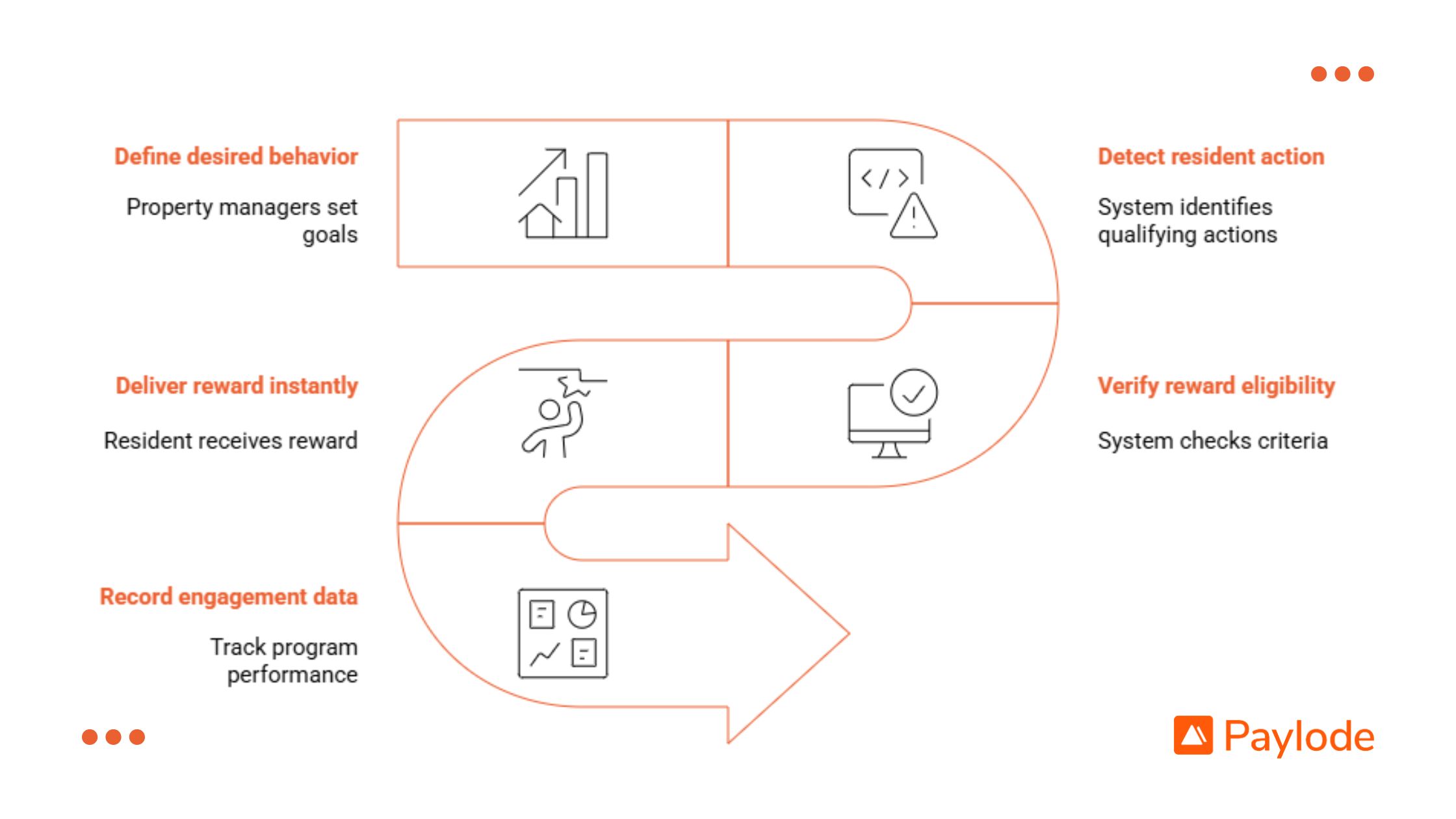
In property management, a reward program is an engagement framework that links desired resident behaviors—such as on-time rent payments, autopay enrollment, or lease renewals—to tangible incentives. When a resident completes a qualifying action, the system automatically verifies the behavior and delivers a reward.
For property managers, this means:
- Less reliance on reminders and penalties
- More predictable resident behavior
- Reduced administrative follow-ups
- Improved resident satisfaction
The program operates in the background, reinforcing positive habits without requiring manual oversight from onsite teams.
2.2 Difference between resident rewards and property manager reward programs
While residents are the recipients of rewards, the primary beneficiary of the program is often the property manager. This distinction is important.
- Resident rewards focus on delivering value to renters in the form of perks or incentives.
- Reward programs for property managers are designed to improve operational outcomes such as payment consistency, retention, and workflow efficiency.
In other words, resident rewards are the mechanism, while the property manager reward program is the strategy. The program exists to make properties easier to manage, not just to offer perks for their own sake.
2.3 How modern reward programs focus on behavior, outcomes, and automation
Modern reward programs are built around behaviors that directly impact property performance. Instead of rewarding participation arbitrarily, they incentivize actions that matter operationally, including:
- Paying rent on time
- Enrolling in autopay
- Switching to paperless billing
- Renewing early
- Engaging with digital tools
Automation is central to this model. Once rules are defined, the system tracks behavior, verifies eligibility, delivers rewards, and sends notifications automatically. This ensures consistency, fairness, and scalability—key requirements for property managers overseeing multiple responsibilities or communities.
2.4 Why rewards are shifting from discounts to value-based incentives
Historically, property managers relied on rent discounts, concessions, or gift cards to influence behavior. While effective in the short term, these incentives reduce revenue and are difficult to sustain.
Modern reward programs have shifted toward value-based, merchant-funded incentives, which provide residents with everyday savings without impacting rent or operating budgets. These incentives feel valuable to residents while remaining financially responsible for operators.
This shift allows property managers to:
- Protect NOI
- Avoid rent erosion
- Scale programs across portfolios
- Deliver ongoing value instead of one-time giveaways
Value-based rewards make incentive programs sustainable, predictable, and aligned with long-term property performance.
3. How reward programs fit into modern property management strategies
Reward programs are no longer side initiatives or optional add-ons. In modern property management, they function as strategic tools that support retention, operational efficiency, and resident experience. When designed correctly, a reward program for property managers aligns directly with broader management objectives rather than operating in isolation.
3.1 Reward programs as part of experience-driven management
Property management has shifted from a purely transactional model to an experience-driven one. Residents now evaluate communities based on how they feel living there—not just pricing or amenities. Reward programs contribute to this shift by introducing regular moments of appreciation and value throughout the lease lifecycle.
Instead of only interacting with residents during rent collection or maintenance issues, reward programs create positive touchpoints tied to everyday behaviors. This helps property managers deliver a more balanced experience—one that includes recognition and engagement alongside operations.
3.2 Aligning rewards with operational KPIs
Effective reward programs are directly tied to operational key performance indicators. Rather than offering generic incentives, modern programs reinforce behaviors that support measurable outcomes such as:
- On-time rent payment rates
- Autopay and paperless adoption
- Renewal and retention performance
- Reduced delinquency
- Increased digital engagement
By aligning rewards with these KPIs, property managers can influence performance without increasing enforcement or manual follow-ups.
3.3 Supporting both resident satisfaction and manager efficiency
One of the biggest advantages of reward programs is their dual impact. Residents benefit from recognition and tangible value, while property managers benefit from smoother operations.
Reward programs help:
- Reduce friction around rent payments
- Minimize repetitive reminders and follow-ups
- Encourage self-service behaviors
- Improve communication tone and trust
When positive behavior is rewarded automatically, property managers spend less time managing issues and more time focusing on service, leasing, and community building.
3.4 Why reward programs are becoming a standard, not a perk
As markets become more competitive and operational pressure increases, reward programs are quickly moving from “nice to have” to “must have.” Communities that rely solely on enforcement and pricing struggle to keep pace with those that offer experience-driven engagement.
Reward programs are becoming standard because they:
- Scale easily through automation
- Deliver value without increasing costs
- Improve retention without rent concessions
- Support consistent, portfolio-wide execution
For property managers, reward programs are no longer optional perks—they are a foundational element of modern property management strategy that supports long-term performance and resident loyalty.
4. Key goals of a reward program for property managers
A reward program for property managers is most effective when it is built around clear, measurable goals. Rather than offering incentives in isolation, modern reward programs are designed to influence specific behaviors that improve daily operations, resident relationships, and long-term property performance.
Below are the primary goals that reward programs help property managers achieve.
4.1 Improving on-time rent payments
On-time rent payments are essential for predictable cash flow and reduced administrative burden. Reward programs encourage proactive payment behavior by reinforcing positive actions instead of relying solely on reminders or penalties.
When residents know they will receive recognition or rewards for paying on time, they are more likely to prioritize rent payments. This proactive approach:
- Improves payment consistency
- Reduces late fees and disputes
- Strengthens resident accountability
Reducing collection workload
By incentivizing timely payments and autopay enrollment, reward programs significantly reduce the need for manual follow-ups and collections. Property managers spend less time chasing payments and more time focusing on service and leasing activities.
4.2 Increasing resident retention
Retention is one of the most important performance indicators for property managers. Reward programs support renewals by delivering ongoing value throughout the lease term, not just at renewal time.
By rewarding positive behaviors and long-term consistency, property managers:
- Create emotional loyalty
- Reinforce appreciation and recognition
- Make renewal decisions feel more value-driven
Using rewards to support renewals helps reduce turnover costs and stabilizes occupancy across communities.
4.3 Reducing operational friction
Operational friction often stems from manual processes, inconsistent communication, and low digital adoption. Reward programs can be used strategically to incentivize residents to adopt behaviors that simplify management.
Examples include:
- Rewards for enrolling in autopay
- Incentives for switching to paperless billing
- Encouragement to use resident portals or apps
- Rewards tied to proactive maintenance requests
These behaviors reduce administrative effort and streamline day-to-day operations.
4.4 Supporting team performance
A well-designed reward program should support property managers—not add to their workload. Automation ensures that behavior tracking, reward eligibility, delivery, and communication happen without manual intervention.
As a result, property managers benefit from:
- Fewer repetitive tasks
- Clearer workflows
- Reduced resident friction
- More time for high-value responsibilities
By making daily operations smoother, reward programs help property managers perform more effectively and sustainably.
When aligned with these goals, a reward program becomes a powerful operational tool rather than a simple engagement initiative. It helps property managers influence behavior, improve retention, and reduce workload—while maintaining a positive resident experience.
5. Types of reward programs property managers can use
Reward programs are most effective when they are tailored to the behaviors and outcomes property managers want to influence. Rather than relying on a single incentive model, modern property management teams deploy a mix of reward types that address payments, engagement, efficiency, and retention. Below are the most common and effective reward program structures property managers can use today.
5.1 Resident-focused reward programs
Resident-focused reward programs are designed to reinforce everyday behaviors that directly impact property performance. These programs are simple, intuitive, and highly effective because they reward actions residents already understand.
On-time rent rewards
Rewarding residents for paying rent on time encourages consistency without relying on penalties. These rewards create positive reinforcement around timely payments, improving cash flow predictability and reducing late-payment follow-ups.
Autopay and paperless incentives
Autopay enrollment and paperless billing significantly reduce administrative workload. Offering rewards for adopting these behaviors helps property managers streamline operations while improving resident convenience.
Renewal and loyalty rewards
Loyalty-based rewards recognize residents for tenure and consistency. Renewal incentives tied to positive payment history or long-term residency make renewals feel earned and appreciated, increasing retention without rent concessions.
5.2 Behavior-based reward programs
Behavior-based reward programs focus on actions that reduce friction for onsite teams and improve operational efficiency. These programs are especially valuable for property managers balancing multiple responsibilities.
Rewards for actions that reduce workload
Property managers can incentivize behaviors such as:
- Using digital portals for requests
- Submitting maintenance issues early
- Completing surveys or feedback forms
- Following community guidelines
Each of these actions reduces manual work and improves response times.
Encouraging compliance and consistency
Rewarding consistent behavior—rather than one-time actions—helps establish habits. Residents who consistently follow processes make properties easier to manage and communities more predictable.
5.3 Merchant-funded reward programs
Merchant-funded reward programs have become the preferred model for property managers because they deliver meaningful value without increasing operating costs.
Everyday perks funded by merchants
These programs provide residents with real savings on categories they use daily, such as dining, retail, wellness, and home essentials. Because the rewards are funded by merchants, property managers can offer high-value incentives without impacting budgets.
Zero-cost incentives for operators
This model allows reward programs to scale across portfolios while protecting NOI. Platforms like Paylode Perks enable property managers to deliver ongoing value without allocating funds for gift cards or rent credits.
5.4 Event- and milestone-based rewards
Event- and milestone-based rewards create moments of recognition that strengthen emotional loyalty and community connection.
Lease anniversaries
Recognizing residents on lease anniversaries reinforces appreciation and acknowledges long-term commitment to the community.
Community engagement moments
Rewards tied to events—such as resident gatherings, wellness initiatives, or seasonal activities—encourage participation and help foster a sense of belonging within the community.
By combining resident-focused, behavior-based, merchant-funded, and milestone-driven rewards, property managers can build a flexible reward ecosystem that supports operations, retention, and resident satisfaction. This multi-layered approach ensures reward programs remain relevant, scalable, and aligned with long-term property management goals.
6. How automation strengthens reward programs for property managers
Automation is the foundation that allows reward programs to succeed at scale. Without it, even well-intentioned reward initiatives quickly become inconsistent, labor-intensive, and difficult to sustain. This is why automation is central to any effective reward program for property managers.
6.1 Why manual reward programs fail
Manual reward programs depend heavily on staff availability and attention. Tracking rent payments, verifying eligibility, issuing rewards, and communicating with residents all require time and coordination. In busy communities, these steps are often delayed or overlooked, leading to frustration and reduced trust.
Common challenges with manual programs include:
- Inconsistent reward delivery
- Missed or delayed incentives
- Increased staff workload
- Resident confusion and dissatisfaction
Over time, these issues undermine the effectiveness of the program and increase operational strain.
6.2 Automation for tracking, eligibility, and delivery
Automated reward programs eliminate these challenges by handling every step of the reward lifecycle digitally. Once behaviors and rules are defined, the system:
- Tracks resident actions automatically
- Verifies eligibility in real time
- Delivers rewards instantly
- Updates engagement and performance data
This ensures rewards are accurate, timely, and consistent—without manual oversight.
6.3 Eliminating staff intervention
One of the greatest benefits of automation is the removal of staff intervention. Property managers no longer need to:
- Monitor individual payment behaviors
- Approve rewards manually
- Follow up on missed incentives
- Resolve disputes about eligibility
Instead, automation allows property managers to focus on higher-value responsibilities such as resident service, leasing, and community building.
6.4 Ensuring fairness and consistency
Automation applies reward rules uniformly across all residents and properties. This consistency:
- Builds resident trust
- Reduces complaints about favoritism
- Ensures compliance with internal policies
- Simplifies portfolio-wide management
Fairness is especially important in larger portfolios where manual oversight is impractical.
6.5 Using automation platforms to scale rewards
Dedicated automation tools, such as Paylode Boost, allow property managers to design and deploy behavior-triggered reward workflows without custom development. These platforms connect payment data, resident actions, messaging, and rewards into a single system, making reward programs easy to scale and manage.
Automation transforms reward programs from administrative burdens into strategic assets. By eliminating manual effort, ensuring fairness, and delivering consistent value, automated reward programs empower property managers to achieve better outcomes with less operational stress.
7. Operational benefits of reward programs for property managers
When reward programs are designed around automation and behavior-based incentives, they deliver tangible operational benefits for property managers. Rather than adding complexity, these programs simplify daily workflows and improve overall property performance. Below are the key operational advantages of implementing a reward program for property managers.
7.1 Higher payment consistency
Reward programs encourage residents to prioritize rent payments by offering positive reinforcement for on-time behavior. When residents know they will receive recognition or tangible value for paying on time, consistency improves naturally.
Higher payment consistency results in:
- More predictable cash flow
- Fewer last-minute payment issues
- Reduced stress during rent cycles
This stability allows property managers to plan and operate more efficiently.
7.2 Reduced delinquency and follow-ups
Late payments create administrative burden and strain resident relationships. Reward programs reduce delinquency by motivating residents to stay current through incentives rather than penalties.
As delinquency decreases, property managers experience:
- Fewer collection calls and emails
- Less time spent resolving payment issues
- Improved tone in resident communications
This shift supports a more positive management environment.
7.3 Less administrative work
Manual tasks such as tracking payments, verifying incentives, and issuing rewards can consume significant staff time. Automated reward programs remove these responsibilities entirely.
Property managers benefit from:
- Fewer spreadsheets and manual checks
- Reduced coordination between teams
- Automated reporting and visibility
This reduction in administrative work improves efficiency across the board.
7.4 Better use of onsite staff time
With fewer repetitive tasks, onsite teams can focus on higher-value activities such as:
- Resident service and support
- Leasing and tours
- Community engagement
- Preventive maintenance coordination
Reward programs help property managers allocate staff time more strategically.
7.5 Improved resident–manager relationships
Reward programs shift the relationship dynamic from enforcement to appreciation. Residents interact with management through positive experiences rather than reminders and penalties.
This leads to:
- Higher trust
- Better communication
- Fewer disputes
- Stronger long-term relationships
Improved relationships make properties easier to manage and contribute to a healthier community environment.
By improving payment consistency, reducing delinquency, minimizing administrative work, and strengthening resident relationships, reward programs deliver real operational value. These benefits make reward programs a practical, results-driven tool for property managers focused on efficiency and long-term performance.
8. Resident benefits that make reward programs successful
For a reward program to succeed, residents must see clear, personal value in participating. When rewards feel meaningful and fair, residents engage more consistently and respond positively. This is why the best reward programs for property managers are designed with resident experience in mind—delivering benefits that support everyday living while reinforcing positive behaviors.
8.1 Feeling appreciated rather than penalized
Traditional rent management often emphasizes penalties for late payments or non-compliance. Reward programs reverse this dynamic by focusing on appreciation. Residents are recognized for doing the right things, such as paying rent on time or maintaining autopay.
This shift:
- Improves resident morale
- Reduces tension around payments
- Builds goodwill with management
Feeling appreciated strengthens loyalty and increases long-term engagement.
8.2 Instant, practical rewards
Residents are more likely to engage with rewards that provide immediate and practical value. Modern reward programs avoid delayed gratification or complicated point systems.
Instant rewards:
- Feel tangible and useful
- Reinforce behavior immediately
- Increase participation rates
Everyday perks—such as savings on dining, retail, or essentials—fit naturally into residents’ routines.
8.3 Transparency and trust
Transparency is critical for resident trust. Effective reward programs clearly communicate:
- Which behaviors earn rewards
- When rewards are triggered
- How rewards can be accessed
Residents can see the direct connection between their actions and outcomes, reducing confusion and disputes.
8.4 Improved financial habits
Reward programs encourage residents to build healthier financial behaviors without pressure. Incentives tied to on-time payments, autopay enrollment, and paperless billing help residents develop consistency and discipline.
Over time, these habits:
- Reduce financial stress
- Improve payment reliability
- Create smoother interactions with management
This benefits both residents and property managers.
8.5 Stronger community experience
Reward programs also contribute to a more positive community atmosphere. Recognition for milestones, participation in events, or long-term residency fosters a sense of belonging.
Stronger community experience leads to:
- Higher satisfaction
- Increased renewal likelihood
- More positive referrals and reviews
By focusing on appreciation, immediacy, transparency, and everyday value, reward programs create a resident experience that feels supportive rather than transactional. These resident benefits are what ultimately make reward programs successful for property managers.
9. Financial impact of reward programs on property performance
Beyond engagement and operations, reward programs have a direct and measurable impact on financial performance. For property managers, the true value of a reward program lies in its ability to improve outcomes without eroding revenue. When aligned with automation and merchant-funded incentives, reward programs strengthen margins while supporting long-term asset health.
9.1 Rewards vs. rent concessions
Rent concessions are a common but costly tactic used to influence behavior or secure renewals. While they may provide short-term relief, concessions permanently reduce effective rent and can reset resident expectations.
Reward programs offer a smarter alternative. Instead of lowering rent, property managers deliver value through incentives that do not affect rent rolls. This preserves pricing integrity while still motivating residents to pay on time, renew, and stay engaged.
9.2 Impact on NOI
Net Operating Income is highly sensitive to both revenue erosion and operational inefficiencies. Reward programs protect NOI by:
- Avoiding rent discounts
- Improving payment consistency
- Reducing delinquency-related losses
- Supporting higher renewal rates
Because modern reward programs rely on merchant-funded perks rather than operator-funded incentives, they deliver value without increasing operating expenses.
9.3 Reduced turnover costs
Turnover is one of the largest hidden costs in property management. Vacancies, unit turns, marketing, and leasing labor all add up quickly. Reward programs reduce turnover by creating ongoing value throughout the lease—not just at renewal.
Lower turnover results in:
- Fewer vacant days
- Reduced make-ready expenses
- Less marketing spend
- More stable occupancy
These savings directly improve property-level financial performance.
9.4 Predictable cash flow improvements
Consistent, on-time rent payments improve cash flow predictability. Reward programs incentivize behaviors like autopay enrollment and payment streaks, reducing variability in monthly collections.
Predictable cash flow supports:
- More accurate forecasting
- Reduced reliance on collections
- Improved investor and lender confidence
For property managers, this stability simplifies budgeting and reporting.
9.5 Why merchant-funded rewards protect margins
Merchant-funded rewards are the key to making reward programs financially sustainable. Because rewards are funded by third-party merchants, property managers can offer high-perceived-value incentives without allocating budget or reducing rent.
This model:
- Scales easily across portfolios
- Protects operating margins
- Avoids incentive fatigue
- Delivers long-term value without long-term cost
When evaluated holistically, reward programs improve financial performance by stabilizing revenue, reducing expenses tied to turnover and collections, and preserving NOI. This makes them a financially disciplined strategy—not just an engagement initiative—for property managers focused on long-term success.
10. How Paylode enables reward programs for property managers
Implementing a reward program successfully requires more than good intent—it requires a platform that integrates seamlessly with existing workflows, automates execution, and scales across properties without adding cost or complexity. Paylode is built specifically to support reward programs for property managers by combining merchant-funded perks, automation, and centralized visibility into a single, cohesive solution.
Below is how Paylode enables property managers to launch and scale effective reward programs.
10.1 Reward programs powered by Perks
Paylode’s Perks ecosystem delivers everyday, merchant-funded rewards that residents can use immediately. These rewards are practical, relevant, and designed to drive consistent engagement.
With Perks, property managers can:
- Reward on-time rent payments without rent discounts
- Incentivize autopay and paperless billing
- Recognize long-term residents and renewal commitments
- Deliver value that residents actually use
Because perks are funded by merchants, property managers avoid the cost burden associated with gift cards or concessions—protecting margins while still delivering high perceived value.
10.2 Automation with Boost
Automation is critical to making reward programs sustainable. Paylode’s Boost layer automates behavior tracking, eligibility verification, reward delivery, and resident communication.
Boost allows property managers to:
- Trigger rewards automatically when rent is paid on time
- Deliver streak-based incentives for consistent behavior
- Send proactive reminders and appreciation messages
- Reduce delinquency without increasing follow-ups
- Eliminate manual reward administration
This automation ensures programs run consistently in the background, supporting teams rather than adding to their workload.
10.3 Centralized dashboards and insights
Paylode provides portfolio-level visibility into how reward programs are performing. Property managers and operators can monitor:
- On-time payment trends
- Reward engagement and redemption
- Autopay adoption
- Retention signals tied to behavior
These insights help teams optimize reward rules, identify at-risk residents earlier, and align incentives with operational goals.
10.4 White-label experiences for properties
Adoption improves when rewards feel like a natural extension of the community experience. Paylode supports white-label deployment, allowing property managers to present rewards under their own brand.
White-label capabilities help:
- Maintain brand consistency
- Build resident trust
- Reduce friction in adoption
- Integrate rewards into existing portals or apps
By delivering a cohesive, branded experience, property managers increase participation and long-term engagement.
10.5 A scalable foundation for modern property management
By combining merchant-funded value, automation, analytics, and white-label flexibility within the Paylode platform, property managers can deploy reward programs that scale effortlessly across communities—without increasing operational overhead.
Paylode turns reward programs into a reliable operational asset, helping property managers influence behavior, improve retention, and simplify daily management.
11. Best practices for launching a reward program for property managers
Launching a reward program is not just about turning on a new feature—it’s about embedding incentives into daily property operations in a way that is clear, scalable, and sustainable. The most successful programs follow proven best practices that align resident value with operational goals, ensuring the program supports property managers rather than creating new complexity.
Below are best practices property managers should follow when rolling out a reward program.
11.1 Start with a small number of high-impact behaviors
Avoid trying to reward every possible action from the start. Focus on behaviors that deliver immediate operational value, such as:
- On-time rent payments
- Autopay enrollment
- Paperless billing adoption
Starting with a limited scope makes the program easier to manage, communicate, and optimize before expanding.
11.2 Automate from day one
Manual reward programs quickly break down under real-world conditions. Automation should handle:
- Behavior tracking
- Eligibility verification
- Reward delivery
- Resident notifications
Automating from the beginning ensures consistency, fairness, and minimal staff involvement—critical for long-term success.
11.3 Clearly communicate how the program works
Residents need to understand the program immediately. Clear communication should explain:
- What actions earn rewards
- When rewards are delivered
- What types of rewards are available
- Where rewards can be accessed
Use multiple channels—email, resident portals, move-in materials, and onsite messaging—to reinforce understanding.
11.4 Align rewards with renewal and retention strategy
Reward programs should support renewals, not operate separately from them. Effective programs:
- Recognize long-term residents
- Offer loyalty-based renewal incentives
- Use payment and engagement history to personalize offers
This alignment strengthens retention without relying on rent concessions.
11.5 Train onsite teams at a high level
Onsite teams don’t need to manage rewards manually, but they should understand the basics. Simple training helps teams:
- Confidently explain the program
- Direct residents to the right resources
- Reinforce positive behaviors
This builds resident trust and improves adoption.
11.6 Track performance and optimize continuously
Treat the reward program as a living system. Monitor:
- Payment behavior trends
- Reward engagement and redemption
- Resident feedback
- Retention outcomes
Use these insights to refine reward rules, expand behaviors, and increase overall impact.
When launched with focus, automation, and clear communication, reward programs become a long-term operational asset. These best practices help property managers maximize adoption, reduce friction, and ensure the program delivers measurable value over time.
12. Common mistakes to avoid with property manager reward programs
Even well-intentioned reward programs can fall short if they are not designed and managed carefully. Property managers often face challenges not because rewards are ineffective, but because of avoidable missteps during planning or execution. Understanding these pitfalls is essential to ensuring a reward program delivers long-term value rather than added complexity.
12.1 Treating the reward program as a short-term campaign
One of the most common mistakes is launching a reward program as a limited-time promotion. Short-term campaigns create inconsistent expectations and weaken trust when rewards disappear unexpectedly.
Reward programs work best when they are:
- Always-on
- Predictable
- Embedded into daily resident behavior
Consistency helps residents form habits and increases long-term engagement.
12.2 Using costly, operator-funded incentives
Gift cards, rent credits, or cash-based incentives may seem effective initially, but they quickly become expensive and unsustainable. These incentives directly reduce margins and often force programs to scale back over time.
Merchant-funded rewards avoid this issue by:
- Delivering meaningful value without budget impact
- Scaling easily across properties
- Protecting NOI
This model ensures rewards remain viable long term.
12.3 Overcomplicating reward rules
Complex eligibility criteria confuse residents and reduce participation. If residents struggle to understand how rewards are earned, engagement drops quickly.
Effective reward programs:
- Use simple, intuitive rules
- Clearly connect actions to rewards
- Avoid excessive tiers or exceptions
Simplicity improves adoption and trust.
12.4 Failing to promote the program consistently
Another common mistake is assuming residents will automatically discover and understand the program. Without consistent promotion, even the best-designed rewards go unused.
Successful programs reinforce awareness through:
- Move-in communications
- Portal announcements
- Monthly reminders
- Renewal messaging
- Onsite team reinforcement
Ongoing communication keeps the program top of mind.
12.5 Relying on manual processes
Manual tracking and fulfillment introduce delays, errors, and frustration. They also increase staff workload and reduce consistency across communities.
Automation is critical to:
- Ensure timely reward delivery
- Maintain fairness
- Reduce administrative effort
- Scale programs portfolio-wide
Programs that depend on manual oversight rarely succeed at scale.
12.6 Ignoring data and resident feedback
Launching a reward program without monitoring performance limits its effectiveness. Property managers should regularly review:
- Engagement and redemption rates
- Payment behavior trends
- Resident feedback
- Retention outcomes
Data-driven optimization ensures the program continues to support operational goals.
12.7 Separating rewards from renewal strategy
When rewards are disconnected from renewals, property managers miss a key opportunity. Reward programs should reinforce renewal decisions by:
- Recognizing long-term consistency
- Rewarding tenure
- Offering early renewal incentives
This integration strengthens retention without resorting to rent concessions.
Avoiding these common mistakes helps property managers build reward programs that are sustainable, scalable, and impactful. When aligned with automation, merchant-funded value, and clear communication, reward programs become a reliable operational tool rather than a short-lived initiative.
Conclusion: Why reward programs are essential for property managers
Property management is no longer defined solely by operational execution. Today’s property managers are expected to drive retention, improve payment behavior, reduce friction, and deliver a positive resident experience—all while managing limited resources. In this environment, a well-designed reward program for property managers has become an essential operational strategy, not a discretionary add-on.
Reward programs work because they align incentives with outcomes. Instead of relying on enforcement, penalties, or costly rent concessions, property managers can motivate positive behavior through appreciation and value. On-time payments, autopay adoption, digital engagement, and renewals become easier to influence when residents feel recognized rather than pressured.
What truly elevates modern reward programs is automation and merchant-funded value. Automation removes administrative burden, ensures fairness, and enables consistency across properties. Merchant-funded rewards allow property managers to deliver meaningful, everyday value without increasing operating expenses or eroding NOI. Together, these elements make reward programs scalable, sustainable, and financially responsible.
Reward programs also reflect a broader shift in property management—from transactional oversight to experience-driven leadership. Communities that reward responsible behavior feel more supportive, modern, and resident-centric. Over time, this leads to stronger resident relationships, higher renewal rates, and lower turnover costs.
For property managers navigating rising expectations and operational complexity, reward programs provide a practical way to improve performance without adding friction. When implemented thoughtfully, they become a long-term asset that supports daily operations, strengthens resident loyalty, and protects property value.
FAQs
What is a reward program for property managers?
A reward program for property managers is an automated system that incentivizes positive resident behaviors—such as on-time rent payments or autopay enrollment—using rewards instead of penalties or rent discounts.
How do reward programs help property managers reduce workload?
By automating behavior tracking, eligibility, and reward delivery, reward programs eliminate manual follow-ups and administrative tasks, allowing property managers to focus on higher-value responsibilities.
Are reward programs expensive to run?
Not when they use merchant-funded rewards. These programs deliver resident value at zero cost to operators, making them financially sustainable.
What behaviors can property managers incentivize with reward programs?
Common behaviors include on-time rent payments, autopay enrollment, paperless billing, digital portal usage, lease renewals, and community engagement.
Do reward programs improve resident retention?
Yes. Reward programs deliver ongoing value and appreciation, which strengthens resident satisfaction and increases renewal likelihood.
Can reward programs scale across multiple properties?
Yes. Automated, platform-based reward programs can be deployed consistently across portfolios with centralized analytics and controls.