Understanding renter behavior has become a strategic priority for modern property management. As operating margins tighten and resident expectations rise, property teams are under increasing pressure to influence outcomes such as on-time rent payments, renewals, and digital adoption—without relying on penalties or rent concessions. This shift has led many operators to look beyond traditional incentives and focus instead on the psychology behind instant rewards for renters.
Renting is fundamentally different from other consumer experiences. Rent is a fixed, non-discretionary expense, and interactions with property management are typically infrequent and transactional. Because of this, delayed incentives like points, future discounts, or end-of-lease rewards often fail to motivate behavior in meaningful ways. Renters value simplicity, predictability, and immediate relief—especially when managing monthly budgets.
Instant rewards work because they align with how renters think and feel. Immediate reinforcement creates a clear connection between action and benefit, making positive behaviors feel acknowledged rather than enforced. Whether it’s paying rent on time, enrolling in autopay, or renewing a lease, renters respond more positively when value is delivered at the moment it matters.
Across the residential real estate industry, operators are beginning to recognize that behavioral psychology plays a critical role in resident engagement. Programs designed around instant rewards outperform delayed incentive models because they tap into motivation, habit formation, and emotional loyalty—key drivers of long-term retention and satisfaction.
In this article, we explore the psychology behind instant rewards for renters, examine why they outperform traditional incentive models, and explain how property operators can apply these insights to drive better outcomes across the resident lifecycle.
1. Understanding renter psychology in residential real estate
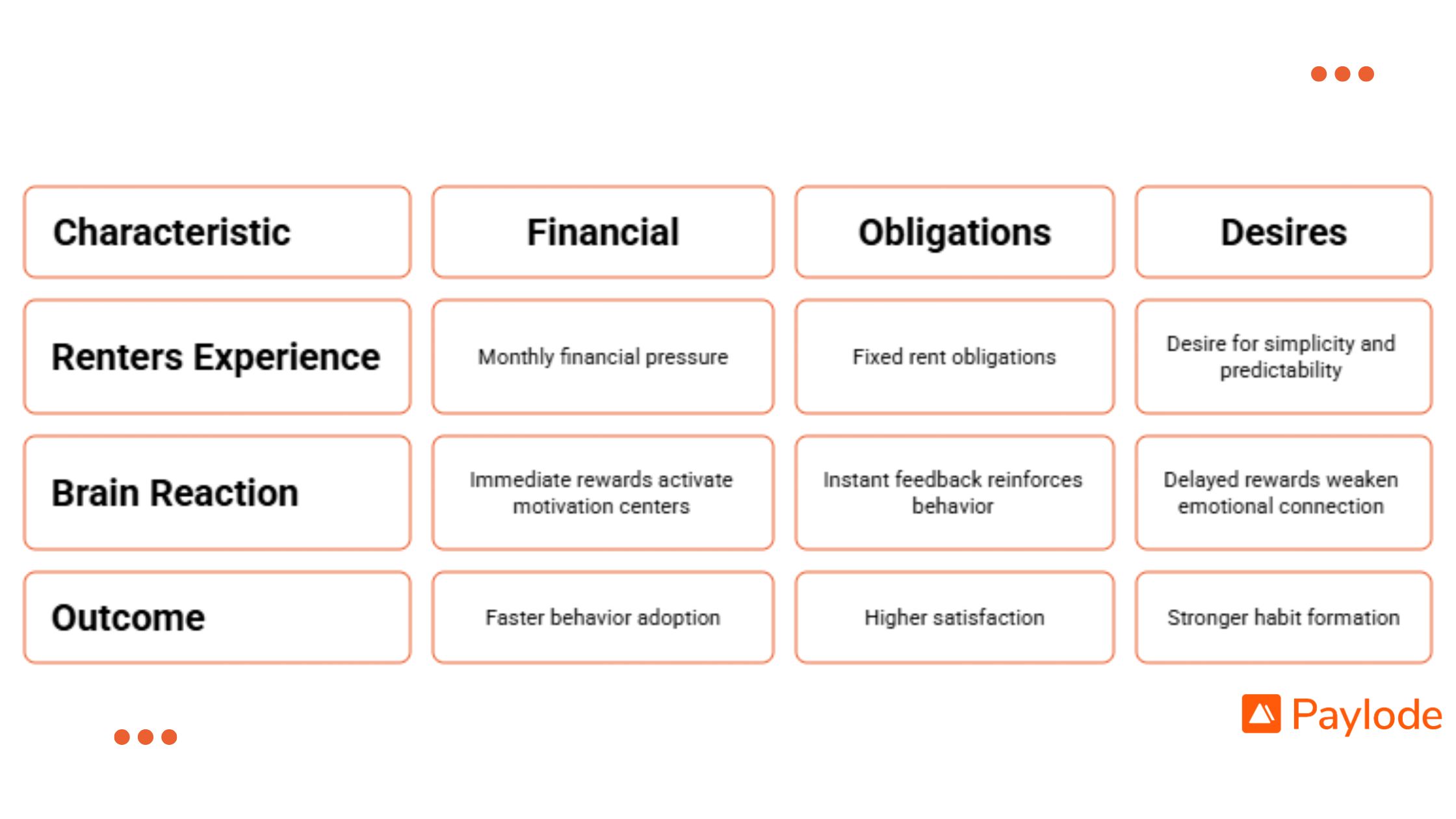
To understand why instant rewards are effective, it’s important to first understand how renters think about housing. Renting is not a transactional purchase in the same way as shopping or dining. It is a long-term, emotionally weighted commitment that shapes daily life, financial planning, and personal stability. This distinction is central to the psychology behind instant rewards for renters.
Renters prioritize security and predictability. Monthly rent is often one of the largest fixed expenses in a household budget, leaving little room for uncertainty. Because of this, renters are more sensitive to experiences that reduce stress and increase clarity. Incentives that feel complicated, delayed, or conditional often add cognitive friction rather than motivation.
Another key psychological factor is trust. Renters develop loyalty when they feel treated fairly and consistently. Programs that require tracking points, reaching thresholds, or navigating redemption rules can feel opaque or manipulative. In contrast, instant rewards feel transparent. When a renter completes an action and immediately receives value, trust is reinforced.
Renters also respond more strongly to appreciation than gamification. Housing is personal. Residents want to feel recognized, not “played.” Instant rewards act as moments of acknowledgment that signal appreciation for responsible behavior, such as paying rent on time or committing to autopay.
Finally, renter behavior is shaped by habit rather than impulse. Unlike retail purchases, housing-related actions are repetitive and predictable. The most effective incentives reinforce these routines consistently and without friction. Instant rewards fit naturally into this pattern by strengthening positive habits at the moment they occur.
By aligning incentives with renter psychology—simplicity, trust, appreciation, and habit formation—instant rewards become a powerful tool for influencing behavior in residential real estate.
2. Why delayed rewards fail to motivate renters
Delayed rewards struggle to influence renter behavior because they conflict with how renters experience housing, finances, and motivation. While delayed incentives may work in high-frequency consumer environments, they lose effectiveness in residential real estate—where interactions are infrequent and decisions carry greater emotional and financial weight.
Rent is a non-discretionary expense. Renters do not view rent payments as optional spending that can be gamified over time. When rewards are delayed—such as points that accumulate slowly or benefits promised months in the future—they feel disconnected from the immediate responsibility of paying rent. This disconnect weakens motivation and reduces engagement.
Delayed rewards also suffer from what behavioral science calls “reward distance.” The further away a reward feels, the less influence it has on present behavior. In residential settings, where rewards may require months of accumulation or long wait periods, renters lose sight of the benefit long before it materializes. Over time, this erodes interest and participation.
Cognitive fatigue plays another role. Delayed reward systems often require renters to remember balances, track progress, or understand redemption rules. For renters already managing multiple financial obligations, this added mental effort feels unnecessary. When the effort outweighs perceived value, renters disengage entirely.
There is also a lack of emotional reinforcement with delayed rewards. Motivation is strongest when action and reward are closely linked in time. When that link is broken, renters fail to associate positive behavior—such as paying rent on time—with any meaningful benefit. Without emotional reinforcement, behavior remains unchanged.
Finally, delayed rewards fail to create habits. Habit formation relies on consistent, immediate feedback. Without instant reinforcement, renters revert to default behaviors rather than adopting new ones. This is why delayed incentives struggle to drive long-term improvements in payment consistency or digital adoption.
In short, delayed rewards fail because they are too distant, too complex, and too disconnected from renter psychology. Instant rewards succeed by addressing these gaps directly.
3. The science behind instant rewards
Instant rewards are not just a convenience feature—they are grounded in well-established principles of behavioral science. Understanding the science behind them explains why they are especially effective in influencing renter behavior and why they outperform delayed incentives in residential real estate.
3.1 Dopamine and immediate reinforcement
At the neurological level, instant rewards activate the brain’s dopamine system. Dopamine is released when the brain experiences an immediate positive outcome following an action. This release creates a sense of satisfaction and reinforces the desire to repeat the behavior.
When renters receive an immediate reward after paying rent on time or completing a desired action, the brain links that behavior with a positive outcome. This strengthens motivation far more effectively than a reward that arrives weeks or months later. Delayed rewards fail to trigger the same neurological response because the brain no longer associates the action with the benefit.
3.2 Habit formation and behavioral loops
Behavioral psychology explains habit formation through a simple loop: cue, action, reward. For habits to form, the reward must follow the action quickly and consistently.
In residential real estate:
- The cue might be a rent due date or renewal reminder
- The action is paying rent or enrolling in autopay
- The reward must be immediate to reinforce the loop
Instant rewards complete this loop effectively. Over time, the repeated association between action and reward turns responsible behaviors into habits, reducing the need for reminders or enforcement.
3.3 Positive reinforcement vs. punishment
Traditional property management often relies on penalties—late fees, warnings, or reminders—to correct behavior. While penalties can stop negative actions temporarily, they do little to encourage positive, long-term habits.
Instant rewards use positive reinforcement instead. Behavioral science consistently shows that positive reinforcement is more effective at shaping behavior over time than punishment. When renters feel rewarded rather than penalized, they are more likely to comply willingly and consistently.
3.4 The timing effect in decision-making
Timing plays a critical role in how people evaluate incentives. The closer a reward is to the moment of action, the greater its perceived value. Even smaller rewards feel meaningful when delivered instantly.
For renters, this means that a modest, immediate benefit often carries more psychological weight than a larger reward promised in the future. Instant rewards capitalize on this timing effect, making them powerful despite their simplicity.
By leveraging dopamine response, habit loops, positive reinforcement, and timing effects, instant rewards align naturally with human psychology. This scientific foundation explains why they are so effective in influencing renter behavior and why they have become a core strategy in modern residential engagement programs.
4. How instant rewards influence key renter behaviors
The true value of instant rewards lies in how they shape everyday renter behavior. By delivering immediate reinforcement, these rewards influence actions that directly impact property performance—without relying on pressure or penalties. Below are the key renter behaviors most positively affected by instant rewards.
4.1 On-time rent payments
On-time rent payments are one of the most critical outcomes for property operators, yet they are also one of the hardest to influence using traditional methods. Late fees and reminders are reactive and often damage resident relationships.
Instant rewards change this dynamic by reinforcing positive behavior at the moment it occurs. When renters receive immediate value after paying rent on time, the action feels acknowledged rather than enforced. This positive reinforcement encourages consistency and reduces the mental friction associated with rent deadlines.
Over time, renters begin to associate paying rent on time with a positive outcome, strengthening the habit and improving payment reliability.
4.2 Autopay and paperless adoption
Many property managers want renters to adopt autopay and paperless billing to reduce administrative workload. However, renters often delay these changes because there is no immediate incentive to act.
Instant rewards provide a clear “why now.” When renters receive immediate benefits for enrolling in autopay or switching to paperless statements, the barrier to action is lowered. The reward offsets any perceived inconvenience and accelerates adoption.
As a result, properties see faster digital adoption, fewer payment issues, and smoother operations.
4.3 Lease renewals
Lease renewal decisions are influenced by emotion as much as economics. Renters are more likely to renew when they feel valued, recognized, and supported throughout their lease term.
Instant rewards contribute to this emotional loyalty by creating frequent moments of appreciation. When renters are consistently rewarded for responsible behavior, they develop a stronger positive association with the community. This makes renewal feel like a continuation of a valued relationship rather than a purely financial decision.
4.4 Ongoing engagement and compliance
Beyond payments and renewals, instant rewards can influence ongoing engagement. Renters are more likely to:
- Respond to surveys
- Participate in community initiatives
- Follow community guidelines
- Use resident portal
When rewards are immediate and predictable, renters engage willingly rather than out of obligation. This creates a healthier, more cooperative community environment.
By reinforcing behaviors at the exact moment they occur, instant rewards align with renter psychology and create lasting habits. This is why they outperform delayed incentives and play a central role in modern resident engagement strategies.
5. Instant rewards vs. points-based incentives
Instant rewards and points-based incentives may appear similar on the surface, but they operate on fundamentally different psychological principles. In residential real estate, these differences determine whether a program drives real behavior change or fades into the background.
Points-based incentives rely on accumulation. Renters earn small amounts of value over time and must wait until a threshold is reached before experiencing any benefit. This delay weakens motivation, especially in a housing context where interactions are infrequent and rent is a fixed obligation. Points feel abstract, and their value is often unclear or forgotten.
Instant rewards remove this friction entirely. The renter completes an action—such as paying rent on time—and receives value immediately. There is no balance to track, no waiting period, and no cognitive effort required. This immediacy strengthens the emotional connection between action and outcome, which is critical for motivation and habit formation.
Another key difference is simplicity. Points-based programs introduce complexity through rules, thresholds, and redemption steps. Instant rewards are self-explanatory. Renters understand exactly why they received the reward and how to use it. This clarity builds trust and encourages repeat behavior.
From a psychological standpoint, instant rewards also feel more sincere. Points can feel like gamification layered onto a serious responsibility, while instant rewards feel like genuine appreciation. This distinction matters in residential environments, where renters want to feel respected rather than “marketed to.”
Ultimately, instant rewards outperform points-based incentives because they align with how renters think, feel, and act. They deliver immediate reinforcement, reduce mental friction, and create positive emotional associations—making them far more effective for driving engagement and loyalty in residential real estate.
6. The role of everyday value in renter motivation
Not all rewards motivate renters equally. One of the strongest psychological drivers behind instant rewards is everyday value—benefits that renters can realistically use as part of their daily routine. In residential real estate, practical rewards consistently outperform novelty or luxury-based incentives.
Renters manage fixed monthly budgets with limited flexibility. Rewards that help offset everyday expenses—such as dining, groceries, wellness, or household needs—feel immediately relevant. Even small savings in these categories reduce financial pressure, creating a positive emotional response. This is why everyday, merchant-funded perks available through Paylode Perks resonate more strongly than delayed or aspirational rewards.
Everyday value also increases perceived fairness. When rewards are useful to nearly all residents, programs feel inclusive rather than selective. Renters do not need to change their lifestyle or wait for a special occasion to benefit. This universality strengthens trust and encourages broader participation across the community.
Another psychological advantage of everyday rewards is frequency of use. Renters are more likely to redeem rewards that fit naturally into their routines. Each redemption reinforces the positive association between responsible behavior and real-world benefit, strengthening loyalty over time. In contrast, rewards that are rarely used fail to create repeated reinforcement.
Importantly, everyday rewards do not need to be high in dollar value to be effective. Behavioral science shows that relevance and timing outweigh size. A modest reward delivered instantly and tied to daily life carries more motivational weight than a larger reward delivered later.
By focusing on immediate, practical value through merchant-funded perks, property operators align incentives with renter psychology while maintaining financial sustainability. Everyday rewards feel real, useful, and worth engaging with—making them one of the most effective tools for motivating renter behavior.
7. How automation amplifies the impact of instant rewards
Instant rewards are most effective when they are delivered at the exact moment a desired behavior occurs. This level of precision is difficult to achieve manually, which is why automation plays a critical role in amplifying the psychological impact of instant rewards for renters.
Automation removes delays between action and reward. When a renter pays rent on time or enrolls in autopay, an automated system can trigger the reward immediately—without waiting for staff review or manual approval. This immediacy strengthens the mental connection between behavior and benefit, reinforcing motivation and habit formation.
Automation also ensures consistency. Renters are highly sensitive to fairness. If rewards are delivered inconsistently or selectively, trust erodes quickly. Automated workflows apply the same rules to every resident, every time. This predictability builds confidence in the program and increases long-term engagement.
Another key advantage is reduced cognitive friction. Renters do not need to remember to claim rewards, track progress, or follow up with management. Everything happens automatically in the background. This simplicity aligns with renter psychology, where lower effort increases participation and satisfaction.
From an operational perspective, automation protects staff time while improving outcomes. Property teams are no longer responsible for tracking eligibility, issuing rewards, or resolving disputes related to delays. Platforms that enable behavior-triggered workflows—such as Paylode Boost—allow instant rewards to scale across communities without adding administrative burden.
Finally, automation enables data-driven optimization. By tracking when rewards are triggered and how renters respond, operators can refine timing, behaviors, and messaging to maximize impact. This continuous feedback loop strengthens both psychological effectiveness and operational performance.
In short, automation ensures instant rewards are truly instant, fair, and effortless. By removing delays and inconsistencies, automated delivery amplifies the psychological benefits of immediate reinforcement—making instant rewards far more powerful than manual or delayed incentive models.
8. Psychological trust: Why fairness and consistency matter
Trust is a foundational element of renter psychology. Renters are more likely to engage with incentives when they believe the system is fair, predictable, and transparent. Instant rewards are especially effective when they are delivered consistently, because consistency reinforces trust and reduces skepticism.
Fairness matters because renters compare experiences—both consciously and subconsciously. If rewards appear inconsistent or discretionary, renters may question the legitimacy of the program. Even a valuable reward loses impact if renters are unsure whether they will receive it every time they meet the criteria. Consistent delivery reassures renters that positive behavior will always be recognized.
Transparency strengthens this trust further. When renters clearly understand which actions trigger rewards and when those rewards will arrive, confidence in the program increases. Instant rewards naturally support transparency because the connection between action and outcome is immediate and visible. There is no ambiguity about eligibility or timing.
Consistency also reduces emotional friction. Renters already manage enough uncertainty around housing costs and responsibilities. Reward programs that feel predictable and reliable reduce cognitive load and create a sense of stability. This emotional reassurance makes renters more receptive to engagement initiatives.
From a behavioral standpoint, consistency reinforces habit formation. When renters know a reward will reliably follow a behavior, repetition becomes easier. Over time, the behavior becomes self-sustaining, requiring less conscious effort. Inconsistent rewards, by contrast, break this reinforcement loop and weaken motivation.
Ultimately, fairness and consistency transform instant rewards from a promotional tactic into a trusted part of the resident experience. When renters trust the system, they engage willingly—and that trust is what allows instant rewards to drive lasting behavioral change.
9. Emotional loyalty vs. transactional incentives
In residential real estate, loyalty is driven far more by emotion than by calculation. Renters do not stay because they have accumulated enough points or unlocked a future benefit—they stay because they feel comfortable, appreciated, and confident in their living experience. This distinction explains why emotional loyalty consistently outperforms transactional incentives.
Transactional incentives, such as points or delayed discounts, frame the renter–property relationship as an exchange. The renter performs an action and expects a payoff later. While this model can work in retail or travel, it feels misaligned in housing. Renting is personal, and residents want to feel respected—not managed through gamification.
Instant rewards contribute to emotional loyalty by creating moments of appreciation rather than transactions. When renters receive immediate recognition for responsible behavior, the message is clear: you are valued. These moments accumulate over time, shaping how renters feel about the community and management team.
Emotional loyalty is also more resilient. Rent increases, market changes, or minor service issues are less likely to trigger move-outs when renters feel positively connected to their community. Transactional incentives, by contrast, are fragile. Once the perceived value declines, engagement disappears.
Another key difference is memory. Renters remember how a community made them feel far longer than they remember the mechanics of a rewards program. Instant rewards create positive emotional touchpoints that are easier to recall at renewal time, influencing decisions subconsciously.
In practice, emotional loyalty translates into:
- Higher renewal rates
- Better communication and cooperation
- More forgiving attitudes during issues
- Stronger word-of-mouth and referrals
By focusing on emotional loyalty rather than transactional incentives, instant reward programs align with renter psychology at a deeper level. They transform routine actions into moments of recognition—building relationships that last longer than any point balance ever could.
10. How Paylode applies renter psychology at scale
Understanding renter psychology is only valuable if it can be applied consistently, fairly, and without adding operational burden. This is where Paylode translates behavioral science into a scalable, real-world solution for residential real estate operators—turning instant rewards into a repeatable engagement strategy.
10.1 Instant, merchant-funded rewards that feel relevant
Paylode applies renter psychology by delivering instant, everyday rewards that align with how renters manage their lives and budgets. Instead of abstract points or future promises, renters receive immediate value they can use in familiar categories such as dining, retail, wellness, and essentials.
Because these rewards are merchant-funded, operators can deliver high-perceived-value incentives without impacting operating budgets or rent revenue. This balance between psychological impact and financial sustainability is critical for long-term adoption.
10.2 Automated behavior-based incentives
Timing is everything in behavioral reinforcement. Paylode uses automation to ensure rewards are triggered at the exact moment a renter completes a desired action, such as paying rent on time or enrolling in autopay.
Through automated workflows powered by Paylode Boost, rewards are delivered instantly and consistently—eliminating delays, manual intervention, or subjective decision-making. This immediacy strengthens the action–reward connection that renter psychology depends on.
10.3 White-label resident experiences that build trust
Trust and familiarity play a major role in renter engagement. Paylode supports white-label deployment, allowing rewards to appear as a natural extension of the property’s own resident experience rather than a third-party add-on.
When renters interact with a branded, familiar interface, they are more likely to trust the program and engage with it repeatedly. This consistency reinforces psychological safety and reduces skepticism around incentives.
10.4 Portfolio-wide consistency and insight
Paylode enables operators to apply renter psychology consistently across properties through centralized rules and analytics. Every renter is evaluated fairly, every reward is delivered predictably, and every interaction generates insight into what behaviors drive the strongest response.
By delivering instant, behavior-driven rewards through a single, automated system, the Paylode platform allows operators to apply renter psychology at scale—turning individual moments of motivation into portfolio-wide performance improvements.
Conclusion
The psychology behind instant rewards for renters is rooted in how people experience housing, money, and motivation. Renters are not driven by delayed gratification or abstract point systems. They respond to simplicity, immediacy, and genuine appreciation—especially when managing fixed monthly expenses and long-term living decisions.
Instant rewards succeed because they create a clear, emotional connection between action and benefit. By delivering value at the exact moment a renter does the right thing, these programs reinforce positive behavior, build habits, and strengthen trust. Over time, these small moments of recognition accumulate into emotional loyalty, which plays a far greater role in retention than transactional incentives ever could.
In contrast, delayed rewards introduce friction, cognitive fatigue, and disengagement. They fail to align with renter psychology and often add operational complexity without producing meaningful results. Modern residential real estate requires engagement strategies that feel supportive, not manipulative—and instant rewards meet that requirement naturally.
By combining behavioral science with automation and everyday value, instant reward programs offer a scalable way to improve payment behavior, digital adoption, and renewals. When applied consistently, they transform routine interactions into positive experiences that renters remember and respond to.
FAQs
Why do instant rewards work better for renters than delayed incentives?
Instant rewards work better because they align with renter psychology. Immediate reinforcement strengthens the connection between action and benefit, making positive behaviors feel acknowledged rather than enforced.
Do renters prefer instant rewards over rent discounts?
Yes. Many renters prefer instant, everyday value over rent discounts because rewards feel like appreciation rather than a price adjustment and can be used immediately for daily needs.
How do instant rewards impact on-time rent payments?
Instant rewards reinforce timely behavior at the moment it occurs, helping renters form consistent payment habits without relying on penalties or repeated reminders.
Can instant rewards influence lease renewals?
Yes. Instant rewards contribute to emotional loyalty by creating ongoing positive experiences throughout the lease, which plays a key role in renewal decisions.
Are instant rewards expensive for property operators?
Not when they are merchant-funded. Modern reward platforms allow operators to deliver high-perceived-value rewards without increasing operating expenses or reducing rent revenue.
Do instant rewards work across large property portfolios?
Yes. When delivered through automated, centralized platforms, instant rewards can be applied consistently across properties while maintaining fairness, transparency, and scalability.