Renters today expect more than a place to live. Their everyday experiences with consumer brands have reshaped how they define value, convenience, and service in rental housing.
Resident perks are no longer optional. Many rental housing communities now see them as part of the overall living experience, not an add-on.
For property managers and owners, this creates a challenge. Adding benefits often increases effort and raises loyalty program operational costs, especially when programs are managed manually.
That’s where a plug-and-play perks system for rental housing offers a simpler path forward. It allows communities to deliver added value quickly, support the renter journey, and keep operations efficient without adding complexity.
What is a plug-and-play perks system?
A plug-and-play perks system is a ready-to-use way for rental housing communities to offer added value to residents. It does not require custom setup or long implementation timelines.
For property managers, the goal is speed and simplicity. A plug-and-play perks system for rental housing works with existing tools and can be turned on without changing daily operations.
At its core, a plug-and-play perks system gives residents access to everyday savings and benefits through a single platform. It is designed to work out of the box.
Key characteristics include:
- Quick setup with minimal configuration
- No need for custom development
- Easy access for residents
This makes it possible to deliver value without adding new work for on-site teams.
What a plug-and-play perks system is not
A plug-and-play perks system is designed for efficiency, not complexity.
It is not:
- A custom-built rewards program
- A manual perk or discount process
- A short-term promotion
Instead, it is a long-term system that helps rental housing communities deliver consistent value while staying operationally efficient.
Why rental housing communities are adopting plug-and-play perks
Rental housing communities are under pressure to improve the resident experience without increasing workload. Teams are lean, and expectations continue to rise.
Property managers and owners face a common set of challenges:
- Rising acquisition and turnover costs
- Limited staff capacity across communities
- Too many disconnected tools and processes
- Little visibility into what residents actually use
Across the residential real estate industry, these challenges make it harder to scale resident programs consistently and cost-effectively, especially for growing portfolios, as outlined in Paylode’s overview of the residential real estate industry.
A plug-and-play perks system for rental housing helps address these issues. It allows communities to add resident value quickly, without adding systems, staff time, or operational strain.
Why “plug-and-play” matters for operators
Speed and simplicity matter in day-to-day operations. Property teams need solutions that work immediately.
A plug-and-play approach offers:
- Faster rollout across communities
- Easier adoption for on-site teams
- Lower risk than custom programs
This makes it easier to improve resident experience while keeping operations stable and predictable.
How plug-and-play perks systems work in rental housing communities
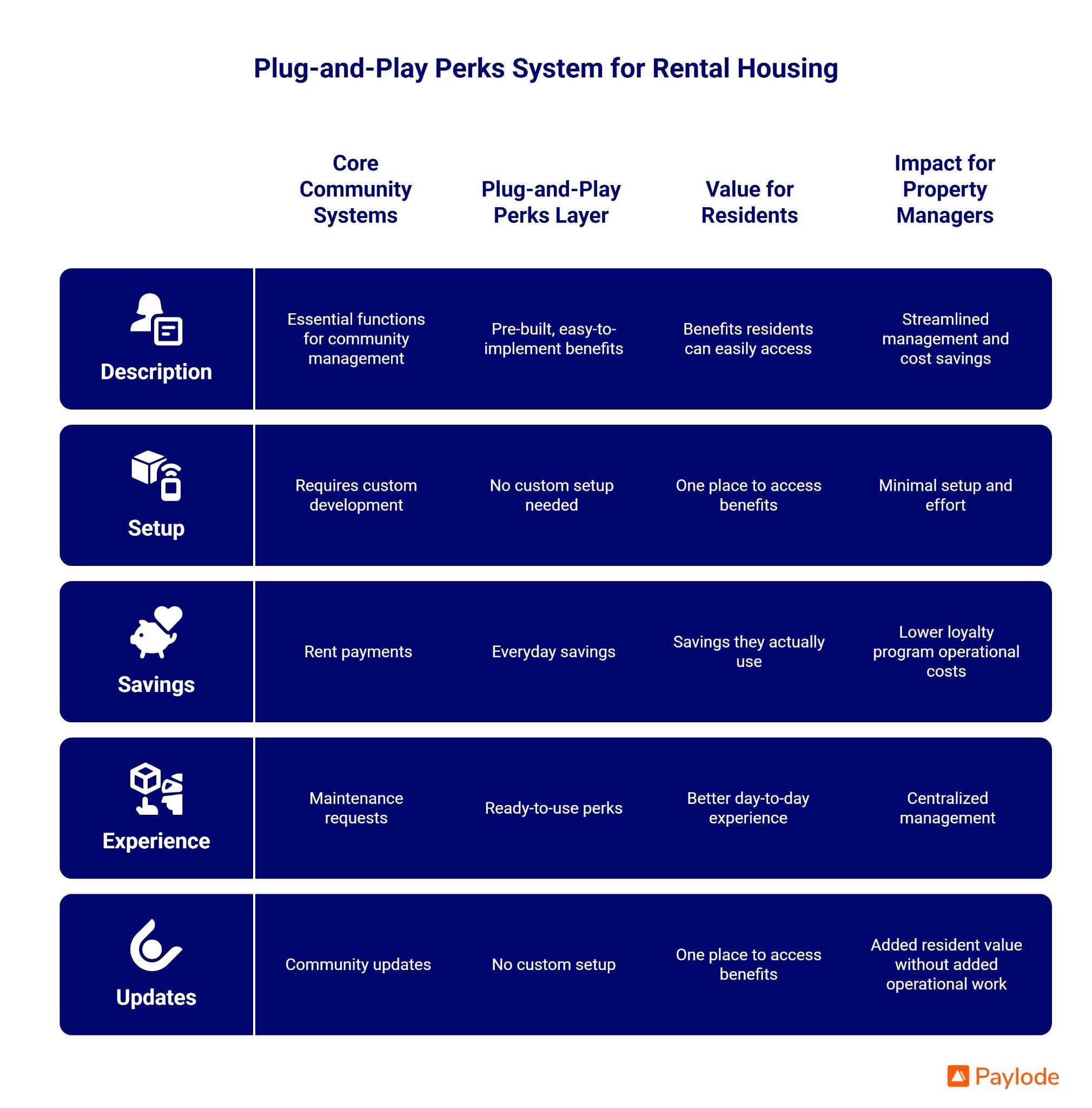
A plug-and-play perks system is designed to fit into existing operations. It works with the tools property teams already use and does not require major changes.
For residents, the experience feels simple and familiar. For property teams, it stays behind the scenes.
A plug-and-play perks system for rental housing is typically accessed through tools residents already rely on, such as a resident app or portal.
It works alongside:
- Rent payments
- Maintenance requests
- Community updates
Residents do not need to learn a new system. Everything feels like part of the same experience.
What does the setup look like for property teams?
Setup is light and focused on speed. Property teams do not need technical expertise to get started.
From an operational view, this means:
- Minimal setup and configuration
- No disruption to daily workflows
- Centralized management across communities
This approach allows rental housing teams to deliver value without increasing workload or training time.
How plug-and-play perks support the full renter journey
A plug-and-play perks system supports residents from first contact through long-term retention. It delivers value at each stage without adding operational burden for property teams.
Leasing stage: Attracting the right renters
Renters often compare communities quickly. Value and everyday benefits can influence decisions before price does.
How perks support leasing:
- Act as a clear differentiator in listings and tours
- Appeal to value-focused renters without offering rent discounts
- Help prospects see long-term value, not just move-in incentives
By positioning perks as part of the living experience, property teams can improve lease conversion, as shown in Paylode’s approach to resident perks.
Move-in stage: Creating a strong first impression
Move-in is a critical moment. Early value helps residents feel confident in their choice.
How perks support move-in:
- Digital welcome perks are available immediately
- Reinforce the decision to lease on day one
- Reduce early questions and uncertainty
This creates a smoother transition for residents and on-site teams.
Living stage: Driving ongoing engagement
After move-in, residents expect benefits they can actually use.
How perks support daily living:
- Everyday savings that fit real routines
- Easy access through familiar systems
- Clear value beyond maintenance and amenities
Perks can also support behaviors that reduce operational effort:
- Encouraging billing efficiency through switching to paperless
- Supporting on-time payments with automatic payments
This keeps engagement high while simplifying day-to-day operations.
Renewal stage: Supporting renewals without rent concessions
Renewal decisions reflect the full lease experience, not just price.
How perks support renewals:
- Build emotional loyalty over time
- Reinforce value during renewal conversations
- Reduce reliance on short-term incentives
This approach supports stronger outcomes tied to raising customer lifetime value.
Retention stage: Long-term relationship building
Retention delivers benefits that grow over time. Each renewal reduces turnover effort and cost.
How perks support retention:
- Ongoing engagement beyond renewal cycles
- Lower vacancy and turnover costs
- Stronger, more consistent brand perception
These long-term gains align with Paylode’s approach to increasing retention, helping communities build stability without added operational strain.
How plug-and-play perks systems reduce loyalty program operational costs
Plug-and-play perks systems are designed to control costs while improving the resident experience. They replace manual effort with a simpler, more predictable approach.
The hidden costs of traditional perks programs
Traditional perks programs often seem manageable at first. Over time, they create work that is hard to track and scale.
Common cost drivers include:
- Manual tracking and reward fulfillment
- Staff time spent coordinating perks and follow-ups
- Managing multiple vendors and offers
- Inconsistent resident experiences across properties
These gaps quietly increase loyalty program operational costs, especially as portfolios grow.
Cost efficiency through simplicity and scale
A plug-and-play model removes many of these issues by design. It works as one system instead of many moving parts.
How this improves cost control:
- One system instead of multiple tools
- Vendor-funded perks rather than operator-funded rewards
- Predictable costs that scale across communities
- Less reliance on staff time for day-to-day management
By keeping perks simple and centralized, property managers can deliver consistent value while maintaining tighter control over loyalty program operational costs.
What should property managers and owners look for in a plug-and-play perks system?
The right plug-and-play perks system should simplify operations, not add new layers of work. It should be easy to launch, easy to manage, and easy for residents to use.
Must-have features for operators include:
- Easy setup and onboarding with little training required
- Centralized management across communities from one place
- Minimal ongoing admin effort for on-site and corporate teams
- Clear engagement and retention insights to support better decisions
These features help property managers and owners deliver consistent resident value while keeping operations organized and efficient.
Questions to ask perk providers
Before selecting a solution, property managers and owners should understand how it will fit into daily operations. The right questions help avoid added work or unexpected costs.
Key questions to ask perk providers include:
- How are perks funded?
- What operational work is required from onsite or corporate teams?
- How does this scale across properties as the portfolio grows?
- How does it integrate with existing systems already in use?
Clear answers ensure the perks system supports resident value while keeping operations simple and predictable.
Conclusion: Turning resident perks into an operational advantage
Plug-and-play perks support the full renter lifecycle, from leasing through long-term retention. They help attract the right renters, deliver early value, and maintain engagement throughout the lease.
For property managers and owners, the benefit goes beyond experience. A plug-and-play approach balances resident satisfaction with operational efficiency and cost control.
When used correctly, resident perks are not short-term promotions. They become a long-term strategy that strengthens retention, simplifies operations, and supports more predictable portfolio performance.
Ready to simplify resident perks without adding work?
A plug-and-play perks system helps rental housing communities deliver real resident value while keeping operations simple and cost-controlled.
Explore how Paylode makes it easy to launch and manage resident perks without adding new tools or manual effort.
FAQs: Plug-and-play perks systems for rental housing communities
What is a plug-and-play perks system?
A plug-and-play perks system is a ready-to-use way to offer residents added value without complex setup. A plug-and-play perks system for rental housing integrates seamlessly with existing tools and can be launched quickly, requiring minimal effort from property teams.
How do perks improve resident retention?
Perks keep residents engaged beyond move-in by offering ongoing, practical value. When residents see benefits they actually use, they are more likely to stay and renew.
Do perks increase the operational costs of loyalty programs?
Not when they are designed to be simple. A centralized perks system helps reduce loyalty program operational costs by minimizing manual work and making programs easier to manage.
Are perks better than rent discounts?
In many cases, yes. Rent discounts are short-term, while perks deliver ongoing value that supports long-term satisfaction without lowering rent.