For property operators, net operating income is not just a financial metric. It is the foundation that supports asset value, investor confidence, and long-term portfolio growth. Even small changes in expenses or resident turnover can quietly weaken NOI over time.
Today, operators are under pressure from rising maintenance costs, higher service expenses, and growing expectations from residents. At the same time, many incentive programs meant to improve engagement or retention reduce revenue or add new costs. This is where a different approach becomes essential.
Merchant-funded rewards protect NOI by helping operators influence resident behavior and satisfaction without spending their own operating dollars. Instead of discounts or credits that reduce income, these rewards deliver value to residents while keeping financial performance stable. In the sections that follow, we explain how this model works and why it is becoming a practical strategy for residential real estate operators.
The hidden cost of traditional resident incentives
Many property operators rely on incentives to improve renewals, encourage timely payments, or increase participation in resident programs. While these efforts are well intentioned, the financial impact is often underestimated.
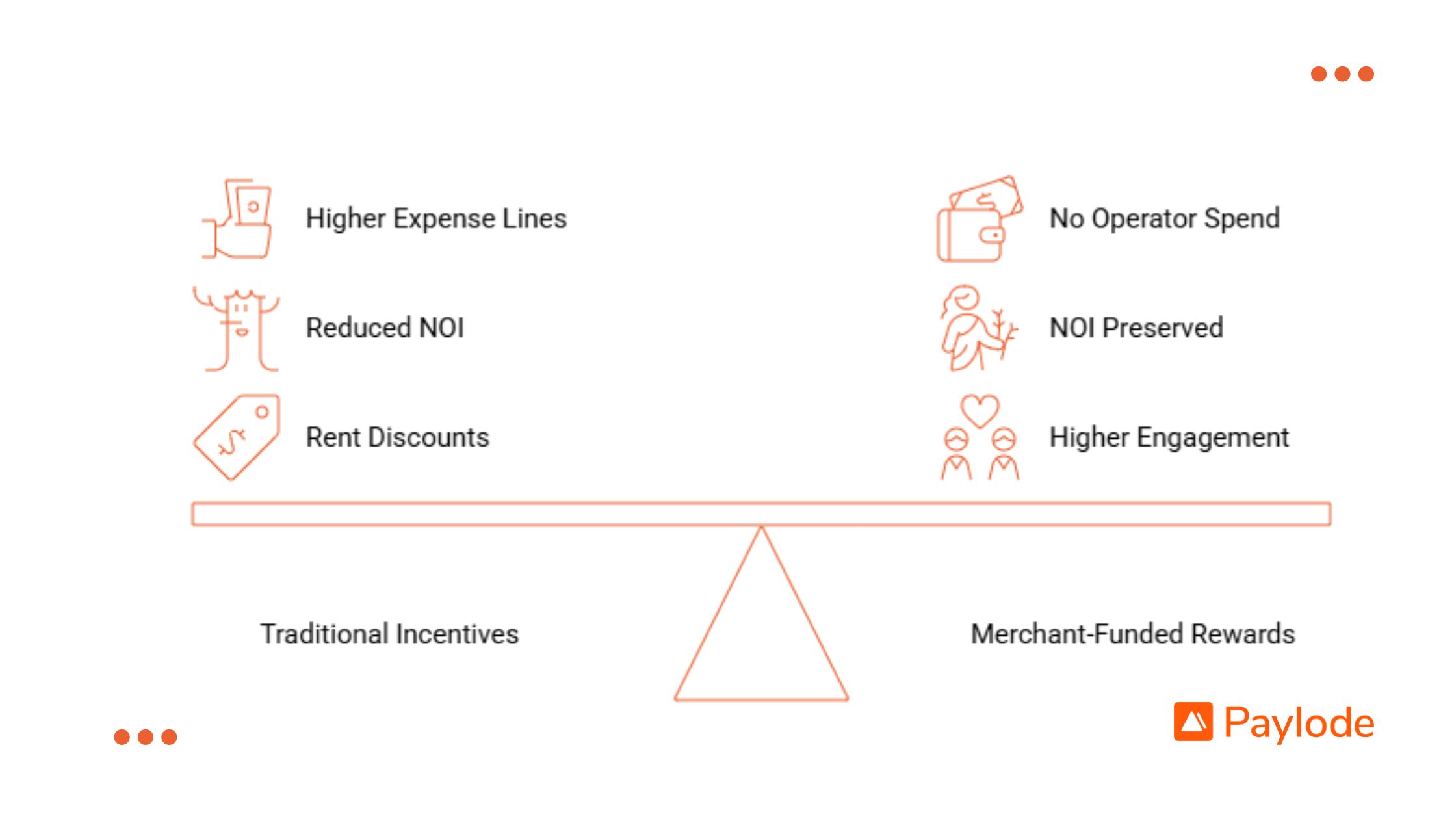
Common incentives such as rent discounts, fee waivers, and operator-funded gift cards directly reduce income or increase expenses. Over time, these costs accumulate and quietly weaken net operating income. What looks like a small concession at the unit level becomes a meaningful drag on performance at the portfolio level.
There is also a long-term risk. Residents can begin to expect discounts as a condition for staying, rather than seeing value in the overall living experience. This creates a cycle where incentives must increase each year, putting even more pressure on NOI.
This is why many operators are rethinking how incentives are funded. Merchant-funded rewards protect NOI by removing the operator from the cost equation, while still giving residents meaningful benefits they use and appreciate.
What merchant-funded rewards mean for property operators
Merchant-funded rewards are simple by design. Local and national merchants provide offers, discounts, or perks to residents in exchange for visibility and customer traffic. The property operator does not pay for these rewards and does not subsidize the value offered to residents.
From an operator’s perspective, this model changes how incentives work. Instead of pulling from operating budgets, rewards are supplied by businesses that want to reach a high-intent residential audience. Residents receive real, everyday savings, while operators avoid adding new expenses.
This structure is why merchant-funded rewards protect NOI so effectively. There is no reduction in rent revenue and no increase in operating costs. The rewards exist alongside the property’s core services, enhancing the resident experience without affecting financial performance.
Most importantly, these rewards feel like added value rather than compensation. Residents see them as a benefit of living at the property, not a short-term incentive tied to a transaction. This distinction plays a critical role in long-term engagement and retention.
How merchant-funded rewards directly protect NOI
Net operating income is influenced by two core factors: revenue stability and cost control. Merchant-funded rewards support both, without forcing operators to make trade-offs.
Because the rewards are funded by merchants, operators do not incur additional expenses. There is no budget allocation, reimbursement process, or ongoing cost management required. This alone removes a common source of NOI erosion tied to traditional incentive programs.
At the same time, merchant-funded rewards do not reduce rent or fees. Revenue remains intact, while residents still receive tangible value they can use in their daily lives. This balance is what makes the model sustainable at scale.
Merchant-funded rewards protect NOI by allowing operators to encourage positive behaviors, such as renewals or on-time payments, without sacrificing income. The financial structure stays clean, predictable, and aligned with long-term asset performance.
Merchant-funded rewards vs operator-funded incentives
To understand why this model works, it helps to compare it with traditional incentives that operators commonly use today. The difference is not just about cost, but about sustainability.
Operator-funded incentives come directly from the property’s budget. Whether it is a rent credit, a gift card, or a fee waiver, the financial impact is immediate. Revenue goes down or expenses go up, and NOI is affected every time the incentive is used.
Merchant-funded rewards work differently. The value comes from merchants who want to reach residents. Operators are not paying for the reward, managing payouts, or tracking reimbursements. The incentive exists outside the operating budget.
This distinction explains why merchant-funded rewards protect NOI over the long term. Operators can continue offering value to residents without creating a recurring financial obligation. The program scales across units and properties without increasing cost, which is rarely true for discounts or cash-based incentives.
Why resident engagement improves without discounts
Resident engagement does not depend on how much money an operator gives away. It depends on whether residents feel supported, recognized, and rewarded in ways that fit their daily lives.
Discounts and credits are often tied to a single action, such as signing a lease or renewing a contract. Once used, the value disappears. Merchant-funded rewards, on the other hand, offer ongoing benefits that residents can access repeatedly, such as savings on food, services, or local experiences.
This ongoing access changes how residents perceive value. Instead of seeing incentives as a one-time transaction, they experience them as part of living at the property. That sense of continuity builds stronger engagement over time.
Merchant-funded rewards protect NOI while improving engagement because they deliver consistent value without lowering rent or increasing costs. Residents stay active, feel appreciated, and associate those benefits with the property, not with a temporary promotion.
How merchant-funded rewards support renewals and retention
Retention has a direct and lasting impact on NOI. Each non-renewal triggers vacancy loss, marketing spend, and operational effort to turn a unit. Even a small improvement in renewal rates can meaningfully stabilize income across a portfolio.
Merchant-funded rewards help influence renewals without relying on rent reductions. Residents who regularly receive useful offers and everyday savings are more likely to feel connected to their living experience. That ongoing value makes staying feel beneficial, not just convenient.
This is where merchant-funded rewards protect NOI in a practical way. Instead of using renewal discounts that permanently reduce revenue, operators create reasons for residents to stay that do not affect rent levels. Over time, higher retention supports predictable cash flow and lowers turnover-related costs.
Practical use cases where merchant-funded rewards protect NOI
Merchant-funded rewards are most effective when they are tied to everyday resident actions. These are moments where operators want to encourage behavior, but traditional incentives would normally impact income or add cost.
One common use case is encouraging timely rent payments. Instead of offering late-fee waivers or rent credits, operators can recognize on-time behavior with access to merchant-funded offers. Residents feel acknowledged, while rent revenue remains untouched.
Another use case is driving adoption of digital services such as automatic payments or paperless communication. When residents are rewarded for choosing efficient options, operational costs decline over time. Fewer manual processes mean lower administrative effort and fewer errors.
In each scenario, merchant-funded rewards protect NOI by aligning resident behavior with operational efficiency. Operators influence outcomes without reducing rent, increasing expenses, or creating ongoing financial commitments.
Why this rewards model scales across residential portfolios
What works for one property must also work across dozens or hundreds of locations. Many incentive programs fail at this stage because costs grow in direct proportion to portfolio size. The more units involved, the higher the expense and the greater the pressure on NOI.
Merchant-funded rewards scale differently. Because merchants fund the value, adding more residents does not increase operator spend. The program expands without requiring additional budget approvals or financial adjustments. This makes it practical for both single-asset operators and large portfolios.
Consistency is another advantage. Residents across different properties receive access to the same type of everyday value, creating a uniform experience. That consistency supports brand perception and operational simplicity, both of which are important for long-term portfolio performance.
This is another reason merchant-funded rewards protect NOI at scale. Operators can grow their portfolios without growing incentive costs, while still delivering meaningful benefits to residents.
How Paylode enables merchant-funded rewards without adding complexity
For property operators, simplicity matters as much as results. A rewards program should be easy to launch, easy to manage, and easy for residents to use. If it adds complexity, adoption drops and value is lost.
Paylode enables merchant-funded rewards through a single, unified platform that fits naturally into the resident experience. Operators can offer everyday rewards without managing vendors, negotiating deals, or tracking redemptions. Merchants fund the rewards, residents receive the value, and operators stay focused on running their properties.
This structure ensures merchant-funded rewards protect NOI while remaining practical at scale. There is no hidden workload for on-site teams and no ongoing financial oversight required. The program runs quietly in the background, supporting engagement without disrupting operations.
Connecting rewards to everyday resident actions
Rewards are most effective when they feel relevant. Instead of being tied only to major events, merchant-funded rewards can be connected to routine resident actions that already support property performance.
For example, residents who opt into automatic payments or digital communication help reduce administrative effort and processing costs. When those choices are reinforced with merchant-funded rewards, adoption increases naturally. Over time, these small efficiency gains contribute to more predictable operating outcomes.
This approach allows operators to guide behavior without mandates or penalties. Merchant-funded rewards protect NOI by encouraging smarter choices while keeping the resident experience positive and voluntary.
Why this approach builds trust with residents
Trust plays a larger role in retention than many operators realize. When residents feel they are being “bought” with discounts, the relationship becomes transactional. When value is added without reducing rent or changing terms, trust grows.
Merchant-funded rewards feel like a benefit, not a negotiation. Residents are not asked to trade loyalty for a discount. Instead, they receive access to everyday savings simply because they live at the property.
Over time, this strengthens the relationship between residents and operators. That trust supports longer stays, fewer disputes, and a more stable community, all of which contribute to NOI protection.
Merchant-funded rewards as a long-term NOI strategy
Short-term incentives can solve immediate problems, but they rarely support long-term financial health. Each renewal discount or credit reduces future income potential and sets a precedent that is difficult to reverse.
Merchant-funded rewards offer a different path. They allow operators to invest in resident experience without touching rent or expenses. As portfolios grow, the financial structure remains consistent and predictable.
This is why merchant-funded rewards protect NOI not just today, but over the life of an asset. They align resident satisfaction with financial discipline, rather than forcing a choice between the two.
Conclusion – protecting NOI without reducing resident value
Property operators no longer need to choose between strong financial performance and a compelling resident experience. Merchant-funded rewards make it possible to deliver both at the same time.
By shifting the cost of rewards away from the operator and toward merchants, this model preserves income, controls expenses, and supports long-term retention. Residents receive real, usable value, while operators maintain the financial stability that NOI depends on.
For teams looking to strengthen engagement without sacrificing margins, exploring merchant-funded rewards through the Paylode platform, including its perks offering and automation capabilities, is a practical next step. Reviewing available plans and booking a demo can help operators understand how this approach fits into their portfolio strategy.
FAQs
How do merchant-funded rewards protect NOI?
They provide resident value without reducing rent or increasing operating expenses, keeping income stable.
Do property operators pay for merchant-funded rewards?
No. The rewards are funded by merchants who want access to residents.
Can merchant-funded rewards replace renewal discounts?
Yes. They support retention without lowering rent, making them more sustainable long term.
Are these rewards useful for residents?
Yes. They focus on everyday savings that residents can use regularly.
Do merchant-funded rewards work for large portfolios?
Yes. Because costs do not scale with unit count, the model works across portfolios of any size.