Late fees have long been the default tool for rent enforcement in residential real estate. For decades, penalties, warnings, and manual follow-ups formed the backbone of rent collection strategies. When operating models were simpler and renter expectations lower, this approach was often enough to keep payments on track.
Today, that reality has changed. Rising cost-of-living pressures, digital-first renter expectations, and leaner onsite teams have made enforcement-heavy strategies less effective—and more costly. Late fees may still correct individual missed payments, but they rarely improve long-term payment behavior. In many cases, they increase friction, strain resident relationships, and create more work for property teams.
As the industry evolves, property operators are beginning to rethink rent enforcement altogether. Instead of asking how to penalize late payments more effectively, they are asking how to prevent lateness in the first place. This shift has given rise to modern alternatives for rent enforcement that focus on loyalty, behavior, and automation rather than punishment.
Across the residential real estate landscape, successful operators are moving from fear-based compliance to motivation-driven engagement. By reinforcing positive behavior, reducing friction in the payment process, and using technology to deliver consistency at scale, they are achieving better on-time rent outcomes without increasing conflict.
This article explores the transition from late fees to loyalty. We’ll examine why traditional enforcement strategies are losing effectiveness, the hidden costs of penalty-driven models, and how modern, loyalty-based alternatives are reshaping rent collection into a more sustainable, resident-friendly process.
1. Why late fees became the standard rent enforcement tool
Late fees became the foundation of rent enforcement because they were simple, familiar, and easy to implement. In traditional property management models, penalties were viewed as a direct way to discourage late payments and protect cash flow without requiring additional systems or processes.
Historically, late fees worked because renter behavior and operating environments were different. Renters had fewer digital payment options, onsite teams were larger, and manual follow-ups were more common. A clearly defined penalty created urgency, and most residents adjusted their behavior quickly to avoid additional charges.
Late fees were also attractive because they were reactive and low-effort. Property managers did not need to predict behavior or motivate renters proactively. If rent was late, the system responded with a fee. This approach fit well within compliance-driven property management frameworks where enforcement was prioritized over engagement.
Another reason late fees became standard is that they aligned with legal and accounting structures. Penalties were easy to document, apply consistently, and justify as part of lease agreements. For many years, this made them the most straightforward option available.
However, while late fees addressed missed payments in the moment, they were never designed to build habits or improve long-term behavior. As renter expectations and financial pressures evolved, the limitations of enforcement-only strategies became more apparent.
2. Why late fees are losing effectiveness today
Late fees are still widely used, but their ability to influence renter behavior has declined significantly. Modern residential real estate operates in a very different environment than it did even a decade ago. As renter psychology, financial pressure, and operating models evolve, enforcement-first strategies are delivering diminishing returns.
2.1 Rising cost-of-living pressure reduces deterrence
Renters today face higher costs across essentials like groceries, utilities, transportation, and healthcare. In this environment, a late fee often feels less like a deterrent and more like an added burden. Instead of motivating earlier payment, penalties can push renters further behind and increase stress.
In many residential real estate markets, late fees no longer change behavior because renters are already operating close to financial limits. When penalties fail to account for this reality, they lose their effectiveness as a behavioral tool.
2.2 Late fees are reactive, not preventative
Late fees only apply after rent is already overdue. By the time a penalty is triggered, the desired behavior—on-time payment—has already failed. This makes late fees corrective rather than preventative.
Modern alternatives for rent enforcement focus on influencing behavior before rent is due. Strategies that rely solely on penalties miss the opportunity to motivate timely payment proactively.
2.3 Enforcement fatigue and diminishing impact
Repeated exposure to late fees reduces their psychological impact. When renters experience penalties month after month, fees become normalized rather than motivating. Over time, enforcement loses urgency and becomes part of the background.
This enforcement fatigue is especially common in communities where reminders, warnings, and notices are frequent but offer no positive reinforcement.
2.4 Late fees strain resident–manager relationships
Penalty-driven enforcement often turns rent-related communication into negative interactions. When most contact with management revolves around fees or warnings, trust erodes. Renters become less likely to engage proactively or communicate early when issues arise.
This strained dynamic increases conflict and can negatively affect retention, satisfaction, and community reputation—outcomes that matter far beyond rent collection.
2.5 Late fees do not build long-term payment habits
Late fees may correct a single missed payment, but they do little to reinforce consistent, on-time behavior over time. They rely on fear rather than motivation, which rarely leads to habit formation.
Modern rent strategies recognize that long-term improvement comes from reinforcement, not punishment. This realization is driving the shift away from enforcement-only models toward loyalty-based alternatives.
3. The hidden costs of enforcement-first rent strategies
Enforcement-heavy rent collection models often appear effective on the surface, but they carry hidden costs that impact operations, resident relationships, and long-term performance. These costs are rarely captured in financial reports, yet they directly influence retention, workload, and brand perception.
3.1 Increased conflict between residents and management
When rent enforcement relies primarily on penalties, interactions between residents and management become reactive and emotionally charged. Conversations about rent are framed around what went wrong rather than how to improve outcomes.
This dynamic:
- Increases defensiveness and frustration
- Reduces trust and cooperation
- Discourages proactive communication from residents
Over time, conflict becomes normalized, making rent-related issues harder—not easier—to resolve.
3.2 Higher staff workload tied to collections and disputes
Enforcement-first strategies create operational drag. Late fees often lead to:
- Disputes over charges
- Requests for exceptions
- Payment plan negotiations
- Manual follow-ups and documentation
Each interaction consumes staff time that could be spent on leasing, service, or resident experience. As portfolios scale or staffing levels shrink, this workload becomes unsustainable.
3.3 Negative impact on retention and brand perception
Renters remember how they are treated during stressful moments. Communities known for strict or inflexible enforcement often develop a negative reputation, even if policies are technically fair.
Penalty-driven environments:
- Reduce goodwill
- Increase dissatisfaction
- Undermine emotional loyalty
When renters feel punished rather than supported, renewal decisions are more likely to tilt toward moving out.
3.4 Why enforcement increases churn risk
Late fees may protect short-term revenue, but they can increase long-term churn. Renters who feel constantly penalized are less forgiving of rent increases, service issues, or market changes.
Churn driven by enforcement has real costs:
- Vacancy loss
- Turnover expenses
- Marketing and leasing effort
Modern alternatives for rent enforcement aim to reduce these risks by motivating timely payment through engagement rather than fear.
4. The psychology of rent compliance vs. rent motivation
To understand why modern alternatives for rent enforcement are more effective, it’s important to distinguish between rent compliance and rent motivation. While enforcement strategies focus on forcing compliance, loyalty-based approaches aim to motivate consistent, voluntary behavior. This difference has a significant psychological impact on renters.
4.1 Rent is a non-discretionary expense
Renters do not view rent as optional spending. It is a fixed, high-priority obligation that already carries emotional and financial weight. When enforcement strategies rely on fear—late fees, warnings, or notices—they add pressure to an already stressful responsibility.
Compliance-based models assume renters need to be pushed to pay. In reality, most renters want to pay on time but need systems that reduce friction and reinforce good behavior.
4.2 Fear-based compliance fails long term
Fear can correct behavior temporarily, but it does not build habits. Renters who pay on time only to avoid penalties are reacting, not forming routines. Over time, this leads to inconsistency, reminder fatigue, and resentment.
When enforcement is the primary motivator:
- Payment behavior fluctuates
- Engagement declines
- Communication becomes avoidant
This is why fear-based compliance often plateaus or worsens over time.
4.3 Motivation is built through positive reinforcement
Motivation works differently. When renters receive acknowledgment or value for paying on time, the behavior feels appreciated rather than enforced. This positive reinforcement strengthens the connection between action and outcome, making repetition more likely.
Motivated renters:
- Pay on time more consistently
- Engage proactively with management
- Communicate earlier when issues arise
This shift from pressure to appreciation is a key driver behind modern rent strategies.
4.4 Habit formation matters more than enforcement
Long-term improvement in on-time rent comes from habit formation. Behavioral science shows that habits form when actions are consistently followed by positive outcomes.
Motivation-based strategies:
- Reinforce on-time payment every month
- Reduce reliance on reminders and penalties
- Create predictable payment routines
Modern alternatives for rent enforcement are designed to support these habit loops rather than interrupt them with punishment.
5. Modern alternatives for rent enforcement that actually work
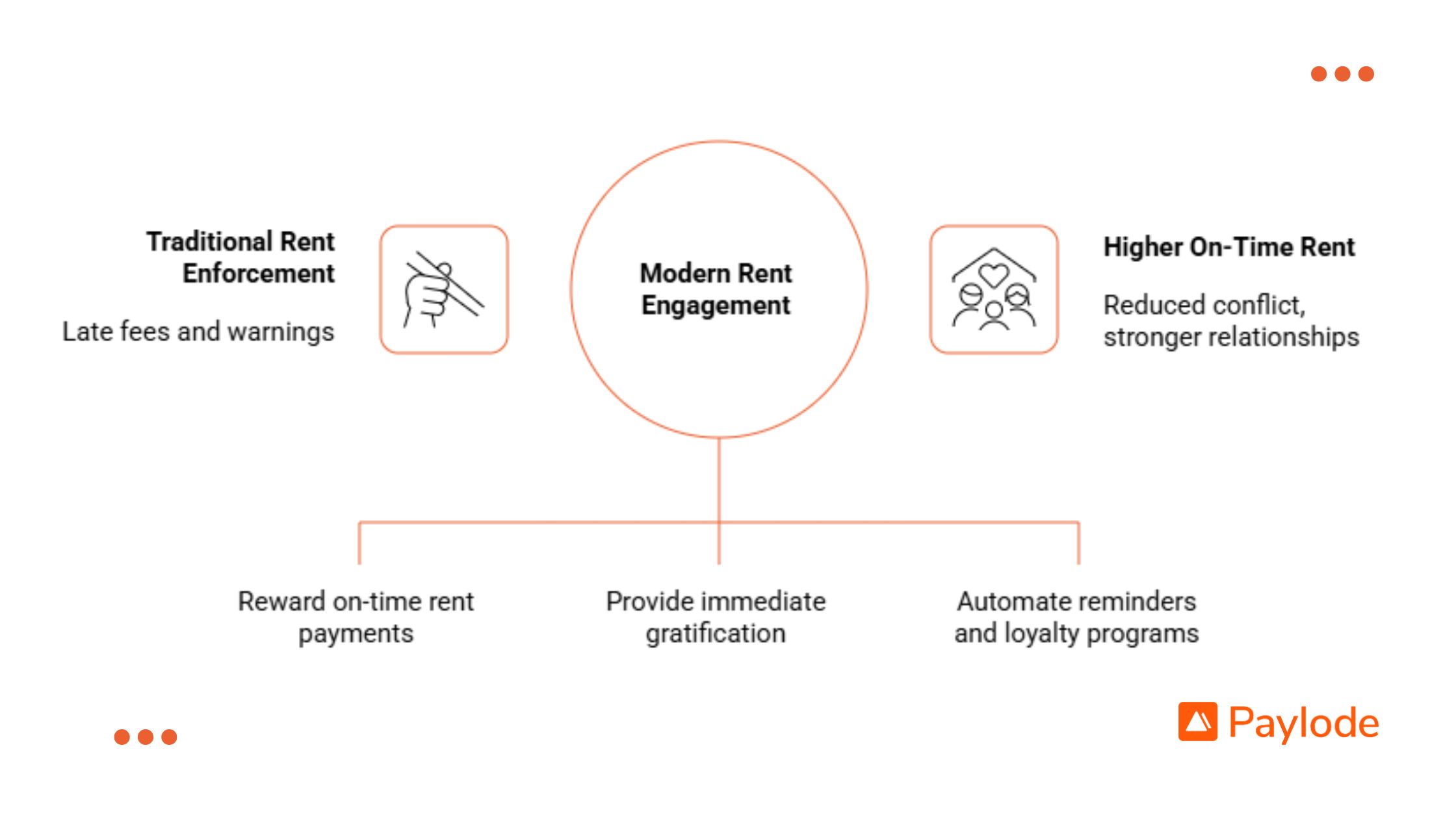
Modern rent enforcement strategies focus on influencing behavior before rent is late rather than correcting it afterward. These approaches replace fear-based penalties with motivation-driven engagement, creating better outcomes for both renters and property managers.
5.1 Rewarding on-time rent instead of penalizing lateness
One of the most effective modern alternatives for rent enforcement is shifting from punishment to recognition. Instead of focusing on what happens when rent is late, property managers reward renters when rent is paid on time.
This shift has a powerful behavioral impact. When renters feel acknowledged for doing the right thing, timely payment becomes a positive experience rather than a stressful obligation. Recognition reinforces responsibility and encourages renters to repeat the behavior consistently.
Behavioral benefits of rewarding on-time rent include:
- Stronger habit formation
- Reduced reminder fatigue
- Improved renter–manager relationships
- Lower likelihood of repeat delinquency
Recognition-based strategies also change the emotional tone of rent collection, making compliance feel voluntary rather than forced.
5.2 Using instant rewards to reinforce payment behavior
Immediacy is critical when reinforcing behavior. Rewards delivered weeks or months after rent is paid lose their psychological impact because the connection between action and reward fades. Instant rewards solve this problem by delivering value at the exact moment the desired behavior occurs.
When renters receive immediate benefits after paying rent on time, the behavior feels complete and satisfying. This real-time reinforcement strengthens motivation far more effectively than delayed incentives or point accumulation.
Instant rewards outperform delayed incentives because they:
- Create a clear cause-and-effect relationship
- Require no tracking or waiting from renters
- Feel tangible and relevant to everyday life
Everyday, merchant-funded rewards available through Paylode Perks are especially effective because they provide practical value renters can use immediately—without increasing operating costs for property managers.
By combining recognition with instant value, modern alternatives for rent enforcement motivate renters proactively, reducing late payments without relying on penalties or conflict.
6. Loyalty-driven rent strategies vs. enforcement models
As property managers rethink rent enforcement, the contrast between loyalty-driven strategies and traditional enforcement models becomes clear. While both aim to improve on-time rent, they operate on fundamentally different principles—and deliver very different results.
6.1 Transactional compliance vs. emotional loyalty
Enforcement models are transactional. Renters comply to avoid negative consequences such as late fees or notices. This form of compliance is fragile and short-lived. Once the fear of penalties diminishes, so does its effectiveness.
Loyalty-driven strategies focus on emotional loyalty instead. Renters are motivated because they feel appreciated, supported, and valued. This emotional connection encourages consistent behavior even when circumstances change, making loyalty-based approaches more resilient over time.
6.2 Short-term correction vs. long-term behavior change
Late fees are designed to correct behavior after a problem occurs. They address a single missed payment but rarely influence what happens next month. As a result, property teams remain stuck in a cycle of reminders, penalties, and follow-ups.
Loyalty-driven strategies aim for long-term behavior change. By reinforcing on-time payment consistently through recognition and rewards, renters form habits that reduce the need for ongoing intervention. Over time, timely payment becomes automatic rather than reactive.
6.3 Pressure-based enforcement vs. motivation-based engagement
Enforcement models rely on pressure. Renters pay on time because they fear penalties. This pressure often increases stress and avoidance, leading to strained communication and lower satisfaction.
Motivation-based engagement works differently. Renters are encouraged to pay on time because there is a positive outcome attached to the action. This approach lowers emotional friction and creates a cooperative dynamic between residents and management.
6.4 Scalability and sustainability
Enforcement-heavy strategies become harder to sustain as portfolios grow. Manual follow-ups, disputes, and exceptions increase staff workload and inconsistency. Loyalty-driven models, especially when paired with automation, scale more easily and remain consistent across properties.
By shifting from enforcement to loyalty, property managers move from controlling behavior to cultivating it. This transition is at the heart of modern alternatives for rent enforcement and explains why loyalty-driven strategies consistently outperform penalty-based models.
7. Automation as a modern alternative to manual enforcement
Automation is a critical enabler of modern alternatives for rent enforcement. By removing manual intervention from routine rent collection tasks, property managers can shift from reactive policing to proactive engagement—without increasing staff workload or inconsistency.
7.1 Removing staff from rent policing
Manual enforcement places staff in the uncomfortable role of policing rent payments. Repeated follow-ups, warning calls, and exception handling not only consume time but also strain resident relationships.
Automation removes staff from this position. System-driven workflows handle reminders, confirmations, and incentives automatically, allowing teams to focus on service, leasing, and resident experience rather than collections.
7.2 Automated reminders, rewards, and workflows
Automation enables rent strategies that operate in real time. Reminders can be timed precisely before due dates, rewards can be triggered instantly after on-time payments, and follow-ups can be handled consistently without manual oversight.
This closed-loop approach:
- Reinforces positive behavior immediately
- Prevents late payments before they occur
- Eliminates delays that weaken motivation
Automated workflows ensure that every renter receives the same experience, every month.
7.3 Consistency and fairness at scale
Fairness is essential to renter trust. Automation applies the same rules to all residents, removing subjectivity and inconsistency that often arise with manual processes.
As portfolios grow, this consistency becomes even more important. Automation allows modern rent strategies to scale across properties without increasing complexity or staffing needs.
Platforms like Paylode Boost enable property managers to automate behavior-driven incentives and rent workflows, making loyalty-based enforcement practical and sustainable at scale.
8. How modern rent strategies reduce delinquency without conflict
One of the biggest advantages of moving from late fees to loyalty-based rent strategies is the ability to reduce delinquency without creating tension between residents and management. Modern alternatives for rent enforcement are designed to prevent late payments proactively rather than react to them after the fact.
8.1 Preventing late payments before they happen
Modern rent strategies focus on early intervention. Automated reminders, clear due-date communication, and incentives tied to on-time payment help renters act before rent becomes overdue. By reinforcing expectations ahead of time, these systems reduce the likelihood of delinquency altogether.
When renters know there is a positive outcome attached to paying on time, the motivation shifts from avoidance to intention.
8.2 Neutral, system-driven communication
Conflict often arises when rent enforcement feels personal. Manual calls, warnings, or emails can feel confrontational—even when they are necessary. Modern rent strategies rely on system-driven communication that is neutral, consistent, and predictable.
This neutrality:
- Reduces emotional defensiveness
- Prevents misunderstandings
- Keeps rent discussions professional rather than personal
Automated messages feel informational rather than punitive, which lowers friction and preserves trust.
8.3 Supporting renters instead of pressuring them
Loyalty-based approaches position property management as supportive rather than punitive. When renters experience recognition for positive behavior, they are more likely to communicate early if challenges arise.
This openness allows property teams to address issues before they escalate into delinquency. Instead of reacting to missed payments, managers can focus on prevention, flexibility, and long-term consistency.
8.4 Building cooperation through predictability
Predictable processes reduce anxiety. When renters understand exactly how rent is handled—what reminders look like, when rewards are delivered, and how automation works—they feel more in control.
This predictability builds cooperation and makes timely payment the path of least resistance.
By reducing friction, removing emotion from enforcement, and reinforcing positive behavior, modern rent strategies lower delinquency while strengthening resident relationships. This is the core benefit of shifting from late fees to loyalty.
9. Financial benefits of moving from late fees to loyalty
Shifting from late fees to loyalty-based rent strategies is not just a resident experience decision—it delivers measurable financial benefits for property owners and operators. Modern alternatives for rent enforcement improve revenue stability while reducing costs tied to collections and turnover.
9.1 More predictable cash flow
On-time rent is the foundation of predictable cash flow. Loyalty-based strategies improve payment consistency by motivating renters before payments are due rather than penalizing them afterward. When more residents pay on time, properties experience fewer cash flow gaps and less reliance on reserves or short-term adjustments.
Predictability also improves financial planning, making budgeting and forecasting more accurate at both the property and portfolio levels.
9.2 Reduced bad debt and write-offs
Late payments often escalate into partial payments, extended delinquency, or uncollectible balances. By preventing lateness rather than reacting to it, loyalty-driven approaches reduce the likelihood that rent becomes bad debt.
Lower delinquency means fewer write-offs and a healthier rent roll—outcomes that directly protect revenue.
9.3 Lower operational costs tied to collections
Enforcement-first models generate hidden costs through staff time spent on:
- Manual follow-ups
- Payment disputes
- Exception handling
- Documentation and reporting
Loyalty-based strategies reduce these activities by improving on-time behavior upstream. Automation further minimizes the need for staff intervention, allowing teams to focus on higher-value tasks such as leasing, service, and resident engagement.
9.4 Improved net operating income (NOI)
Improved cash flow and reduced operating costs combine to strengthen NOI. Even modest improvements in on-time payment rates can produce meaningful gains when applied across multiple units or properties.
Unlike late fees, which create unpredictable revenue and potential resident friction, loyalty-based strategies deliver sustainable financial performance without increasing churn risk.
9.5 Stronger long-term asset performance
Properties with consistent rent collection and lower delinquency are more attractive to owners, lenders, and investors. Stable payment behavior reduces perceived risk and supports stronger valuations.
By moving from late fees to loyalty, operators align financial performance with resident satisfaction—creating a more resilient asset over the long term.
10. Real-world comparison: late fees vs. loyalty-based approaches
When evaluated side by side, the difference between traditional late-fee enforcement and modern, loyalty-based rent strategies becomes clear. While both aim to protect revenue, they deliver very different resident experiences, operational outcomes, and long-term results.
10.1 Resident experience
Late fees frame rent as a penalty-driven obligation. Renters associate payments with stress, warnings, and consequences. Over time, this creates defensiveness and disengagement.
Loyalty-based approaches reframe rent as a positive interaction. Renters experience recognition for responsible behavior, which builds goodwill and emotional loyalty. Paying rent on time feels acknowledged rather than merely expected.
10.2 Payment consistency
Late fees correct behavior after rent is already late. They may recover some revenue, but they do not reliably improve consistency month over month.
Loyalty-based strategies influence behavior before payments are due. By motivating renters proactively, these approaches deliver higher on-time payment rates and fewer recurring delinquencies.
10.3 Staff workload
Enforcement-heavy models increase operational burden. Staff spend significant time on follow-ups, disputes, and exception handling related to penalties.
Loyalty-based models—especially when automated—reduce this workload. Rewards, reminders, and workflows operate in the background, freeing teams to focus on leasing, service, and community building.
10.4 Retention impact
Renters who experience frequent penalties are more likely to leave at renewal, particularly when faced with rent increases or service issues.
Loyalty-driven strategies strengthen retention by creating positive, ongoing experiences throughout the lease term. Renters are more forgiving and more likely to renew when they feel valued.
10.5 Scalability across portfolios
Late-fee enforcement becomes harder to manage consistently as portfolios grow. Manual processes introduce variability and risk.
Loyalty-based approaches scale more effectively. Automated systems apply the same rules across properties, ensuring fairness, consistency, and predictable outcomes at scale.
This comparison highlights why modern alternatives for rent enforcement are moving away from penalties and toward loyalty. The shift delivers better payment behavior, lower operational friction, and stronger long-term performance.
11. How Paylode enables modern alternatives for rent enforcement
Modern alternatives for rent enforcement require more than good intentions—they require a platform that can consistently motivate behavior, reduce friction, and scale across properties without increasing cost or complexity. Paylode is purpose-built to support the shift from late fees to loyalty by combining rewards, automation, and portfolio-wide visibility into a single system.
11.1 Merchant-funded loyalty rewards that motivate renters
Paylode replaces penalty-driven enforcement with everyday, merchant-funded rewards that renters actually value. Instead of relying on late fees or rent credits, property managers can recognize on-time rent with practical savings on dining, retail, wellness, and essentials.
These rewards are delivered through Paylode Perks, allowing operators to offer meaningful incentives without impacting operating budgets or NOI. Because rewards are funded by merchants, programs remain sustainable while delivering high perceived value to residents.
11.2 Automated, behavior-driven incentives
Timing is critical in behavioral reinforcement. Paylode automates reward delivery so incentives are triggered immediately after rent is paid on time. This real-time reinforcement strengthens habit formation and reduces the need for reminders or follow-ups.
Through Paylode Boost, property teams can create automated workflows that link rent behavior to rewards, reminders, and communication—without manual intervention. This ensures consistency, fairness, and reliability across all residents.
11.3 Portfolio-wide visibility and consistency
Paylode provides centralized insight into rent behavior and engagement trends across properties. Property managers can monitor on-time payment patterns, reward participation, and behavioral outcomes from a single dashboard.
This visibility enables data-driven decision-making and allows teams to refine rent strategies proactively rather than reacting to delinquency after it occurs.
11.4 White-label resident experience that builds trust
Trust plays a major role in renter engagement. Paylode supports white-label deployment, allowing loyalty and reward experiences to appear as a seamless part of the property’s existing resident ecosystem.
When incentives feel integrated and familiar, renters are more likely to engage consistently. This branded experience reinforces trust while strengthening the emotional connection between residents and the community.
By combining merchant-funded rewards, automation, and portfolio-level insight through the Paylode platform, property managers can replace enforcement-heavy rent strategies with loyalty-driven alternatives that improve on-time rent, reduce conflict, and scale effortlessly.
12. Common mistakes when replacing late fees with loyalty strategies
Transitioning from enforcement-first rent strategies to loyalty-based alternatives requires careful execution. When done incorrectly, even well-intentioned programs can underperform or create confusion. Below are the most common mistakes property managers make when moving away from late fees—and how to avoid them.
12.1 Removing penalties without adding motivation
One of the biggest mistakes is eliminating late fees without introducing a motivating alternative. Removing penalties alone does not improve behavior; it simply removes a consequence. Without positive reinforcement, renters lack a reason to change payment habits.
Successful loyalty strategies replace penalties with clear incentives that reward on-time behavior rather than merely eliminating enforcement.
12.2 Using delayed or low-value incentives
Loyalty programs fail when rewards arrive too late or feel irrelevant. Delayed incentives weaken the psychological connection between action and reward, while low-value rewards fail to motivate.
Modern alternatives for rent enforcement rely on instant, everyday value—rewards renters can use immediately and repeatedly.
12.3 Relying on manual processes
Manual reward tracking, approvals, or communication introduce delays and inconsistency. These issues quickly erode trust and increase staff workload.
Automation is essential. Loyalty strategies must operate in real time and without manual intervention to remain effective and scalable.
12.4 Inconsistent application across properties or residents
Inconsistency undermines fairness. When rewards are applied unevenly—by property, unit, or situation—renters become confused or disengaged.
Loyalty-based enforcement must be standardized and predictable to build trust and reinforce habits.
12.5 Poor communication during the transition
Failing to clearly explain how new rent strategies work can create uncertainty. Renters need to understand:
- What behaviors are rewarded
- When rewards are delivered
- How automation works
Clear, proactive communication ensures adoption and prevents skepticism.
Avoiding these mistakes allows loyalty-based rent strategies to work as intended. When motivation replaces punishment, and automation replaces manual enforcement, on-time rent becomes easier to achieve—and sustain.
Conclusion
Late fees may still have a place in rent policy, but they are no longer sufficient as the primary tool for rent enforcement. As renter expectations evolve and operational efficiency becomes more critical, enforcement-first strategies create friction, increase workload, and fail to drive consistent on-time payments.
Modern alternatives for rent enforcement focus on loyalty, behavior, and automation. By rewarding on-time rent, delivering instant value, and removing manual intervention from collections, property managers can motivate renters proactively instead of reacting to missed payments. This shift reduces conflict, improves payment consistency, and strengthens resident relationships.
Moving from late fees to loyalty is not about being lenient—it’s about being effective. When renters feel appreciated rather than penalized, they are more likely to form consistent payment habits. When systems are automated and fair, property teams gain predictability without added complexity.
The future of rent enforcement is not stricter penalties, but smarter engagement. Loyalty-driven strategies create better outcomes for renters, property managers, and asset performance alike.
FAQs
Are late fees still necessary in modern property management?
Late fees can still serve as a backstop, but they should not be the primary rent enforcement strategy. On their own, they are reactive and do not improve long-term payment behavior.
Do loyalty-based rent strategies actually improve on-time payments?
Yes. Loyalty-based strategies that reward on-time rent and reinforce behavior proactively have been shown to improve payment consistency and reduce repeat delinquency.
How do rewards reduce late rent without increasing costs?
Modern programs use merchant-funded rewards, which provide real value to renters without impacting operating budgets or reducing rental income.
Can loyalty-based alternatives scale across large portfolios?
Yes. When combined with automation, loyalty-based rent strategies can be applied consistently across properties while maintaining fairness and visibility.
Does removing penalties increase delinquency risk?
Not when penalties are replaced with motivation. Removing late fees without adding incentives can increase risk, but loyalty-driven strategies paired with automation reduce delinquency proactively.
What is the biggest benefit of moving from late fees to loyalty?
The biggest benefit is sustainable behavior change. Loyalty-based strategies improve on-time rent while reducing conflict, staff workload, and churn risk.