A security deposit return letter is a written statement that a landlord sends to a former resident after the lease ends. It shows the original deposit, lists any deductions with their costs, states the amount being returned or still owed and explains how the refund is paid. State laws set a deadline for the letter, and in some states, such as New York, missing it means the landlord loses the right to keep any part of the deposit.
The stakes are real. In New York, a landlord who does not provide the itemized statement and refund within 14 days of the resident leaving forfeits any right to keep any portion of the deposit. In California, a court can award a resident up to twice the amount of the deposit, plus actual losses, when a landlord keeps it in bad faith.
How Long Does A Landlord Have To Return A Security Deposit?
In the five states below, the clock starts when the resident leaves or the lease ends, with the exceptions noted.
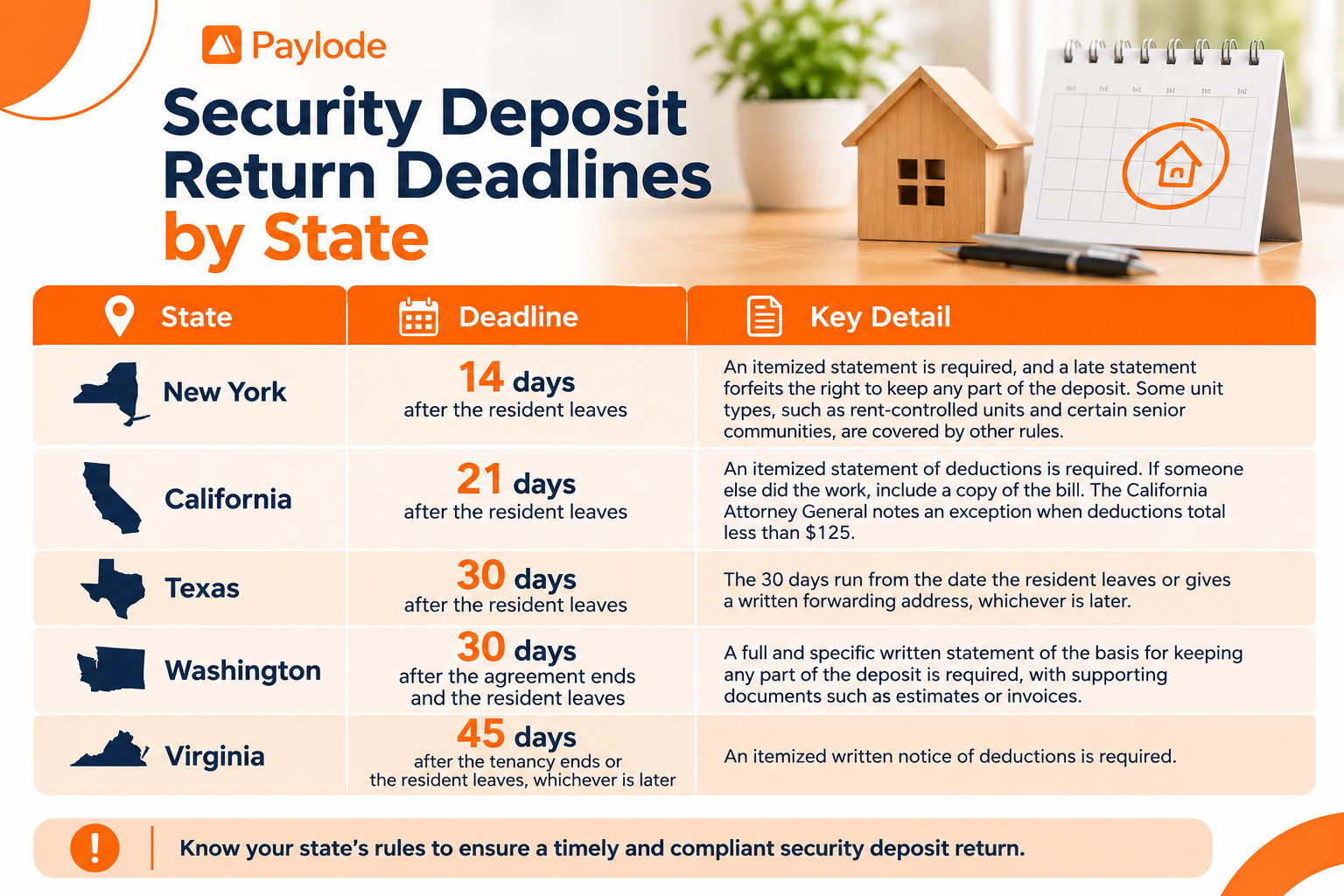
Cities and subsidized housing programs can add their own rules. This article is general information. Have your legal team confirm the deadline, statement format and payment rules for each state and city where you operate.
What Should A Security Deposit Return Letter Include?
- The date of the letter and the former resident's name
- The unit address and the date the resident left
- The original deposit amount and any interest required by state or local law
- Each deduction, with a description, the cost and the evidence behind it
- Copies of bills or invoices where required, such as California's rule for work done by others
- The total refund, or the balance the resident still owes
- How and when the refund is being paid
- A contact name for questions or disputes
Security Deposit Return Letter Examples
Copy and adapt the examples below. Replace everything in brackets and have your legal team confirm the wording for each state.
Example 1: Full refund
[Date]
Dear [Former resident name],
Thank you for living at [Property name]. Your lease for [Unit address] ended on [Date], and we completed the final inspection on [Date].
We are pleased to return your full security deposit of $[Amount] [If required: plus interest of $Amount]. The refund was sent by [Payment method] to [Forwarding address or account] on [Date].
If you have any questions, please contact [Name] at [Phone or email]. We wish you all the best in your new home.
Sincerely,
[Name], [Title]
[Management company]
Example 2: Partial refund with itemized deductions
[Date]
Dear [Former resident name],
Your lease for [Unit address] ended on [Date], and we completed the final inspection on [Date]. Below is the itemized statement of your security deposit.
Original deposit: $[Amount]
Deductions (see the enclosed itemized statement): $[Amount]
Refund due to you: $[Amount]
Each deduction is supported by the condition report signed at the start of your lease, photos taken at the final inspection and [invoices or a description of the work, time and rate]. Copies are enclosed.
Your refund of $[Amount] was sent by [Payment method] on [Date]. If you have questions about any item, please contact [Name] at [Phone or email] by [Date].
Sincerely,
[Name], [Title]
Example 3: Deductions exceed the deposit
[Date]
Dear [Former resident name],
Your lease for [Unit address] ended on [Date]. After applying your security deposit of $[Amount] to the itemized charges below, a balance of $[Amount] remains.
The enclosed statement lists each charge with photos and invoices. Please pay the balance by [Date] at [Payment link], or contact [Name] at [Phone or email] to discuss a payment plan.
Sincerely,
[Name], [Title]
Example 4: Tenant request for return of the deposit
[Date]
Dear [Landlord or property manager name],
I returned the keys to [Unit address] on [Date]. Please send my security deposit of $[Amount], with an itemized statement of any deductions, to my forwarding address: [Address].
Under [State] law, the deposit and an itemized statement of any deductions are due within [Number] days. Thank you for your help.
Sincerely,
[Name]
[Phone] | [Email]
Sample Itemized Deduction Table
The amounts below are illustrative only. Use your actual invoices, labor time and rates.
Deductions generally cannot cover normal wear and tear. California, for example, allows deductions for damage caused by tenants or their guests but excludes ordinary wear and tear.
How Do You Avoid Security Deposit Disputes?
- Start with a signed condition report. Paylode's move-in and move-out inspection checklist covers both inspections, the photo standard and state rules.
- Offer a pre-departure inspection. Residents who know what to fix before they go can leave fewer charges to dispute.
- Collect a forwarding address early. Ask for it in the non-renewal letter or the resident's notice to vacate.
- Itemize everything. One line per charge, each with a photo and an invoice or a time-and-rate record.
- Send early. Aim to send every letter well before the shortest deadline in your portfolio.
How Do Large Operators Meet Every Deadline?
Scale turns a simple letter into a process. RealPage reported that just over 54% of renters in market-rate apartments renewed their leases in the year ending October 2024. Math for a 10,000-unit portfolio (illustrative only): if about 9,000 leases expire in a year and 54% renew, about 4,140 residents leave, and each one needs a deposit letter on a state clock that can be as short as 14 days in New York.
Operators can set the deadline in their property management system the day the resident gives notice, connect the final inspection directly to the deposit statement, use one letter template per state and review every letter with deductions above a set amount before it is sent. Paylode's apartment turnover checklist shows where the deposit step fits in the turn.
How Can A Departure Reward Help?
Many deposit disputes involve a unit left in poor condition, a missing key or no forwarding address. A small reward for the right actions can help with all three. Operators can use Paylode to send a gift card or moving discount when a departing resident completes the pre-departure inspection, returns every key on time or shares a forwarding address. The reward can be released only when the action is complete.
Rewards have moved resident behavior before. When FirstKey Homes used Paylode to reward residents for enrolling in auto-pay, it saw a 25% increase in auto-pay enrollments in the first campaign period. Paylode is now part of Moved, a platform that automates resident moves. Together the companies support over 1.2 million residential units. That means a departing resident can also get practical help with the move itself.
Frequently Asked Questions
What is a security deposit return letter?
A written statement sent to a former resident that shows the deposit, any itemized deductions and the amount returned or still owed.
How long does a landlord have to return a security deposit?
It depends on the state: 14 days in New York, 21 days in California, 45 days in Virginia and 30 days in Texas and Washington.
What happens if a landlord misses the deadline?
Penalties vary. In New York, the landlord forfeits the right to keep any part of the deposit. In California, if a landlord keeps the deposit in bad faith, a court can award the resident's actual losses plus up to twice the deposit.
Do I need receipts for deductions?
Often. California requires a copy of the bill when someone else did the work, and a description of the work, time and hourly rate when the landlord did it.
Can a landlord deduct for normal wear and tear?
Generally no. Deductions cover damage beyond normal wear and tear, unpaid rent and other charges allowed by state law and the lease.
How should a tenant ask for a security deposit back?
Send a short letter with the date the keys were returned, the deposit amount and a forwarding address, and keep a copy. Example 4 above can be used as a template.
Close Every Lease Cleanly
Paylode can help property managers reward the actions that keep turns short and deposits simple, such as on-time key return or sharing a forwarding address. See how it works for residential real estate or book a demo.