A rent ledger is a running record of every charge, payment and credit on one resident's account. Each line shows the date, a description, the amount charged or paid and the balance after that entry. A complete ledger answers two questions at any moment: what does this resident owe, and how did the balance get there?
The ledger is the record behind resident conversations about money. It supports a late rent notice, a payment plan, a renewal decision and the final security deposit return letter. When the ledger is wrong or incomplete, each of those steps becomes harder to explain and easier to dispute.
Rent Ledger, Rent Receipt Or Rent Roll?
Three records are easy to confuse. Each has a different job.
What Should A Rent Ledger Include?
- Resident and unit details: names on the lease, unit address, lease start and end dates
- Date of each entry
- Charge code and description: rent, pet rent, parking, utilities, late fee, damage
- Charges: the amount added to the balance
- Payments: the amount received, with the payment method and reference number
- Credits: concessions, adjustments and refunds, each with a reason
- Running balance after every line
- Security deposit: recorded separately, so it is never mixed with rent paid
What Does A Rent Ledger Look Like?
The example below covers three months for one resident with rent of $1,650, pet rent of $35, rent due on the 1st and a $50 late fee after a grace period. The figures are illustrative only.
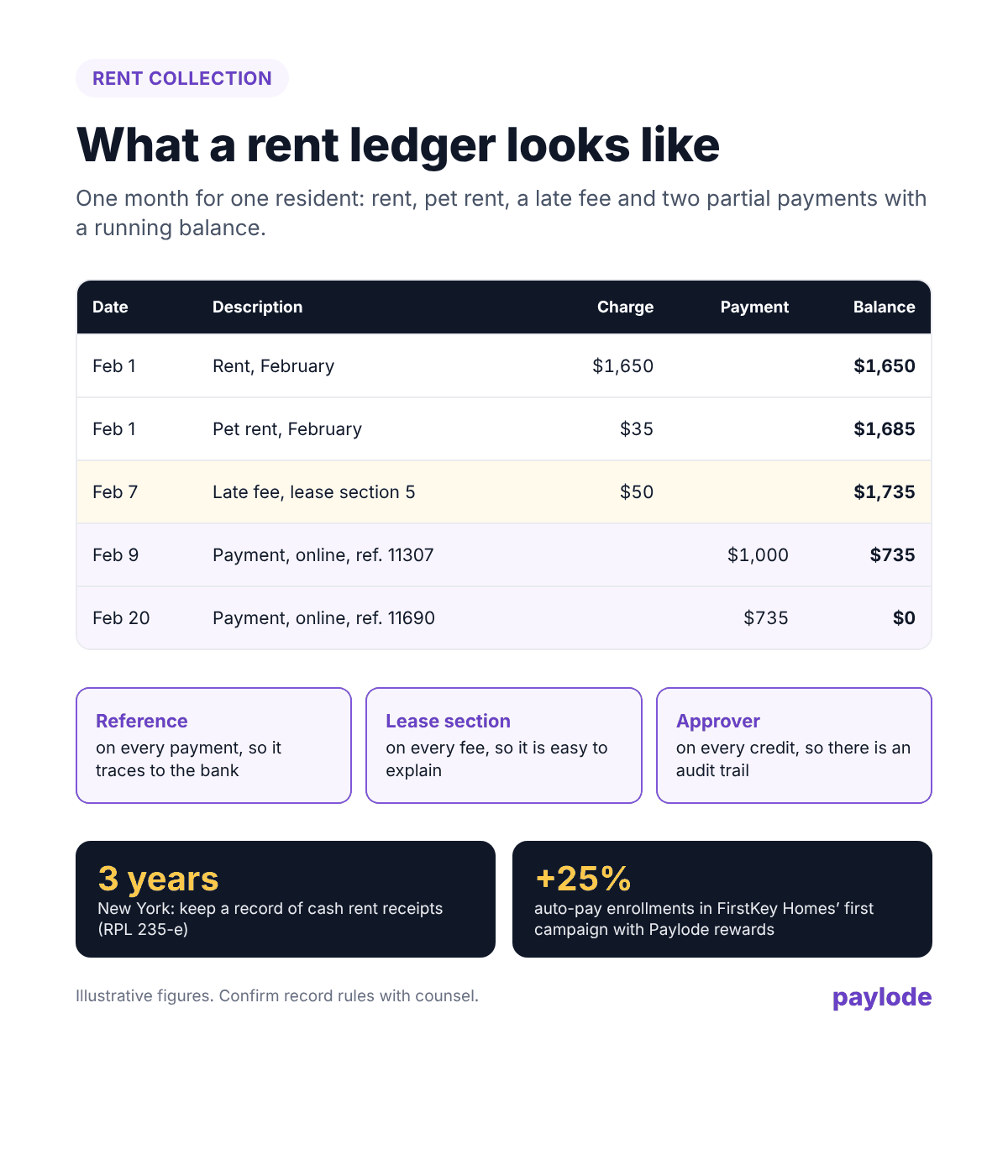
Three details make this ledger useful in a dispute. Every payment has a reference number. The late fee names the lease section that allows it. The credit names the person who approved it.
What Record Rules Apply To Rent Ledgers?
Requirements vary by state, and a few federal tax rules affect how entries are recorded. Two examples:
Late fees on the ledger must also follow state law. New York, for example, allows a late fee only after rent is five days late and caps it at $50 or 5% of the monthly rent, whichever is less. This article is general information. Have your legal and accounting teams confirm the rules for each state where you operate.
How Do You Set Up A Rent Ledger Template?
A spreadsheet works for a small portfolio, and the same columns apply inside a property management system. Set up the template in this order:
- Header block: resident names, unit, lease start and end dates, monthly rent, recurring charges and the security deposit amount.
- Entry columns: date, charge code, description, charge, payment or credit, reference number, balance and notes.
- Balance formula: each balance equals the previous balance plus the charge minus the payment or credit, so the running total updates on every line.
- Charge code list: a fixed drop-down list, such as RENT, PET, PARK, UTIL, LATE, DAMAGE and CREDIT, so entries stay consistent.
- Deposit tab: a separate tab for the security deposit and any interest, kept apart from rent.
- Month-end check: a summary row that totals charges, payments and the closing balance for each month.
What Rent Ledger Mistakes Should You Avoid?
- Lumping charges together. One "rent and fees" line makes it hard to show what a late fee was for.
- Posting payments without a reference. Without a reference number, a disputed payment is hard to trace to the bank.
- Mixing the deposit with rent. A deposit recorded as a rent payment can create tax and refund problems later.
- Deleting entries. A deleted line removes the audit trail. Use an adjusting entry with a note.
- Waiting to post credits. A concession promised at renewal and posted months later creates a balance the resident does not recognize.
How Do You Keep A Rent Ledger Accurate?
- Post charges automatically. Recurring rent, pet rent and parking should post on the same day each month from the lease terms.
- Use clear charge codes. Separate rent, fees, utilities and damages so each one can be reported and disputed on its own.
- Never edit history. Fix mistakes with a dated adjusting entry and a note, so the record shows what changed and why.
- Record who approved every credit. Concessions and waivers should name the approver.
- Reconcile monthly. Match ledger payments to bank deposits and payment processor reports.
- Share the ledger with the resident. A resident who can see the same ledger in the portal can check a charge before disputing it.
How Do Large Operators Manage Ledgers At Scale?
A 10,000-unit portfolio posts roughly 10,000 rent charges a month at full occupancy, before fees, utilities and payments. At that volume, ledgers are easier to keep clean with one property management system, one charge code list across every community and a monthly review of open balances by community.
The ledger also shows where to act. Residents who pay late month after month, or in several partial payments, are strong candidates for auto-pay. When FirstKey Homes used Paylode to reward residents for enrolling in auto-pay, it saw a 25% increase in auto-pay enrollments in the first campaign period, with perks delivered only after enrollment. Fewer late payments mean fewer late fee entries, fewer notices and a cleaner ledger.
A reward also keeps the ledger simple. A gift card is paid outside the resident's account. A rent credit adds an entry and lowers collected rent. Paylode's guide to net effective rent shows how credits change the real rent a resident pays.
Paylode is now part of Moved. When the acquisition was announced, the companies said they will support over 1.2 million residential units together.
Can A Rent Ledger Help Residents Build Credit?
Yes, when the operator reports on-time payments to credit bureaus. From September 2022 to June 30, 2025, Fannie Mae's Positive Rent Payment pilot covered the cost of positive-only rent reporting for 12 months through approved vendors (Esusu, Jetty and Entrata). Positive-only reporting sends only on-time payments to the bureaus. Any rent reporting program depends on an accurate ledger.
Frequently asked questions
What is a rent ledger?
A running record of every charge, payment and credit on one resident's account, with the balance after each entry.
Is a tenant ledger the same as a rent ledger?
Yes. The terms are used for the same record. Some operators also call it a resident ledger or lease ledger.
What is the difference between a rent ledger and a rent roll?
A rent ledger covers one resident's account over time. A rent roll is a snapshot of every unit in a property at one point in time.
Can a tenant ask for a copy of the rent ledger?
Residents can ask, and operators can share the ledger in the resident portal. Some states also set receipt rules. New York, for example, requires a written receipt for rent paid in cash.
How long should a landlord keep rent records?
It depends on state law and tax needs. New York requires landlords to keep a record of cash rent receipts for at least three years. Confirm retention periods with your accounting team.
Should late fees appear on the rent ledger?
Yes, as a separate charge with the lease section that allows it, and only in an amount state law permits.
Turn a clean ledger into on-time rent
With Paylode, property managers can reward auto-pay enrollment and deliver rewards only after residents enroll. See how it works for residential real estate or book a demo.