A pet addendum is a signed add-on to a lease that sets the rules for a resident's pet. It names the pet and states any pet deposit, pet fee or pet rent. It lists the rules on noise, waste, leashes and damage. It also explains what happens if the rules are broken. It keeps pet terms in one place without rewriting the main lease.
Pets matter to a large share of renters. Zillow reports that 58% of renters have pets, up from 46% in 2019, and that pet-friendly listings on its site were typically leased eight days faster than listings that did not allow pets. About 57% of Zillow Rentals listings allowed pets in 2024. A clear addendum lets an operator say yes to pets with terms that protect the property.
What Should A Pet Addendum Include?
- Pet details: type, breed, name, weight and a photo of each approved pet
- Charges: any pet deposit, one-time pet fee and monthly pet rent, with amounts
- Limits: the number of pets allowed and any size, type or breed rules permitted by law and your insurance
- Records: current vaccinations and any local license or registration
- Rules: leashes in common areas, waste pickup, noise and unattended pets
- Damage: the resident's responsibility for damage and cleaning beyond normal wear and tear
- Insurance: any required renters insurance liability coverage that includes the pet
- Breach: what happens if a rule is broken or an unapproved pet is found
- Signatures: signatures and dates from the landlord and everyone on the lease
- Assistance animals: a statement that requests for assistance animals are handled under the reasonable accommodation process
Pet Deposit, Pet Fee Or Pet Rent?
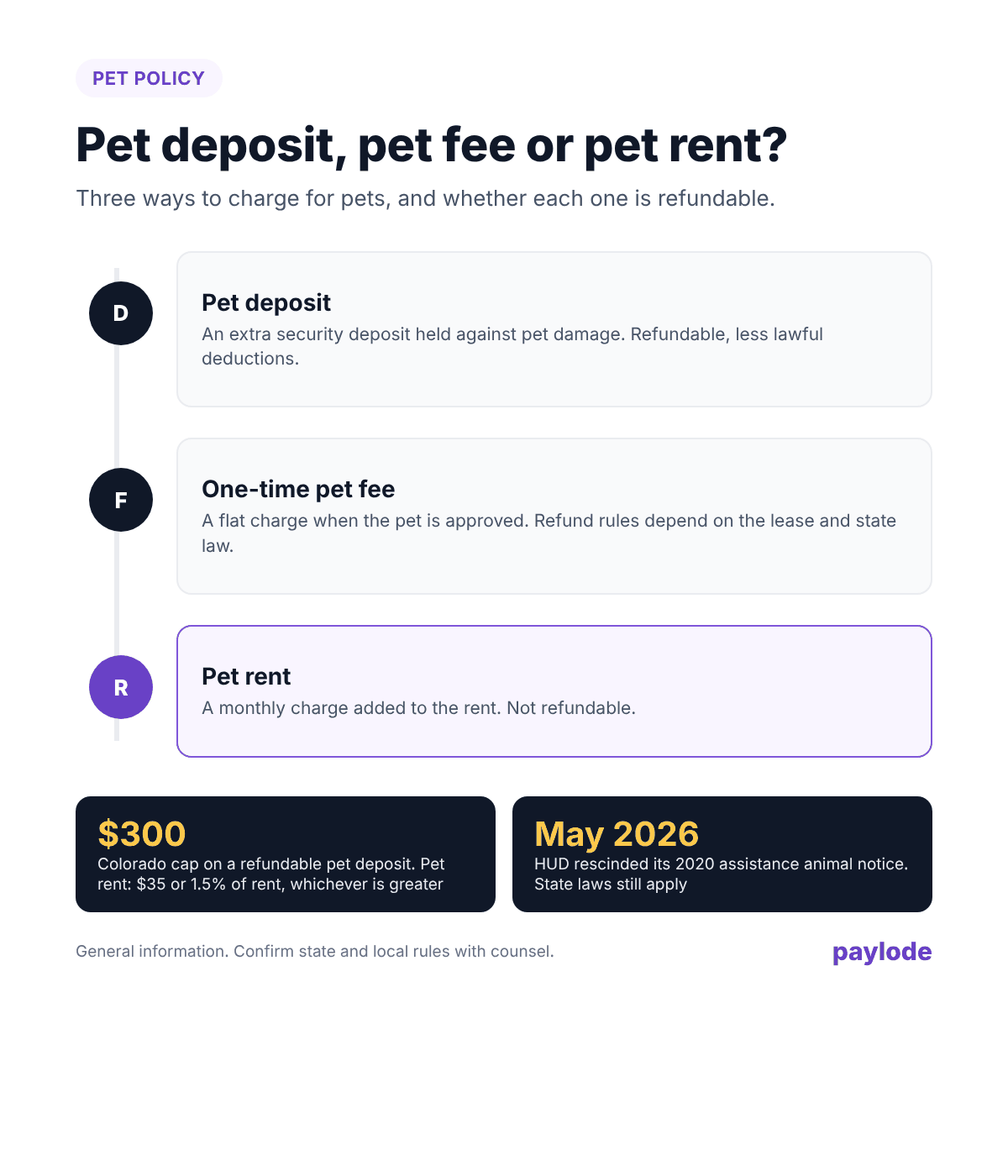
Some states limit these charges. Colorado, for example, caps an additional pet security deposit at a refundable $300 and limits pet rent to $35 a month or 1.5% of the monthly rent, whichever is greater. The law took effect on January 1, 2024. Record pet rent as its own charge code on the resident's rent ledger, so it can be reported and disputed separately from rent.
What Changed For Emotional Support Animals In 2026?
On May 22, 2026, HUD's Office of Fair Housing and Equal Opportunity announced that it was permanently rescinding its 2020 notice on assistance animals, according to a June 2026 alert from the law firm Holland & Knight. Under the new enforcement approach described in that alert:
- Requests to waive pet policies for animals individually trained to do work or tasks related to a person's disability are presumptively reasonable.
- Requests to waive pet policies for untrained emotional support animals are not presumptively reasonable, and HUD no longer expects providers to grant them categorically, including requests to waive pet fees.
- State and local laws are not affected by the change, and some may impose broader obligations.
- Residents can still bring private lawsuits under the Fair Housing Act, and HUD plans formal rulemaking.
The change is to HUD's enforcement guidance, and HUD plans formal rulemaking before changing its rules. The Fair Housing Act's reasonable accommodation duty still applies, and HUD's own page continues to describe a request to waive a pet deposit or fee for an assistance animal as a type of accommodation request. Review each request individually, keep a written record and have counsel update your assistance animal policy for each state. Do not treat this change as a blanket permission to charge pet rent for emotional support animals.
Sample Pet Addendum
Adapt the sample below and have your legal team approve it for each state.
Pet Addendum. This Addendum is part of the Lease dated [Date] between [Landlord] and [Resident names] for [Unit address].
- Approved pet: [Type], [Breed], named [Name], weighing about [Number] pounds. No other animal may be kept in the unit without written approval.
- Charges: Resident will pay a refundable pet deposit of $[Amount], a one-time pet fee of $[Amount] and monthly pet rent of $[Amount], as permitted by [State] law.
- Records: Resident will provide proof of current vaccinations and any required license within [Number] days and on request.
- Rules: The pet must be leashed in common areas, waste must be picked up immediately and the pet must not disturb other residents.
- Damage: Resident is responsible for any damage, cleaning or pest treatment caused by the pet beyond normal wear and tear.
- Breach: If Resident breaches this Addendum, Landlord may require removal of the pet after written notice and may use the remedies in the Lease and applicable law.
- Assistance animals: Requests related to assistance animals are handled under Landlord's reasonable accommodation policy and applicable law, and this Addendum does not limit those rights.
Signed: [Landlord signature and date] | [Resident signatures and dates]
How Do You Handle An Unauthorized Pet?
- Document it: Record the date, what was seen and any photos, and note who reported it.
- Check for an accommodation request first: If the resident says the animal is an assistance animal, start the reasonable accommodation process before treating it as a lease violation.
- Send a written notice: Give the resident a set number of days to either sign the pet addendum and pay the approved charges or remove the animal, as the lease and state law allow.
- Apply the policy consistently: Treat every resident in the same situation the same way and keep a record of each decision.
- Follow up: Confirm the outcome in writing and update the resident's file and ledger.
How Should Large Operators Manage Pets?
- Use one pet policy across the portfolio: With state-specific versions where the law requires them.
- Screen pets consistently: Collect the same records for every pet and apply the same approval rules.
- Track pets in the property management system: with photos, so unauthorized pets are easier to spot.
- Explain pet rules in the welcome letter: Paylode's tenant welcome letter guide includes the wording.
- Add pet perks: Discounts on pet food, grooming and pet insurance can give pet owners a reason to stay.
- Review the policy each year: Check charges against new state and local laws and against what nearby communities offer.
Math for a 10,000-unit portfolio (illustrative only): if 3,000 households pay $35 a month in pet rent, that is $105,000 a month, or $1.26 million a year. Check every amount against state and local caps before you set it.
Pet perks can also lift engagement. Paylode's analysis of pet and renters insurance engagement explains why pet and renters insurance offers see stronger engagement than traditional insurance lines. Operators can use Paylode to give pet owners perks and rewards and deliver them only after a resident takes an action, such as enrolling in auto-pay. When FirstKey Homes used Paylode to reward residents for enrolling in auto-pay, it saw a 25% increase in auto-pay enrollments in the first campaign period. Paylode is now part of Moved, and when the acquisition was announced, the companies said they will support over 1.2 million residential units together.
Frequently Asked Questions
What is a pet addendum?
A signed add-on to a lease that sets the rules, charges and responsibilities for a resident's pet.
Is it legal to charge pet rent and a pet deposit?
Yes, if both are in the lease and follow state and local law. Some states set limits. Colorado caps a pet deposit at a refundable $300 and pet rent at $35 a month or 1.5% of the monthly rent, whichever is greater.
What is the difference between pet rent and a pet fee?
Pet rent is a monthly charge and is not refundable. A pet fee is a one-time charge when the pet is approved, and whether it is refundable depends on the lease and state law. A pet deposit is refundable less lawful deductions.
Can a landlord charge pet rent for an emotional support animal?
HUD changed its federal enforcement approach in May 2026, but the Fair Housing Act and state law still apply. HUD rescinded its 2020 notice and said requests to waive pet policies for untrained emotional support animals are not presumptively reasonable. HUD's assistance animals page still lists a request to waive a pet deposit or fee as an accommodation request, and state and local laws and private lawsuits are not affected, so review each request individually with counsel.
Do service animals require a pet addendum?
No. Handle a service animal or other assistance animal through the reasonable accommodation process. HUD treats requests to waive pet policies for animals individually trained to do work or tasks for a person with a disability as presumptively reasonable, and HUD's assistance animals page lists a request to waive a pet deposit or fee as an accommodation request. Confirm your policy with counsel.
Can a pet addendum be added in the middle of a lease?
Yes, when the resident asks to add a pet and both parties sign the addendum.
Make Your Pet Policy A Reason To Stay
With Paylode, property managers can offer pet perks and deliver rewards only after residents take an action, such as enrolling in auto-pay. See how it works for residential real estate or book a demo.