A move-in and move-out inspection checklist is a written record of a rental unit's condition, taken when a resident moves in and again when they move out. The landlord and resident walk the unit room by room, note the condition of each item, take dated photos and sign the form. Comparing the two records shows what changed during the tenancy and supports any security deposit deduction.
Some states tie the deposit to a written condition record made at the start of the tenancy. In Washington, a landlord who collects a deposit without giving the resident a written checklist or statement of the unit's condition at the start of the tenancy is "liable to the tenant for the amount of the deposit". For an operator with 10,000 units, one missing form costs one deposit. A missing process puts thousands at risk.
Why do move-in and move-out inspections matter?
- They protect the deposit decision. A deduction is easier to defend when the move-in and move-out records use the same items, the same order and dated photos.
- They meet state law. Several states set deadlines and content rules for these inspections, covered in the next section.
- They reduce disputes. A resident who signed the move-in report and attended the move-out walk-through is less likely to challenge a fair charge.
- They speed up the turn. A detailed final inspection record becomes the repair list for the make-ready crew.
What do state laws require?
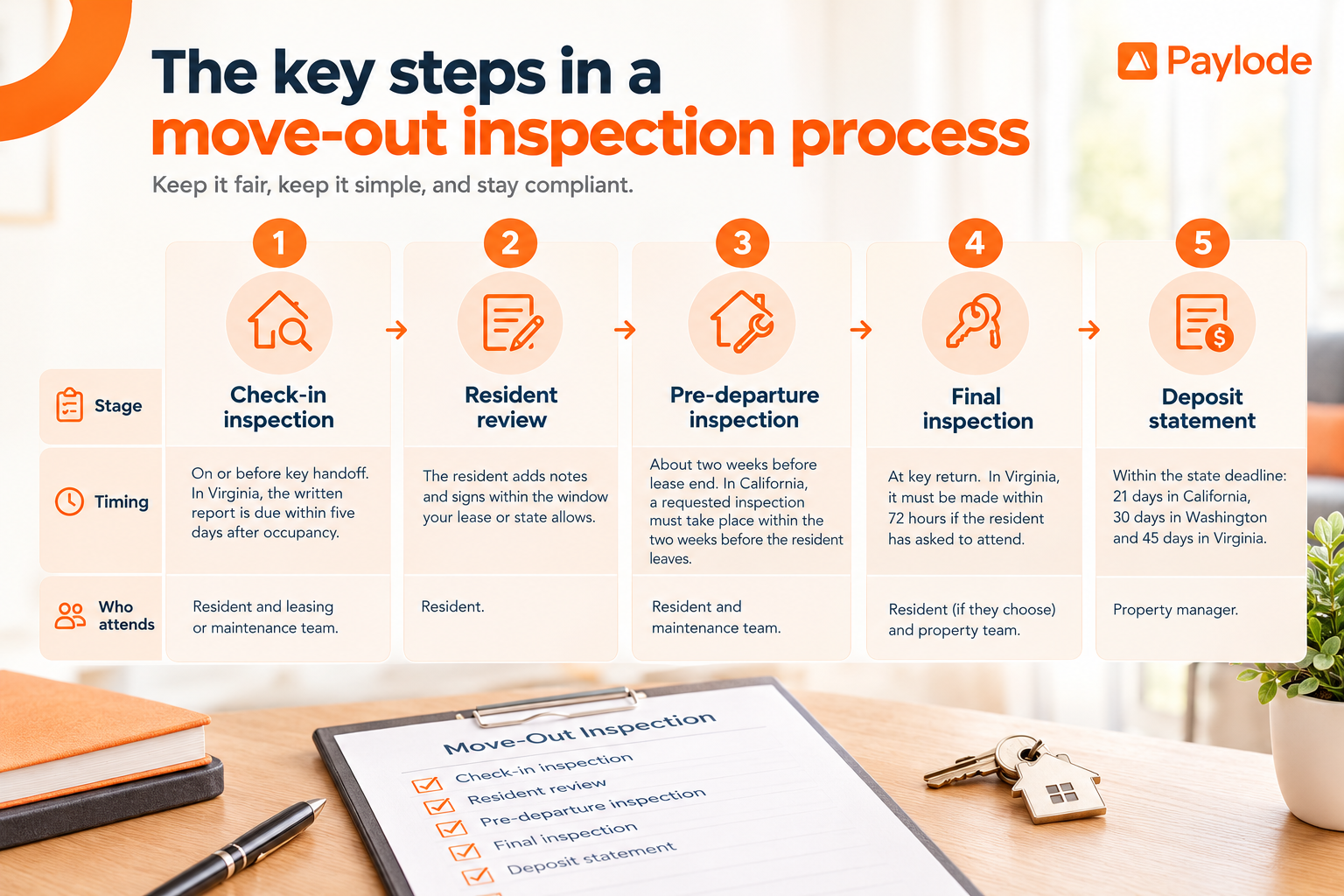
When Should Each Inspection Happen?
Room-By-Room Move-In And Move-Out Inspection Checklist
Use the same list, in the same order, at both inspections. For each item, record the condition (good, fair or damaged), a short note and the photo numbers. The rooms and items below follow the categories in HUD's inspection form, with a few additions common in modern apartments.
How Should You Document The Condition?
- Photograph in a fixed order. Start at the front door and move clockwise through each room, so the move-in and move-out photos line up.
- Use dated photos or video. Keep the original files with their timestamps and store them in the resident's file.
- Write specific notes. Write "Two-inch scratch on the kitchen counter, left of the sink." Vague notes such as "some wear" are hard to defend.
- Get both signatures. Ask the resident to sign the starting condition report and give them a copy. Offer the same at the final inspection.
- Record meter readings. Note any utility meters the resident is responsible for at the start and end of the lease.
Normal Wear And Tear Or Damage?
Deposits generally cannot be used for normal wear and tear. California, for example, says deductions may cover damage caused by tenants or their guests, "not including ordinary wear and tear". The line between wear and damage is often argued, so the examples below are common guidance only. State law and your lease decide the final answer.
How Do Large Operators Run Thousands Of Inspections?
Scale changes the problem. RealPage reported that just over 54% of market-rate residents renewed their leases in the year ending October 2024. Math for a 10,000-unit portfolio (illustrative only): if about 9,000 leases expire in a year and 54% renew, about 4,140 residents move out. Each of those units needs a move-out inspection, and if every unit is re-leased, each new resident needs a move-in inspection: about 8,300 inspections a year.
At that volume, consistency matters more than any single form. Operators that handle it well:
- Use one digital checklist across every community, with the same rooms, items and rating scale.
- Require a minimum photo set for every room at both the move-in and move-out inspections.
- Set system reminders for each state deadline, from the five-day Virginia report to the 45-day Virginia deposit statement.
- Track completion rates by community and follow up on any unsigned condition report within the review window.
- Feed the final inspection directly into the make-ready work order. Paylode's apartment turnover checklist covers the turn that follows.
How Can Rewards Improve Inspection Completion?
The hardest part of an inspection program is resident participation. Residents often skip the condition report review, miss the pre-departure walk-through or return keys late. A small, well-timed reward helps. Operators can use Paylode to send a gift card when a resident signs the condition report on time, schedules the pre-departure inspection or returns every key by the deadline. The reward is released only when the action is complete, so the operator pays for results.
The approach has worked for other resident actions. When FirstKey Homes used Paylode to reward residents for enrolling in auto-pay, it saw a 25% increase in auto-pay enrollments in the first campaign period. Paylode is now part of Moved, a platform that automates resident moves, and together the companies serve over 1.2 million residential units. That links the inspection program to practical help with each move-in and move-out.
Frequently Asked Questions
What is a move-in and move-out inspection checklist?
A room-by-room record of a rental unit's condition, completed when a resident moves in and again when they move out, usually with photos and signatures.
Are move-in and move-out inspections required by law?
In some states, yes. Washington requires a written condition checklist at the start of the tenancy whenever a deposit is collected, and Virginia requires a written report of existing damage within five days of occupancy.
Does the tenant have to be present at the final inspection?
Usually not, but some states give the resident the right to attend. In Virginia, a resident who asks in writing to be present must be told the date and time, and the inspection must be made within 72 hours of the resident returning possession.
What is a pre-departure inspection?
A walk-through before the resident leaves that shows them what to fix to avoid deductions. It is often called a pre-move-out inspection, and it sits between the move-in and move-out inspections. In California, a resident can request one, and it must take place within the two weeks before they leave.
How long does a landlord have to return a security deposit?
It depends on the state. California allows 21 days, Washington 30 days and Virginia 45 days.
Should I take photos during the inspection?
Yes. Dated photos support every note on the checklist, and California now requires photos at the start of tenancies that began on or after July 1, 2025, and before and after any repairs or cleaning deducted from the deposit.
Make Every Inspection Count
Paylode helps property managers reward residents for completing the steps that protect the property, from signing the condition report to returning keys on time. See how it works for residential real estate or book a demo.