A non-renewal of lease letter is a written notice that a lease will end on its expiration date and will not be renewed. A landlord sends it to a resident, or a resident sends it to a landlord. It names the unit, the lease end date and the date the keys must be returned, and it must arrive before the notice deadline set by the lease and by state or local law.
Most leases do renew, but a large share do not. RealPage reported that just over 54% of market-rate residents renewed their leases in the year ending October 2024, against a 2010 to 2019 average of 50.7%. On a 10,000-unit portfolio with mostly 12-month leases, that leaves thousands of units a year that turn over. Some of those are residents who chose to leave. Others are leases the operator chose to end. Either way, the non-renewal letter is the first step of the resident's departure, and the quality of that letter shapes how smoothly the unit comes back.
When Does A Landlord Send A Non-Renewal Letter?
Landlords send a non-renewal letter when they do not plan to offer a new lease. Common reasons include:
- The owner or a family member plans to live in the unit.
- The unit is being sold, renovated or taken off the rental market.
- The resident has repeated lease violations or late payments.
- The property is converting to a different use or lease program.
Residents send a non-renewal letter when they plan to leave at the end of the term. Many leases require that notice in writing 30 to 60 days ahead, and a resident who misses it may be held to a month-to-month term or a new lease.
How Much Notice Do You Need To Give For Non-Renewal?
Start with your lease, then check state and local law. Some states set minimum notice periods, and some limit whether a landlord can refuse to renew at all. Three examples:
Cities can add their own rules on top of these, and affordable and subsidized programs often require good cause for non-renewal. This article is general information. Have your legal team approve your notice periods and templates for each state and city where you operate.
Can A Landlord Refuse To Renew A Lease Without A Reason?
In many states, yes, as long as the notice period is met. In states and cities with just-cause rules, such as Washington and California, the landlord usually needs a reason from the approved list. In every state, the decision cannot be based on a protected class under fair housing law, and it cannot be retaliation for a resident's complaint or request for repairs. Keep the reason factual, apply the same standard to every resident and keep records of the lease history that supports the decision.
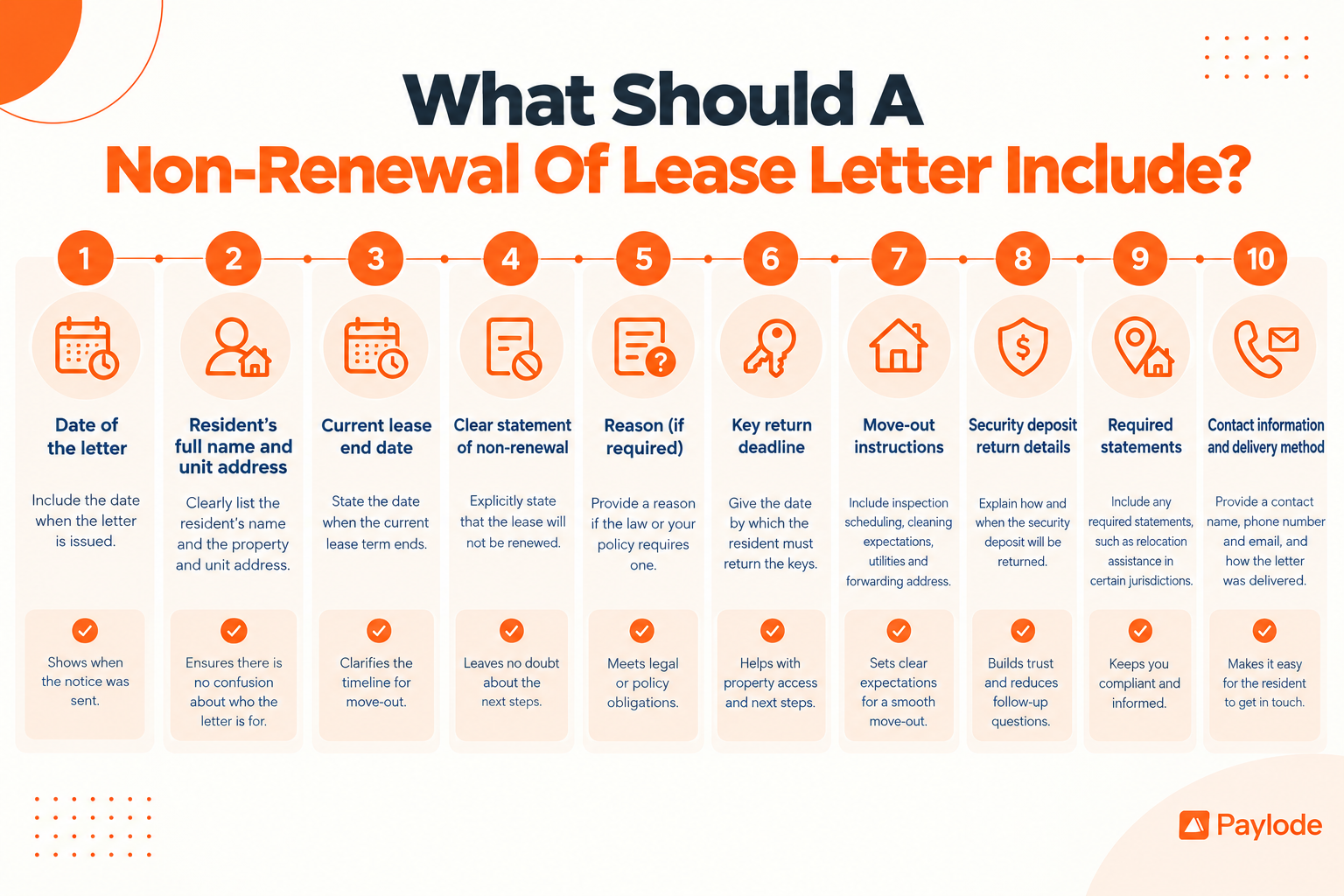
What Should A Non-Renewal Of Lease Letter Include?
Non-Renewal Of Lease Letter Templates
Copy and adapt the templates below. Replace everything in brackets and have your legal team confirm the wording for your state.
Template 1: Landlord to tenant, standard end of term
[Date]
Dear [Resident name],
This letter is formal notice that your lease for [Unit address] will not be renewed. Your lease ends on [Lease end date], and we ask that you return all keys and access devices to the leasing office by [Time] on that date.
To help your move go smoothly:
- Schedule your final inspection by contacting [Name] at [Phone or email]. You may attend.
- Share your forwarding address so we can send your security deposit and any itemized statement within [Number] days, as required by [State] law.
- Transfer or close utilities in your name effective [Lease end date].
We have also arranged moving discounts and services for departing residents. You will receive them by email this week.
Thank you for living at [Property name]. Please contact us with any questions.
Sincerely,
[Name], [Title]
[Management company]
[Phone] | [Email]
Template 2: Landlord to tenant, owner occupancy or sale
[Date]
Dear [Resident name],
We are writing to let you know that your lease for [Unit address] will not be renewed when it ends on [Lease end date]. [The owner intends to occupy the unit as a principal residence / The home is being sold.] This notice is provided [Number] days in advance as required by [Law or lease section].
[If required in your jurisdiction: You are entitled to relocation assistance of $[Amount], which will be paid by [Date and method].]
Please return all keys by [Date and time]. We will contact you to schedule a final inspection, and your security deposit will be returned to your forwarding address within [Number] days.
We know a move is a lot of work. To help, we are offering [Moving perk or gift card] once your keys are returned on time.
Sincerely,
[Name], [Title]
Template 3: Landlord to tenant, lease violations
[Date]
Dear [Resident name],
This letter is notice that your lease for [Unit address] will not be renewed and will end on [Lease end date]. This decision follows the lease violations documented in our notices dated [Dates], regarding [Brief factual description].
Please return all keys by [Date and time] and contact [Name] at [Phone or email] to schedule your final inspection. Your security deposit, less any lawful deductions, will be sent to your forwarding address within [Number] days.
Sincerely,
[Name], [Title]
Template 4: Tenant to landlord
[Date]
Dear [Landlord or property manager name],
Please accept this letter as my [Number]-day notice that I will not renew my lease for [Unit address]. My lease ends on [Lease end date], and I plan to return the keys on [Date].
Please let me know when you would like to schedule the final inspection. My forwarding address for the security deposit is [Address].
Thank you,
[Name]
[Phone] | [Email]
How Should You Deliver A Non-Renewal Letter?
Use the delivery method your lease and state law require. Many operators send the letter two ways, for example through the resident portal and by certified mail with a return receipt, and keep a dated copy in the resident file. If the notice is late, some states extend the tenancy until the full notice period has passed. New York, for example, continues the tenancy on existing terms until the notice period expires when a landlord gives late notice.
What Happens After A Non-Renewal Letter Is Sent?
The letter starts the resident's departure. How the next 30 to 90 days go decides whether the unit comes back on time, in good condition and with a positive last impression. A simple plan:
The move-in and move-out inspections should use the same checklist and photos, so damage is easy to document and the deposit decision is easy to explain. Paylode's apartment turnover checklist covers the turn itself.
How Can A Departure Reward Help?
A resident who is leaving has little reason to return keys early, leave the unit clean or share a forwarding address. A small reward changes that. Operators use Paylode to send a gift card or moving discount when a departing resident completes the steps that matter: keys returned by the deadline, utilities transferred, forwarding address shared. The reward is released only when the action happens, so the operator pays for results.
The approach works across the resident lifecycle. When FirstKey Homes used Paylode to reward auto-pay enrollment, it saw a 25% increase in auto-pay enrollments in the first campaign period. Paylode is now part of Moved, which helps residents plan both move-in and move-out, and together the companies serve over 1.2 million residential units and about 550 ancillary brands. That gives departing residents real moving help, and gives the operator a cleaner handoff to the next resident.
Should You Send A Non-Renewal Letter Or A Renewal Offer?
Every non-renewal creates a turn, with vacancy days, make-ready work and marketing cost. Before you send one, confirm the reason is worth that cost. If the issue is late payment, a payment plan or auto-pay enrollment may solve it. If the issue is price, a lease renewal letter with a clear rent change and a renewal reward may keep a good resident. If the rent change is large, use a compliant rent increase letter with the notice your state requires.
Frequently Asked Questions
What is a non-renewal of lease letter?
A written notice that a lease will end on its expiration date and will not be renewed. It can come from the landlord or the tenant.
How much notice does a landlord need to give for non-renewal?
It depends on the lease and the state. New York requires 30, 60 or 90 days based on how long the resident has lived there. Washington requires 60 or 90 days in the situations where non-renewal is allowed.
Does a landlord need a reason not to renew a lease?
Not in every state. In just-cause states and cities, such as California and Washington, the landlord usually needs a reason from a list in the law.
Can a tenant send a non-renewal letter by email?
Only if the lease allows email notice. Otherwise, use the delivery method in the lease and keep a copy.
What happens if the landlord sends the notice late?
In some states the tenancy continues until the full notice period passes. In New York, the tenancy continues on existing terms until the notice period expires.
Can a landlord refuse to renew because a tenant complained?
No. Non-renewal in retaliation for a complaint or repair request is prohibited in most states, and non-renewal based on a protected class violates fair housing law.
Make every move-in and move-out smoother
Paylode helps property managers reward residents for the actions that keep turns short, from on-time key return to renewal. See how it works for residential real estate or book a demo.