Rent discounts have become the default response to slower traffic and rising vacancy. When occupancy softens, many property managers reduce base rent or offer one month free to keep leasing velocity steady.
But rent cuts come with long-term consequences. Once you lower published pricing, it affects future renewals, market comps, and asset value. Reversing those reductions later can be difficult.
That’s why more operators are exploring how gift cards and perks can replace rent discounts without hurting leasing velocity. Instead of lowering rent, they offer targeted, time-based rewards that create urgency while protecting pricing power.
In today’s competitive residential real estate environment, operators are looking for smarter ways to drive leases without starting a pricing race. Structured incentive programs are becoming a strategic alternative, especially across multifamily portfolios focused on long-term revenue stability.
This guide breaks down:
- Why rent discounts create hidden revenue problems
- Why renters respond strongly to rewards
- How timing matters more than incentive size
- Tactical ways to replace concessions without slowing leasing
If your goal is to protect NOI while maintaining strong leasing performance, this framework will show you how gift cards and perks can replace rent discounts without hurting leasing velocity — in a way that is measurable, controlled, and sustainable.
Why rent discounts create long-term pricing problems
Rent discounts may feel like a quick solution, but they create long-term pricing pressure. When you lower the base rent, you reset expectations for future residents and renewals.
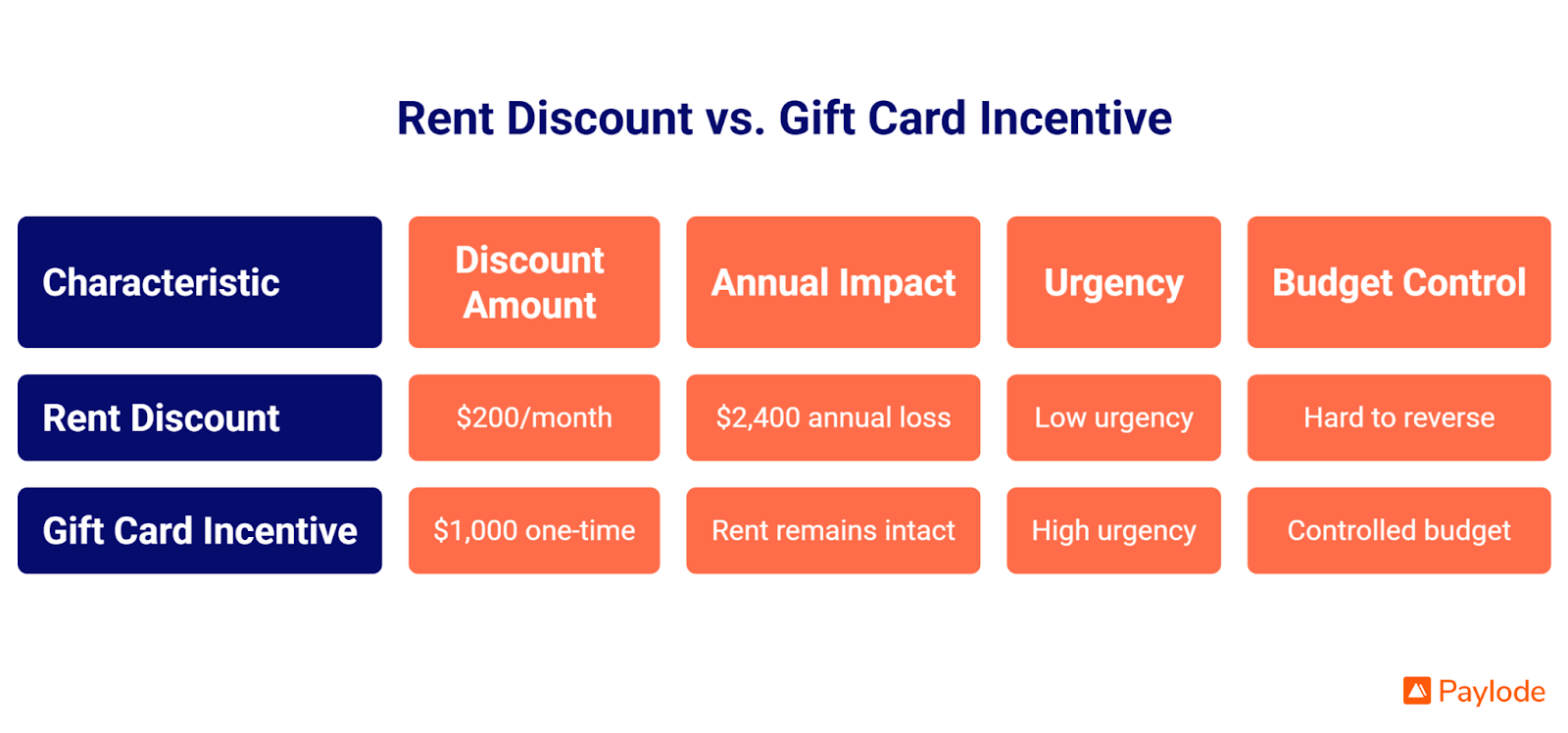
A $200 monthly discount does not just affect the first lease term. Over 12 months, that reduction equals $2,400 in lost revenue. More importantly, it lowers the public price of the unit, which influences comparable properties and future pricing decisions.
The race to the bottom effect
When one community drops rent, competitors often follow. Soon, the entire submarket adjusts downward. Leasing velocity may temporarily improve, but pricing power erodes.
Unlike rewards, rent reductions are difficult to reverse. Residents anchor to the lower rate. Renewal conversations become harder, and even modest increases feel aggressive.
Revenue comparison: discount vs reward
Consider this simplified comparison:
With a one-time incentive, your effective cost is capped. Your base rent stays protected.
This is why many operators are evaluating how gift cards and perks can replace rent discounts without hurting leasing velocity. The goal is not to reduce urgency — it is to create urgency without lowering price.
In competitive residential real estate markets, preserving rent integrity while driving decisions is becoming a core leasing strategy.
Why renters respond similarly to rewards
Many leasing leaders assume that lowering rent is the strongest way to motivate a prospect. In reality, renters often respond just as strongly to structured rewards.
Understanding this behavior is central to how gift cards and perks can replace rent discounts without hurting leasing velocity. The psychology behind the decision matters just as much as the dollar amount.
Perceived value feels bigger upfront
A $1,000 move-in gift card feels substantial. It is immediate, visible, and easy to calculate.
By comparison, a $150 monthly rent discount feels smaller. Even though the annual value may be higher, the impact is spread out over time and feels less meaningful in the moment.
When prospects are comparing communities, the upfront benefit often wins attention.
Immediate gratification drives faster decisions
Renters face multiple upfront costs:
- Moving expenses
- Deposits
- Utility setup
- Furnishing costs
A reward delivered at move-in helps offset those expenses instantly. That creates relief and momentum.
An offer such as:
- “Sign within 72 hours and receive a $750 gift card”
- “Move in before the 25th and receive a $1,000 reward”
creates urgency without lowering base rent.
Rewards create momentum without lowering pricing
Time-based incentives push prospects to act instead of continuing to shop. The key is structure and delivery.
With solutions like Paylode’s Perks platform, property managers can distribute digital rewards quickly while maintaining full control over budgets and tracking. That means incentives remain strategic, not reactive.
In competitive residential real estate markets, renters respond to clarity, immediacy, and simplicity. When rewards are targeted and time-bound, they create the same urgency as rent discounts — but without permanently lowering price.
This behavioral insight is a major reason why gift cards and perks can replace rent discounts without hurting leasing velocity while protecting long-term revenue stability.
Timing matters more than size
When operators evaluate how gift cards and perks can replace rent discounts without hurting leasing velocity, one factor stands out: timing often drives stronger results than incentive size.
A smaller reward delivered with urgency can outperform a larger reward offered indefinitely.
Why limited-time offers work
Open-ended discounts reduce urgency. Prospects assume the offer will still be available next week.
Time-bound incentives create clarity and pressure to act.
Examples that work in residential real estate:
- $500 gift card if the lease is signed within 48–72 hours of touring
- $750 incentive for move-ins before a specific date
- Targeted reward for a specific floorplan that needs velocity
These strategies focus on decision timing, not price reduction.
Move-in windows outperform blanket discounts
Instead of advertising “one month free,” consider structuring incentives around move-in windows.
For example:
- Move in before the 20th → receive $750
- Move in within 10 days of approval → receive $1,000
This protects base rent while accelerating occupancy.
Because the incentive is conditional, it encourages faster action without reducing long-term revenue.
Target specific inventory, not the entire property
Another advantage of rewards is precision. You can apply them to:
- Hard-to-lease floorplans
- Higher-rent units
- Units sitting beyond target days on market
You avoid lowering rent across the entire community.
Coordinating these campaigns becomes easier when using structured systems like the Paylode platform, which allows property teams to automate reward delivery and maintain consistency across locations. For more advanced targeting and campaign control, tools like Paylode Boost help operators refine incentive timing without manual tracking.
The result is controlled urgency.
Instead of lowering pricing permanently, you create short-term momentum. That momentum maintains leasing velocity while keeping rent intact — which is the core principle behind how gift cards and perks can replace rent discounts without hurting leasing velocity.
Tactical playbook: replacing rent discounts step-by-step
Understanding the strategy is important. Executing it correctly is what protects revenue.
Below is a practical framework that property managers can use to implement how gift cards and perks can replace rent discounts without hurting leasing velocity.
Step 1: Audit your current concessions
Start with your numbers.
Review:
- Total monthly rent discounts offered
- Average concession per lease
- Total annual revenue impact
If you are offering $250 off per month on a 12-month lease, that equals $3,000 in lost revenue. Many operators are surprised when they calculate the full exposure across multiple units.
Compare that total to a capped, one-time reward model.
The difference is often significant.
Step 2: Define clear incentive tiers
Instead of open-ended discounts, create structured offers tied to timing or inventory.
Example framework:
Notice the difference. Each incentive is:
- Time-bound
- Controlled
- Targeted
- Budgeted
Your base rent remains unchanged.
Step 3: Align rewards with real resident value
Rewards should feel practical and useful. Popular options include:
- Grocery gift cards
- Travel rewards
- Streaming services
- Dining credits
- Local partnerships
Structured resident incentive programs, such as those used in Paylode’s resident perks solutions, allow operators to offer meaningful rewards without increasing operational complexity.
When rewards align with everyday expenses, they feel more valuable than incremental rent savings.
Step 4: Communicate clearly across leasing channels
Your leasing team should have simple scripts:
- “We’re offering a $750 move-in reward if you sign by Friday.”
- “This incentive applies only to leases executed within 72 hours.”
Consistency builds credibility.
Avoid confusing messaging. Make the deadline visible. Reinforce urgency in follow-up emails and tour recap messages.
Step 5: Track results and refine
Measure:
- Lease conversion rate
- Days on market
- Cost per lease
- Effective rent preservation
Over time, you will see that structured incentives maintain or improve leasing velocity without lowering price.
This is how gift cards and perks can replace rent discounts without hurting leasing velocity in a disciplined, repeatable way — while protecting long-term asset value.
Protecting renewal pricing while boosting retention
One of the biggest advantages of shifting from rent discounts to rewards is long-term pricing protection.
When you reduce base rent, you affect more than the initial lease. You influence renewal conversations, comparable market pricing, and future increases. Once rent is lowered, raising it later becomes more difficult.
This is why understanding how gift cards and perks can replace rent discounts without hurting leasing velocity is not just about new leases. It is also about preserving renewal strategy.
Why intact base rent matters
When base rent remains consistent:
- Renewal increases feel reasonable
- Market positioning stays strong
- Asset valuation is protected
- Pricing power is maintained
A one-time reward does not reset the rental baseline. It is a controlled cost tied to a specific leasing moment.
Over time, this creates stability across the portfolio.
Extend rewards beyond the lease signing moment
Rewards are not limited to move-in incentives. They can support ongoing resident engagement and retention.
For example:
- Offering incentives for residents who enroll in automatic payments can improve on-time collections and reduce administrative workload. Structured programs like Paylode’s automatic payments solution help encourage consistent behavior without reducing rent.
- Encouraging residents to switch to digital billing through initiatives like Paylode’s switch to paperless use case lowers operational costs while providing a small reward that feels meaningful.
- Broader engagement efforts, including programs designed to increase retention, help strengthen resident satisfaction without relying on pricing concessions.
When operators think beyond discounts and build structured incentive ecosystems, they also raise overall customer lifetime value. Strategic initiatives such as those outlined in Paylode’s raise customer LTV approach show how engagement supports long-term revenue growth.
Revenue stability beats temporary occupancy boosts
A short-term rent reduction may fill a vacancy. But a structured incentive strategy supports:
- Faster leasing decisions
- Cleaner renewals
- Better resident engagement
- Higher long-term revenue stability
This holistic view is what makes gift cards and perks a stronger alternative. They protect pricing today while strengthening retention tomorrow — without sacrificing leasing velocity.
Real examples of replacing concessions successfully
Many property managers ask whether this strategy works in real leasing environments. The answer is yes — when structured correctly.
Below are practical scenarios that demonstrate how gift cards and perks can replace rent discounts without hurting leasing velocity across different property types.
Example 1: Urban Class A community
Challenge:
Traffic slowed during peak supply delivery. Competitors began offering one month free.
Old strategy:
One month free on a 12-month lease.
New strategy:
$1,200 gift card for leases signed within 14 days of first tour.
Outcome:
- Base rent remained unchanged
- Leasing decisions accelerated
- Effective rent improved compared to discount model
- Renewal conversations remained clean
Because the reward was time-based, urgency increased without publicly lowering pricing.
Example 2: Suburban garden-style property
Challenge:
Three-bedroom floorplans had extended days on market.
Old strategy:
Permanent $150 monthly rent reduction on select units.
New strategy:
$1,000 move-in reward for three-bedroom units signed within 10 days.
Outcome:
- Targeted inventory improved
- No property-wide pricing impact
- Controlled budget exposure
- Leasing velocity remained steady
This approach allowed management to solve a specific inventory issue instead of lowering rent across the entire community.
Example 3: Portfolio-wide repositioning
Challenge:
Multiple properties were using inconsistent concession models.
Solution:
Standardized incentive campaigns across assets using structured campaign management tools like Paylode Boost, allowing centralized control of timing, audience, and reward value.
Outcome:
- Predictable incentive budgeting
- Improved reporting visibility
- Stronger pricing discipline
- Faster decision cycles
Operators who adopt this model often align it with broader engagement strategies found in Paylode’s real estate industry approach, where incentives support both acquisition and retention.
What these examples prove
Gift cards and perks are not random giveaways. When applied strategically, they:
- Maintain base rent integrity
- Accelerate decision timing
- Target specific leasing challenges
- Prevent price wars
This is the practical application of how gift cards and perks can replace rent discounts without hurting leasing velocity in real-world property management environments.
Conclusion: stop lowering rent. Start controlling incentives.
Rent discounts may feel like the fastest way to protect occupancy. But they often create long-term revenue pressure that is difficult to reverse.
Lowering base rent affects renewals, comparable pricing, and asset valuation. Once pricing moves down, bringing it back up becomes harder.
Gift cards and structured perks offer a smarter alternative.
When designed correctly, they:
- Create urgency
- Accelerate leasing decisions
- Protect base rent
- Cap incentive exposure
- Preserve renewal flexibility
This is the practical framework behind how gift cards and perks can replace rent discounts without hurting leasing velocity. The strategy focuses on timing, targeting, and controlled budgeting rather than reactive price cuts.
For residential real estate operators, the goal is not just to fill units. It is to protect long-term revenue stability while maintaining competitive leasing performance.
Frequently asked questions
Below are clear, direct answers to common questions property managers ask when evaluating how gift cards and perks can replace rent discounts without hurting leasing velocity.
Do gift cards really maintain leasing velocity?
Yes. When incentives are time-based and clearly communicated, they create urgency similar to rent discounts. The key difference is that the reward is capped and does not reduce base rent.
Prospects respond to immediate value. A structured move-in reward can accelerate decisions without impacting long-term pricing.
How large should the incentive be?
The incentive should cost less than the total rent discount you would otherwise offer.
For example, if you are considering $250 off per month for 12 months ($3,000 total), a $1,000–$1,200 reward often delivers comparable urgency at a significantly lower long-term cost.
Will residents expect rewards every renewal?
No. When positioned correctly, incentives are framed as limited leasing offers tied to specific timing or inventory needs.
Because base rent remains unchanged, renewal discussions focus on value and market positioning rather than reversing previous discounts.
Can this strategy work for value-add or repositioned properties?
Yes. In fact, it works especially well when:
- Introducing renovated units
- Repositioning pricing
- Targeting specific floorplans
- Accelerating absorption during lease-up
The flexibility of rewards allows operators to solve targeted leasing challenges without reducing property-wide rent.
How do operators manage incentive delivery at scale?
Structured platforms simplify tracking, budgeting, and distribution. For example, Paylode’s platform overview explains how residential operators can centralize incentive campaigns while maintaining compliance and reporting visibility.
This reduces manual errors and ensures consistent messaging across communities.
What is the biggest advantage of replacing rent discounts?
The biggest advantage is pricing control.
When base rent remains intact:
- Market positioning stays strong
- Renewal increases remain manageable
- Asset value is protected
- Revenue forecasting becomes more stable
That stability is the core reason why gift cards and perks can replace rent discounts without hurting leasing velocity in today’s competitive residential real estate environment.