Student housing operators use gift cards to reward specific actions across the leasing year: completed tours, group applications, roommate referrals, finished lease packets, move-in and move-out tasks, survey responses and early renewals. Each reward is paid only after the action happens, which keeps the cost targeted and easy to measure at the property level.
The 2026-27 leasing season shows why targeted rewards matter. Preleasing at the Yardi 200 schools reached an estimated 89.1% in July 2026, according to Yardi Matrix. That national figure hides a split market. The Yardi Matrix August 2026 report counted 35 markets still below 80% preleased and 25 markets at least 10% behind the prior year. Yardi Matrix points to heavy new supply in large markets and sharp declines in international student enrollment as the main reasons the recovery was uneven.
For an operator with beds across dozens of campuses, that split creates two different problems inside one portfolio. Some assets need help converting tours into signed leases in the spring. Others are already full and need current residents to renew. A blanket rent concession treats both problems the same way and lowers revenue on beds that would have leased anyway. A gift card program pays for the exact step that moves a lease forward, at the property that needs it. Paylode covers the wider economics in its guide on how gift cards and perks can replace rent discounts.
Where do gift cards fit in the student housing leasing calendar?
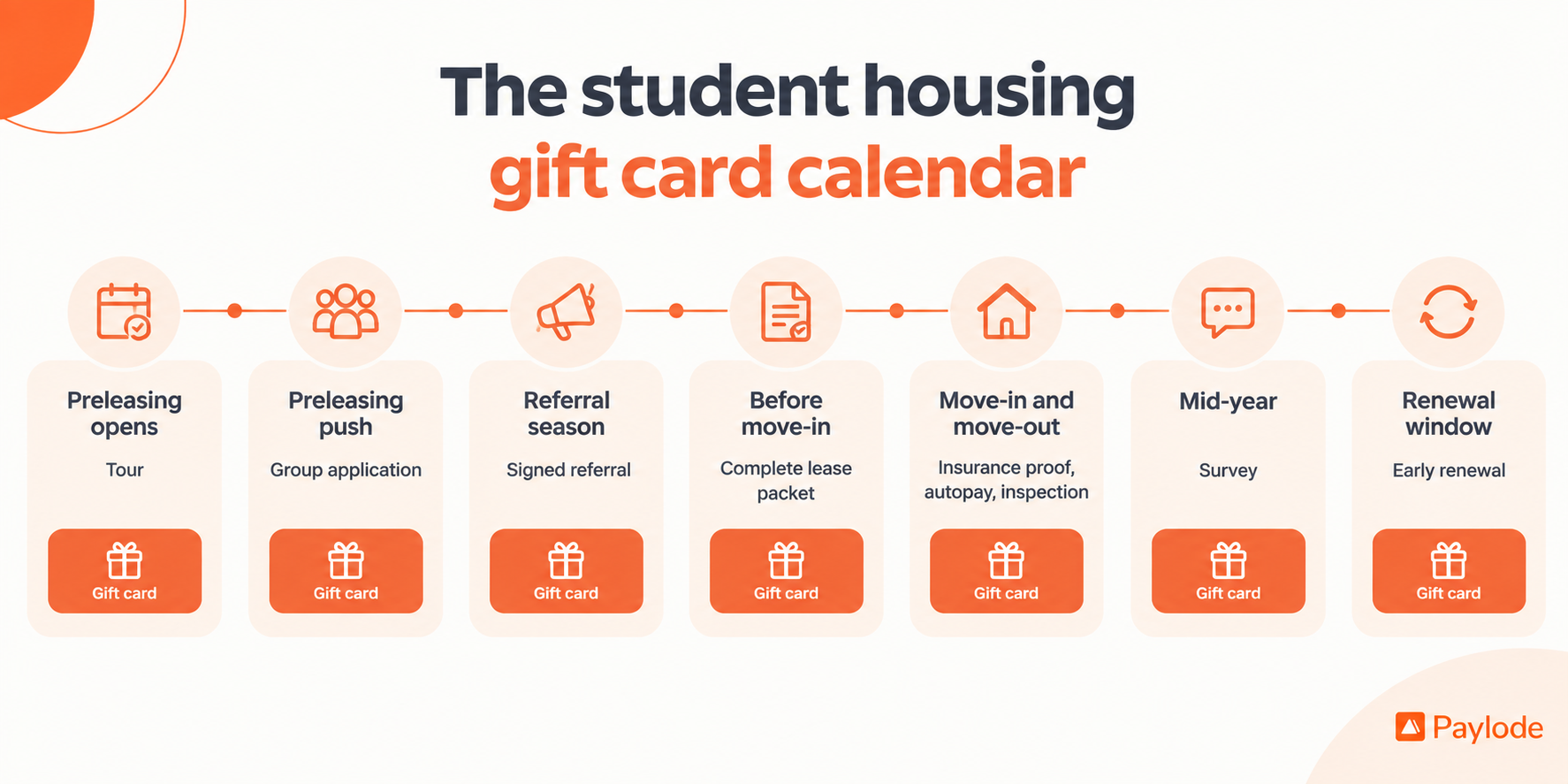
Student housing runs on the academic calendar, so the reward calendar should follow it. The table below maps seven actions to the leasing phase where each one matters most, a gift card type that fits the moment, and the number the property team should watch. The gift card types are illustrative starting points that each portfolio can adjust by market and budget.
1. Reward completed tours during early preleasing
Early preleasing sets the pace for the whole year. A modest gift card for a completed tour gives a prospect a reason to book now and see the property before a competing leasing office reaches them. Tie the reward to a tour the CRM can verify, and send it within minutes of the visit so the prospect connects the reward with the property. Portfolio teams can switch the offer on for assets pacing behind their comp set and switch it off where preleasing is already ahead.
2. Speed up group applications
Students often lease with friends, and one group application can fill an entire unit. A gift card for each group member who completes an application by a set date gives the whole group a shared deadline. It also cuts the time leasing agents spend chasing the one roommate who has not submitted documents. Pay the reward after the last application in the group is complete, so the incentive pulls the group over the line together.
3. Turn current residents into referral sources
Current residents know which friends are still looking for next year's housing. A referral gift card, paid once the referred student signs a lease, turns that knowledge into signed beds. Choice cards work well here because the referrer picks a brand they already use. Publish one referral rule for the property, apply it to every resident, and track the referral share of new leases so the budget follows the results.
4. Get lease packets and guarantor forms finished
A signed lease with missing guarantor forms, ID uploads or payment details still creates work for the leasing team in the weeks before move-in. A small gift card for a complete lease packet by a set date gives residents a reason to finish the paperwork early and bring their parents or guarantors into the process sooner. Track the number of days between lease signing and a complete file, and compare it with properties that do not run the offer.
5. Make move-in and move-out tasks happen on time
Move-in and move-out create the most concentrated workload in student housing, because large groups of residents arrive and leave within a short window. Gift cards can reward the tasks that make those days run smoothly: uploading proof of renters insurance, enrolling in autopay, booking a move-out inspection and returning keys on schedule. Paylode has run this model in single-family rentals. FirstKey Homes, which manages more than 50,000 homes, offered a gift card through Paylode Boost to the first 60 residents who enrolled in autopay and recorded a 25% increase in autopay enrollments in the first campaign period, as documented in the FirstKey Homes case study. For insurance proof, pair the reward with the guidance in Paylode's article on renters insurance rewards compliance.
This is also where Paylode's place inside Moved matters. Moved acquired Paylode in November 2025 to bring perks and rewards into the resident move, the stage where operators already coordinate utilities, insurance and moving services. A gift card for a completed move-in or move-out task fits directly into that workflow.
6. Pay for feedback with a survey reward
Resident feedback shapes the reviews prospects read before they tour. J Turner Research reports that 70% of residents choose to live in apartment communities with a better online reputation. A mid-year survey with a small gift card for every completed response gives the property team time to fix problems before they reach a public review site. The reward should depend on completing the survey and nothing else. The Federal Trade Commission's rule on consumer reviews prohibits incentives conditioned on a review expressing a particular sentiment, positive or negative, so keep any review request separate from the reward. Paylode's survey incentives use case covers the setup.
7. Protect renewals with an early-deadline reward
Student housing renewals are decided months before the lease ends, often while residents are still weighing summer plans and next year's roommates. A higher-value choice card for renewing before an early deadline gives the resident a concrete reason to decide early. It also gives the property an early read on how many beds it must lease to new residents. The approach works best inside a year-round program, as covered in Paylode's guide to student housing loyalty programs that drive renewals.
Which gift cards do students redeem?
Gift cards remain the most used non-cash incentive in North America. The Incentive Research Foundation found that gift cards account for at least 43% of all incentives in North America in its Industry Outlook for 2025. Its Industry Outlook for 2026 shows dining gift cards (54%) passing online-only retailers (50%) as the most used branded gift card type among North American program owners.
For students, the brands that work are the ones tied to daily spending: food delivery, groceries, coffee, ride-share and streaming. Choice cards, where the resident picks a brand at redemption, suit the larger rewards such as referrals and early renewals. On value, the IRF 2025 Trends Report notes that $50 and $100 gift cards now account for half of all distributions. Student housing programs can run a lower value ladder for quick actions like tours and surveys and keep the larger values for signed referrals and renewals.
How do you keep a student housing gift card program fair and compliant?
Four rules keep a program consistent across a portfolio:
- Publish the criteria. Every prospect or resident who completes the same action receives the same reward, and the written rules sit with the property team.
- Reward a verified action. Each gift card follows an event recorded in the CRM or property management system, such as a signed lease, a completed form or an autopay enrollment.
- Keep reviews separate. Survey rewards depend on completion only, and public review requests carry no reward tied to a rating.
- Set a guarantor policy before launch. Operators can reward the resident only or extend rewards to guarantors, and counsel should approve the choice before the program goes live.
How should operators measure a student housing gift card program?
Measure each reward against the step it was built to move. The core numbers are:
- Cost per completed action, by property and by reward type.
- Preleasing pace against the prior year and against the local comp set.
- Referral share of new leases.
- Autopay enrollment and renters insurance compliance at move-in.
- Survey response rate.
- Renewal conversion before the early deadline.
Paylode's perk program performance dashboard reports redemptions and campaign results in one place, so regional teams can move budget from assets that are ahead to assets that are behind during the season.
How does Paylode deliver gift cards for student housing?
Paylode Boost runs each reward as a simple sequence: choose the incentive, show the resident what they will receive, confirm the action and deliver the reward. Operators pick from gift cards, perks and discounts in one catalog, send a single reward or order gift cards in bulk, and deliver through email, SMS, the resident portal or a QR code. Between campaigns, a branded perks center keeps everyday value in front of residents, as described on Paylode's student perks page. Portfolio teams can find more detail on Paylode's residential real estate solutions.
Frequently asked questions
Are gift cards more cost-effective than rent concessions in student housing?
A gift card is paid only when a prospect or resident completes a specific action, and it can be switched on for one property at a time. A rent concession applies to every bed that receives it, including beds that would have leased without it. The targeted reward is easier to control and easier to measure.
When should a student property offer a renewal gift card?
Offer it before the early renewal deadline and announce it with the renewal notice. Students decide on next year's housing well before the lease ends, so a reward that arrives after they have signed elsewhere has no effect.
Can a student housing operator reward parents or guarantors?
Yes, when the policy is written down and applied the same way to every household. Rewarding the resident for a complete lease packet is the simpler option, since the resident holds the lease and the ongoing relationship.
Can gift cards be offered in exchange for online reviews?
Under the FTC rule, an incentive cannot be conditioned on a review expressing a particular sentiment. Review platforms also set their own rules on incentives. Use gift cards for private surveys and keep public review requests separate.
Plan your leasing-year reward calendar
Gift cards work best in student housing when each one is tied to a step on the leasing calendar and measured against it. Book a demo with Paylode to see how Boost delivers gift cards and perks across a student housing portfolio.