Renters insurance compliance sounds like a paperwork problem, but for most property teams it behaves more like a marketing problem. Every operator has some version of the same story: a lease clause requires proof of coverage, a resident signs it in good faith, and six months later the policy has lapsed and nobody noticed until a claim came in. This is where renters insurance rewards compliance programs are starting to change the math. Instead of relying on lease language and periodic audits alone, more communities across the residential property management industry are testing whether a small, well-timed incentive can turn a compliance obligation into a habit residents actually keep up with. The idea isn't radical. It borrows the same logic that gets people to opt into autopay or switch to paperless billing: make the desired behavior easy, make it visible, and reward it when it happens. Applied to renters insurance, that reframing has measurable upside for occupancy risk, liability exposure, and the day-to-day workload of a leasing office that would rather not spend Friday afternoons chasing down expired policies.
What is renters insurance compliance and why does it matter for property managers?
Renters insurance compliance refers to a resident maintaining an active liability and personal property policy that meets whatever minimum coverage a lease requires, typically somewhere between $100,000 and $300,000 in liability protection. Most operators require it because it shifts a meaningful share of risk away from the property. Water damage from a resident's washing machine, a dog bite in a common area, a kitchen fire that starts in one unit and spreads to another — these are the everyday incidents that renters insurance is designed to cover, and without it, the property's own liability policy often ends up absorbing costs it was never meant to carry.
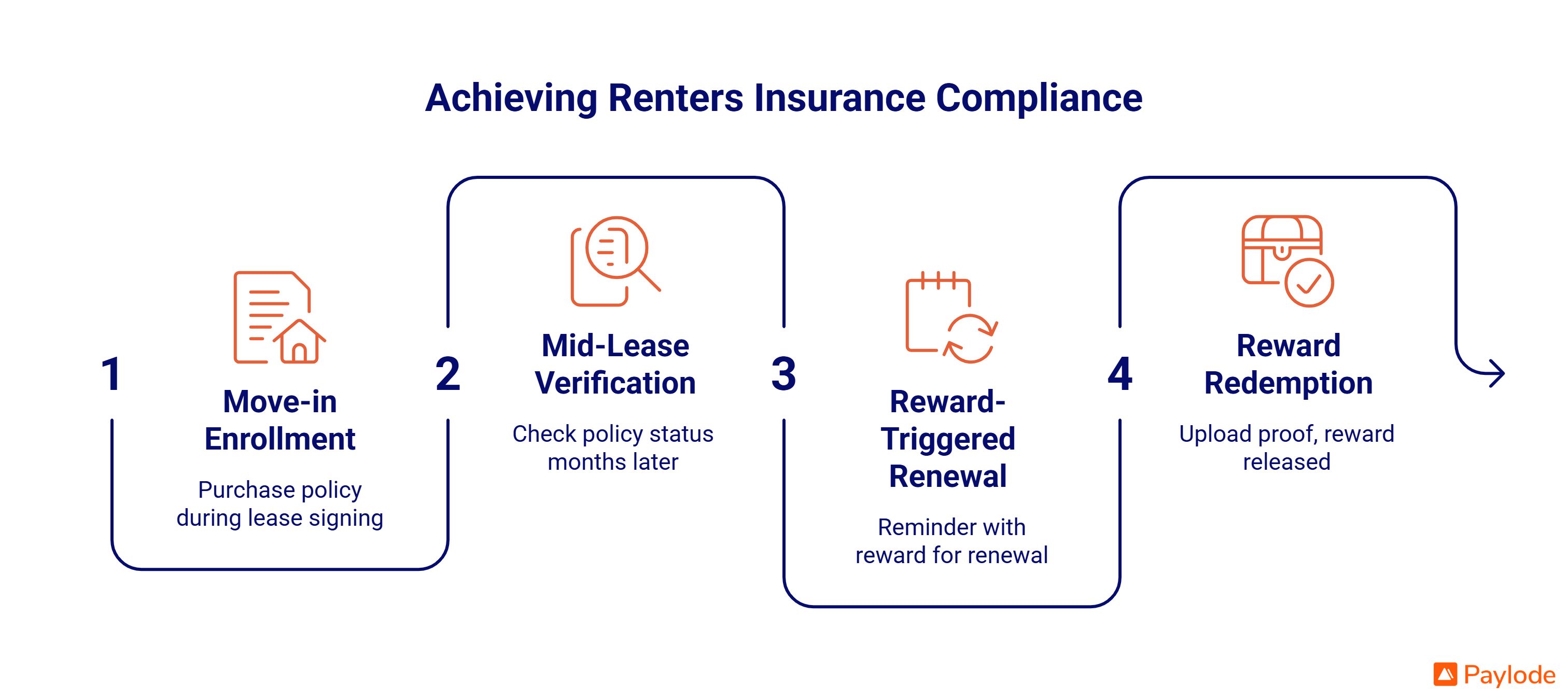
The trouble is that compliance is rarely a one-time event. A resident might purchase a qualifying policy during move-in, satisfy the leasing requirement, and then let it lapse at renewal because the reminder email got buried or the premium increased and they decided to shop around and never finished the process. For residential real estate operators, this creates a rolling compliance gap that's difficult to see without dedicated tracking, and difficult to close without repeatedly reaching out to residents who have already mentally moved past the topic. That gap is exactly where a rewards-based nudge tends to outperform a compliance notice.
Why do so many residents fall out of renters insurance compliance?
Ask most leasing teams why enrollment slips, and the answer usually isn't defiance — it's friction and forgetfulness. Renters insurance rarely feels urgent to someone who has never filed a claim, so it sits low on a long list of monthly obligations. Add in the fact that policies often auto-cancel for nonpayment without an obvious signal to the resident, and it becomes easy to understand why compliance rates drift downward over time rather than staying flat.
A few patterns show up consistently:
- Residents assume a policy purchased at move-in stays active indefinitely, so renewal reminders get ignored or missed entirely.
- Coverage lapses when a resident switches jobs, changes bank accounts, or has a card expire, quietly breaking an autopay renewal.
- Property teams enforce compliance only at move-in and lease renewal, leaving a wide window in between where nobody is checking.
None of these are compliance failures in the traditional sense. They're attention failures, and attention is precisely what a reward can recapture.
How can renters insurance rewards compliance programs change resident behavior?
Traditional compliance enforcement relies on friction in the other direction — late notices, lease violation letters, or the threat of a property-placed policy that costs residents more than a market-rate plan would. Those tools work, but they arrive after the fact and tend to feel punitive, which doesn't build goodwill with the resident. A rewards approach flips the timing. Instead of penalizing a lapse after it happens, it reinforces the behavior before or as it occurs, which is a fundamentally different psychological trigger.
This is the core logic behind renters insurance rewards compliance strategies: pair the desired action — uploading proof of active coverage, renewing before expiration, or enrolling in autopay for a policy — with an immediate, visible perk delivered through a resident perks program. When a resident sees a tangible benefit tied directly to the moment they complete the task, the action gets associated with a positive outcome rather than a bureaucratic requirement. Over enough repetitions across a portfolio, that shift can measurably raise the percentage of residents who stay continuously covered, not just the percentage who were compliant on the day they signed their lease.
What does a renters insurance rewards program look like in practice?
In a typical setup, a property team builds a resident-facing perk center that residents can access through their existing portal or a link shared over email and text. When a resident uploads proof of an active renters insurance policy, or completes an insurance provider's enrollment flow through a linked partner, they unlock a reward from that perk center — something like a discount on local services, a gift card, or credit toward an amenity they already use. The perk center itself does the heavy lifting of presentation: it shows residents what's available, tracks what they've already claimed, and keeps the offer fresh so it doesn't feel like a one-time gimmick.
The reward doesn't need to be large to be effective. What matters more is timing and visibility — the resident should be able to complete the qualifying action and see the reward appear in the same session, rather than waiting weeks for a manual review. That immediacy is what separates a rewards program that changes behavior from one that residents forget about after the first month.
How does Paylode support renters insurance enrollment and renewal incentives?
Paylode gives property teams the infrastructure to run this kind of program without building anything from scratch. The Paylode platform connects a branded perk center to specific resident actions, so a property manager can define renters insurance enrollment or renewal as a qualifying event and attach a reward to it automatically, rather than tracking completions in a spreadsheet.
Paylode Boost is the piece that ties the reward directly to the action. Instead of a generic perks page that residents may or may not visit, Boost targets a specific behavior — in this case, uploading current proof of insurance or completing a renewal — and only releases the reward once that action is verified. This keeps the incentive tied to actual compliance rather than general engagement, which matters if a team wants defensible reporting on how the program is affecting coverage rates.
On the resident-facing side, Paylode Perks supplies the actual reward inventory: discounts and offers from national and local brands that residents can redeem once they've completed the qualifying step. Because the perks marketplace is broad, teams aren't limited to a single reward type — they can rotate offers seasonally or tailor them to what tends to resonate with a given resident population, without renegotiating partnerships themselves.
What resident actions can property managers reward beyond enrollment?
Renters insurance compliance rarely operates in isolation from the rest of a property's operational goals, and that's part of what makes a rewards framework efficient — the same infrastructure that incentivizes insurance enrollment can extend to other behaviors a property team wants to encourage. A resident who's already engaging with a perk center to unlock an insurance-related reward is a natural candidate for other action-based incentives, like completing automatic payment enrollment so rent arrives on time every month, or choosing to switch to paperless billing, which reduces printing and mailing costs at scale.
Bundling these actions together, rather than running a single-purpose insurance campaign, tends to improve overall program economics. A resident who has already formed the habit of checking the perk center for one reward is more likely to notice and complete a second qualifying action, which means the cost of building resident awareness gets spread across multiple compliance and operational goals instead of just one.
How do rewards-based compliance programs affect resident retention and lifetime value?
There's a secondary effect worth accounting for beyond the direct compliance numbers: residents who interact positively with a property's reward system tend to view that property more favorably overall, which has measurable downstream effects on renewal decisions. A rewards program built to increase resident retention isn't a separate initiative from insurance compliance — the two reinforce each other. Every positive interaction a resident has with a perk, whether it's tied to insurance, autopay, or something else entirely, adds to their overall sense that the property is looking out for their interests rather than only enforcing rules.
Over a full lease cycle, that accumulated goodwill contributes to the kind of loyalty that shows up in renewal statistics. Programs designed to raise resident lifetime value generally work by stacking small, positive touchpoints rather than relying on a single large gesture, and renters insurance compliance rewards fit naturally into that stacking strategy because insurance is something nearly every resident interacts with, regardless of unit type or lease term.
What should property managers track when measuring renters insurance rewards compliance?
A rewards program is only as useful as the data a team collects around it, and renters insurance compliance offers a fairly clean set of metrics to watch. The most direct number is the compliance rate itself — the percentage of active leases with verified, current coverage — measured before the program launches and at regular intervals afterward. A second figure worth tracking is time-to-renewal, meaning how quickly residents complete a required renewal after their policy's expiration date; a rewards program should shorten that window meaningfully if the incentive is working as intended.
Beyond the compliance numbers, it's worth watching redemption rates on the reward itself. If residents are completing the insurance action but not claiming the associated perk, that's usually a sign the reward isn't visible enough within the resident experience, rather than a sign the incentive doesn't matter to them. Finally, teams running a bundled program should track completion rates across the other actions being rewarded alongside insurance, since a drop-off in one area can sometimes flag a broader issue with how offers are being communicated to residents.
Frequently asked questions
Does offering a reward for renters insurance compliance actually change enrollment rates, or do residents ignore small incentives?
Renters insurance rewards compliance programs work best when the incentive is tied directly and immediately to the qualifying action, rather than offered as a vague, general perk. Residents respond most strongly when they can see exactly what they'll receive and get it right after completing the task, which is why timing matters more than the size of the reward itself.
What size or type of reward tends to work best for renters insurance enrollment incentives?
There's no single reward size that works for every property, but smaller, immediately redeemable perks — like a local discount or a modest gift card — tend to outperform larger rewards that require a long redemption process. The goal is to make the reward feel like an instant thank-you rather than a prize residents have to work for a second time.
Can a renters insurance rewards program replace lease enforcement entirely?
No. A rewards program is most effective as a complement to lease requirements, not a replacement for them. It reduces how often a property needs to rely on penalty-based enforcement by catching lapses earlier, but the underlying lease clause requiring coverage should stay in place as a baseline.
How quickly can a property expect to see a change in compliance rates after launching a rewards program?
Most properties start to see movement in renewal completion times within the first one to two renewal cycles after launch, since that's the point where residents first experience the reward tied to a real renewal deadline. Full compliance-rate improvements across a portfolio typically take longer to show up, since they depend on cycling through every resident's individual renewal date.
Do renters insurance rewards programs work differently across different types of residential communities?
The core mechanics stay consistent, but the reward mix that resonates can vary by community. Some populations respond better to local, everyday discounts, while others engage more with rewards tied to convenience or lifestyle categories. Testing a few reward types early in the program tends to reveal what a given resident population values most.
Renters insurance compliance doesn't have to be a recurring chase between leasing staff and residents who mean to renew but never quite get around to it. When the desired action is paired with a reward that shows up at the right moment, compliance starts to look less like enforcement and more like a habit residents keep on their own. If your team is exploring how a rewards-based approach could raise renters insurance compliance rates across your portfolio, explore Paylode's pricing plans to find the right fit for your properties, or book a demo to see how the platform can be configured around your specific compliance requirements.