Residential operations depend on everyday resident actions. Paying rent on time, renewing leases, and using digital tools all shape how smoothly a community runs. When these actions happen consistently, teams spend less time fixing issues and more time supporting residents.
Resident expectations have changed. People want digital access, clear communication, and experiences that feel simple. They also expect interactions to feel rewarding, not repetitive or frustrating.
At the same time, property managers are working with limited staff. Daily responsibilities continue to grow, but time and resources do not. This creates pressure to find better ways to guide resident behavior without adding manual work.
Action unlock rewards offer a practical solution. They connect everyday actions to immediate value. Residents complete an action, and a reward becomes available. The process feels natural and easy.
This approach reflects a broader shift toward behavior-based rewards for residents. Instead of reminders or enforcement, operators encourage positive behavior through recognition. The result is better engagement, smoother operations, and a more balanced workload for property teams.
What are action unlock rewards in residential rentals?
Action unlock rewards are incentives that become available after a resident completes a specific action. The action comes first. The reward follows. This keeps the experience clear and easy to understand.
In a residential setting, the “action” is something residents already do. This may include paying rent, renewing a lease, or using the resident app. “Unlock” means the reward is released only after that action is completed. There is no guessing and no extra steps.
These rewards are different from giveaways or promotions. Giveaways are often one-time and not tied to behavior. Promotions usually focus on spending or limited offers. Action unlock rewards are consistent and connected to daily living.
This model focuses on behavior rather than spending because behavior drives operations. When residents complete key actions on time, properties run more smoothly. Teams spend less time on reminders and corrections.
Property managers are adopting behavior-based rewards for residents because they support long-term habits. Instead of pushing promotions, operators positively guide behavior. The result is better engagement, stronger relationships, and more predictable operations.
How action unlock rewards work step by step.
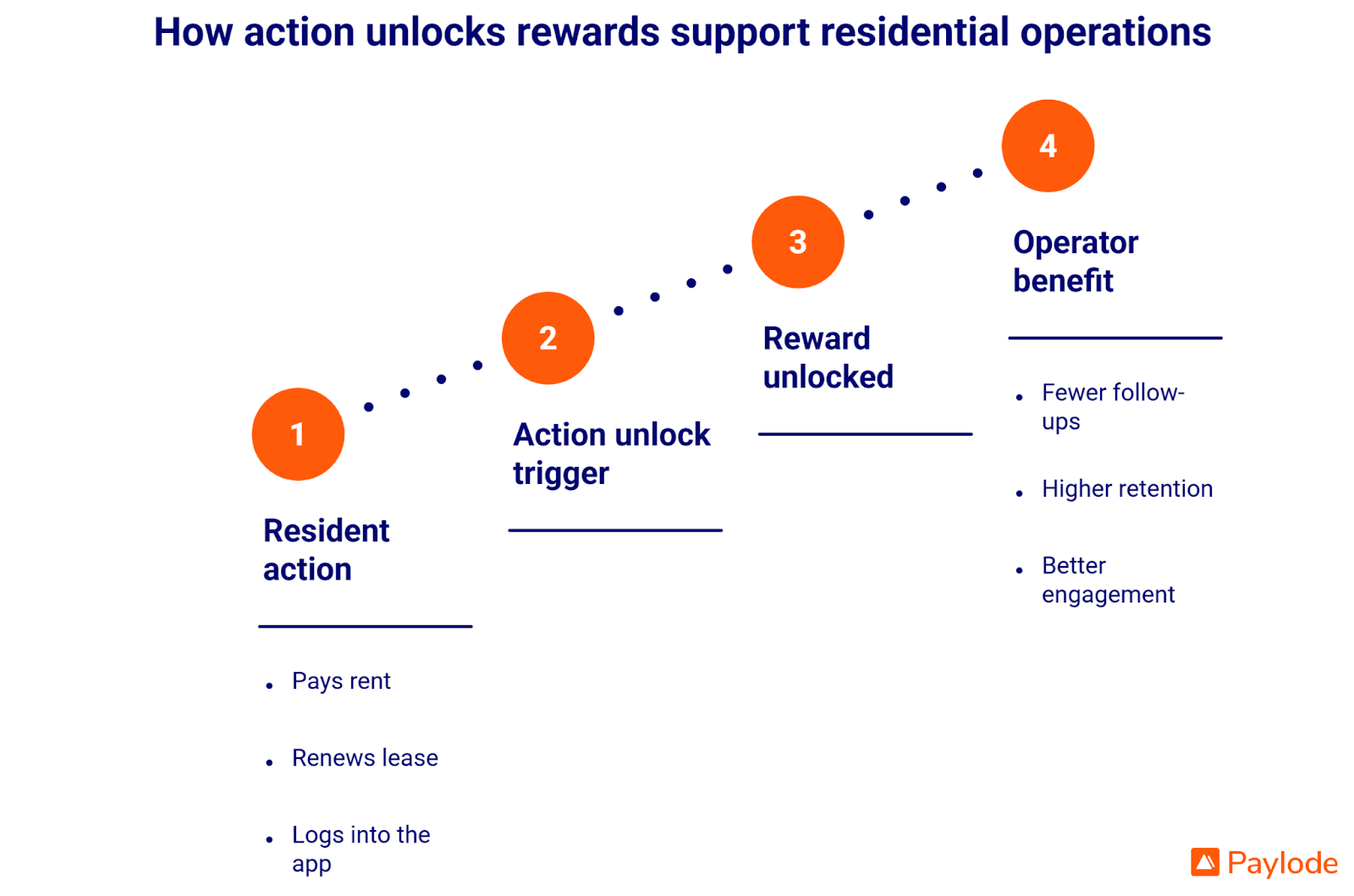
Action unlock rewards follow a simple and predictable flow. Each step is designed to support resident behavior without adding work for property teams.
First, the resident completes a specific action. This could be paying rent on time, renewing a lease, or logging into the resident app. The action is part of everyday living, not an extra task.
Next, the system confirms the action. Verification happens in the background through existing property systems. There is no manual review or staff involvement.
Once confirmed, the reward becomes available automatically. The resident does not need to submit a request or wait for approval. The reward appears as soon as the action is completed.
The resident then chooses and uses the reward. This step gives residents flexibility and control. Rewards feel personal rather than assigned.
Automation is essential to this flow. It keeps the process consistent and reliable. Property teams avoid manual tracking. Residents experience immediate value. Together, these steps make action unlock rewards that are practical, scalable, and easy to manage.
Why the residential rental market is shifting toward behavior-based rewards
Traditional incentives have clear limits in residential settings. One-time offers and short promotions create brief attention but rarely change daily behavior. Once the offer ends, habits return to normal.
Missed resident actions create ongoing operational issues. Late payments require follow-ups. Delayed renewals increase uncertainty. Low digital engagement leads to repeated communication. These challenges pull time away from higher-value work.
Behavior-based rewards offer a different approach. They guide residents without pressure. Instead of reminders or enforcement, residents are encouraged through recognition. Completing an action leads to immediate value, making the behavior easier to repeat.
Consistency is the key difference. Campaigns come and go. Behavior-based rewards stay in place. When residents see the same actions rewarded over time, habits form naturally. For operators, this creates steadier operations and fewer disruptions across the rental lifecycle.
Resident actions that commonly unlock rewards
Action unlock rewards work best when they are tied to behaviors that already support daily operations. These actions reduce manual effort, improve communication, and create more predictable outcomes for property teams.
Rent payment
Rent payment carries the highest operational value. On-time payments support steady cash flow and reduce follow-ups. When residents are rewarded for paying on time, consistency improves, and administrative pressure decreases.
Lease renewal
Early renewal decisions help operators plan. They reduce vacancy risk and limit last-minute leasing activity. Rewards tied to renewal timing encourage residents to act sooner and with confidence.
App login
Regular app use is essential for clear communication. When residents log in consistently, they stay informed about updates, notices, and services. This reduces inbound questions and scattered communication.
Paperless billing
Switching to digital billing supports faster delivery and easier recordkeeping. It also reduces printing and mailing tasks. Rewards help residents adopt paperless options more quickly and stay engaged.
Automatic payments
Automatic payments significantly reduce missed or late rent. Once set up, payments become reliable and hands-off. Rewarding this action encourages automatic payment adoption and long-term consistency. Learn more about how automatic payments support smoother operations.
By focusing rewards on these actions, operators strengthen everyday behavior that keeps communities running smoothly.
Why do behavior-based rewards for residents work better than discounts
Rewards and rent discounts are often grouped together, but they serve very different purposes. Rent discounts reduce the amount residents pay. Rewards provide added value after a positive action is completed.
Discounts directly affect revenue. Once introduced, they are difficult to remove. Over time, they can reset expectations and reduce long-term income. They also do little to encourage consistent behavior beyond the moment they are offered.
Behavior-based rewards for residents take a different approach. They add value without changing rent or fees. Residents receive something useful while pricing remains intact. This protects revenue while still improving engagement.
Rewards are also tied to actions, not timing. They reinforce habits like on-time payments and early renewals. This creates ongoing benefits instead of short-term spikes.
For operators, this model is more sustainable. Costs are predictable. Rewards can be automated and scaled. Over time, the operational improvements often outweigh the cost of the rewards themselves.
Benefits of action unlock rewards for property managers and owners
Action unlock rewards deliver practical benefits across operations, finances, and resident experience. They support daily workflows without adding complexity or workload.
Operational benefits
When rewards are tied to clear actions, residents complete tasks more consistently. This leads to fewer reminders and follow-ups. Teams spend less time chasing payments or confirmations. Manual tasks decrease as actions and rewards are handled automatically. With more predictable behavior, planning becomes easier and more reliable.
Financial benefits
Consistent actions support consistent revenue. On-time payments improve cash flow stability. Early renewals reduce vacancy periods and lower turnover-related costs. Over time, these improvements help protect revenue without relying on discounts.
Experience benefits
Rewards create positive interactions between residents and properties. Residents feel recognized rather than managed. Communication becomes clearer when residents engage through digital channels. Stronger relationships form because the experience feels supportive and transparent.
Together, these benefits make action unlock rewards a practical tool for property managers and owners focused on long-term performance.
Benefits for residents
- Feeling recognized for everyday actions.
Routine behaviors like on-time payments or app use are acknowledged, not overlooked.
- Clear connection between behavior and value
Residents understand exactly which actions unlock rewards, with no confusion.
- Rewards that feel useful, not promotional
Perks fit into daily life and provide real value without sales pressure.
- Increased satisfaction without added complexity
Rewards are earned naturally through normal actions, with no extra steps required.
Designing action unlock rewards residents actually want
The success of action unlocks rewards depends on relevance. A reward does not need to be large to be effective. It needs to fit naturally into a resident’s daily life. Small, practical rewards often create more engagement than larger offers with restrictions.
Effective rewards share a few clear characteristics:
- Everyday usefulness, so residents can easily use them
- Easy to understand, with clear actions and outcomes
- Consistent availability, so residents know what to expect
Choice also plays an important role. Choice-based perks allow residents to select rewards that matter to them. This increases participation because the experience feels personal rather than assigned.
It is equally important to avoid rewards that feel complicated or sales-driven. Long instructions, limited conditions, or promotional language reduce trust. Action unlock rewards should feel like a benefit for residents, not a marketing campaign.
Controlling costs with action unlocks rewards
Cost control is a common concern for operators. Many worry about unpredictable spending, added administration, or rewards growing beyond the budget. Without structure, these concerns can limit adoption.
Behavior-based rewards are easier to budget because they are tied to defined actions. Each action has a clear trigger and a set reward value. This makes costs predictable and easier to plan over time.
Several methods help operators stay in control:
- Fixed reward values, so spending remains consistent
- Limited unlock frequency, preventing repeated or excessive use
- Automation instead of manual tracking, reducing staff time and errors
Automation plays a critical role. When rewards are triggered automatically, teams avoid manual review and distribution. Programs scale without increasing workload or cost.
Centralized management strengthens this approach. A single system allows operators to set limits, monitor activity, and maintain visibility across properties. More details on centralized cost control can be found.
With the right structure, action unlocks rewards remain cost-aware. Operators gain better behavior outcomes without financial uncertainty.
Why action-unlock rewards fit the full resident lifecycle
Action unlock rewards support residents from the first day through long-term residency. Instead of focusing on a single moment, they create value at every stage of the resident journey.
Move-in stage
During move-in, rewards help residents get set up quickly. Actions like activating the resident app or choosing digital billing can be encouraged early. This supports digital adoption and reduces manual setup work for teams.
Daily living stage
In daily living, rewards reinforce routine behavior. On-time rent payments, regular app use, and digital communication become habits. Residents stay engaged, and operations remain steady with fewer interruptions.
Renewal stage
Renewal is a critical decision point. Rewards give residents a reason to act early and feel appreciated for staying. This supports retention and reduces last-minute uncertainty. Learn more about how rewards improve retention.
Long-term residency
For long-term residents, rewards recognize consistency over time. Continued engagement and reliability is acknowledged without changing pricing. This strengthens loyalty and improves satisfaction across the entire lifecycle.
Choosing the right platform to manage action unlock rewards
Many operators begin with spreadsheets or manual systems. These tools may work at first, but they quickly break down. Updates are missed. Tracking becomes inconsistent. Scaling across multiple properties becomes difficult.
Centralized reward management solves these issues. A single platform keeps actions, rewards, and limits in one place. This provides clarity, consistency, and control without daily oversight.
When evaluating a platform, operators should focus on a few essential capabilities:
- Automation, so rewards trigger without staff involvement
- Reporting, to track participation and outcomes clearly
- Easy resident access, ensuring rewards are simple to view and use
A platform designed for residential operations supports these needs by default. It reduces manual work while improving the resident experience. Learn more about how a centralized platform supports action unlock rewards.
With the right system in place, rewards remain effective, manageable, and scalable across properties.
Conclusion: Why action unlock rewards are the future of resident engagement
Action unlock rewards help residential communities run more smoothly. They reduce reminders, improve consistency, and lower manual effort for property teams. At the same time, residents feel recognized for everyday actions that already support the community.
This approach highlights the value of behavior based rewards for residents. Instead of relying on discounts or one-time offers, operators guide long-term habits. Rewards reinforce positive behavior without changing pricing or adding complexity.
Now is the right time to adopt this model. Resident expectations continue to rise, while teams are asked to do more with fewer resources. Action unlock rewards offer a practical way to improve engagement, efficiency, and satisfaction at scale. Take the next action, and discover available perks.
FAQs about action unlock rewards in residential rentals
What actions should operators reward first?
Operators should start with rent payments and lease renewals. These actions have the biggest impact on cash flow and occupancy. Rewarding them delivers immediate operational value.
Do small rewards actually change behavior?
Yes. Consistency matters more than size. Small rewards given regularly help build habits and encourage repeat behavior over time.
Are action unlock rewards hard to manage?
No, when automation is in place. Automated systems handle tracking and reward delivery without manual effort from property teams.
Can this work across multiple properties?
Yes. Centralized systems allow operators to manage rewards across locations from one platform, ensuring consistency and control as portfolios grow.