Lease conversions sit at the center of multifamily performance. Traffic, tours, and follow-ups all lead to one decision: whether a prospect commits to a lease. For years, rent concessions have been the most common tool used to influence that decision. They are familiar, fast, and easy to explain.
But the environment has changed. Marketing costs are rising, competition is tighter, and operators are under pressure to protect pricing. In this context, discounting rent to drive conversions creates tension between short-term wins and long-term value. What works quickly does not always work sustainably.
This is why more operations and marketing leaders are rethinking how value is offered during the leasing decision. The question is no longer whether incentives are needed, but where those incentives should come from and how they should be structured. Concessions and marketing rewards both influence behavior, but they do so in very different ways.
This article compares concessions and marketing rewards side by side. We’ll look at how each approach affects lease conversions, budgets, and pricing integrity. The goal is to help teams choose strategies that drive decisions today without weakening performance tomorrow.
The core difference: discounting the product vs rewarding the decision
Concessions and marketing rewards are often treated as interchangeable tools, but they work in fundamentally different ways. Understanding this difference is critical for operations and marketing leaders who want to improve lease conversions without weakening pricing.
Discounting the product: how concessions work
In multifamily, the product is the lease. When concessions are used, rent becomes the incentive. Free rent, reduced rent, or credits lower the price of the unit to influence commitment.
This approach changes the value of the lease itself. Even when positioned as temporary, the discount becomes part of how the unit is perceived. Prospects compare prices, not timing or experience. Over time, rent starts to feel negotiable rather than fixed.
From an operations standpoint, concessions can deliver quick results. Conversions may increase, and occupancy may stabilize. However, the cost is embedded in the lease and directly impacts effective rent once the agreement is signed.
Rewarding the decision: how marketing rewards work
Marketing rewards focus on the decision, not the price. Rent remains unchanged, and value is delivered after a specific action is completed, such as applying, signing, or moving forward within a defined window.
This shifts the conversation away from negotiation. Prospects are not asking for a lower price. They are choosing to act in order to receive a reward. The lease retains its full value, and the incentive sits outside the rent structure.
For marketing teams, this creates flexibility. Rewards can be adjusted, targeted, or paused without changing pricing strategy.
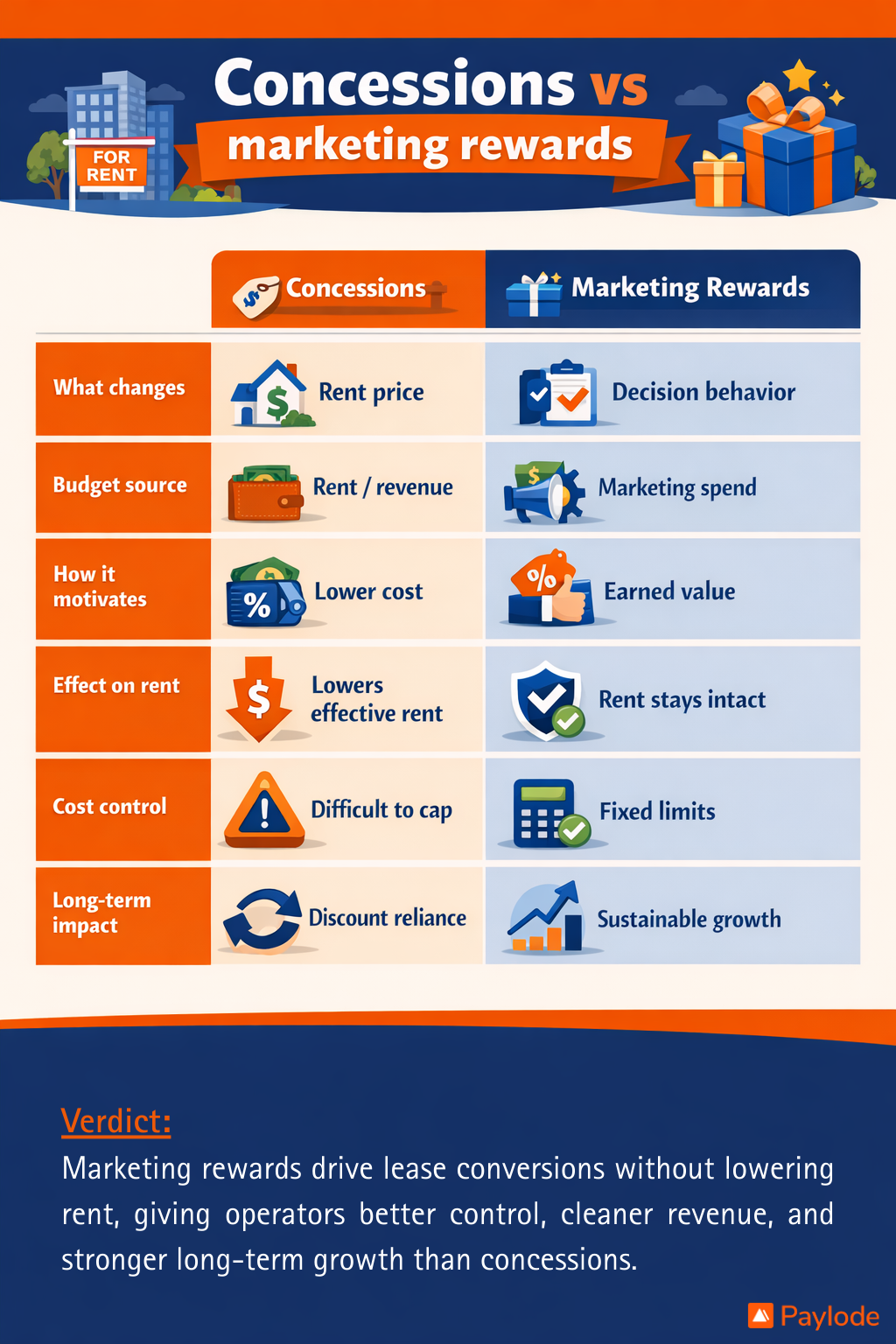
Side-by-side comparison: concessions vs marketing rewards
Why this distinction matters for lease conversions
Both approaches can drive conversions, but the quality of those conversions differs. Discounts encourage price-led decisions, which increase negotiation and delay over time. Rewards encourage commitment-led decisions, which create urgency without resetting rent expectations.
For ops and marketing leaders, this difference determines whether lease conversions are driven by lower prices or clearer decisions. It also determines whether today’s gains strengthen or weaken future pricing power.
How concessions influence lease conversions
Concessions are widely used because they work quickly. When leasing teams need immediate results, rent discounts feel like the most direct way to influence decisions. Understanding why they convert fast also explains why their impact weakens over time.
Why concessions convert quickly
Concessions succeed early because the value message is simple. Free rent or a reduced rate is easy for prospects to understand and compare. There is no learning curve or explanation required.
They are also familiar. Many renters expect to see discounts, especially in competitive or slower markets. When an offer matches what prospects already anticipate, it reduces hesitation and speeds up decisions.
For leasing teams, concessions are easy to use. They fit existing processes and scripts, require little training, and can be adjusted quickly. When goals are time-sensitive, this ease makes concessions the default conversion tool.
The hidden tradeoffs behind fast conversions
The same simplicity that drives quick conversions also creates long-term challenges. Once concessions become common, prospects begin to wait for better deals. Instead of responding to the value of the community, they time their decisions around discounts.
This shifts the mindset from choosing a home to negotiating a price. Conversations become focused on “what’s the best offer” rather than “is this the right place.” As a result, conversion behavior becomes discount-driven rather than decision-driven.
Over time, leasing teams may feel pressure to offer more to achieve the same results. What worked last quarter no longer delivers the same lift.
What conversions look like over time
As concessions are repeated, their impact diminishes. Each new discount feels less special, requiring deeper or more frequent offers to move the needle.
This creates higher dependency on rent discounts to maintain conversion rates. Pricing power weakens, and teams have fewer levers to pull without touching rent again.
In the long run, concessions may still fill units, but they do so at a growing cost. Lease conversions become tied to lower prices rather than stronger decisions, making sustainable performance harder to maintain.
How marketing rewards influence lease conversions
Marketing rewards influence lease conversions by changing how prospects make decisions. Instead of lowering rent to create urgency, rewards motivate action while keeping pricing intact. This distinction is what allows teams to improve conversions without weakening long-term value.
How rewards create urgency without lowering rent
Marketing rewards are most effective when they are time-bound. A reward available for a limited window encourages prospects to act sooner rather than delaying a decision. The urgency comes from timing, not price.
Rewards are also triggered by specific actions. Applying, signing, or completing a next step activates the reward. This structure makes the path forward clear and removes uncertainty about what the prospect needs to do.
There is also a psychological element at play. Earning a reward feels different from receiving a discount. Prospects feel they have gained something through their decision, rather than negotiated something away. This creates a positive association with the choice to move forward.
Why rewards change decision behavior
Marketing rewards shift focus from negotiation to commitment. Instead of asking for a better price, prospects decide whether they want to complete the required action. This reduces back-and-forth and keeps conversations centered on timing and fit.
The value exchange is clear. The prospect understands what they receive and what they need to do to receive it. This clarity builds confidence and reduces hesitation.
Because rent does not change, price sensitivity decreases. The lease retains its full value, and the decision becomes about readiness rather than affordability. This leads to cleaner, faster decision-making.
Conversion quality vs conversion speed
Marketing rewards can drive fast decisions without eroding rent. While concessions often deliver speed at the expense of pricing, rewards balance both. Prospects act quickly, but the asset’s value remains intact.
Over time, this improves conversion quality. Leases are signed because the prospect chose to commit, not because the price was temporarily lowered. This alignment supports stronger renewals and more sustainable performance.
For ops and marketing leaders, this difference matters. Marketing rewards do not just increase conversion speed. They improve how and why conversions happen, creating results that hold up over time.
Budget source differences: rent line vs marketing line
One of the most important differences between concessions and marketing rewards is where the cost lives. For operations and marketing leaders, this distinction affects forecasting, reporting, and long-term revenue health just as much as lease conversions.
Where concessions come from
Concessions come directly from the rent and revenue line. When free rent or discounts are offered, the cost is embedded in the lease itself. This means every concession immediately lowers effective rent and reduces total income collected.
Because concessions are tied to rent, they are difficult to cap over time. As market pressure increases, teams may feel compelled to extend offers, deepen discounts, or repeat them more frequently. What starts as a short-term adjustment can quietly turn into a recurring revenue reduction.
From a finance perspective, this creates challenges. Concession costs are spread across leases, making them harder to isolate and manage. Over time, they introduce ongoing drag on revenue rather than a one-time expense.
Where marketing rewards come from
Marketing rewards are funded from existing marketing budgets. Instead of lowering rent, they are treated as an acquisition or conversion cost, similar to advertising or lead generation spend.
This makes them easier to forecast and justify. Costs are defined upfront, tied to specific actions, and capped based on campaign design. Rewards are only issued when a desired outcome occurs, such as a signed lease or completed action.
Because marketing rewards sit outside the lease, they do not affect effective rent. Revenue remains intact, and incentive costs stay clearly separated from pricing.
Why this matters to finance and ops teams
For finance teams, the difference shows up in reporting clarity. Marketing rewards are visible, trackable expenses. Concessions are baked into revenue and harder to explain.
For operations teams, this distinction enables better control. Rewards allow for clearer ROI conversations, where spend can be directly linked to outcomes. Over time, this reduces long-term revenue drag and supports more predictable performance.
When incentives are treated as a marketing investment rather than a pricing adjustment, teams gain flexibility without sacrificing rent integrity.
Control, targeting, and cost caps
Beyond budget impact, another major difference between concessions and marketing rewards is the level of control they offer. For ops and marketing leaders, control determines how efficiently incentives are used and how predictable results become.
Control with concessions
Concessions are usually applied broadly. Once an offer is live, it tends to apply to all prospects or large segments, regardless of intent or readiness to lease. This broad application makes concessions simple, but it also limits precision.
Targeting is minimal. Leasing teams may adjust offers based on availability or timing, but the incentive itself is not tied to a specific action. As a result, discounts are often given to prospects who would have leased anyway.
Concessions are also reactive. They are introduced in response to slowing performance rather than as part of a planned strategy. This makes them harder to manage and easier to overuse.
Control with marketing rewards
Marketing rewards offer far greater control. They are tied to specific actions, such as applying, signing, or completing a defined step in the leasing process. This ensures incentives are only delivered when value is created.
Eligibility is clearly defined. Teams decide who qualifies, when rewards are available, and under what conditions they are triggered. This precision allows campaigns to be tailored by property, market, or timeframe.
Cost limits are set in advance. Because rewards are planned and budgeted, teams know exactly how much they are willing to spend and when to pause or adjust campaigns.
Why targeting improves efficiency
Targeting improves efficiency by aligning spend with outcomes. Marketing rewards are issued only when the desired action occurs, which reduces wasted incentives and improves cost control.
This approach also improves attribution. Teams can clearly see which incentives drive conversions and which do not. Over time, this data supports smarter decisions and better performance.
For ops and marketing leaders, control is the difference between reacting to pressure and executing with intention. Marketing rewards provide that control while preserving rent integrity.
Why marketing rewards preserve pricing integrity
Pricing integrity is one of the most valuable assets a multifamily portfolio has. Once it is weakened, it is difficult to restore. Marketing rewards help protect that integrity by influencing decisions without changing rent.
Rent integrity as a strategic asset
Asking rent sets the market position of a community. When rent remains consistent, prospects understand the value of the product and compare communities based on fit rather than price alone. Marketing rewards allow operators to keep that signal clear.
Effective rent stability matters just as much. When incentives sit outside the lease, the revenue collected aligns closely with the rent advertised. This stability makes pricing decisions easier because teams are not constantly compensating for hidden discounts.
Over time, consistent rent supports clearer strategy. Pricing adjustments feel intentional, not reactive, and are easier to explain across operations, marketing, and asset teams.
How rewards avoid resetting expectations
One of the biggest risks of concessions is expectation reset. When rent is discounted, prospects and residents begin to expect similar treatment in the future. Marketing rewards avoid this problem because rent never changes.
There are no lease-level discounts to carry forward. Renewals are not anchored to a lower price, which reduces pressure to offer ongoing concessions year after year. Rewards can be offered, paused, or adjusted without altering the lease structure.
This flexibility is critical. Marketing rewards can respond to market conditions without training renters to wait for discounts.
Long-term benefits for portfolios
At the portfolio level, preserved pricing integrity delivers compounding benefits. Rent comps stay clean, making it easier to benchmark performance across properties.
Asset optics improve as revenue tells a consistent story. Asking rent, effective rent, and growth trends align more closely, which builds confidence with stakeholders.
Most importantly, growth becomes more defensible. When rent is protected and incentives are controlled, portfolios scale without relying on discounts to drive results. This is what allows marketing rewards to support both conversion performance and long-term value.
Side-by-side comparison: concessions vs marketing rewards
The table below summarizes how concessions and marketing rewards differ across the factors that matter most to operations, marketing, and revenue teams.
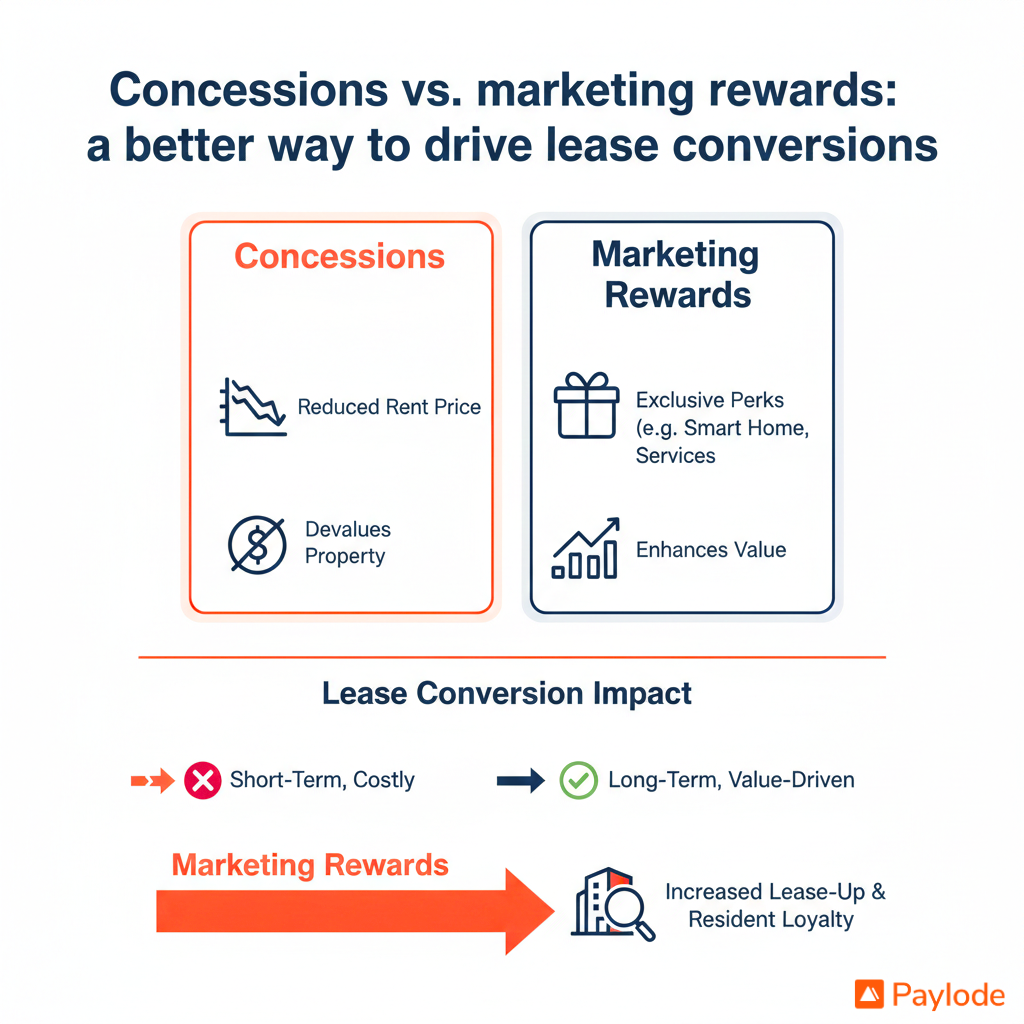
This comparison highlights the core tradeoff. Concessions prioritize speed and simplicity, often at the expense of long-term control. Marketing rewards prioritize precision, predictability, and pricing integrity, making them better suited for sustainable lease conversion strategies.
When marketing rewards work best
Marketing rewards are most effective when they are used intentionally and aligned with clear goals. They work best in situations where operators need flexibility without compromising rent.
Ideal use cases for marketing rewards
In competitive submarkets, rewards help properties stand out without matching every rent discount nearby. Instead of racing to the bottom on price, teams can offer value tied to action and timing.
During lease-ups, marketing rewards support early momentum without cutting rent. This helps establish pricing strength from the start while still encouraging faster decisions.
Renewal decision windows are another strong fit. Rewards can acknowledge loyalty and prompt earlier renewals without creating pressure to lower rent year after year.
Marketing rewards also work well as operational behavior incentives. Encouraging actions like timely payments, digital engagement, or process adoption becomes easier when residents receive value for completing specific steps.
Where concessions still tend to appear
Despite their drawbacks, concessions still show up in some situations. Legacy processes often default to rent discounts because that is how teams have always operated.
Short-term stabilization pressure can also drive concession use, especially when quick occupancy gains are prioritized over long-term impact.
Finally, misaligned incentives across teams can reinforce discounting. When success is measured only by speed or occupancy, concessions feel like the fastest answer.
Understanding where marketing rewards work best helps teams choose strategies that deliver results without weakening pricing integrity.
How this connects to modern multifamily strategy
Multifamily strategy is shifting away from price-led decisions and toward value-led conversions. As margins tighten and competition increases, lowering rent to win leases becomes harder to justify. Operators need approaches that influence behavior without weakening pricing, and this is where marketing rewards fit naturally.
Value-led conversions focus on why a prospect chooses to act, not how much the price is reduced. Rewards reinforce commitment, timing, and engagement while keeping rent intact. This allows communities to stay competitive without training prospects or residents to expect discounts.
This shift also improves alignment across teams. Marketing focuses on driving qualified actions instead of just traffic. Operations teams gain tools to close confidently without negotiating price. Asset teams retain clean rent data and stronger revenue optics. When all teams work toward the same goal, incentives stop pulling performance in different directions.
Over time, this alignment supports long-term performance. Pricing decisions feel intentional, reporting becomes clearer, and assets are easier to position for growth or exit. Operators who adopt this model are better equipped to scale without relying on rent cuts to maintain momentum.
A deeper look at how operators are making this transition is outlined in this guide on how multifamily operators can reduce concessions without hurting occupancy, which connects incentive strategy directly to sustainable performance.
Conclusion: choosing conversion strategies that scale
Concessions and marketing rewards can both increase lease conversions, but they operate very differently. Concessions lower rent to move decisions forward. Marketing rewards preserve rent while encouraging action. That difference shapes revenue quality, pricing integrity, and long-term performance.
While concessions may deliver quick wins, they introduce dependency and reduce effective rent over time. As discounts become expected, pricing power weakens and conversion performance becomes harder to sustain. Marketing rewards avoid this cycle. By keeping rent intact and rewarding commitment instead of price negotiation, they support stronger and more predictable outcomes.
For operations and marketing leaders, scalability matters. A strategy that works across lease-ups, competitive markets, and renewal windows must protect revenue while remaining flexible. Marketing rewards meet that standard. They provide control, budget clarity, and targeting precision without eroding rent.
Choosing conversion strategies that scale means thinking beyond speed. It means building systems that protect asset value while still driving decisions. Marketing rewards offer that balance, making them a more sustainable path for multifamily growth.
FAQs
Are marketing rewards better than rent concessions?
Marketing rewards are often better than rent concessions because they influence decisions without lowering rent. Concessions reduce effective rent and reset pricing expectations, while rewards preserve lease value and support sustainable conversions.
Do rewards really convert leases?
Yes. Rewards convert leases by creating urgency and encouraging commitment. When rewards are tied to specific actions and timeframes, prospects are more likely to move forward without negotiating rent.
Who should own reward-based incentives?
Reward-based incentives work best when marketing and operations share ownership. Marketing designs the offer and budget, while operations uses it at the point of decision. This shared approach keeps incentives aligned with performance goals.
How do rewards affect renewal pricing?
Rewards protect renewal pricing because rent is never discounted. Residents receive value without anchoring expectations to lower rent, which reduces pressure to offer discounts at renewal and supports long-term pricing stability.