Policyholder engagement has quietly become one of the most powerful levers in insurance growth. While pricing, underwriting, and acquisition still dominate strategic conversations, the real opportunity lies in what happens after a policy is sold.
Most insurers still operate in a low-touch model. Customers interact at purchase, occasionally during claims, and then again at renewal. This gap in engagement creates weak relationships, making it easier for policyholders to switch providers when a competitor offers even a small price advantage.
The challenge is clear: how do you increase engagement without reducing premiums or impacting margins?
Rewards offer a practical and scalable answer.
Instead of lowering prices, insurers can incentivize meaningful actions across the policy lifecycle. These actions—when designed correctly—improve retention, increase satisfaction, and drive long-term value, all while maintaining pricing discipline.
Why engagement is the missing growth lever in insurance
Insurance products are essential, but they are not frequently used. This creates a perception gap where customers don’t fully see the ongoing value of their policy.
When engagement is low, several issues emerge. Customers forget policy benefits, undervalue coverage, and become more price-sensitive. Over time, this leads to lower renewal rates and weaker brand loyalty.
Modern insurers are shifting away from this passive model. Instead of waiting for renewal cycles, they are building continuous engagement strategies that keep the brand relevant throughout the year.
Rewards play a critical role in enabling this shift. They provide a reason for customers to interact, explore, and stay connected with their insurer.
Understanding engagement rewards in insurance
Engagement rewards are structured incentives given to policyholders for completing specific actions. Unlike traditional discounts, they are not applied to premiums. Instead, they act as a “thank-you” for behaviors that benefit both the customer and the insurer.
These rewards are designed to be:
- Action-based
- Measurable
- Cost-controlled
Because rewards are only triggered when a desired behavior occurs, insurers gain much better visibility into ROI compared to blanket discounts.
This approach aligns naturally with lifecycle marketing and customer experience strategies, where every interaction has a defined purpose.
Where rewards drive the most impact across the policy lifecycle
Engagement does not happen at a single moment. It is built through multiple touchpoints across the lifecycle, each with its own opportunity to influence behavior.
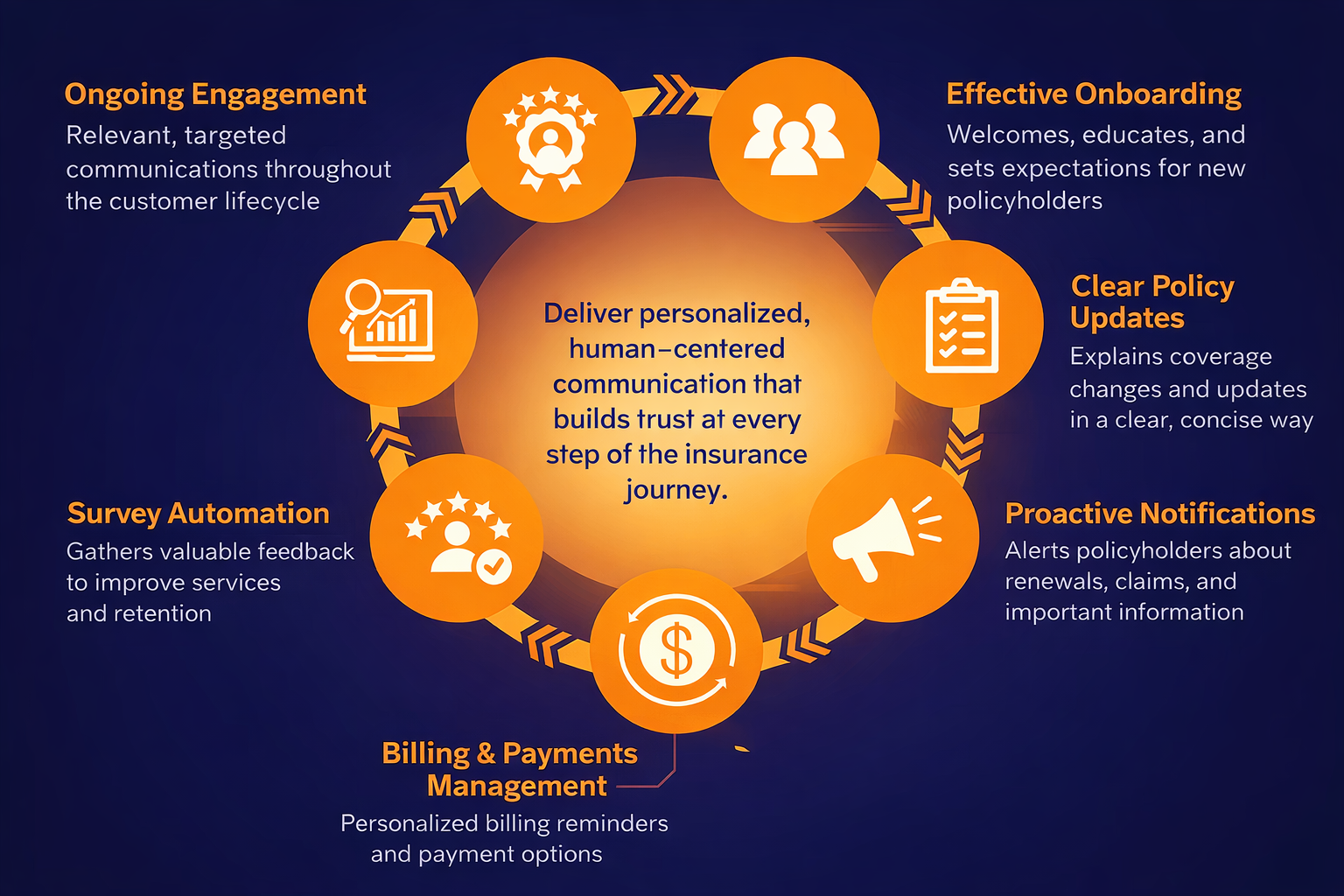
At the onboarding stage, the focus is on activation. When customers first purchase a policy, their willingness to engage is at its highest. Encouraging them to complete account setup, download the app, or set preferences creates early habits that carry forward.
As the policy matures, education becomes important. Many policyholders do not fully understand their coverage, which reduces perceived value. Encouraging them to explore benefits or complete simple educational steps strengthens trust and satisfaction.
Financial engagement is another critical layer. Actions such as setting up auto-pay or switching to digital billing reduce operational friction while improving customer convenience. These behaviors can be aligned with automatic payment adoption strategies and paperless billing engagement programs to create a smoother experience.
For implementation, insurers can explore Paylode’s solutions for automatic payments and switching to paperless, which are designed to drive these behaviors effectively.
Finally, the renewal stage represents the most important moment of truth. Encouraging early renewal shifts the conversation from reactive retention to proactive commitment.
Why “thank-you” rewards outperform discounts
Discounts have long been the default retention strategy in insurance. While they may deliver short-term results, they introduce long-term challenges.
Reducing premiums directly impacts revenue and creates expectations among customers. Over time, this can lead to a cycle where customers only stay if they receive a discount.
Rewards, on the other hand, operate on a completely different psychological level.
They are perceived as added value rather than a price reduction. When a customer receives a reward, it feels like recognition. This emotional response strengthens the relationship and builds goodwill toward the brand.
From a business perspective, rewards are far more efficient. Since they are tied to specific actions, insurers only incur costs when there is a measurable outcome. This makes budgeting more predictable and performance easier to track.
Timing is what makes rewards effective
Rewards are not just about what you offer—they are about when you offer it.
If a reward is delivered too late, the connection between action and benefit weakens. If it is delivered at the right moment, it reinforces behavior and increases the likelihood of repetition.
In the early stages, immediate rewards work best because they create instant reinforcement. When a customer completes onboarding or enables auto-pay and receives a reward right away, the experience feels seamless and satisfying.
As the relationship progresses, milestone-based rewards become more effective. Recognizing consistent behavior over time encourages long-term engagement rather than one-time actions.
Closer to renewal, timing becomes even more strategic. Offering rewards before the renewal decision nudges customers toward early commitment, reducing churn risk.
Occasionally, surprise rewards can be introduced to strengthen emotional connection. These unexpected moments of appreciation can differentiate an insurer in a highly competitive market.
Measuring engagement lift without risking margins
One of the biggest advantages of rewards-based engagement is measurability. Unlike discounts, which often lack clear attribution, rewards can be directly tied to outcomes.
To evaluate effectiveness, insurers should focus on a few core metrics:
- Engagement rate (how many users complete targeted actions)
- Renewal uplift between rewarded and non-rewarded groups
- Cost per completed action
- Long-term customer value
These insights help validate strategies and ensure that rewards are driving meaningful results. They can also be connected to customer lifetime value optimization strategies using Paylode’s LTV solution.
A controlled testing approach is essential. Starting with small pilots, comparing results across segments, and scaling successful strategies ensures minimal risk and maximum efficiency.
Building a scalable rewards strategy for insurance
A successful rewards program is not about giving incentives randomly. It requires a structured approach that aligns with business goals.
The first step is identifying the behaviors that truly matter. Not every action needs to be incentivized. The focus should be on actions that directly influence retention, engagement, or operational efficiency.
Once behaviors are defined, rewards should be calibrated carefully. They need to be meaningful enough to motivate action, but not so large that they impact margins.
Automation is the next critical layer. Insurers can use Paylode’s engagement platform to trigger rewards in real time, ensuring consistency and reducing manual effort.
To enhance effectiveness, personalization should be introduced. Different customer segments respond to different incentives, and tailoring rewards can significantly improve engagement rates.
Finally, building a broader rewards ecosystem through Paylode perks enables variety and flexibility, making the experience more engaging for policyholders.
Industry shift: from transactional to engagement-driven insurance
Insurance is undergoing a shift similar to what telecom and subscription-based industries experienced years ago. The focus is moving from one-time transactions to continuous engagement.
Customers today expect more than just coverage. They expect ongoing value, personalized experiences, and meaningful interactions.
Rewards enable insurers to meet these expectations without altering their pricing models. They bridge the gap between functional service and emotional connection.
Common mistakes insurers should avoid
One of the most common mistakes is over-incentivizing low-impact actions. This leads to unnecessary costs without meaningful returns.
Another issue is poor timing. Even a well-designed reward loses effectiveness if it is not delivered at the right moment.
Some insurers also fail to measure outcomes properly. Without clear tracking, it becomes difficult to justify investment in rewards programs.
Finally, treating rewards as discounts can dilute their value. Rewards should enhance the experience, not replace pricing strategy.
FAQs
Can rewards really improve policyholder engagement without lowering premiums?
Yes. Rewards encourage behavior without reducing base pricing, making them a more sustainable strategy.
What types of actions should be incentivized first?
Focus on onboarding, payment setup, and renewal behaviors, as they have the highest impact on retention.
How quickly can results be seen?
Engagement improvements can be visible within weeks, while retention impact becomes clearer over renewal cycles.
Are rewards scalable for large insurers?
Yes. With Paylode Boost, rewards can be automated and scaled efficiently.
Do rewards replace discounts completely?
In many cases, they can reduce or eliminate the need for discounts by improving perceived value and engagement.
Conclusion: engagement is the new growth strategy
Insurance growth does not have to come from lowering premiums. It can come from strengthening relationships.
Rewards provide a structured way to encourage meaningful actions, improve customer experience, and increase long-term value. They allow insurers to move from reactive retention to proactive engagement.
The result is a more loyal customer base, better financial outcomes, and a stronger competitive position.