
Customer churn in the home warranty space is rarely accidental. It is often tied to predictable life events - and one of the most critical is moving.
A home move disrupts routines. Customers reassess every recurring expense, question ongoing value, and eliminate anything that does not feel immediately useful. For warranty providers, this creates a high-risk churn window. But it also opens a unique opportunity to strengthen retention - if handled correctly.
The core issue is not pricing. It is perceived as relevant.
This blog explains how warranty companies can reduce churn during moves by making coverage visible, useful, and action-driven at the exact moment customers need it most - following structured engagement principles outlined in the Paylode Insurance Content SOP.
Why moving becomes a churn trigger
When customers move homes, they enter what can be called a “decision reset phase.” Every service is evaluated from scratch.
Home warranties often fall into a vulnerable category because they are not actively used during the move. Unlike electricity or broadband, they do not demand immediate attention.
As a result, even satisfied customers cancel - not out of dissatisfaction, but because the value is not visible in the moment.
The problem is not product-market fit. It is the timing of value delivery.
The gap between coverage and perceived value
Home warranties are designed for future protection. But during a move, customers operate in the present.
They are focused on logistics - packing, shifting, setting up appliances, and getting their new home functional. If the warranty does not show up in this journey, it gets deprioritized.
This creates a disconnect. The product is valuable, but the customer does not feel that value during a critical decision window.
To reduce churn, warranty providers must bridge this gap by embedding themselves into the moving experience.
Retention begins before cancellation intent
Most retention strategies fail because they are reactive. By the time a customer clicks “cancel,” the decision is already made.
The more effective approach is to identify early signals of a move and intervene proactively.
These signals can include address updates, service transfer requests, or billing changes. At this stage, communication should shift from generic reminders to contextual guidance.
Instead of talking about renewals, providers should focus on continuity - helping customers understand how their coverage transitions to the new home and why it still matters.
This subtle shift reframes the warranty from a passive service to an active support system.
Making coverage relevant during home transitions
To reduce churn during moves, warranty providers need to align their service with what customers are actually doing.
This means connecting coverage to real actions.
When customers move into a new home, they are setting up appliances, checking systems, and ensuring everything works. These are natural entry points for engagement.
If the warranty becomes part of these actions, it stops feeling abstract.
For example, instead of simply stating coverage benefits, providers can guide customers through steps like reviewing their new home systems or scheduling a check-up. Each interaction reinforces value in a practical way.
This is where action-driven engagement becomes powerful - it transforms the warranty from a background product into a visible utility.
Why “thank-you” rewards outperform discounts
Discounts focus on price. Rewards focus on experience.
During a move, customers are not always looking for the cheapest option. They are looking for services that feel helpful and responsive.
This is why “thank-you” rewards are more effective.
When customers take meaningful actions - like transferring their plan or engaging with services - and receive something in return, it creates a sense of recognition. It also builds momentum.
Instead of reducing revenue through blanket discounts, providers can increase perceived value through targeted incentives.
This approach aligns with broader engagement-led retention strategies used across insurance and financial services ecosystems.
Timing: the most overlooked retention lever
Timing determines whether a retention effort feels helpful or intrusive.
A reward offered too early feels irrelevant. A reward offered too late feels reactive.
The most effective strategy is to align rewards with customer actions in real time.
When a customer updates their address, that is the moment to reinforce continuity. When they settle into their new home, that is the moment to encourage engagement.
This creates a sequence of small, meaningful interactions instead of a single retention attempt.
Over time, these interactions build familiarity and trust, making churn less likely.
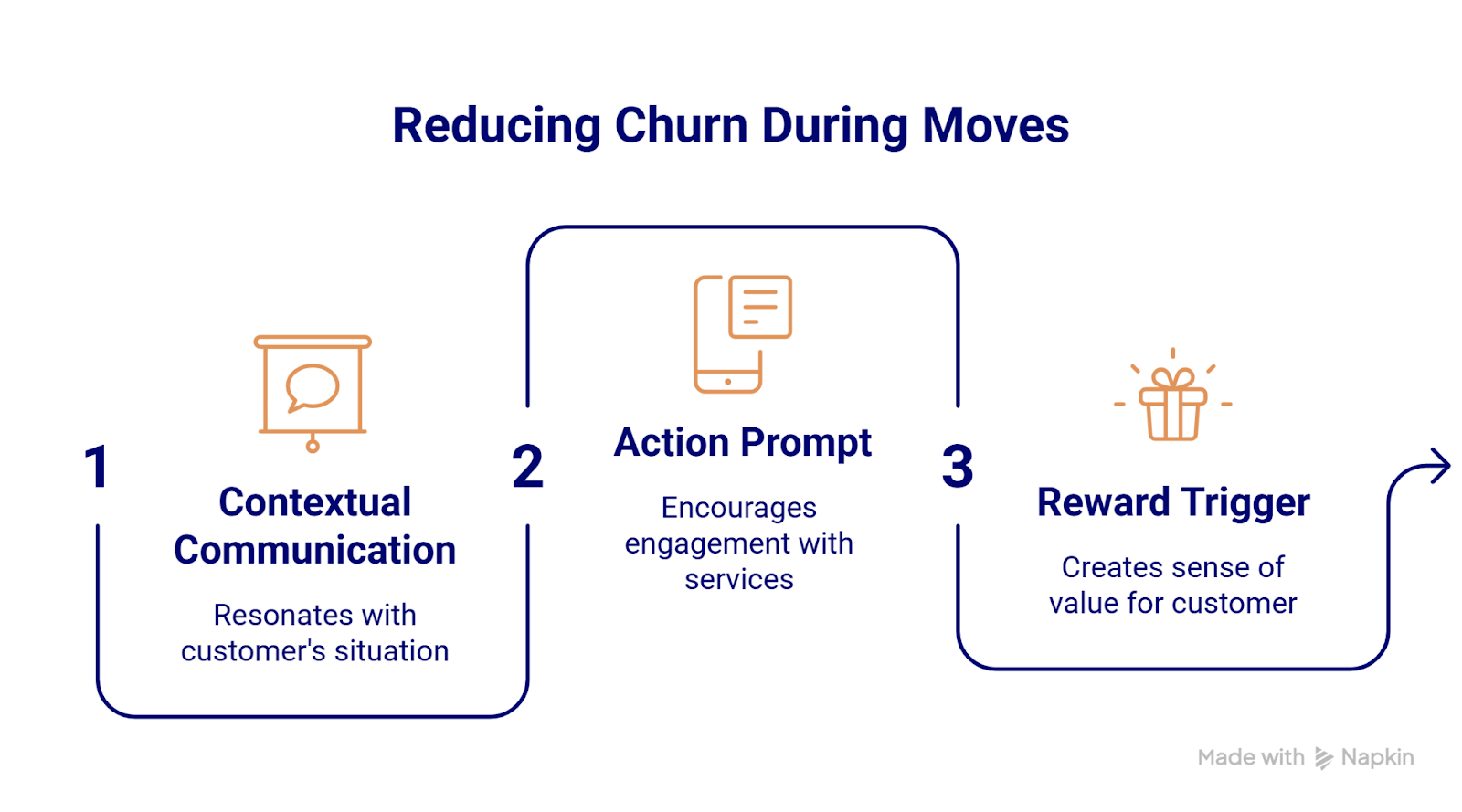
ALT text: Customer retention journey for warranty companies during home relocation using action-based rewards
From reactive retention to action-based engagement
Traditional retention strategies rely heavily on reacting to churn signals. This often means offering discounts or making last-minute retention calls.
While these methods can delay churn, they rarely build long-term loyalty.
A more effective approach is to focus on action-based engagement.
This means encouraging customers to interact with the service in meaningful ways during key lifecycle moments - like moving - and reinforcing those actions with rewards.
The shift is subtle but important. Instead of trying to stop customers from leaving, providers give them reasons to stay engaged.
Embedding rewards into the customer journey
For this strategy to work at scale, rewards cannot be treated as one-time campaigns. They need to be integrated into the customer lifecycle.
This requires systems that can detect behavioral signals, trigger relevant incentives, and track outcomes.
Platforms like Paylode Platform help warranty providers automate engagement workflows and deliver rewards at the right moment.
Similarly, curated offerings through Paylode Perks ensure that rewards feel relevant to customers during transitions like moving.
To further optimize engagement timing and delivery, solutions such as Paylode Boost can be used to align incentives with customer behavior.
Extending retention beyond the move
The move itself is just one phase of the customer journey.
Once customers settle into their new home, they enter a new evaluation cycle. This is where long-term retention is either strengthened or weakened.
Warranty providers can maintain engagement by continuing to connect their service with real-life actions - such as maintenance, seasonal checks, or system upgrades.
For example, encouraging ongoing engagement through structured retention strategies like increasing customer retention, ensures that the relationship does not fade after the move.
The objective is to build continuity, not just prevent cancellation.
Driving retention without impacting premiums
One of the biggest advantages of this approach is that it does not rely on reducing prices.
Instead, it focuses on increasing perceived value.
By making the service more visible, rewarding meaningful actions, and engaging customers at the right time, warranty providers can improve retention while protecting margins.
This creates a more sustainable model compared to discount-driven strategies, which often erode long-term profitability.
Industry perspective: why this model works
Across the broader insurance industry, there is a clear shift toward engagement-led retention.
Providers are moving away from purely transactional relationships and focusing on ongoing value delivery.
For warranty companies, this shift is especially relevant. The overlap between home warranty and insurance means that similar engagement strategies can be applied effectively.
Moves, in particular, represent a critical lifecycle moment where this approach can deliver measurable impact.
Conclusion: turning disruption into retention
A home move will always disrupt customer behavior. But disruption does not have to lead to churn.
With the right strategy, it can become a powerful opportunity to strengthen engagement.
By making coverage relevant during the move, aligning rewards with actions, and embedding engagement into the customer journey, warranty providers can transform a high-risk moment into a retention advantage.
If you’re looking to operationalize this approach, explore Paylode Plans to structure your engagement strategy or book a walkthrough via Get a Demo.
FAQs
Why is churn higher during home moves?
Because customers reassess all expenses and prioritize services that feel immediately useful. Warranties often get canceled if their value is not visible.
How do rewards help reduce churn?
Rewards encourage customers to take actions that increase engagement, making the service feel more valuable and relevant.
Are discounts effective for retention?
Discounts can work short-term, but often reduce margins. Engagement-driven rewards are more sustainable.
When should warranty providers engage customers during a move?
As early as possible - ideally when move-related signals like address changes are detected.
Can this strategy work without changing pricing?
Yes. The focus is on increasing perceived value through engagement rather than reducing price.

.jpg)
