
Customer acquisition in the auto warranty space has traditionally relied on one lever - discounting.
Lower the price, reduce friction, close the sale.
But this approach creates a long-term problem. It attracts price-sensitive buyers, compresses margins, and weakens perceived value. More importantly, it brings in customers who are more likely to churn later.
The smarter strategy is not to reduce price, but to improve conversion quality.
This blog explores how auto warranty providers can acquire better customers - without discounting coverage - by focusing on post-purchase reinforcement, action-based rewards, and reducing buyer’s remorse.
The hidden problem with discount-driven acquisition
Discounts create immediate conversions, but they often attract the wrong audience.
Customers who buy based on price are more likely to:
- Question value after purchase
- Compare alternatives frequently
- Cancel early if expectations are not met
This leads to poor retention and lower lifetime value.
The real issue is not acquisition volume - it is acquisition quality.
High-quality customers are those who understand the value of the product, engage with it, and stay longer. These customers are not necessarily looking for the cheapest option. They are looking for confidence in their decision.
Shifting from price-led to value-led acquisition
To move away from discounting, warranty providers need to rethink how value is communicated.
Instead of focusing only on what the product covers, providers should focus on what the customer experiences after purchase.
This is where post-purchase reinforcement becomes critical.
The acquisition journey does not end at conversion. In fact, the moments immediately after purchase are the most important in shaping customer perception.
If handled correctly, this phase can:
- Reinforce the buying decision
- Reduce uncertainty
- Increase engagement
If ignored, it can lead to doubt and eventual churn.
Understanding buyer’s remorse in auto warranties
Auto warranties are often purchased during high-pressure moments - vehicle purchase, financing discussions, or dealership upsells.
Customers may agree in the moment but question the decision later.
This is known as buyer’s remorse.
It typically happens when:
- The value is not immediately visible
- The product feels complex or unclear
- There is no immediate interaction post-purchase
Left unaddressed, buyer’s remorse leads to cancellations, refunds, or disengagement.
The solution is not to justify the price. It is to reinforce the value.
Post-purchase reinforcement: the most underused growth lever
Most warranty providers invest heavily in pre-sale marketing but neglect the post-purchase experience.
This is a missed opportunity.
The first few days after purchase are when customers are most attentive. They are open to communication and actively forming opinions about the product.
This is the ideal window to:
- Clarify coverage
- Guide next steps
- Encourage small, meaningful actions
When customers engage early, they are more likely to stay.
This is where structured engagement journeys can make a measurable difference.
Turning actions into acquisition drivers
Acquisition does not end at the point of sale. It extends into how customers interact with the product after purchase.
Action-based engagement plays a central role here.
Instead of leaving customers passive, providers should encourage specific actions that reinforce value.
For example, after purchase, customers can be guided to:
- Review their coverage details
- Save service contact information
- Schedule a basic vehicle check
- Understand claim processes
Each action builds familiarity and reduces uncertainty.
Over time, this creates a stronger connection between the customer and the product.
Why rewards work better than discounts
Discounts reduce the cost of entry. Rewards increase the value of ownership.
This distinction is important.
When customers receive rewards for engaging with the product, they feel recognized and supported. This creates positive reinforcement.
Instead of questioning their purchase, they start experiencing benefits.
Rewards also create momentum. Once a customer completes one action and receives a benefit, they are more likely to continue engaging.
This builds a habit loop that strengthens retention.
Using rewards to reduce buyer’s remorse
Buyer’s remorse is often driven by inactivity. When customers do nothing with a product, they begin to question it.
Rewards solve this by encouraging action.
For example, after purchase, providers can:
- Offer a small incentive for completing onboarding
- Reward customers for exploring their coverage
- Provide perks for taking the first service-related action
These interactions create immediate value.
Instead of waiting months for a claim, customers experience benefits within days of purchase.
This shifts perception from “I hope this is worth it” to “This is already useful.”
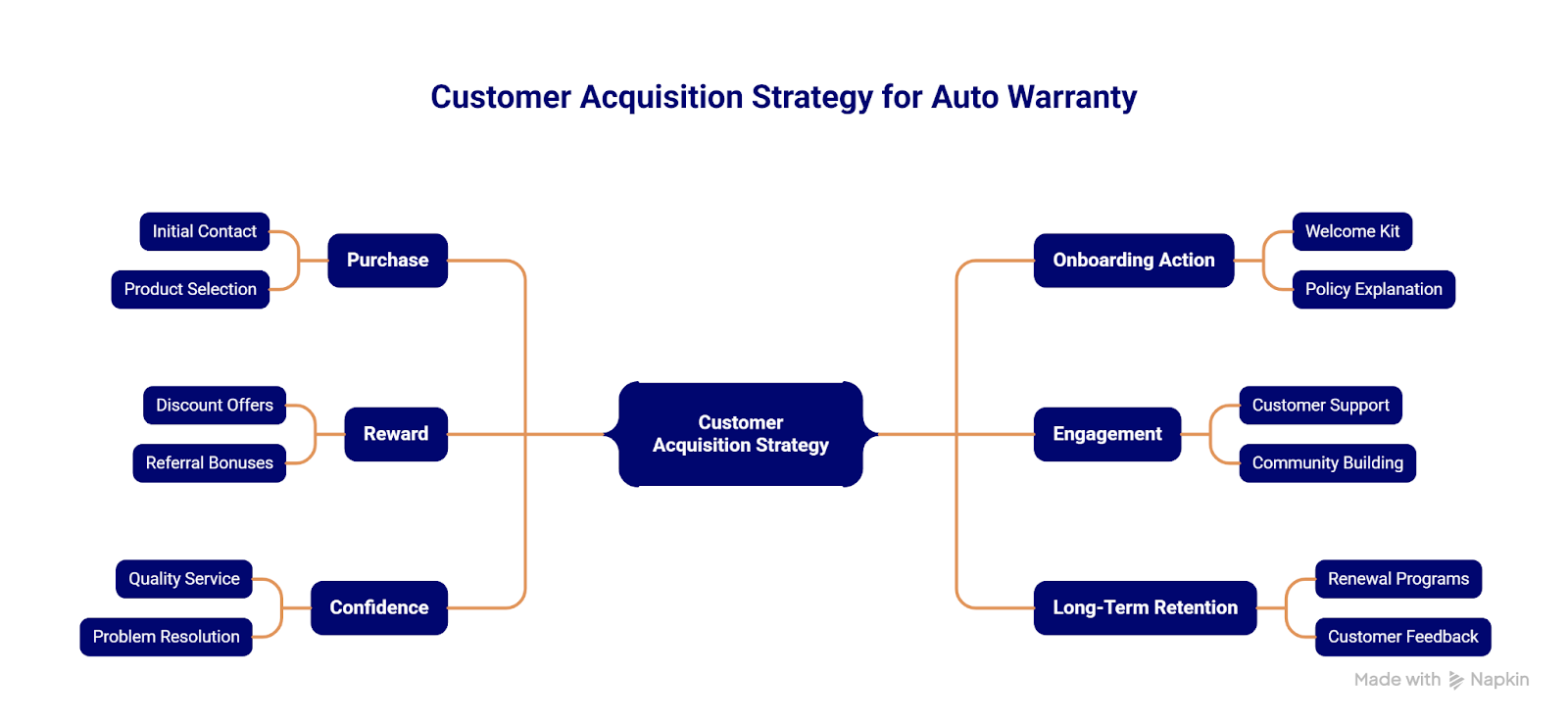
Improving conversion quality through engagement
Not all conversions are equal.
A customer who understands the product and engages with it is far more valuable than one who buys purely based on price.
By integrating engagement into the acquisition journey, providers can improve conversion quality.
This means:
- Fewer cancellations
- Higher retention rates
- Better lifetime value
Instead of focusing only on closing the sale, the focus shifts to strengthening the relationship.
Embedding rewards into the acquisition journey
To make this strategy scalable, rewards must be embedded into the customer lifecycle.
This requires systems that can trigger incentives based on behavior.
Platforms like Paylode Platform enable warranty providers to automate these engagement workflows and deliver rewards at the right time.
With Paylode Perks, companies can offer relevant benefits that align with customer needs, making the experience more tangible.
Additionally, Paylode Boost helps optimize when and how these rewards are delivered, ensuring maximum impact.
Creating a seamless post-purchase journey
A strong post-purchase journey should feel guided, not overwhelming.
Customers should know exactly what to do next.
This can be achieved through:
- Clear onboarding steps
- Timely nudges
- Simple, actionable communication
The goal is to reduce friction and make engagement easy.
When customers feel guided, they are more likely to participate.
Extending acquisition into retention
Acquisition and retention are often treated as separate functions. In reality, they are deeply connected.
A high-quality acquisition strategy naturally leads to better retention.
By reinforcing value early and encouraging engagement, providers can ensure that customers stay longer.
For example, ongoing engagement strategies like increase customer retention can be integrated into the post-purchase journey to sustain long-term value.
This creates continuity between acquisition and retention.
Protecting margins while improving growth
One of the biggest advantages of this approach is that it protects pricing.
Instead of lowering premiums, providers invest in experience.
This leads to:
- Higher perceived value
- Stronger customer relationships
- More sustainable growth
It also differentiates the brand. While competitors compete on price, providers using engagement-led strategies compete on value.
Industry perspective: why this shift matters
The broader insurance industry is moving toward engagement-driven models.
Providers are realizing that long-term growth depends not just on acquiring customers, but on acquiring the right customers.
Auto warranty providers are uniquely positioned to adopt this model because their product naturally aligns with ongoing customer interactions.
By focusing on post-purchase engagement, they can turn acquisition into a long-term growth engine.
Conclusion: acquisition is no longer just about conversion
Customer acquisition for auto warranties is evolving.
The goal is no longer just to close the sale - it is to ensure that the customer feels confident, engaged, and supported after purchase.
By reducing buyer’s remorse, reinforcing value early, and using action-based rewards, warranty providers can improve conversion quality without relying on discounts.
This creates a more sustainable and scalable growth model.
If you want to implement this approach, explore Paylode Plans to structure your acquisition strategy or book a walkthrough at Get a Demo.
FAQs
Why should auto warranty companies avoid discounting?
Discounting attracts price-sensitive customers and reduces margins. It also leads to lower retention and weaker long-term value.
What is post-purchase reinforcement?
It is the process of engaging customers immediately after purchase to reinforce their decision and increase perceived value.
How do rewards improve acquisition quality?
Rewards encourage engagement, reduce buyer’s remorse, and help customers experience value early, leading to better retention.
What causes buyer’s remorse in auto warranties?
It usually happens when customers do not immediately see value or do not interact with the product after purchase.
Can acquisition improve without lowering prices?
Yes. By focusing on engagement, timing, and value delivery, providers can improve conversion quality without reducing pricing.
.jpg)
