Residential property teams are expected to deliver more value with fewer resources. Residents now look for added benefits as part of everyday living, not just housing.
Many properties offer perks through third-party programs. These programs often introduce outside logos and mixed messages. As a result, residents may not connect the perk to the property itself.
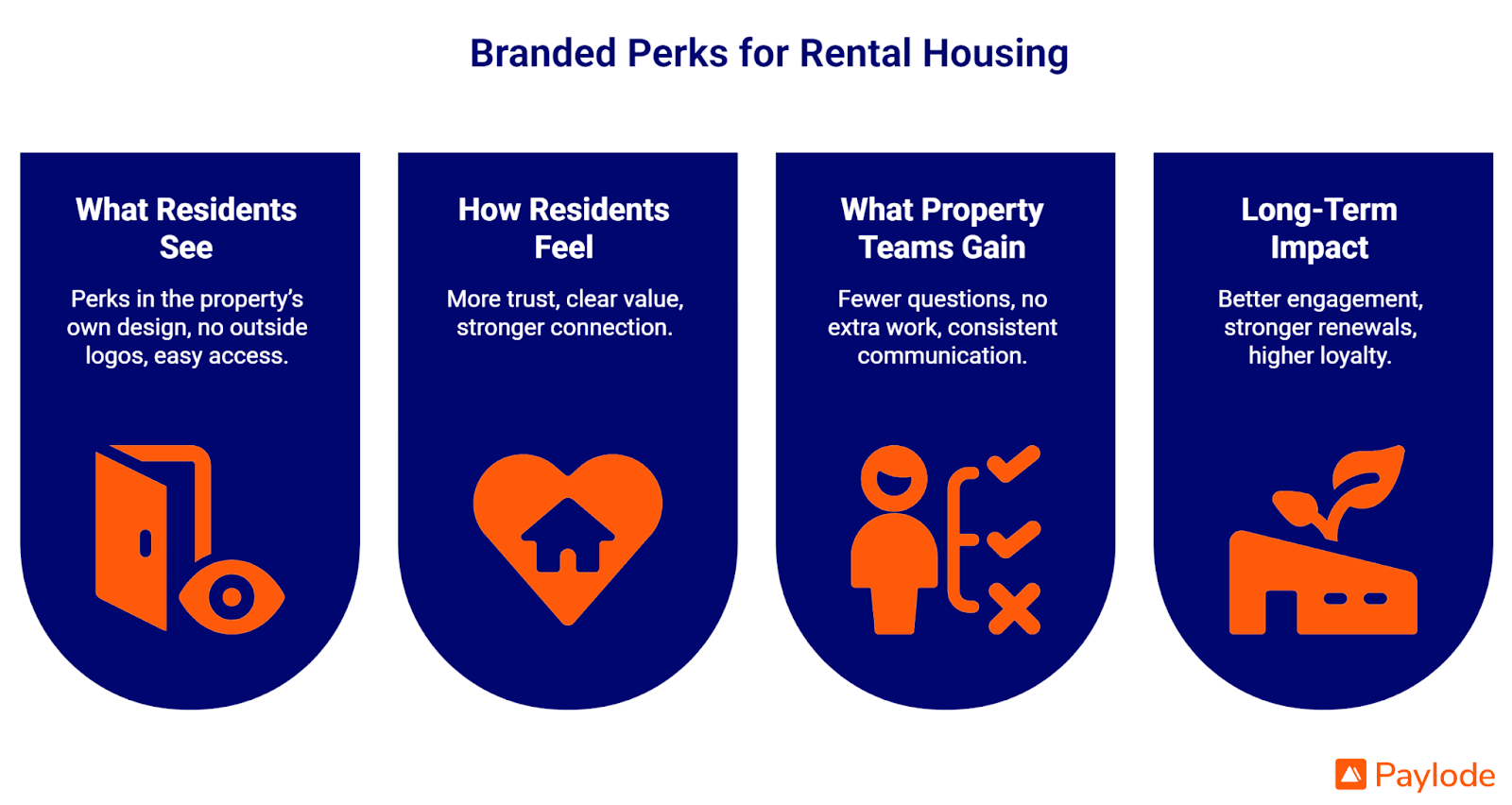
Branded perks for rental housing solve this problem. When perks match the property’s design and voice, they feel more trustworthy. Residents see them as part of the community, not an external promotion.
For property managers and owners, brand-controlled perks protect identity. They also reduce questions, confusion, and extra work for on-site teams.
This blog explains how residential brands can add perks in their own design, avoid outside branding, and deliver consistent value without increasing daily workload.
What branded perks mean in the residential real estate context
Branded perks are benefits offered to residents under the property’s own identity. They are designed to feel like a natural extension of the living experience, not an add-on from an outside company. Residents access these perks through familiar property channels, using the same look, tone, and experience they already trust.
Defining branded perks for rental housing
Branded perks for rental housing are perks that appear fully owned by the residential brand. They carry the property’s design, messaging, and voice. There are no external logos, pop-ups, or third-party names competing for attention.
This approach is different from traditional discount portals or coupon programs. Those programs often feel transactional and disconnected. Residents must visit separate platforms, remember new logins, or question who is providing the benefit. Over time, this reduces usage and weakens engagement.
Branded perks feel simpler. Residents see them as part of what the property offers, just like maintenance support or online payments. The experience feels unified, not fragmented.
Why branding matters in the renter experience
Residents associate consistent branding with trust. When perks look and feel familiar, residents are more likely to use them. They also associate these perks with professional management and thoughtful care.
Branding also creates consistency across the renter journey. From move-in to renewal, perks reinforce the property’s value without feeling like short-term promotions. Instead of isolated offers, branded perks support a steady, reliable living experience that residents recognize and appreciate.
The problem with third-party branded perk programs
Third-party perk programs often seem like an easy way to add value. In practice, they create challenges for both residents and property teams.
How outside branding creates confusion for residents
When perks carry unfamiliar logos or vendor names, residents may not know where the benefit comes from. Some assume the offer is unrelated to the property. Others question whether it is safe or even real.
This confusion reduces engagement. Residents are less likely to use perks they do not recognize or trust. Without an emotional connection to the property, the perk feels optional and forgettable. Over time, usage drops, and the perceived value disappears.
The hidden operational costs for property teams
Third-party programs often shift work back to on-site staff. Teams spend time explaining who provides the perk and how it works. These conversations repeat week after week with new residents.
Property managers also receive questions about legitimacy, access issues, and expired offers. None of these tasks improve the resident experience, yet they consume valuable time.
Aligning third-party perks with property goals becomes difficult. These programs are not designed to support retention, engagement, or long-term relationships. They operate separately from the renter journey, making it harder to measure real impact.
Why do many property managers hesitate to launch perks
Many property managers worry about losing control over the resident experience. Outside branding can clash with a property’s identity and tone.
There is also concern about cluttered communications. Mixed messages confuse residents and weaken trust. As a result, some teams delay offering perks at all, even when residents clearly expect them.
The problem with third-party branded perk programs
Third-party perk programs often seem like an easy way to add value. In practice, they create challenges for both residents and property teams.
How outside branding creates confusion for residents
When perks carry unfamiliar logos or vendor names, residents may not know where the benefit comes from. Some assume the offer is unrelated to the property. Others question whether it is safe or even real.
This confusion reduces engagement. Residents are less likely to use perks they do not recognize or trust. Without an emotional connection to the property, the perk feels optional and forgettable. Over time, usage drops, and the perceived value disappears.
The hidden operational costs for property teams
Third-party programs often shift work back to on-site staff. Teams spend time explaining who provides the perk and how it works. These conversations repeat week after week with new residents.
Property managers also receive questions about legitimacy, access issues, and expired offers. None of these tasks improve the resident experience, yet they consume valuable time.
Aligning third-party perks with property goals becomes difficult. These programs are not designed to support retention, engagement, or long-term relationships. They operate separately from the renter journey, making it harder to measure real impact.
Why do many property managers hesitate to launch perks
Many property managers worry about losing control over the resident experience. Outside branding can clash with a property’s identity and tone.
There is also concern about cluttered communications. Mixed messages confuse residents and weaken trust. As a result, some teams delay offering perks at all, even when residents clearly expect them.
Why residential brands want perks that look and feel like their own
Residential brands are placing more focus on how every interaction feels to residents. Perks are no longer viewed as extras. They are part of how a property builds relationships and earns long-term trust.
Branding as part of a retention strategy
Residents are more likely to stay where they feel recognized and valued. When perks carry the property’s name and design, they feel purposeful. They do not appear random or temporary.
A perk that looks and feels like it comes directly from the property sends a clear message. It shows that management has invested in the resident experience. This sense of intention strengthens emotional connection, which plays a key role in renewal decisions.
Perks tied to the property brand also feel more reliable. Residents trust them in the same way they trust other property services.
How branded perks support long-term resident loyalty
Branded perks for rental housing help create consistency across the full living experience. Residents see the same look and messaging when they pay rent, access their resident portal, or receive community updates.
This consistency builds familiarity. Familiar experiences feel easier and more dependable. Over time, residents associate that steady experience with the property itself.
Instead of being isolated offers, branded perks become part of daily life. They quietly reinforce value without requiring reminders or promotions. This steady presence supports loyalty, improves engagement, and strengthens the relationship between residents and the residential brand.
How a residential brand can add perks without outside branding
Adding perks does not require handing over control to third-party programs. With the right structure, residential brands can deliver value while keeping the experience fully their own.
Step 1: Centralize perks inside the resident experience
Perks should live where residents already spend time. When residents do not need to visit separate platforms, engagement increases naturally.
The most effective approach is embedding perks directly into existing touchpoints, such as payment portals and resident dashboards. This keeps the experience simple and familiar. When resident perks are part of the same environment residents already trust, they feel like a built-in benefit rather than an add-on (resident perks).
Step 2: Customize the look and feel to match the property brand
Brand consistency matters. Fonts, colors, and messaging should match the property’s identity. Residents should never feel like they are being redirected to an outside vendor.
When there are no visible third-party labels, perks feel owned by the property. This strengthens trust and reinforces professionalism.
Step 3: Offer perks that feel practical, not promotional
Residents respond best to everyday value. Practical perks are used more often and remembered longer.
Effective options include:
- Local services residents already use
- Digital subscriptions that support daily life
- Lifestyle benefits that reduce common expenses
For branded perks for rental housing, relevance matters more than volume. Fewer, useful perks outperform large collections that feel generic.
Step 4: Automate delivery to avoid staff workload
Perks should activate automatically without manual work from on-site teams. Automation keeps operations efficient and consistent.
Many properties tie perks to positive behaviors, such as on-time rent payments (automatic payments) or choosing paperless billing (switch to paperless). This approach rewards residents while reducing administrative effort.
How branded perks fit into the full renter lifecycle
Branded perks create the most impact when they support residents at every stage of their living experience. Instead of acting as one-time offers, they quietly reinforce value from move-in through renewal.
Move-in: Setting expectations early
The move-in stage sets the tone for the entire resident relationship. Introducing branded perks as part of the welcome experience shows residents that the property is thoughtful and resident-focused from day one.
When perks are positioned alongside lease details, payment setup, and community information, they feel intentional. Residents understand early that added value is built into living at the property. This first impression helps build trust and reduces uncertainty during a busy transition period.
Day-to-day living: Reinforcing value without reminders
During daily living, residents should be able to access perks anytime without needing help from on-site teams. When perks are easy to find and simple to use, they become part of routine life rather than something residents forget.
This approach reduces inbound questions and repetitive requests. Staff are no longer asked where to find benefits or how programs work. Residents help themselves, which improves satisfaction while protecting team time.
Because perks remain consistently available, they continue delivering value quietly without repeated promotions or reminders.
Renewal time: Turning everyday value into retention
At renewal time, residents reflect on their overall experience. Branded perks support these conversations naturally. Instead of listing isolated discounts, property teams can point to the ongoing value residents have received throughout their stay.
Everyday savings and benefits reinforce the idea that staying longer has advantages. Over time, this steady value strengthens loyalty and supports retention goals tied to long-term revenue growth (raising customer LTV).
When perks are woven into the full renter lifecycle, they become part of why residents choose to stay, not just a reason to sign up.
How modern platforms make branded perks possible at scale
Delivering branded perks consistently across one property or many locations requires the right technology. Without it, even well-designed perks can become difficult to manage.
Why technology matters for property teams
Manual perk management does not scale. When teams rely on spreadsheets, emails, or separate vendors, the workload grows quickly. Updates take longer. Mistakes happen. Staff spend time managing perks instead of focusing on residents.
Modern platforms remove this burden. They allow residential brands to launch and manage perks under their own design without adding daily tasks. Branding stays consistent, and delivery remains reliable, even as portfolios grow.
Technology makes it possible to offer branded perks for rental housing without increasing headcount or complexity.
Supporting property teams without added complexity
The most effective platforms bring everything into one place. Property teams can manage perks, engagement, and automation from a single system. There is no need to switch between tools or explain multiple experiences to residents.
Centralized management ensures that perks align with property goals and branding across locations (platform). A built-in perks catalog makes it easy to offer relevant, ready-to-use benefits without sourcing individual vendors (perks).
Engagement tools further strengthen impact by encouraging consistent resident interaction without manual follow-ups (boost). Together, these capabilities help property teams scale perks confidently while keeping the resident experience simple, branded, and easy to maintain.
Common concerns property managers have about branded perks
Even when the value is clear, property managers often pause before launching a perks program. Most concerns are practical and tied to workload, adoption, and scale.
“Will this add more work for my team?”
This is one of the most common concerns. Many managers assume perks require ongoing setup, updates, and resident support.
With branded perks delivered through modern platforms, this is not the case. Once perks are set up, they run in the background. Residents access them on their own, without staff involvement. There is no need for manual tracking, reminders, or explanations. Instead of creating work, branded perks often reduce repetitive questions and administrative tasks.
“Will residents actually use these perks?”
Residents use perks when they are easy to find and clearly connected to the property. When perks live inside familiar resident experiences and carry the property’s design, they feel trustworthy.
Usage increases when perks are practical. Everyday savings and useful benefits perform far better than large collections of generic offers. When residents see real value, engagement follows naturally.
“Is this only for large portfolios?”
Branded perks are not limited to large operators. Small and mid-sized properties often benefit the most. They gain access to the same structured, professional experience without building systems from scratch.
The approach scales up or down easily. Whether managing one community or many, property teams can deliver a consistent, branded experience without added complexity or overhead.
Conclusion: Turning perks into a brand advantage
Perks have become an expected part of the residential experience. However, how those perks are delivered matters just as much as what is offered. When perks are controlled by outside branding, their value weakens. Residents feel less connected, and property teams take on unnecessary work.
Branded perks for rental housing give residential brands back that control. They allow properties to deliver everyday value in a way that feels intentional and trustworthy. Residents clearly associate the benefit with the property, not an unknown vendor.
This approach strengthens trust by keeping experiences consistent. It supports retention by reinforcing value throughout the renter lifecycle. It also improves operational efficiency by reducing questions, explanations, and manual effort for on-site teams.
For property managers and owners, perks should not feel like another system to manage. They should feel like a natural extension of the brand and the resident experience.
Now is the time to rethink how perks are delivered and who they truly represent.
Take the next step and book a demo now.
FAQs about branded perks for rental housing
What are branded perks for rental housing?
Branded perks for rental housing are benefits offered to residents under the property’s own name and design. They feel like part of the living experience, not an external promotion. Residents associate these perks directly with the property, which builds trust and engagement.
Can perks be customized for different properties?
Yes. Perks can be tailored to match each property’s brand, resident profile, and location. This allows property teams to offer relevant value while maintaining a consistent experience across their portfolio.
Do branded perks replace amenities?
No. Branded perks complement amenities rather than replace them. While amenities focus on physical spaces, perks add everyday value that residents can use both inside and outside the property.
How quickly can a branded perks program be launched?
A branded perks program can be launched quickly once the platform is set up. Because perks are pre-built and automated, properties can start offering value without long implementation timelines or staff training.
Are branded perks measurable?
Yes. Branded perks are measurable through engagement, usage, and retention data. Property teams can track adoption and understand how perks support resident satisfaction and long-term loyalty.