Property managers are under increasing pressure to create resident experiences that go beyond maintaining buildings and offering amenities. Today's renters compare living experiences the same way consumers compare brands. They expect value, convenience, and benefits that extend beyond the lease agreement.
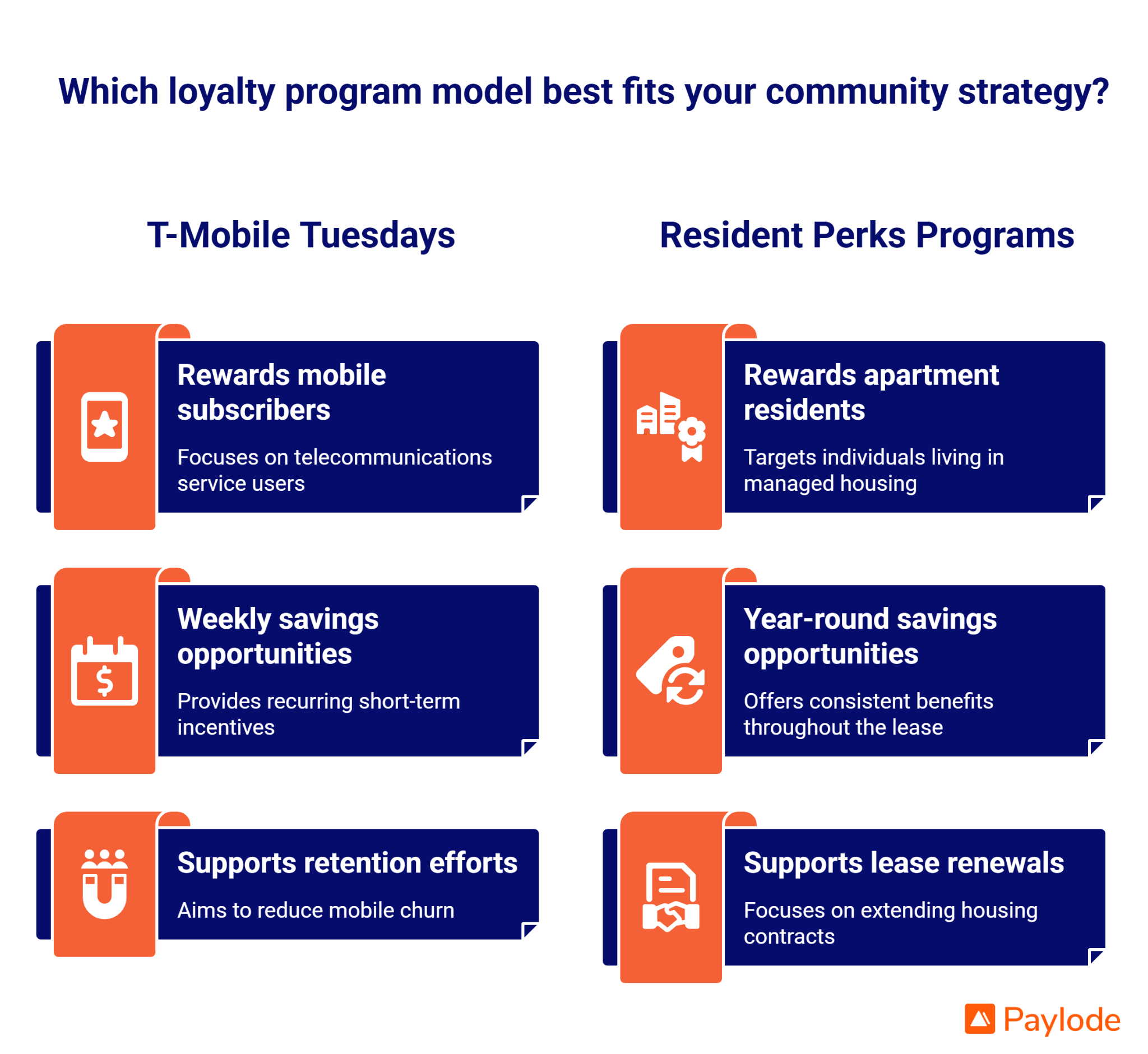
Many industries have already solved this challenge through customer rewards programs. One of the most recognizable examples is T-Mobile Tuesdays. The program provides customers with ongoing access to savings, discounts, giveaways, and exclusive offers simply for being a subscriber. The concept is simple but effective. Instead of focusing only on acquiring new customers, the company continually delivers value to existing ones.
This raises an important question for property managers: what is the closest residential real estate version of reward programs like T-Mobile Tuesdays?
The answer is resident perks programs. Similar to how telecom companies use rewards to strengthen customer relationships, apartment communities and multifamily operators are increasingly using resident perks to create ongoing engagement throughout the resident journey. Rather than offering a one-time welcome gift or occasional event, these programs provide continuous value that residents can access throughout their lease term.
As competition increases across the residential real estate market, operators are looking for practical ways to stand out without investing millions in renovations or new amenities. A well-designed resident rewards strategy helps properties create differentiation while supporting retention, satisfaction, and long-term resident value.
In this guide, we'll explore why resident perks programs are becoming the closest real estate version of reward programs, how they compare to T-Mobile Tuesdays, and why more property management companies are adopting them as part of their resident experience strategy.
What makes T-Mobile Tuesdays so successful as a customer rewards model?
To understand why resident perks programs are gaining momentum, it helps to understand why T-Mobile Tuesdays became so popular in the first place.
The program succeeds because it delivers value consistently. Customers do not have to wait for a contract renewal or special promotion to receive benefits. Instead, they receive regular opportunities to save money and access offers that fit into their everyday lives.
This approach creates a simple but powerful relationship between the brand and its customers. Every reward reminds customers that their membership has value beyond the primary service they pay for. The experience extends beyond mobile connectivity and becomes part of the customer's lifestyle.
How does recurring value keep customers engaged in a real estate version of reward programs?
People naturally respond to benefits they can use regularly. When rewards become part of everyday life, they create repeated positive interactions.
For property managers, the same principle applies. Residents often interact with management teams only when paying rent, requesting maintenance, or renewing a lease. While these interactions are important, they do not always create positive engagement opportunities.
A resident rewards program changes that dynamic. By providing ongoing access to discounts and savings through a resident-focused experience, operators create additional touchpoints that remind residents of the value their community provides.
This is one reason why many multifamily operators are investing in solutions such as Resident Perks offered through Paylode's resident engagement ecosystem. Instead of creating value only during move-in season, properties can deliver benefits throughout the year.
Why do residents stay longer when they feel rewarded?
Retention is influenced by more than rent pricing. Residents often evaluate their overall experience when deciding whether to renew.
When residents consistently receive useful benefits, they may perceive greater value from their community. That value can come from savings on everyday purchases, entertainment offers, travel discounts, or local experiences.
The effect is similar to what telecom companies experience with rewards programs. Customers who regularly benefit from a program are more likely to feel connected to the brand. In residential real estate, that same sense of value can contribute to stronger resident satisfaction and improved renewal outcomes.
This does not mean rewards replace excellent service. Maintenance quality, communication, and property operations remain essential. However, rewards can complement those efforts by providing another layer of value that residents appreciate.
What lessons can residential real estate learn from T-Mobile Tuesdays?
The biggest lesson is that ongoing value often creates stronger engagement than occasional incentives.
Many communities rely on resident appreciation events, seasonal giveaways, or renewal promotions. While these efforts can be effective, they often reach residents for only a short period.
A true real estate version of reward programs focuses on continuous engagement. It creates opportunities for residents to receive benefits throughout the year rather than only during special occasions.
Property managers can also learn the importance of simplicity. T-Mobile Tuesdays works because customers can easily understand and access rewards. Resident programs should follow the same principle. Easy access, relevant offers, and clear communication are often the ingredients that drive participation.
As resident expectations continue to evolve, communities that provide consistent value may be better positioned to strengthen relationships and create experiences that residents remember long after move-in day.
What is the closest real estate version of reward programs available today?
As resident expectations continue to rise, many property managers are searching for ways to deliver value beyond the apartment itself. While upgraded amenities and community events still matter, they are no longer enough to create meaningful differentiation in many markets.
The closest real estate version of reward programs available today is a resident perks program that provides ongoing access to savings, discounts, and exclusive offers. Much like T-Mobile Tuesdays, these programs reward residents simply for being part of a community.
Instead of focusing solely on rent collection and property operations, resident rewards programs help transform the relationship between residents and property managers into something more engaging. Residents receive access to benefits they can use throughout the year, while operators create additional opportunities to strengthen resident satisfaction.
This model has become increasingly attractive because it provides value that extends beyond the walls of the property. Residents may enjoy discounts on shopping, travel, dining, entertainment, wellness services, and local experiences. These are benefits they can use regularly, making the program relevant long after move-in day.
How do resident perks programs mirror the real estate version of reward programs like T-Mobile Tuesdays?
The similarities are surprisingly strong.
T-Mobile Tuesdays delivers recurring benefits that encourage customers to remain engaged with the brand. Resident perks programs achieve a similar goal by providing ongoing value throughout the resident lifecycle.
Both models focus on three key principles:
First, they create regular opportunities for engagement. Instead of interacting only during billing or contract renewals, users have a reason to return and explore available offers.
Second, they provide practical value. The rewards are not designed as occasional gifts. They are intended to be useful in everyday life.
Third, they reinforce loyalty. When people consistently receive benefits from an organization, they often develop a stronger connection to that brand or community.
For property managers, this approach represents a significant shift from traditional resident engagement strategies. Rather than relying entirely on events or promotions, communities can provide value every week of the year.
Why are resident perks becoming the preferred real estate version of reward programs?
Several market trends are driving adoption.
Renters today compare living experiences in the same way consumers compare brands. They expect convenience, digital access, and added value from the companies they interact with.
At the same time, property managers face ongoing pressure to improve retention. Acquiring new residents is often more expensive than keeping existing ones. As a result, operators are investing in programs that help strengthen resident relationships throughout the lease term.
Resident perks address both objectives.
They help residents feel appreciated while creating a more compelling overall experience. Unlike expensive amenity upgrades, rewards programs can often be implemented without major capital investment.
This is particularly important for operators managing multiple communities. A scalable rewards strategy allows portfolios to deliver a consistent experience across properties while minimizing operational complexity.
Many leading operators have embraced this approach through dedicated resident engagement solutions. For example, communities using Paylode's Resident Perks program can provide residents with access to a wide range of ongoing benefits while maintaining a simple experience for onsite teams.
The result is a practical and scalable real estate version of reward programs that supports both resident satisfaction and business goals.
How does a resident perks marketplace work?
A resident perks marketplace acts as a centralized destination where residents can discover and redeem available offers.
Instead of requiring property teams to negotiate individual partnerships, modern platforms typically provide access to a curated collection of national and local discounts. Residents can browse offers online and take advantage of savings that align with their interests and lifestyles.
The experience is designed to be simple. Residents access the marketplace, explore available opportunities, and redeem offers when needed. Because the program is digital, benefits can be updated regularly, keeping the experience fresh and relevant.
Another advantage is flexibility. Different residents value different types of offers. Some may prioritize travel savings, while others focus on dining, entertainment, wellness, or everyday shopping. A well-designed marketplace accommodates these varying preferences without requiring additional work from property teams.
This approach allows operators to deliver a meaningful resident benefit while avoiding the administrative burden associated with managing a traditional rewards program internally.
Most importantly, it helps transform resident engagement from a periodic activity into an ongoing experience. That continuous value is what makes resident perks the strongest modern example of a real estate version of reward programs.
Why are property managers investing in a real estate version of reward programs?
The growing popularity of resident rewards programs is not simply a response to changing renter expectations. It is also a reflection of evolving business priorities within residential real estate.
Property managers today are expected to improve retention, enhance resident satisfaction, and create stronger community experiences while operating efficiently. Achieving all three goals can be challenging, particularly in competitive markets where renters have multiple options.
This is where a well-designed real estate version of reward programs can make a meaningful difference.
Resident perks programs create value that residents can experience throughout their lease term. Instead of relying on a single touchpoint, operators can provide ongoing benefits that reinforce positive perceptions of the community.
As a result, many property management companies now view rewards programs as a strategic resident engagement tool rather than simply an added benefit.
How do resident rewards help improve retention?
Retention begins with resident satisfaction, but satisfaction is often influenced by more than the apartment itself.
Residents evaluate the complete experience they receive from a community. Communication, convenience, service quality, and perceived value all contribute to renewal decisions.
When residents regularly receive useful benefits, they may feel they are getting more from their housing experience. Those positive interactions can strengthen the relationship between residents and the property.
Many operators are incorporating rewards programs into broader retention strategies because they provide value throughout the lease lifecycle. This aligns closely with initiatives focused on helping operators Increase Retention by creating stronger resident relationships before renewal conversations begin.
The goal is not to replace excellent property management. Instead, rewards become another factor that contributes to a positive resident experience.
Why do perks support stronger resident relationships?
One of the biggest challenges property managers face is maintaining meaningful engagement with residents throughout the lease term. Outside of rent payments, maintenance requests, and community notices, there are often limited opportunities to create positive interactions.
Resident perks programs help bridge that gap.
Instead of only communicating when action is required, operators can provide residents with access to benefits that support their daily lives. Every time a resident uses a discount, discovers a new offer, or saves money through a program, the community becomes associated with positive value.
Over time, these small moments can have a cumulative impact. Residents begin to view their property as more than just a place to live. They see it as a community that actively provides benefits beyond housing.
This shift is important because strong resident relationships are often built through consistency rather than one-time gestures. A holiday event may create a memorable experience, but ongoing value creates repeated engagement opportunities throughout the year.
Property managers who focus on delivering continuous resident value often find it easier to strengthen trust, improve communication, and support long-term resident satisfaction.
How can rewards contribute to higher resident lifetime value?
Every property manager understands the importance of maximizing the value of each resident relationship.
When residents remain engaged, renew leases, and recommend the community to others, the long-term value of that relationship increases significantly. This is one reason many operators are exploring the role rewards programs can play in supporting broader business objectives.
A successful real estate version of reward programs helps create ongoing engagement between the property and the resident. That engagement can contribute to longer residency periods, stronger community participation, and greater overall satisfaction.
In many cases, rewards programs also encourage residents to interact more frequently with property communications and digital experiences. Increased engagement often creates additional opportunities to promote community initiatives, resident services, and value-added programs.
The cumulative effect can support efforts designed to Raise Customer LTV by strengthening resident loyalty throughout the lifecycle of the relationship.
Rather than focusing only on acquisition, operators can create value that continues long after move-in, helping maximize the return on every resident relationship.
How does the real estate version of reward programs compare with traditional resident events?
Resident events have long been a staple of multifamily engagement strategies. From holiday gatherings to food truck nights, these activities can help foster a sense of community and encourage resident participation.
However, many property managers are beginning to recognize the limitations of relying exclusively on events.
While events can generate excitement, their impact is often temporary. Participation levels vary, schedules can create attendance challenges, and benefits are typically limited to a single moment in time.
This is where the real estate version of reward programs offers a different approach.
Rather than creating value on specific dates, rewards programs provide continuous access to benefits that residents can enjoy whenever they choose.
Why are one-time events often limited in impact?
Community events certainly have a place within a resident engagement strategy. They can create opportunities for social interaction and help residents feel connected to their community.
The challenge is that not every resident participates.
Busy work schedules, family commitments, travel, or personal preferences may prevent many residents from attending. Even successful events often reach only a portion of the community.
Additionally, events require planning, staffing, vendor coordination, and budget allocation. Once the event concludes, the value generated typically ends as well.
For this reason, many operators are looking for engagement strategies that provide broader and more consistent resident participation.
How do always-on perks create continuous value?
Unlike events, resident perks programs are available throughout the year.
Residents can access benefits when they need them rather than waiting for scheduled activities. Whether they are shopping online, planning a vacation, dining locally, or purchasing everyday essentials, rewards remain available.
This creates a more inclusive experience because every resident has an opportunity to participate regardless of their schedule.
Continuous access also increases the likelihood that residents will engage with the program multiple times over the course of their lease. Each interaction reinforces the value the community provides.
For property managers, this means engagement becomes an ongoing process rather than a series of isolated events.
What combination delivers the strongest resident engagement?
The most effective resident experience strategies often combine multiple engagement approaches.
Community events help create personal connections and memorable moments. Resident rewards programs provide continuous value between those moments.
Together, they create a more complete experience.
A resident may attend a community gathering one month and use a travel discount the next. Both experiences contribute to their perception of value and strengthen their connection to the property.
Rather than viewing rewards and events as competing strategies, successful operators increasingly use them together to create a richer resident experience.
What types of benefits do residents value most in a rewards program?
The success of any rewards program depends largely on the relevance of the benefits being offered.
Residents are more likely to engage when offers align with their everyday needs and lifestyle preferences. While preferences vary across demographics and locations, several categories consistently generate strong interest.
Understanding what residents value helps property managers evaluate whether a rewards platform will deliver meaningful engagement.
How do everyday savings create meaningful value in a real estate version of reward programs?
For many residents, the most appreciated rewards are often the simplest ones.
Savings on routine purchases can provide value throughout the year. Because these purchases occur regularly, residents are more likely to return to the program frequently.
This recurring use reinforces engagement and strengthens awareness of the benefits provided by the community.
The appeal of everyday savings is also universal. Residents across different income levels and life stages can benefit from opportunities to reduce common expenses.
As a result, these offers often become a cornerstone of successful resident rewards programs.
Why do lifestyle benefits increase participation?
Lifestyle-focused rewards help expand the value of a resident program beyond basic savings.
Travel offers, entertainment experiences, wellness benefits, and recreational opportunities allow residents to enjoy experiences they may not otherwise access.
These benefits often generate excitement because they enhance quality of life rather than simply reducing costs.
When residents associate a property with enjoyable experiences, the community becomes more memorable and differentiated from competing options.
This emotional connection can play an important role in shaping overall resident satisfaction.
How can local business partnerships strengthen community engagement?
Local offers provide an additional layer of value that many residents appreciate.
Partnerships with neighborhood businesses help residents discover services, restaurants, and experiences near their community. At the same time, they support local economic activity and strengthen ties between the property and surrounding area.
Residents often appreciate recommendations that help them feel more connected to their neighborhood.
A strong rewards marketplace combines both national brands and local opportunities, creating a balanced experience that appeals to a broad range of residents while reinforcing community engagement.
How does a resident perks platform make implementation easier for property managers?
One of the reasons resident rewards programs have gained traction in residential real estate is their ability to deliver meaningful value without creating significant operational work.
Property management teams already manage leasing, maintenance coordination, resident communications, vendor relationships, and day-to-day operations. Any new initiative must be simple to launch and easy to maintain.
A modern real estate version of reward programs addresses this challenge by centralizing the resident experience within a digital platform. Rather than requiring onsite teams to build partnerships, negotiate discounts, or administer offers manually, residents gain access to a curated collection of benefits through a single destination.
This approach allows operators to focus on resident experience outcomes while minimizing administrative effort.
Why is simplicity important when launching a real estate version of reward programs?
Even the best resident engagement idea can struggle if implementation becomes too complex.
Property managers need solutions that fit naturally into existing workflows. Programs that require extensive staff training, manual administration, or ongoing maintenance often face adoption challenges.
A successful resident rewards program should be straightforward for both operators and residents.
When residents can easily access offers and property teams can launch the experience with minimal effort, participation tends to increase. Simplicity removes barriers that might otherwise prevent engagement.
This is particularly important for organizations managing multiple communities where consistency and scalability are essential.
How can digital delivery increase adoption?
Modern renters expect digital experiences.
From rent payments to maintenance requests, residents increasingly prefer self-service tools that provide convenience and flexibility. Rewards programs are no different.
Digital delivery allows residents to browse available benefits whenever and wherever it is convenient. Mobile access, simple redemption experiences, and user-friendly interfaces help increase participation.
The ability to access benefits instantly also aligns with broader resident expectations around convenience.
Many operators are leveraging dedicated solutions such as Perk Centers to provide residents with a centralized destination for discovering available rewards and offers. By making benefits easy to access, communities can create a more engaging and consistent resident experience.
Digital delivery also allows programs to evolve over time. New offers can be added, seasonal promotions can be introduced, and resident preferences can be accommodated without requiring additional work from onsite teams.
What should property managers evaluate before choosing a rewards platform?
Not all resident rewards programs are created equally.
Property managers should evaluate platforms based on the quality of available offers, ease of implementation, resident experience, and long-term scalability.
The best solutions provide value that residents can realistically use throughout the year. They also offer a simple administrative experience that does not create unnecessary workload for property teams.
Another important consideration is engagement. Programs should provide opportunities for residents to discover benefits regularly rather than interacting only once.
When evaluating options, operators should look for platforms that support both resident satisfaction and business objectives, creating value for all stakeholders involved.
How can rewards programs support other resident engagement goals?
The strongest resident rewards programs do more than provide discounts.
They can also support broader operational objectives by encouraging participation in initiatives that improve efficiency, communication, and resident engagement.
For property managers, this creates an opportunity to align resident benefits with strategic goals across the portfolio.
A thoughtfully implemented real estate version of reward programs can reinforce behaviors that benefit both residents and operators.
How can perks encourage automatic payments?
Rent collection remains one of the most important operational functions within residential real estate.
Many operators seek ways to encourage enrollment in digital payment options because they simplify processes and improve convenience for residents.
Rewards can help support this effort.
By connecting valuable resident benefits to enrollment campaigns, operators can create additional motivation for residents to participate. The experience feels less like a requirement and more like an opportunity to access added value.
This approach aligns naturally with initiatives designed to promote Automatic Payments while improving the overall resident experience.
When residents perceive a direct benefit from participation, adoption rates often improve.
How can perks help increase paperless adoption?
Property management companies continue to move toward digital communication and paperless operations.
Digital statements, notices, and resident communications can improve efficiency while reducing administrative costs. However, encouraging participation sometimes requires more than simply providing the option.
Resident rewards programs can serve as a valuable engagement tool during these transitions.
When residents associate digital participation with access to ongoing benefits, they may be more likely to adopt new processes.
Many operators use resident value programs to support Switch to Paperless initiatives while simultaneously improving engagement and resident satisfaction.
This creates a win-win scenario where both residents and operators benefit.
How can rewards programs become part of a broader retention strategy?
Retention is rarely driven by a single initiative.
Instead, it results from a collection of positive experiences that shape how residents perceive their community over time.
Resident rewards programs contribute to this effort by creating continuous value throughout the lease lifecycle. Every benefit redeemed serves as another reminder of the advantages associated with living within the community.
When combined with strong service, responsive communication, and quality property operations, rewards become part of a comprehensive resident retention strategy.
The most successful communities recognize that resident loyalty is built gradually. Consistent value often has a greater long-term impact than occasional incentives.
Why is the real estate version of reward programs becoming a competitive advantage?
The residential real estate industry continues to evolve rapidly.
While location, pricing, and amenities remain important decision factors, renters increasingly evaluate the overall experience offered by a community.
This shift is creating new opportunities for operators willing to think beyond traditional differentiation strategies.
A well-executed real estate version of reward programs can provide a competitive advantage because it delivers value that residents experience repeatedly throughout their lease term.
Unlike physical amenities that may eventually become standard across competing properties, rewards programs create ongoing engagement opportunities that continue to reinforce resident satisfaction.
How are resident expectations changing?
Today's renters are influenced by experiences they encounter across many industries.
Retail brands, streaming services, airlines, hotels, and telecom providers have conditioned consumers to expect ongoing benefits and personalized value.
As a result, many residents now evaluate apartment communities through a similar lens.
They are not simply looking for a place to live. They are looking for a living experience that provides convenience, value, and ongoing engagement.
Communities that recognize these changing expectations are often better positioned to attract and retain residents.
Why do modern renters compare experiences instead of amenities alone?
A decade ago, adding a fitness center or coworking space may have provided meaningful differentiation.
Today, many amenities have become common across the multifamily industry.
As communities become more similar in terms of physical offerings, resident experience becomes increasingly important.
Programs that provide continuous value help create distinctions that are difficult for competitors to replicate quickly.
This is one reason resident rewards programs continue gaining momentum across residential real estate.
How can perks help properties stand out in crowded rental markets?
In highly competitive markets, even small differentiators can influence resident perceptions.
A resident perks program gives operators an opportunity to provide tangible value that residents can experience regularly. Rather than promoting benefits that residents may use occasionally, communities can offer rewards that become part of everyday life.
This ongoing value helps create stronger resident relationships while supporting overall satisfaction.
For many operators, resident perks have become one of the most practical ways to differentiate without investing heavily in physical upgrades or renovations.
What does the future of the real estate version of reward programs look like?
The future of resident engagement will likely be shaped by personalization, convenience, and ongoing value.
Property managers are increasingly moving away from one-size-fits-all engagement strategies and toward experiences that reflect individual resident preferences.
As technology continues to improve, rewards platforms will become even more relevant, helping residents discover offers that align with their interests and lifestyles.
Communities that embrace these changes will be better positioned to meet evolving resident expectations while creating stronger competitive differentiation.
Most importantly, resident benefits are no longer viewed as optional extras. They are becoming a meaningful component of modern resident experience strategies.
Why are resident perks the closest real estate version of reward programs?
When property managers ask what the closest residential equivalent to T-Mobile Tuesdays is, the answer is increasingly clear.
Resident perks programs provide many of the same advantages that have made customer rewards programs successful across other industries. They create ongoing engagement, deliver meaningful value, and strengthen long-term relationships.
Unlike one-time promotions or occasional events, rewards programs provide continuous opportunities for residents to experience the benefits of living within a community.
For property managers, this creates a practical way to improve resident satisfaction, support retention efforts, and differentiate properties in competitive markets.
As resident expectations continue to evolve, communities that provide value beyond housing will have a stronger opportunity to stand out. The most successful operators are already recognizing that resident engagement does not end after move-in—it continues throughout the entire resident journey.
If your organization is exploring new ways to strengthen resident engagement, improve retention, and deliver measurable resident value, consider how the Paylode Platform can support your goals. Through Perks, Boost, flexible Plans, and the opportunity to Book a Demo, property managers can create a modern resident experience designed for today's renters.
FAQ
What is the closest residential real estate version of T-Mobile Tuesdays?
The closest residential real estate version of T-Mobile Tuesdays is a resident perks program. These programs provide ongoing access to discounts, savings, and exclusive offers that help create continuous resident engagement throughout the lease term.
Why are resident perks considered a real estate version of reward programs?
Resident perks are considered a real estate version of reward programs because they deliver recurring value beyond housing. Similar to customer loyalty programs in other industries, they help strengthen relationships and encourage long-term loyalty.
How do resident rewards programs help property managers?
Resident rewards programs help property managers improve resident satisfaction, increase engagement, support retention goals, and create a more differentiated resident experience without requiring major property upgrades.
Do resident perks help improve lease renewals?
Resident perks can contribute to stronger lease renewal outcomes by providing ongoing value throughout the resident lifecycle. When residents consistently experience benefits, they may perceive greater overall value from their community.
What types of rewards are included in resident perks programs?
Most resident perks programs include savings on shopping, dining, travel, entertainment, wellness services, local businesses, and other everyday lifestyle categories that residents can use regularly.
Are resident rewards programs difficult to implement?
Modern resident rewards platforms are designed to be easy to launch and manage. Most solutions provide a digital experience that minimizes administrative work for property management teams.
Why are rewards becoming important in residential real estate?
Resident expectations continue to evolve as consumers become accustomed to loyalty programs offered by major brands. Rewards help communities provide ongoing value and create stronger resident experiences.
Can resident rewards support resident retention strategies?
Yes. Resident rewards programs help create regular positive interactions with residents, making them a valuable component of broader retention and resident engagement strategies.