For years, multifamily operators have focused on traditional levers to improve performance - rent increases, occupancy optimization, and cost control. These are important, but they are no longer enough.
Today, resident expectations have changed. People are not just renting an apartment. They are choosing a lifestyle.
This shift is where resident lifestyle perks come into play.
At first glance, perks may seem like a “nice-to-have.” But when implemented correctly, they directly contribute to NOI improvement in real estate strategies by influencing retention, engagement, and operational efficiency.
This blog breaks down the real, often overlooked return on investment of lifestyle perks - and how property managers can use them as a growth driver.
Why multifamily operators are rethinking value
The multifamily market has become more competitive. Residents have more choices, and switching costs are lower than ever.
This means pricing alone cannot secure retention.
Property managers are now asking a different question:
How do we create a living experience that residents don’t want to leave?
Lifestyle perks answer that question by adding everyday value beyond the apartment itself.
What are the resident lifestyle perks?
Resident lifestyle perks are benefits offered to residents that enhance their daily lives.
These are not discounts on rent. Instead, they are added-value experiences such as:
- Savings on everyday brands
- Access to services
- Exclusive offers
- Digital benefits
The goal is simple - to make living in your property more rewarding.
When done right, perks shift the conversation from “cost of rent” to “value of living here.”
The connection between perks and NOI
Net Operating Income (NOI) is driven by two main factors: revenue and expenses.
Most operators focus on increasing revenue through rent or reducing expenses through efficiency. Lifestyle perks impact both - but in a less obvious way.
They influence behavior.
And behavior is what ultimately drives:
- Lease renewals
- Payment consistency
- Operational workload
- Vacancy costs
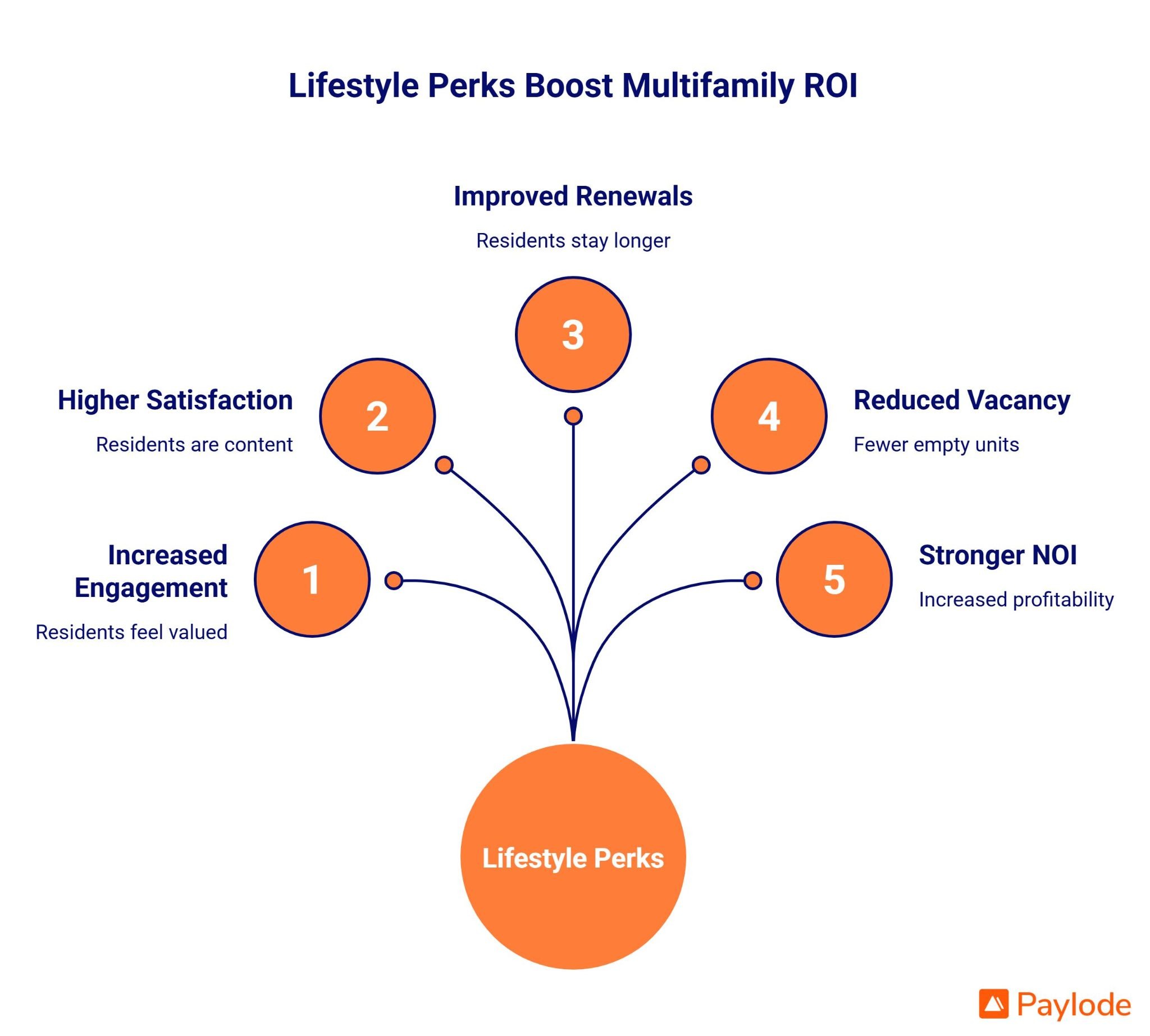
This is how resident lifestyle perks NOI improvement real estate strategies work - they improve the inputs that shape financial outcomes.
Retention: the biggest hidden ROI driver
Retention is one of the most powerful drivers of NOI.
Every time a resident leaves, you incur:
- Vacancy loss
- Marketing costs
- Turnover expenses
Even a small improvement in retention can significantly impact profitability.
Lifestyle perks create a stronger emotional connection between residents and the property. When residents feel they are receiving ongoing value, they are less likely to leave.
This is where perks outperform one-time incentives. They create continuous engagement instead of temporary satisfaction.
You can see how retention-focused strategies work in practice through increased retention initiatives designed for multifamily operators.
Reducing vacancy costs without lowering rent
Lowering rent to fill units is a short-term fix. It reduces revenue and sets a precedent for future negotiations.
Lifestyle perks provide an alternative.
Instead of reducing price, you increase perceived value.
Residents compare not just rent but the overall experience. When perks are part of that experience, your property stands out without sacrificing pricing.
This helps maintain strong occupancy while protecting revenue.
Improving payment behavior
Late payments are a common challenge in multifamily operations. They create cash flow issues and increase administrative work.
Lifestyle perks can be used to encourage better payment behavior.
When residents associate timely payments with rewards, they are more likely to pay on time. This reduces delays and improves consistency.
These strategies work especially well when combined with automatic payments, creating a seamless and reliable payment experience.
Enhancing resident experience at scale
One of the biggest challenges for property managers is delivering a consistent resident experience across multiple properties.
Lifestyle perks solve this by offering scalable value.
Instead of relying solely on on-site teams, perks create a standardized experience that every resident can access.
This ensures that residents feel valued regardless of location or property size.
Programs like resident perks are designed to deliver this kind of consistent engagement across portfolios.
Lowering operational burden
Property management teams often spend significant time on repetitive tasks:
- Payment follow-ups
- Renewal outreach
- Resident engagement efforts
Lifestyle perks reduce this burden by influencing behavior proactively.
When residents are more engaged and responsive, fewer reminders are needed. This allows teams to focus on higher-value activities instead of routine follow-ups.
Increasing resident lifetime value
Resident lifetime value is one of the most important metrics in multifamily operations.
The longer a resident stays and the more they engage, the more value they generate.
Lifestyle perks contribute to this by:
- Encouraging longer stays
- Increasing satisfaction
- Strengthening loyalty
Over time, this leads to higher overall revenue per resident.
Strategies focused on raising customer LTV align closely with the use of lifestyle perks.
Differentiation in competitive markets
In many markets, properties offer similar layouts, amenities, and pricing.
This makes differentiation difficult.
Lifestyle perks provide a unique advantage. They extend the value of the property beyond physical features.
Residents begin to evaluate properties not just based on space, but on the overall experience.
This makes your property more competitive without requiring major capital investments.
Supporting digital transformation
Multifamily operators are increasingly moving toward digital workflows.
Encouraging residents to adopt these tools can be challenging.
Lifestyle perks make this transition easier.
By linking perks to digital actions, such as online payments or paperless billing, property managers can accelerate adoption.
This improves efficiency and reduces manual processes.
The financial impact of small behavior changes
One of the most important aspects of lifestyle perks is their ability to influence small behaviors.
These small changes add up.
For example:
- A slight increase in on-time payments improves cash flow
- A small boost in renewals reduces vacancy costs
- A minor improvement in engagement lowers operational workload
Individually, these changes may seem small. Together, they create meaningful NOI improvement.
Why timing and consistency matter
Lifestyle perks are most effective when they are consistent and timely.
Residents should feel that benefits are ongoing, not occasional.
This creates a sense of continuous value.
Timing also plays a key role. Delivering perks at the right moments - such as after a payment or during renewal - reinforces the desired behavior.
Building a successful lifestyle perks strategy
To maximize ROI, property managers need a clear approach.
Start by identifying key resident behaviors that impact performance. Then align perks with those behaviors in a way that feels relevant and valuable.
The system should be easy to manage and scalable across properties. Automation plays a key role in ensuring consistency.
Over time, performance should be tracked and optimized to improve results.
The role of platforms in delivering perks
Managing lifestyle perks manually is not practical at scale.
This is where platforms come in.
Solutions like the Paylode platform enable property managers to deliver perks efficiently while integrating with existing systems.
They simplify execution and allow teams to focus on strategy rather than operations.
Moving from cost centers to value drivers
Traditionally, perks might have been seen as an added cost.
But when viewed through the lens of behavior and outcomes, they become a value driver.
They influence the factors that directly impact NOI, making them a strategic investment rather than an expense.
The future of multifamily operations
The future of multifamily is not just about buildings. It is about experiences.
Residents expect more than just a place to live. They want value, convenience, and engagement.
Lifestyle perks help meet these expectations while improving financial performance.
As competition increases, this approach will become a standard part of successful multifamily strategies.
Getting started with lifestyle perks
If you are new to this approach, start small.
Focus on one or two key areas, such as retention or payment behavior. Introduce perks and measure the impact.
As you see results, expand the program across more touchpoints.
You can explore solutions like Paylode perks and Paylode Boost to scale your strategy effectively.
Conclusion: unlocking hidden value in multifamily
The ROI of lifestyle perks is not always immediately visible, but it is significant.
By influencing resident behavior, perks improve retention, reduce costs, and enhance overall performance.
They turn everyday interactions into opportunities for engagement and growth.
If you are looking to improve performance without relying on rent discounts, this is one of the most effective strategies available.
Explore how to implement this approach through the Paylode platform, review options on Paylode plans, or take the next step by booking a demo.
FAQs
What are the resident lifestyle perks?
Resident lifestyle perks are benefits offered to residents that enhance their daily living experience, such as discounts, services, and exclusive offers.
How do lifestyle perks improve NOI?
They influence resident behavior, leading to higher retention, better payment consistency, and reduced operational costs.
Are lifestyle perks expensive to implement
When managed through the right platform, they are cost-effective and scalable across properties.
Do perks replace traditional incentives?
No, they complement existing strategies by adding continuous value rather than one-time benefits.
Can lifestyle perks work for large portfolios?
Yes, they are highly scalable and can be implemented across multiple properties with consistent results.