The rental market has become more competitive than ever. Residents are no longer comparing communities only by monthly rent, location, or square footage. They are comparing experiences.
A prospective resident can review dozens of communities online within minutes. They can compare amenities, explore floor plans, read reviews, and evaluate the overall value offered before ever scheduling a tour. For residential operators and property managers, this shift has created a new challenge: how do you create a community experience that feels meaningfully different when many properties offer similar features?
For years, operators relied on traditional differentiators such as upgraded common areas, package lockers, fitness centers, and move-in promotions. While those features still matter, they no longer guarantee a competitive edge.
Today, residents increasingly look for value that extends into everyday life.
That value may come from convenience, savings, experiences, and ongoing benefits that continue after move-in. Communities that deliver these experiences often create stronger emotional connection and stronger resident perception.
This is where Differentiation through resident perks is becoming an important strategy.
Resident perks create visible value beyond the apartment itself. Rather than improving only the physical space, operators create additional benefits that residents can access throughout their residency.
For property managers, this approach provides a practical way to improve resident perception without relying entirely on expensive capital projects.
Residential communities that focus on experience-led engagement strategies are increasingly aligning with solutions designed specifically for Residential real estate because they support both resident value and operational efficiency.
When residents feel they receive more than housing, communities become easier to remember, easier to recommend, and often easier to renew.
Why is differentiation through resident perks becoming more important in residential real estate?
The residential market continues to evolve.
New supply enters many markets. Existing communities continue upgrading amenities. Leasing teams compete aggressively for visibility and occupancy.
As a result, communities often begin to look similar from a resident perspective.
Property managers increasingly need ways to create distinction without constantly rebuilding amenities or reducing pricing.
Why are traditional property differentiators becoming less effective?
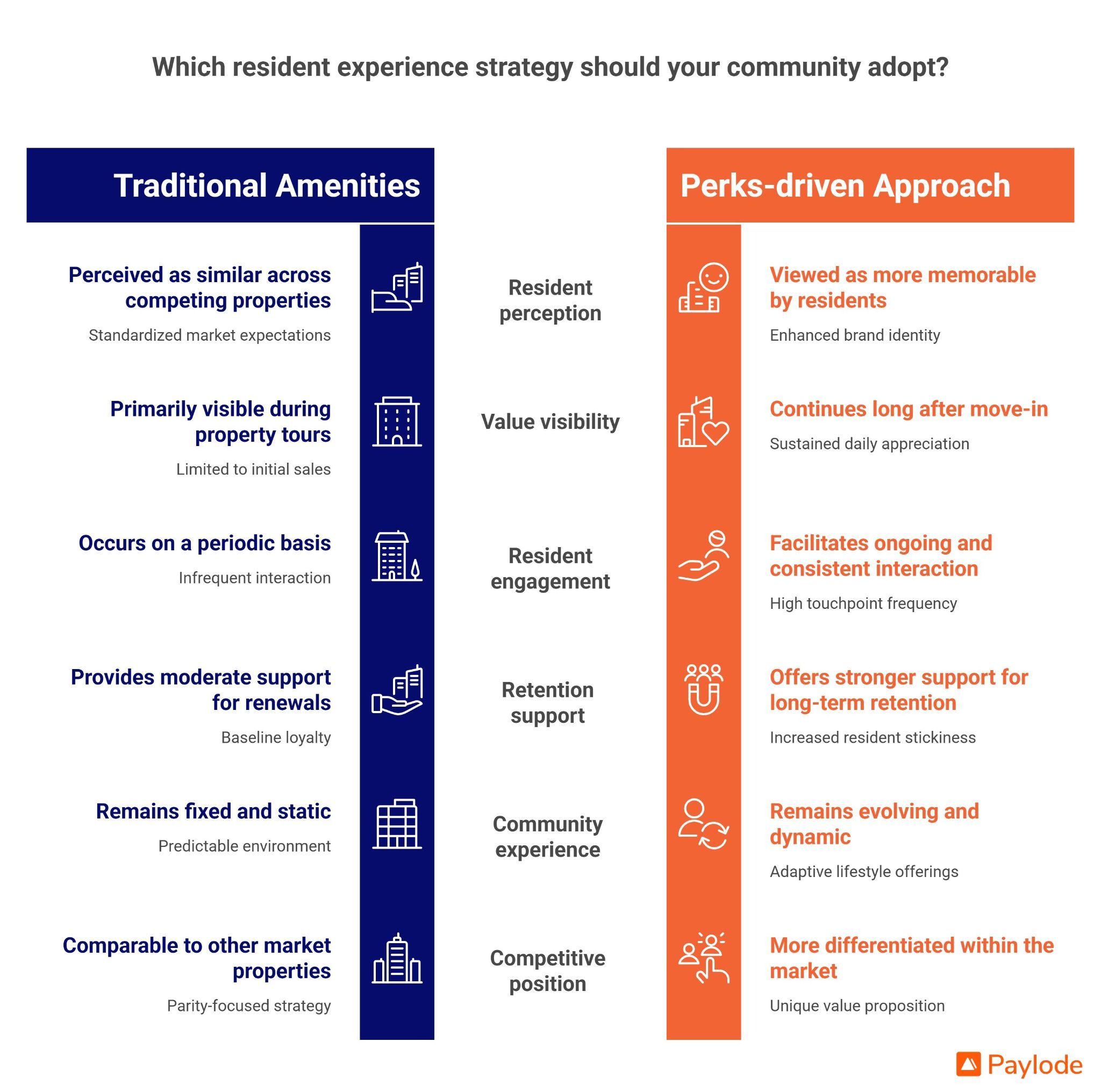
Traditional amenities remain valuable, but they have become expected.
Fitness centers are common.
Shared spaces are common.
Pet-friendly policies are common.
Even upgraded finishes have become more widely available.
When multiple communities provide comparable features, residents begin looking beyond the physical product.
That shift moves attention toward daily experience.
Residents increasingly ask:
“What additional value do I receive after move-in?”
“How does this community improve my lifestyle?”
“What benefits continue throughout my lease?”
These questions influence decision-making because residents evaluate housing as part of their overall living experience.
Communities that answer those questions effectively create stronger positioning.
How do perks create value beyond the apartment itself?
Resident perks extend value into daily routines.
Instead of a feature residents occasionally use, perks become benefits residents can access repeatedly.
Examples may include savings opportunities, local experiences, lifestyle advantages, and services that improve convenience.
These moments of value continue long after the leasing process ends.
That ongoing engagement helps create Differentiation through resident perks because residents experience benefits regularly rather than only noticing amenities during property tours.
Property managers often find that this type of value becomes easier for residents to describe when discussing their living experience with friends, family, and future renters.
Perks also create opportunities to reinforce community messaging throughout the resident lifecycle instead of concentrating value only during acquisition.
How does differentiation through resident perks influence leasing decisions?
Leasing decisions rarely happen in a single moment.
Residents gather information across websites, reviews, property pages, social content, and community interactions before making contact.
That means perception often develops before the first tour.
Communities that demonstrate clear resident value earlier in the journey may create stronger consideration.
Why do renters compare community experiences before signing?
Modern renters evaluate the complete experience.
They consider:
- Monthly cost
- Community reputation
- Convenience
- Lifestyle alignment
- Long-term value
Residents increasingly ask whether a community feels different—not simply whether it looks different.
Perks help answer that question.
When prospective residents see a community providing meaningful ongoing value, the property becomes easier to remember.
That distinction can become especially important in markets where pricing and inventory appear similar.
How do resident perks improve first impressions?
First impressions are often shaped by perceived value.
Resident perks create immediate signals that the operator understands resident priorities.
Rather than communicating only physical amenities, communities demonstrate that value continues after the lease begins.
Operators using structured resident engagement experiences through Resident perks often create stronger opportunities to communicate resident value throughout the leasing journey.
This creates an experience residents can imagine using—not simply viewing.
Communities that support everyday resident value often remain more memorable during comparison shopping.
What types of resident perks help communities stand out the most?
Creating differentiation does not mean offering more perks. It means offering perks that residents actually recognize as valuable.
Property managers sometimes assume that more options automatically create stronger engagement. In practice, residents tend to respond to benefits that fit naturally into their routines and create immediate usefulness.
The strongest resident experiences are built around relevance.
When perks become part of everyday living, they stop feeling like promotions and start feeling like an extension of the community experience.
That shift supports stronger resident satisfaction and strengthens Differentiation through resident perks over time.
How do everyday savings create stronger resident value?
Residents interact with value differently than operators often expect.
Large annual incentives may create short-term interest, but smaller ongoing benefits often create more frequent engagement.
Perks that support daily life create repeated moments of appreciation.
Examples may include:
- Everyday retail savings
- Dining experiences
- Household-related services
- Entertainment opportunities
- Lifestyle-focused offers
These benefits help residents feel they receive more value from where they live.
Unlike traditional amenities that may only appeal to specific groups, resident perks can support a broader range of preferences across a community.
That broader accessibility often creates stronger participation.
Another advantage is visibility.
When residents actively use benefits throughout the year, they associate that value directly with the community experience.
Why do convenience-focused perks increase resident engagement?
Convenience has become one of the strongest drivers of resident satisfaction.
People increasingly value solutions that save time, reduce effort, and make everyday life easier.
Convenience-based perks align closely with those expectations.
Rather than creating another platform residents must learn, successful communities create experiences that feel accessible and simple.
When resident value feels easy to access, engagement increases naturally.
Property managers also benefit because convenience-based experiences require less ongoing promotion than one-time campaigns.
Residents continue discovering value independently.
This approach turns resident engagement into a continuous experience rather than an occasional initiative.
Communities that consistently deliver useful experiences often become easier to differentiate in markets where physical amenities are becoming increasingly standardized.
How can differentiation through resident perks improve resident engagement after move-in?
Leasing is only one part of the resident journey.
Long-term community success depends on what happens after occupancy begins.
Many operators focus heavily on acquisition while underinvesting in post-move-in engagement.
Residents notice the difference.
When value ends after lease signing, engagement often declines over time.
Perks create an opportunity to extend positive experiences beyond move-in.
Why does engagement matter after occupancy?
Residents who interact positively with their community are more likely to develop stronger relationships with where they live.
That relationship influences:
- Satisfaction
- Renewal conversations
- Community participation
- Long-term perception
Engagement creates familiarity.
Familiarity creates connection.
Connection often supports retention.
Perks work particularly well because they create interactions outside traditional resident communications.
Instead of hearing from management only when payments or notices occur, residents receive value-driven touchpoints.
How do perks create repeated moments of value?
Perks support ongoing engagement because they remain available throughout residency.
Residents may discover new benefits months after moving in.
That continued discovery helps maintain interest.
Unlike static amenities, perks evolve through usage.
For property managers, this creates an opportunity to maintain resident attention without creating additional operational complexity.
Communities that treat perks as part of resident experience rather than promotional campaigns often create stronger participation and stronger resident sentiment over time.
Why do property managers prefer perks over adding new physical amenities?
Physical upgrades remain important.
However, they often require larger budgets, longer timelines, and more ongoing maintenance.
Perks create another path to resident value.
Rather than changing the property itself, operators improve how residents experience living there.
How do perks provide faster value than property upgrades?
New amenities often require planning, approvals, construction, and resident communication.
Perks can typically create value faster because the experience is delivered through access rather than physical change.
Residents benefit sooner.
Operators create engagement sooner.
Property managers gain flexibility.
That speed has become increasingly valuable in competitive rental markets.
What makes resident perks easier to scale?
Scaling physical amenities across multiple properties can become expensive and operationally demanding.
Resident experiences scale differently.
Operators can create more consistent value across locations without creating separate implementations for every community.
Teams pursuing broader resident experience initiatives frequently align those experiences with programs designed to Switch to paperless because both reduce friction and simplify resident interactions.
The result is a more connected resident journey.
How does differentiation through resident perks support retention and long-term resident value?
Standing out in a crowded rental market is important, but maintaining that advantage over time is what creates stronger business outcomes.
Retention has become one of the most important priorities for residential operators because acquiring a new resident often requires more effort and cost than keeping an existing one engaged.
Communities that create ongoing value throughout residency are better positioned to maintain stronger relationships.
Resident perks support this by extending value beyond the move-in period and creating reasons for residents to continue feeling connected to where they live.
Why do ongoing benefits influence renewals?
Renewal decisions usually develop gradually.
Residents rarely decide to renew based on one interaction.
Instead, they evaluate the entire living experience.
Questions residents may consider include:
- Has this community delivered value consistently?
- Has living here been convenient?
- Has the experience improved daily life?
- Do I feel recognized as a resident?
Perks help support positive answers to those questions.
Unlike one-time incentives, ongoing benefits continue reinforcing value throughout the lease term.
That continuous experience often creates stronger resident sentiment.
Residents begin associating the community with practical benefits they use regularly.
This changes the relationship from transactional to experience driven.
That perception becomes increasingly valuable during renewal discussions because residents evaluate not only rent but also total living value.
How do resident perks support the full resident lifecycle?
Effective resident engagement begins before move-in and continues throughout residency.
Perks can support multiple moments across that journey.
At move-in, they create an immediate positive experience.
During active residency, they create ongoing interaction.
During renewal periods, they reinforce the value residents have already received.
This consistency helps operators create experiences that feel intentional rather than promotional.
Many operators connect these experiences to broader resident growth initiatives designed to Raise customer LTV by increasing engagement across the full lifecycle.
Long-term value becomes easier to sustain when residents repeatedly experience meaningful benefits.
What should residential operators consider before launching a resident perks strategy?
Perks can support differentiation, but success depends on selecting the right experience.
The goal should not be offering the highest number of benefits.
The goal should be creating relevant value that residents can easily access and understand.
Property managers evaluating resident perks should focus on resident outcomes first.
How do you choose perks residents will actually use?
The strongest resident experiences are built around simplicity.
Residents are more likely to engage when benefits feel useful and require little effort.
Operators should evaluate:
- Relevance to everyday living
- Ease of access
- Resident communication experience
- Long-term flexibility
- Consistency across properties
Perks should enhance the resident experience rather than introduce additional complexity.
Solutions designed around centralized delivery often help communities scale engagement more effectively.
Operators evaluating structured resident engagement experiences can explore solutions such as Perk centers to create a more connected resident experience.
Why should resident experience remain simple?
Complex programs often create lower participation.
When residents cannot immediately understand value, engagement decreases.
Simple experiences encourage discovery and repeated use.
For property managers, simplicity also improves operational adoption.
Teams spend less time explaining programs and more time supporting resident outcomes.
That creates better long-term sustainability.
Why will differentiation through resident perks continue to grow?
Residential communities are operating in an environment where traditional differentiators no longer create the same impact they once did.
Residents increasingly expect more than physical amenities.
They want experiences that provide ongoing value throughout their residency.
That shift creates an opportunity for operators.
Differentiation through resident perks allows communities to create distinction without relying exclusively on property upgrades or pricing adjustments.
Perks create value residents can experience repeatedly.
They help strengthen engagement after move-in.
They support retention conversations.
They improve resident perception over time.
Most importantly, they help property managers deliver meaningful experiences without creating unnecessary operational burden.
Communities that succeed in the coming years will likely be those that combine strong operations with experiences residents genuinely value.
Perks represent one practical way to create that advantage.
FAQs
How do resident perks help residential communities stand out?
Resident perks create additional value beyond physical amenities by giving residents ongoing benefits they can use throughout their lease. This helps communities create stronger differentiation and become more memorable in competitive rental markets.
Why is differentiation through resident perks becoming more important?
Many residential communities now offer similar amenities and pricing structures. Perks help create a more distinctive resident experience by adding convenience, savings, and ongoing engagement.
Can resident perks improve resident retention?
Resident perks can support retention by increasing perceived value and creating more frequent positive interactions during residency, which may strengthen renewal conversations.
What types of resident perks create the strongest resident engagement?
Perks tied to everyday experiences—such as savings opportunities, convenience-focused benefits, and lifestyle experiences—often create stronger resident participation because they remain relevant over time.
Are resident perks easier to implement than adding new amenities?
Resident perks can often be introduced more quickly than physical amenity projects because they focus on improving resident experience rather than changing property infrastructure.