Real estate property managers are facing a clear shift in resident expectations. Today’s renters are not just comparing properties based on rent or location. They are comparing experiences. This change is pushing property managers to think beyond traditional leasing strategies and focus on long-term engagement.
One of the most effective ways to do this is through structured reward programs. Instead of offering one-time discounts or reactive incentives, rewards create ongoing value for residents. This approach helps build stronger relationships while also influencing key behaviors like renewals and on-time payments.
A loyalty management platform makes this possible at scale. It allows property managers to automate rewards, personalize offers, and track performance without adding operational complexity. This is especially important for teams managing multiple properties where consistency is critical.
In residential real estate, retention directly impacts revenue. Every renewal reduces vacancy costs, marketing spend, and operational disruption. That is why many property managers are now exploring solutions such as resident engagement programs with resident perks that deliver continuous value to tenants without increasing workload.
Rewards are no longer an experimental strategy. They are becoming a core part of how modern property managers improve retention, enhance resident satisfaction, and drive predictable growth.
What are real estate rewards programs?
Real estate rewards programs are structured systems designed to encourage specific resident behaviors by offering meaningful benefits. These programs go beyond occasional discounts and instead create a consistent value exchange between property managers and residents.
At their core, these programs reward actions that directly impact property performance. This includes behaviors like paying rent on time, renewing leases, referring new tenants, or engaging with property services. Instead of relying on reminders or penalties, rewards programs use positive reinforcement to guide these actions.
A loyalty management platform plays a critical role in making these programs effective. It connects resident actions with automated rewards, ensuring that every interaction feels timely and relevant. This removes the need for manual tracking and helps maintain consistency across all properties.
For property managers, the goal is not just to give rewards but to shape behavior in a way that improves long-term outcomes. When residents know they are getting ongoing value, they are more likely to stay engaged and loyal.
This approach aligns closely with broader strategies in residential real estate, where improving retention and engagement is becoming just as important as acquiring new tenants. Many property managers are now adopting structured solutions within the real estate ecosystem to make rewards programs more scalable and measurable.
In simple terms, real estate rewards programs turn everyday resident actions into opportunities to build stronger relationships while driving better business results.
Why property managers are adopting rewards programs
Property managers are moving toward rewards programs because traditional retention strategies are no longer delivering consistent results. Discounts, reminders, and reactive offers often come too late in the resident lifecycle. By the time action is taken, the decision to move out is already in motion.
Rewards programs shift this approach from reactive to proactive. Instead of waiting for churn signals, property managers can continuously engage residents throughout their stay. This creates a steady stream of value that keeps residents connected to the property.
A loyalty management platform makes this transition practical. It allows property managers to set up automated triggers for key actions like rent payments or lease milestones. This ensures that residents are rewarded at the right moment without requiring manual intervention.
Another key reason for adoption is predictability. Rewards programs provide measurable outcomes, making it easier to understand what drives retention and engagement. Property managers can track how specific actions influence renewals and adjust strategies accordingly.
There is also a growing focus on improving operational efficiency. Managing multiple properties can make it difficult to maintain a consistent resident experience. A centralized system helps standardize rewards across locations while still allowing for personalization.
Many property managers are also aligning rewards with broader initiatives like digital payments and automated workflows. For example, encouraging residents to adopt automatic payments not only improves cash flow but also reduces administrative effort, creating a win-win scenario.
Ultimately, rewards programs are being adopted because they align business goals with resident expectations. They help property managers create a more engaging, value-driven experience while improving key metrics like retention, renewals, and lifetime value.
key benefits of real estate rewards programs
Real estate rewards programs are not just about offering perks. They are designed to influence behaviors that directly impact revenue, efficiency, and resident satisfaction. When powered by a loyalty management platform, these programs become structured, measurable, and scalable.
Higher tenant retention
Retention improves when residents feel they are getting continuous value, not just a place to live. Rewards create ongoing engagement throughout the lease period, making residents less likely to explore other options.
Instead of reacting to move-out notices, property managers can build loyalty from day one. This shift reduces churn and stabilizes occupancy across properties.
Increased lease renewals
Renewal decisions are often influenced by perceived value. When residents receive benefits tied to their stay, renewing becomes a more attractive option.
Rewards delivered around renewal periods act as positive reinforcement. They help residents associate staying with added advantages rather than just cost considerations.
Better payment behavior
Consistent rent collection is critical for operational stability. Rewards linked to payment behavior encourage residents to pay on time without constant follow-ups.
This approach works especially well when combined with systems like automatic payments, where convenience and incentives together drive better outcomes.
Improved resident experience
Residents today expect more personalized and engaging experiences. Rewards programs help meet these expectations by offering benefits that are useful in everyday life.
From lifestyle perks to savings opportunities, these programs enhance satisfaction without requiring major operational changes.
Higher resident lifetime value
When residents stay longer and engage more, their overall value increases. Rewards programs help extend the resident lifecycle while also improving engagement at every stage.
This directly supports strategies focused on increasing long-term revenue, such as initiatives designed to raise customer LTV.
Summary of impact
These benefits make rewards programs a practical and results-driven strategy for modern property managers. When supported by a loyalty management platform, they move from simple incentives to a structured system that drives measurable growth.
How a loyalty management platform powers real estate rewards
Running a rewards program manually may seem manageable at first, but it quickly becomes difficult as your portfolio grows. Tracking resident actions, delivering rewards on time, and maintaining consistency across properties can create operational friction.
This is where a loyalty management platform becomes essential. It acts as the central system that connects resident behavior with automated rewards, ensuring that every interaction is timely and relevant.
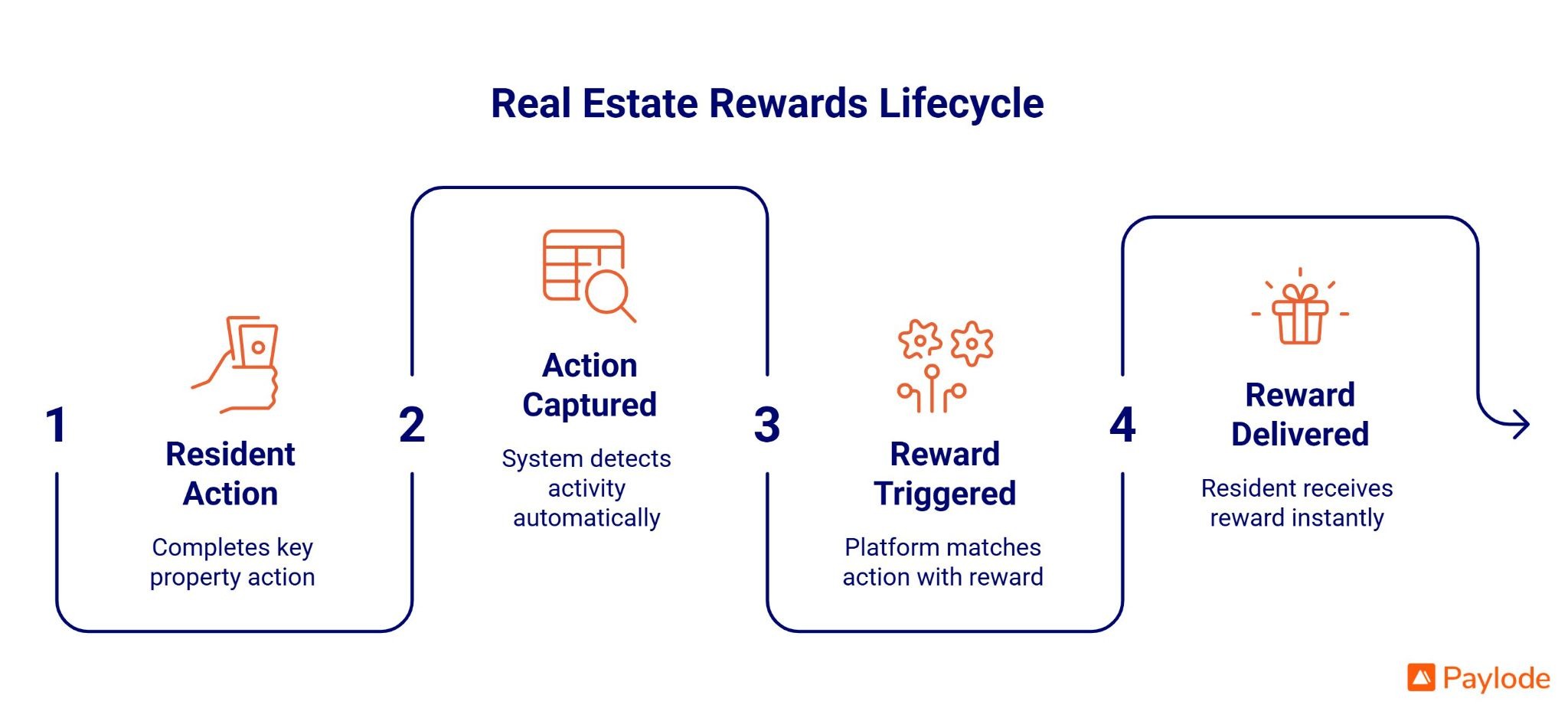
Instead of relying on manual processes, property managers can set up predefined triggers. For example, when a resident pays rent on time or reaches a lease milestone, the platform automatically delivers a reward. This removes delays and creates a seamless experience for residents.
Another advantage is personalization. Not all residents value the same type of rewards. A platform allows you to tailor offers based on preferences, behavior, and lifecycle stage. This increases engagement because the rewards feel more relevant and useful.
Integration also plays a key role. A strong platform connects with property management systems, payment tools, and communication channels. This ensures that rewards are aligned with real-time actions, not outdated data.
For property managers looking to scale efficiently, centralized systems like perk centers help standardize rewards across multiple properties while still allowing flexibility. This ensures that every resident receives a consistent experience regardless of location.
Visibility is another critical benefit. A loyalty management platform provides insights into how rewards are performing. Property managers can track engagement, measure impact on renewals, and understand which incentives deliver the best results.
In simple terms, the platform transforms rewards from a manual effort into a structured growth strategy. It allows property managers to focus less on operations and more on improving resident relationships and long-term outcomes.
Types of rewards you can offer in real estate
Choosing the right rewards is critical to the success of any program. Residents respond best to benefits that feel useful in their daily lives, not just occasional discounts. The goal is to create a mix of rewards that delivers both immediate and long-term value.
A loyalty management platform makes it easier to offer a wide range of rewards without increasing operational complexity. Property managers can curate and deliver these benefits in a structured and scalable way.
Common reward categories
Each category serves a different purpose. Financial rewards drive quick action, while lifestyle and convenience perks improve overall satisfaction.
How to choose the right rewards mix
The most effective programs balance cost with perceived value. Residents do not always need high-cost rewards. They need relevant ones.
A strong rewards mix should:
- Align with resident lifestyle and preferences
- Be easy to understand and redeem
- Deliver value at key moments like renewals or payments
- Encourage repeat engagement
Why variety matters
Offering only one type of reward can limit engagement. Different residents are motivated by different benefits. Some may value savings, while others prioritize experiences or convenience.
This is why many property managers adopt structured programs through resident perks, which provide access to a wide range of curated offers without the need to manage individual partnerships.
Linking rewards to behavior
The effectiveness of rewards depends on when and how they are delivered. The best programs tie rewards directly to actions such as:
- On-time rent payments
- Lease renewals
- Referrals
- Digital engagement
This ensures that rewards are not random but connected to measurable outcomes.
When designed thoughtfully, rewards become more than incentives. They become part of the resident experience. With the support of a loyalty management platform, property managers can deliver the right reward at the right time, creating consistent engagement across the entire resident lifecycle.
How to design a successful real estate rewards program
Designing a rewards program is not just about selecting perks. It requires a clear structure that connects resident actions with measurable outcomes. Without a defined approach, even good rewards can fail to deliver results.
A loyalty management platform helps bring this structure by aligning goals, automation, and tracking into one system.
Start with clear goals
Every rewards program should begin with a specific objective. Property managers typically focus on improving retention, increasing renewals, or encouraging on-time payments.
When goals are clearly defined, it becomes easier to design rewards that directly support those outcomes.
Identify high-impact resident actions
Not all actions are equally valuable. The most effective programs focus on behaviors that influence revenue and operational efficiency.
These include lease renewals, consistent payments, referrals, and engagement with property services. By prioritizing these actions, rewards programs stay aligned with business impact.
Create a simple and clear structure
Residents should immediately understand how the program works. If the process is confusing, engagement drops.
A clear structure answers three questions:
- What action should the resident take
- What reward will they receive
- When will they receive it
Simplicity drives participation.
Automate reward delivery
Manual reward distribution often leads to delays and inconsistencies. Automation ensures that rewards are delivered instantly after an action is completed.
This improves trust and keeps residents engaged. It also reduces operational workload for property teams.
Measure and optimize continuously
A rewards program should not remain static. Property managers need to track performance and refine the strategy over time.
Key areas to monitor include engagement levels, redemption rates, and renewal impact. This data helps identify what is working and where improvements are needed.
Programs designed with retention in mind often align well with broader strategies focused on increasing retention, where consistent engagement plays a central role.
A well-designed rewards program turns everyday resident interactions into opportunities for growth. With the support of a loyalty management platform, property managers can create a system that is not only effective but also easy to manage and scale.
Challenges property managers face without a rewards platform
Running rewards programs without a structured system often creates more problems than results. What starts as a simple initiative can quickly become difficult to manage, especially across multiple properties.
Without a loyalty management platform, most programs rely on manual processes. This leads to delays, inconsistencies, and missed opportunities to engage residents at the right time.
One of the biggest challenges is tracking resident actions. Property managers may not always have real-time visibility into payments, renewals, or engagement. As a result, rewards are either delayed or not delivered at all, which reduces their impact.
Another issue is inconsistency. Different properties may handle rewards differently, leading to an uneven resident experience. This lack of standardization can weaken the overall effectiveness of the program.
Personalization is also limited without a centralized system. Residents expect relevant and meaningful rewards, but manual programs often rely on generic offers that fail to drive engagement.
There is also a lack of clear performance data. Without proper tracking, it becomes difficult to measure whether rewards are actually improving retention or renewals. This makes it harder to justify investment or optimize the program over time.
In many cases, property managers also miss opportunities to align rewards with other initiatives. For example, encouraging digital adoption through actions like switching to paperless can improve efficiency, but without automation, these connections are difficult to execute consistently.
Common limitations without a platform
- Manual tracking leads to errors and delays
- Rewards are not delivered at the right time
- Limited ability to personalize offers
- No clear visibility into program performance
- Difficulty scaling across multiple properties
These challenges highlight why a structured approach is necessary. A loyalty management platform eliminates these gaps by automating processes, ensuring consistency, and providing clear insights into performance.
How to scale rewards across multiple properties
Scaling a rewards program across multiple properties is where most strategies break down. What works for one building often becomes difficult to manage when expanded across a portfolio.
The challenge is not just growth. It is maintaining consistency, relevance, and operational efficiency at the same time.
A loyalty management platform solves this by creating a centralized system that standardizes how rewards are managed while still allowing flexibility at the property level.
Centralize program management
Managing rewards separately for each property leads to duplication and inconsistency. A centralized approach ensures that all properties follow the same structure, rules, and reward logic.
This helps property managers maintain control while reducing administrative effort.
Standardize core rewards while allowing flexibility
Not every property has the same resident profile. While the core rewards structure should remain consistent, there should be room to adjust based on location, demographics, and resident preferences.
This balance ensures that the program feels both scalable and personalized.
Automate across all locations
Automation is essential for scaling. Without it, managing rewards across multiple properties becomes time-consuming and error-prone.
With automation, rewards are triggered instantly based on resident actions, regardless of the property. This ensures a consistent experience across the entire portfolio.
Maintain a unified resident experience
Residents expect the same level of service across properties under the same management. A fragmented rewards program can create confusion and reduce trust.
A centralized system ensures that every resident receives a seamless and predictable experience.
Track performance at both macro and micro levels
Scaling also requires visibility. Property managers need to understand how the program is performing across the entire portfolio while also identifying trends at individual properties.
This allows for better decision-making and continuous optimization.
Scaling is not just about expanding reach. It is about maintaining quality while growing efficiently. With a loyalty management platform, property managers can deliver a consistent rewards experience across all properties without increasing operational complexity.
Conclusion: Turning rewards into a growth engine
Real estate rewards programs are no longer optional. They are becoming a core part of how property managers improve retention, increase renewals, and deliver better resident experiences.
Instead of relying on one-time incentives, rewards create continuous value throughout the resident lifecycle. This shift allows property managers to move from reactive strategies to a more predictable and engagement-driven approach.
A loyalty management platform plays a key role in making this possible. It brings together automation, personalization, and performance tracking into one system, helping property managers run rewards programs that are both effective and easy to manage.
When implemented correctly, rewards programs do more than improve satisfaction. They directly impact business outcomes by reducing churn, improving payment behavior, and increasing long-term resident value.
For property managers looking to stay competitive, the focus should be on building structured and scalable programs that deliver consistent value. This is where the right platform and rewards strategy can make a measurable difference.
If you are ready to take the next step:
- Explore how the platform helps automate and scale rewards programs
- Discover curated offers through perks that residents actually value
- Improve engagement with boost and drive better outcomes
- Review flexible options with plans based on your portfolio size
- Start building your rewards program by booking a demo through book a demo
FAQs
What is a loyalty management platform in real estate?
A loyalty management platform helps property managers automate and manage rewards programs for residents. It connects resident actions with rewards and tracks performance.
How do rewards programs improve tenant retention?
Rewards programs provide ongoing value, keeping residents engaged and more likely to renew their leases rather than move out.
What actions should be rewarded in a real estate program?
Common actions include on-time rent payments, lease renewals, referrals, and engagement with property services.
Are rewards programs expensive to run?
When managed through a platform, rewards programs are cost-efficient because they are tied to measurable actions and outcomes.
Can rewards programs be scaled across multiple properties?
Yes, with the right system in place, property managers can run consistent and automated rewards programs across their entire portfolio.