Consumers today are surrounded by membership programs. Whether they belong to a warehouse club, subscribe to a streaming service, participate in airline loyalty programs, or receive exclusive offers from their favorite retailers, people have become accustomed to receiving value beyond the product or service they purchase.
These programs work because they create a simple exchange. Members maintain their relationship with a brand and, in return, receive ongoing benefits that make it more valuable. Over time, those benefits become part of the overall experience.
The same shift is happening in residential real estate.
Renters are increasingly evaluating communities based on the complete living experience rather than simply comparing floor plans, rental rates, and amenities. While location and property features remain important, residents are also looking for convenience, value, and experiences that make everyday life better.
This trend has created a growing opportunity for property managers to introduce Member-style perks for renters that provide ongoing value throughout the resident journey. Instead of relying solely on traditional resident events or move-in incentives, communities can foster continuous engagement by offering benefits residents can access year-round.
For multifamily operators, the appeal is clear. A well-designed perks program can help strengthen resident relationships, improve satisfaction, support retention goals, and create meaningful differentiation in competitive rental markets.
The good news is that rental communities do not need to build a complex membership ecosystem from scratch. Modern resident engagement solutions enable efficient launch and management of resident benefits programs while delivering value residents genuinely appreciate.
In this guide, we will explore how rental communities can successfully implement member-style perks for renters, why these programs are gaining momentum, and how property managers can use them to enhance the resident experience.
What are member-style perks for renters and why are they gaining popularity?
The concept of resident perks is straightforward. Residents gain access to a range of valuable benefits simply because they live in a community.
These benefits may include savings on everyday purchases, travel opportunities, entertainment offers, wellness experiences, and local services. The goal is not to replace the apartment itself as the primary source of value. Instead, it is to enhance the overall living experience.
As resident expectations evolve, many operators are recognizing that perks can serve as an effective extension of their resident engagement strategy.
What makes member benefit programs so successful?
Successful membership programs share a common characteristic: they consistently deliver value.
Rather than offering benefits only at the beginning of a relationship, they create ongoing opportunities for members to save money, access exclusive experiences, or enjoy additional convenience.
This consistency is what keeps members engaged.
When individuals know they can continue receiving benefits over time, they are more likely to maintain a positive perception of the organization providing those rewards. The value becomes part of the relationship itself.
Major consumer brands have used this approach for years because it strengthens loyalty while creating recurring engagement opportunities. Residential real estate is now applying many of the same principles to resident experiences.
How do member-style perks for renters apply to residential communities?
Property managers can think of resident perks as a resident-focused version of the benefits programs consumers already use in their daily lives.
Instead of rewarding purchases, these programs reward residency.
The community becomes more than a place where someone lives. It becomes a source of ongoing value, supporting everyday activities and lifestyle needs.
This is why many operators are investing in resident engagement solutions such as Resident Perks. By providing residents with access to valuable offers throughout the lease term, communities can create additional touchpoints that strengthen the overall resident experience.
The strategy is particularly effective because it extends beyond the property itself. Residents continue experiencing value whether they are shopping, traveling, dining, or enjoying entertainment.
Why are renters expecting more than traditional amenities?
Amenities remain important, but they are no longer enough to create meaningful differentiation on their own.
Many apartment communities offer similar features such as fitness centers, package lockers, coworking spaces, and resident lounges. As these amenities become more common, renters increasingly focus on the broader experience a community provides.
Consumer expectations also play a role.
People regularly interact with brands that offer rewards, memberships, and personalized benefits. Those experiences shape expectations across other industries, including housing.
As a result, renters often look for communities that provide ongoing value rather than relying solely on physical amenities.
This shift is one of the primary reasons member-style perks for renters are becoming a valuable tool for modern property managers.
How can rental communities create member-style perks for renters?
Creating a successful resident perks program begins with understanding what residents actually value.
The goal is not simply to offer discounts. The goal is to create benefits that improve residents' daily lives while reinforcing the value of living within the community.
When implemented thoughtfully, resident perks become an extension of the overall resident experience.
What is the foundation of a successful resident perks program?
The strongest resident perks programs are built around three principles: relevance, accessibility, and consistency.
Residents should have access to benefits they can realistically use. Offers should be easy to find and simple to redeem. Most importantly, value should be available year-round rather than only occasionally.
Consistency is particularly important because it encourages ongoing engagement. Residents are more likely to return to a program repeatedly when they know new opportunities and savings are available regularly.
A successful perks strategy should feel like a natural part of the resident experience rather than an occasional promotion.
How can communities deliver benefits throughout the resident lifecycle?
Resident engagement should not begin and end at move-in.
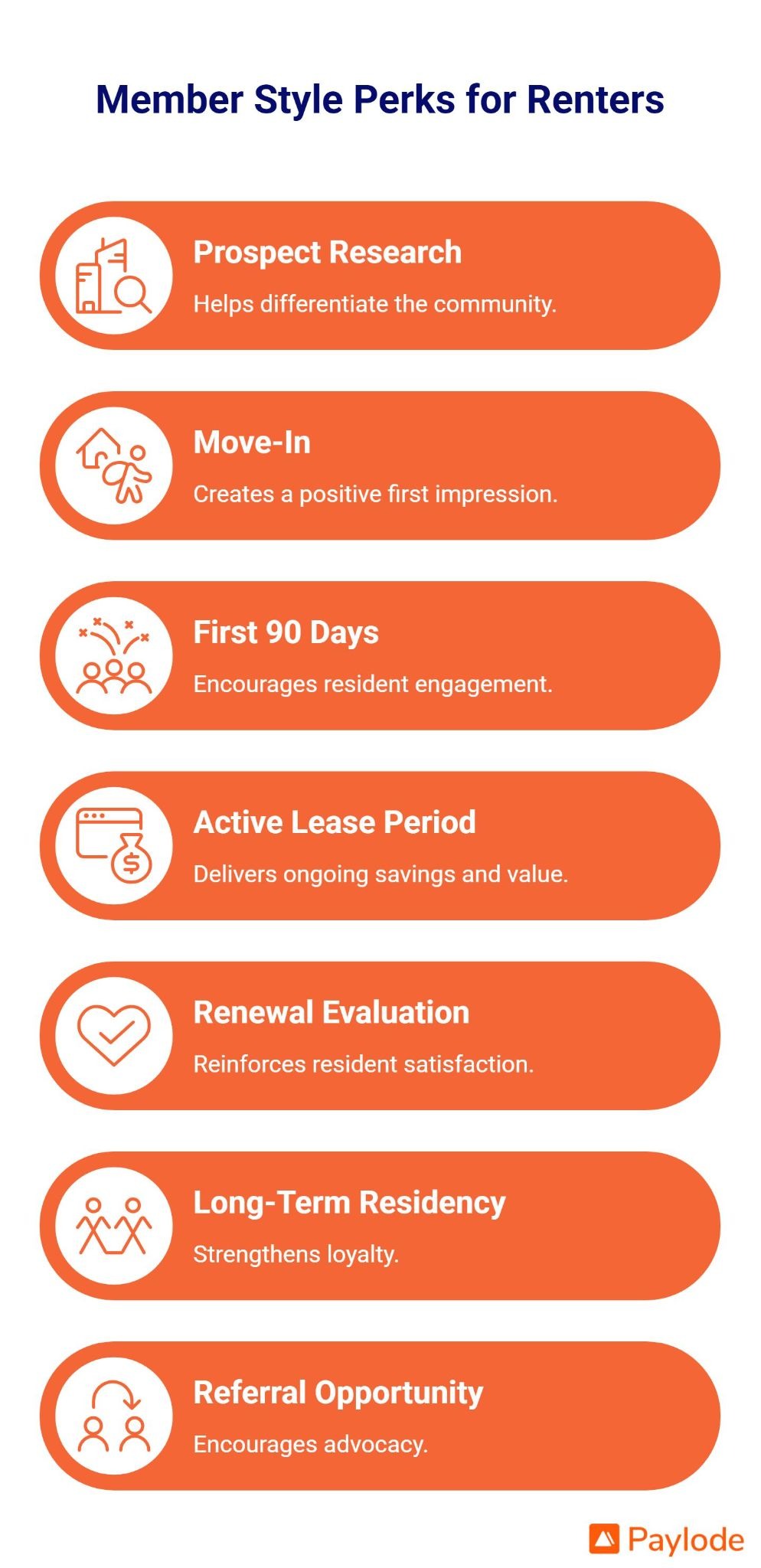
Communities can use perks programs throughout every stage of the resident lifecycle.
During onboarding, benefits help create a positive first impression. New residents quickly discover that their community offers value beyond housing.
Throughout the lease term, perks provide ongoing engagement opportunities. Residents continue receiving benefits that support their daily lives and interests.
As renewal periods approach, those accumulated positive experiences help reinforce the overall value of remaining within the community.
This continuous approach creates a stronger resident relationship than isolated incentives that are only available at specific moments.
Why do always-on benefits perform better than one-time rewards?
One-time rewards can be effective, but their impact is often temporary.
A gift card, giveaway, or special promotion may generate excitement for a short period. However, the value usually disappears once the reward has been used.
Always-on benefits create a different experience.
Residents can access value whenever they need it. This flexibility allows the program to remain relevant throughout the lease term.
For property managers, continuous engagement often generates more meaningful long-term results than occasional promotions because residents repeatedly experience the benefits associated with their community.
What types of member style perks for renters create the most value?
Not every perk generates the same level of engagement. The most successful resident programs focus on benefits that residents can use frequently and easily.
Property managers should think about resident value from a practical perspective. The best benefits are often those that help residents save money, improve convenience, or enhance everyday experiences.
When residents regularly use available offers, the program becomes part of their routine rather than something they forget about after signing a lease.
How do everyday savings improve resident satisfaction?
Residents appreciate benefits that help reduce common expenses.
Savings on shopping, dining, entertainment, and household purchases often receive strong engagement because they provide immediate and tangible value. These are categories residents already spend money on, making the savings easy to understand and appreciate.
When renters consistently save money through a resident perks program, they begin associating that value with the community itself. Over time, these positive experiences contribute to stronger satisfaction and engagement.
Because these benefits are relevant to a broad audience, they help ensure that the program appeals to residents across different demographics and lifestyles.
Why do lifestyle benefits increase program participation?
Lifestyle-focused perks help expand the resident experience beyond financial savings.
Travel opportunities, wellness programs, family attractions, fitness services, and entertainment experiences often generate excitement because they improve quality of life.
These benefits allow residents to enjoy experiences they may not otherwise prioritize. In many cases, they create memorable moments that strengthen positive feelings toward the community.
A balanced perks program combines practical savings with lifestyle benefits to appeal to a wider range of interests and preferences.
How can local business offers strengthen community connections?
Local partnerships create another layer of resident value.
When communities connect residents with nearby restaurants, retailers, service providers, and entertainment venues, they help residents feel more connected to the surrounding neighborhood.
Local offers also benefit businesses by introducing them to potential customers who live nearby.
The result is a mutually beneficial relationship that strengthens community engagement while providing residents with meaningful opportunities to explore and enjoy their local area.
Why do member style perks for renters help improve resident retention?
Retention remains one of the most important priorities for property managers.
While lease renewals are influenced by many factors, residents are more likely to remain in communities where they feel valued and engaged.
A successful perks program contributes to this objective by providing ongoing benefits throughout the lease term.
How does ongoing value influence renewal decisions?
Residents rarely evaluate renewal decisions based on a single factor.
Instead, they consider their overall experience. This includes the quality of service they receive, the convenience of living within the community, and the value they perceive throughout their residency.
Member style perks for renters contribute to this perception by creating positive experiences that continue throughout the year.
Each time a resident uses a discount or enjoys an exclusive offer, they receive another reminder of the value associated with their community.
These small moments may seem insignificant individually, but collectively they help shape overall satisfaction and loyalty.
Why do residents stay longer when they feel appreciated?
People naturally gravitate toward organizations that recognize and reward their loyalty.
Residents are no different.
When communities provide ongoing benefits, residents often feel that management is making an effort to improve their experience. This sense of appreciation can strengthen emotional connections and contribute to long-term resident satisfaction.
Property managers looking to improve resident loyalty frequently combine perks programs with broader strategies focused on Increase Retention. Together, these initiatives help create stronger resident relationships throughout the lease lifecycle.
How can perks contribute to higher resident lifetime value?
Longer resident relationships generally create greater value for both residents and operators.
Residents enjoy stability and continued access to community benefits. Property managers benefit from reduced turnover costs and stronger resident engagement.
A resident perks strategy can also support broader initiatives focused on increasing resident participation in community programs and services. These efforts align closely with goals centered around Raise Customer LTV by encouraging long-term engagement and stronger resident loyalty.
How do member style perks for renters compare to traditional resident events?
Resident events continue to play an important role in multifamily communities.
They create opportunities for social interaction, encourage neighbor connections, and help strengthen community culture. However, events alone often have limitations.
Many residents cannot attend due to work schedules, family commitments, or personal preferences.
This is why many operators are complementing traditional events with resident perks programs.
What are the limitations of one-time events?
Events create value during a specific moment in time.
Once the event concludes, the engagement opportunity ends as well. While residents may remember the experience positively, there are often long gaps between community activities.
Events also require planning, staffing, vendor coordination, and budget allocation.
Although they remain valuable, they typically reach only a portion of the resident population.
Why do ongoing benefits create year-round engagement?
Resident perks programs offer value whenever residents choose to use them.
Unlike events, perks are not limited by schedules or attendance requirements. Residents can engage with available offers based on their own interests and needs.
This flexibility makes the program accessible to a larger percentage of residents.
The continuous availability of benefits helps maintain engagement between community events, creating a more consistent resident experience.
How can communities combine events and perks effectively?
The most successful communities often use both strategies together.
Events create memorable shared experiences while perks provide ongoing individual value.
For example, a property may host a resident appreciation event while also providing year-round access to savings and benefits through a centralized rewards platform.
This combination helps maximize resident engagement throughout the year.
How can technology help rental communities manage member style perks for renters?
Technology plays a critical role in making resident rewards programs scalable and easy to manage.
Without the right platform, administering a large collection of benefits can quickly become time-consuming.
Fortunately, modern resident engagement tools simplify the process considerably.
Why is digital access important for modern renters?
Today's residents expect convenience.
From paying rent online to submitting maintenance requests digitally, renters increasingly prefer self-service experiences that fit into their daily routines.
Resident perks should follow the same principle.
Digital access allows residents to browse offers, discover savings opportunities, and redeem benefits quickly without needing assistance from onsite staff.
This convenience helps drive participation while creating a more seamless resident experience.
How do centralized perk platforms simplify management?
Centralized platforms eliminate much of the complexity traditionally associated with rewards programs.
Instead of negotiating individual partnerships and managing offers internally, operators can leverage dedicated solutions that provide access to a broad network of benefits.
Solutions such as Perk Centers allow communities to offer a curated resident experience while minimizing administrative effort.
This approach enables property managers to focus on resident relationships rather than program administration.
What should property managers look for in a perks platform?
The strongest platforms combine ease of implementation with meaningful resident value.
Property managers should evaluate offer quality, resident usability, scalability, reporting capabilities, and overall resident experience.
Most importantly, the platform should support long-term engagement rather than simply delivering occasional discounts.
How can perks programs support broader property management goals?
The best resident perks programs do more than provide discounts. They can also support operational goals that improve efficiency, communication, and resident engagement across the community.
For many property managers, resident rewards become a valuable tool for encouraging participation in programs that benefit both residents and onsite teams.
When perks are integrated into broader resident engagement initiatives, they create additional opportunities to strengthen community relationships while supporting important business objectives.
How can member style perks for renters encourage automatic payments?
Many property management companies continue to promote digital payment adoption because it improves convenience for residents and streamlines operations.
Resident rewards can help support these efforts by providing additional value that encourages participation. When residents see a direct benefit associated with enrollment, they may be more inclined to embrace digital payment options.
This strategy is often used alongside initiatives focused on Automatic Payments because both approaches help simplify the resident experience while improving operational efficiency.
How can perks support paperless communication initiatives?
Digital communication continues to play an increasingly important role in residential communities.
From statements and notices to community updates and announcements, many operators are encouraging residents to adopt paperless communication preferences.
Perks programs can help support this transition by creating positive incentives for participation. Communities that pair resident benefits with digital engagement campaigns often experience stronger adoption rates.
This approach aligns naturally with efforts designed to encourage residents to Switch to Paperless while creating a more convenient experience for everyone involved.
Why do perks complement broader resident experience strategies?
Resident satisfaction is rarely driven by a single initiative.
Instead, it develops through a series of positive interactions that shape how residents perceive their community over time.
Perks contribute to this process by providing consistent value throughout the resident lifecycle. Every benefit redeemed reinforces the resident's connection to the community and creates another positive touchpoint.
When combined with strong property management practices, resident perks become an effective component of a comprehensive engagement strategy.
Why are member style perks for renters becoming a competitive advantage?
The multifamily industry continues to evolve as resident expectations change.
Today's renters have more choices than ever before. In many markets, communities offer similar floor plans, amenities, and pricing structures. As a result, experience has become one of the most important factors influencing resident perceptions.
Property managers who provide ongoing value beyond housing are increasingly finding new ways to differentiate their communities.
How are renter expectations changing?
Consumers regularly interact with brands that provide rewards, memberships, and exclusive benefits.
These experiences influence expectations across many areas of life, including housing.
Residents increasingly want more than a place to live. They want a community that delivers convenience, value, and ongoing engagement throughout their residency.
Communities that recognize these evolving expectations are often better positioned to attract and retain residents.
Why are communities competing on experience instead of amenities alone?
Amenities remain important, but many have become standard features across multifamily properties.
Fitness centers, package management solutions, coworking areas, and outdoor gathering spaces are now common in many communities.
Because physical amenities are often similar from property to property, operators are focusing more heavily on the resident experience itself.
This trend is particularly visible across the broader Residential Real Estate industry, where operators are increasingly investing in programs that strengthen engagement and resident satisfaction.
How can perks help communities stand out in competitive rental markets?
Resident perks create a practical form of differentiation because they provide value residents can experience repeatedly.
Unlike amenities that may be used occasionally, perks become part of everyday life. Residents can benefit from discounts, experiences, and savings throughout the year.
These ongoing interactions help strengthen resident relationships while creating a more compelling living experience.
For operators looking to stand out without investing heavily in physical renovations, member style perks for renters offer a scalable and cost-effective solution.
What does the future of member style perks for renters look like?
Resident engagement strategies will continue evolving as technology advances and resident expectations change.
The future of resident rewards is likely to focus on personalization, convenience, and increasingly relevant experiences.
Rather than providing generic offers, future programs may deliver benefits that align more closely with resident interests and behaviors.
At the same time, digital platforms will continue making perks easier to access and manage.
As communities seek new ways to strengthen resident relationships, benefits programs will likely become a standard component of modern resident experience strategies rather than an optional enhancement.
The growing adoption of perks programs across the Real Estate Industry reflects this shift toward ongoing value creation and resident-focused engagement.
Why should property managers invest in member style perks for renters today?
The most successful resident engagement strategies create value throughout the entire resident journey.
Member style perks for renters help communities achieve this goal by providing ongoing benefits that residents can access long after move-in day. These programs strengthen resident relationships, improve satisfaction, encourage engagement, and support retention efforts without requiring major capital investments.
As competition continues to increase across multifamily housing, communities that provide meaningful value beyond the apartment itself will be better positioned to stand out.
For property managers seeking practical ways to improve resident experience while supporting long-term business goals, resident perks represent one of the most effective opportunities available today.
Modern solutions available through the Platform make it easier than ever to launch resident engagement initiatives that deliver measurable value. Communities can provide access to curated Perks, increase engagement with Boost, explore flexible Plans, and Book a Demo to see how a resident perks strategy can support their portfolio.
By delivering continuous value instead of one-time incentives, rental communities can create stronger resident experiences that contribute to satisfaction, retention, and long-term success.