Property managers have invested heavily in Property Management Systems (PMS). These systems handle leases, payments, maintenance, and communication efficiently. Yet one challenge still remains - getting residents to take the right actions at the right time.
This is where behavioral incentive logic becomes critical.
Instead of only tracking what residents do, this layer actively influences what they do next. It connects your PMS with real resident behavior and helps you guide outcomes like on-time payments, renewals, and engagement.
In this blog, we’ll explore how behavioral incentive logic PMS automation in real estate is reshaping property management and why it is becoming essential for modern portfolios.
Why PMS automation alone falls short
PMS platforms are designed to organize and automate workflows. They tell you what has happened - who paid rent, who is late, and who is up for renewal.
But they do not influence behavior.
A reminder email does not guarantee a payment. A renewal notice does not ensure a lease extension. This creates a reactive system where teams are constantly following up instead of shaping outcomes.
That is the limitation of traditional PMS automation in real estate.
What is behavioral incentive logic?
Behavioral incentive logic is a structured approach that connects resident actions with timely rewards to encourage positive behavior.
Instead of asking residents to act, it gives them a reason to act.
For example, when a resident pays rent early, they receive a benefit. When they renew their lease, they unlock a reward. When they adopt digital tools, they gain access to perks.
This creates a system where actions are consistently reinforced, leading to better outcomes over time.
The missing layer between systems and actions
Most property management setups operate in two parts. The PMS manages data and workflows, while residents decide how and when to act.
The gap between these two layers is where inefficiencies occur.
Behavioral incentive logic fills this gap. It interprets PMS data and triggers incentives that guide resident behavior. Instead of relying on reminders alone, it builds a system of motivation.
This is the shift from passive systems to active engagement.
Why this matters for property managers
Property managers are under increasing pressure to improve retention, reduce late payments, and enhance resident experience without cutting into revenue.
Traditional approaches often rely on discounts or repeated follow-ups. Both come with trade-offs - either reduced margins or increased workload.
Behavioral incentive logic offers a different path. It focuses on encouraging the right actions without lowering rent or adding operational burden.
It transforms how property managers think about engagement.
How behavioral incentive logic works in real estate
The process is simple but powerful. It starts by identifying key resident behaviors that directly impact business outcomes, such as paying rent on time, renewing leases, or adopting digital tools.
Once these actions are defined, incentives are aligned with each behavior. These incentives are not random. They are designed to reinforce specific actions that benefit both the resident and the property manager.
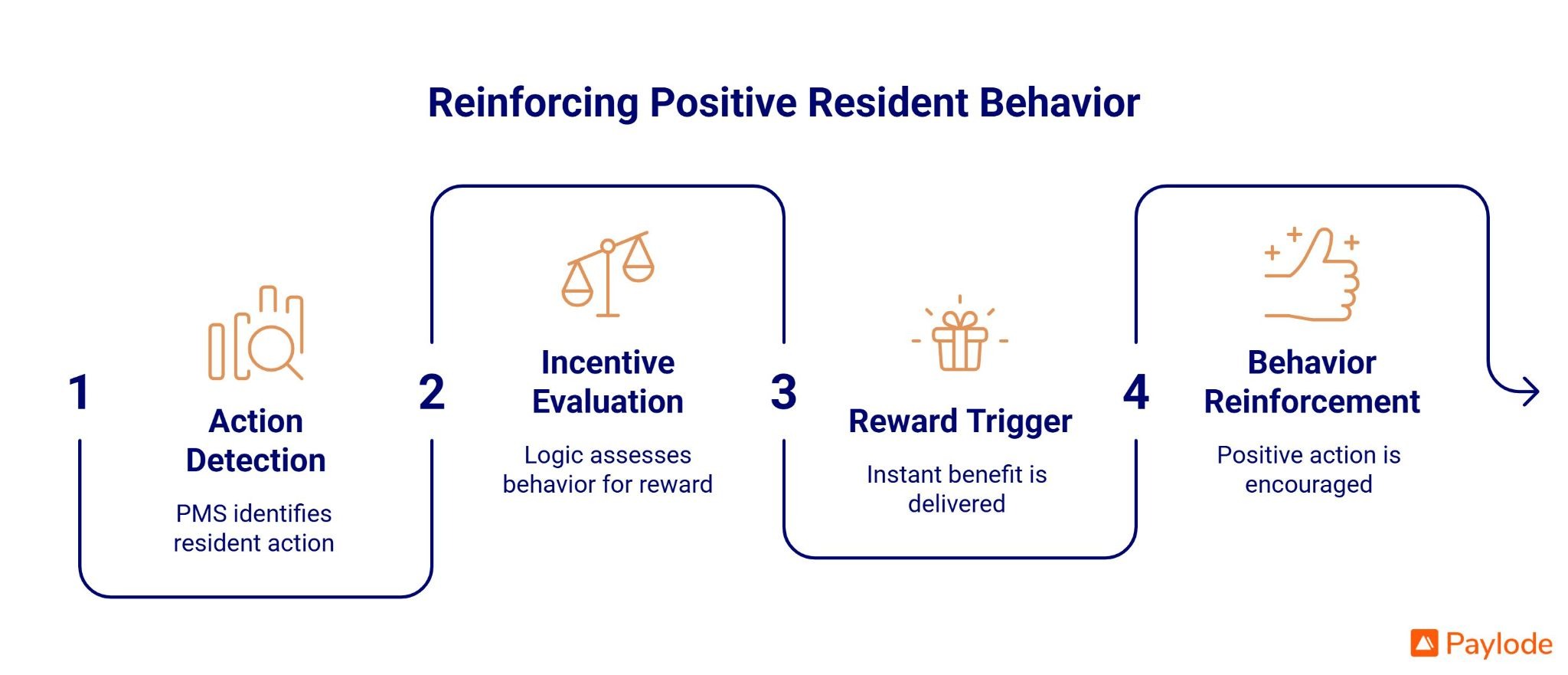
The PMS then plays its role by detecting when these actions occur. When a condition is met, the incentive is automatically triggered. This removes the need for manual tracking or intervention.
Over time, residents begin to associate certain actions with benefits. This creates a natural pattern where positive behaviors are repeated consistently.
Moving from reminders to motivation
Most property management strategies rely heavily on reminders. These reminders are useful, but they depend on resident compliance.
Behavioral incentive logic introduces motivation instead.
When residents know there is a benefit tied to their actions, they are more likely to act proactively. This small shift changes the entire dynamic from chasing actions to encouraging them.
Where PMS automation in real estate meets incentive logic
PMS automation already enables property managers to streamline operations. It can trigger notifications, update records, and manage workflows.
When combined with behavioral incentive logic, these automations become outcome-driven.
For example, when a resident completes a payment before the due date, the PMS records the action. The incentive logic layer then immediately triggers a reward. The resident receives the benefit without delay, reinforcing the behavior.
This creates a seamless loop where automation and motivation work together.
Real-world applications for property managers
One of the most common challenges in property management is ensuring on-time rent payments. Instead of focusing only on penalties for late payments, incentive logic encourages early or timely payments by attaching value to those actions.
This approach aligns well with strategies like automatic payments, where residents are encouraged to build consistent payment habits through seamless experiences.
Another key area is lease renewals. Residents often evaluate multiple factors before deciding to stay. When incentives are introduced during the renewal phase, they create a stronger emotional connection, making residents more likely to continue their lease.
Digital adoption is another opportunity. Encouraging residents to move to digital workflows becomes easier when there is a clear benefit tied to those actions. This can be supported through initiatives like switching to paperless, which simplifies operations while improving resident convenience.
For broader engagement, property managers can leverage resident perks to create ongoing value and enhance the overall living experience.
Benefits of adding incentive logic to your PMS
Behavioral incentive logic allows property managers to improve retention without relying on discounts. Instead of reducing rent, it adds value to the resident experience.
It also creates more predictable behavior patterns. When residents are consistently rewarded for certain actions, those actions become habits. This makes forecasting and planning more reliable.
Operational efficiency improves as well. Automated incentives reduce the need for manual follow-ups and repetitive communication.
Over time, this leads to higher resident lifetime value. Residents who stay longer and engage more contribute significantly more to the property’s overall performance. You can explore strategies focused on raising customer LTV to maximize these outcomes.
Why timing plays a crucial role
The effectiveness of incentives depends heavily on timing. A reward delivered immediately after an action creates a strong connection in the resident’s mind.
If the incentive is delayed, that connection weakens.
Behavioral incentive logic ensures that rewards are triggered at the right moment. This precision is what makes the system effective.
Building a scalable incentive strategy
To implement behavioral incentive logic successfully, property managers need a structured approach.
Start by identifying the behaviors that matter most. Focus on actions that directly impact revenue and retention. Then align incentives with those actions in a way that feels meaningful to residents.
Automation is key. The system should run with minimal manual intervention, allowing teams to focus on strategy rather than execution.
As results come in, the strategy can be refined and expanded. This makes the system scalable across multiple properties and portfolios.
The role of platforms in enabling this
Implementing behavioral incentive logic requires the right infrastructure. Property managers need a platform that can integrate with their PMS and manage incentives efficiently.
Solutions like the Paylode platform provide this capability, acting as the bridge between data and action and enabling seamless execution.
From transactions to relationships
Traditional property management focuses on transactions. Residents pay rent, and services are delivered in return.
Behavioral incentive logic shifts this model toward relationships.
Residents begin to feel recognized and valued. This emotional connection plays a significant role in long-term retention and satisfaction.
The future of PMS automation in real estate
The next phase of PMS automation real estate is not just about efficiency. It is about influence.
Systems will evolve from tracking behavior to shaping it. Behavioral incentive logic will become a standard layer in modern property management.
Property managers who adopt this approach early will gain a competitive advantage in retention, engagement, and operational efficiency.
Getting started with incentive logic
The best way to begin is by focusing on one or two high-impact behaviors, such as on-time payments or lease renewals.
Introduce incentives for these actions and measure the results. As you see improvements, expand the strategy to other areas.
You can explore solutions like Paylode perks and Paylode Boost to operationalize this approach and scale it effectively across your portfolio.
Conclusion: turning systems into growth drivers
Behavioral incentive logic transforms PMS from a tracking system into a growth driver.
Instead of reacting to resident behavior, you start influencing it. This leads to better outcomes across retention, payments, and engagement.
If you are looking to modernize your property management strategy, this is the next step.
Explore how this can work for your portfolio through the Paylode platform, review options on Paylode plans, or take the next step by booking a demo.
FAQs
What is behavioral incentive logic in real estate?
Behavioral incentive logic connects resident actions with rewards to encourage behaviors like timely payments and lease renewals.
How does it work with PMS automation in real estate?
It integrates with PMS systems to detect actions and automatically trigger incentives based on predefined rules.
Does it reduce rental pricing
No, it focuses on adding value through rewards instead of lowering rent.
Can it improve retention?
Yes, by reinforcing positive experiences, it increases satisfaction and encourages residents to stay longer.
Is it scalable for large portfolios?
Yes, with the right platform and automation, it can be implemented across multiple properties with minimal effort.