Yes. In most states a landlord can require renters insurance as a condition of the lease, as long as the requirement is written into the lease, applied to every resident the same way and does not conflict with state, local or subsidized housing rules. The landlord can set a minimum liability limit and ask for proof of coverage before move-in, then confirm it again at move-out.
The question matters because a large share of renters still go without a policy. The Harvard Joint Center for Housing Studies estimates that about 55% of renter households have renters insurance. A 2025 survey of 2,000 renters commissioned by Lemonade put the figure lower, finding that only 40% of renters have renters insurance. On a 10,000-unit portfolio, either number means thousands of households with no coverage for their belongings and no liability policy if a kitchen fire spreads to the unit next door.
Is It Legal For A Landlord To Require Renters Insurance?
In general, yes. No federal law stops a private landlord from making renters insurance a lease requirement, and most states treat it as an ordinary lease term, like a pet policy or a rule about who pays utilities. Some states spell it out. Virginia's Residential Landlord and Tenant Act says that "a landlord may require as a condition of tenancy that a tenant have renter's insurance", and it lets the landlord charge the resident for premiums on a policy the landlord obtains, while the resident keeps the option of buying a separate policy with written proof.
A few rules can limit or shape the requirement:
- State law. Rocket Lawyer's landlord guide reports that Oklahoma bans landlords from requiring renters insurance. Confirm current Oklahoma law with counsel before you write the clause for properties there.
- Existing leases. A new requirement usually applies at the next lease or renewal. Adding it in the middle of a signed lease can be a change the resident has not agreed to.
- Subsidized and affordable housing. Public housing, voucher and tax credit programs can carry their own rules about fees and lease terms. Check the program rules and your regulatory agreement first.
- Local rules. Rent-stabilized markets can restrict new fees or lease conditions.
- Fair housing. Apply the requirement, the minimum limits and the proof deadline to every resident in the same way.
This article is general information. Have your legal team approve the clause for each state you operate in.
Why Do Landlords Require Renters Insurance?
The landlord's own property policy covers the building. It does not cover the resident's furniture, laptop or clothes, and it may not respond first when a resident causes damage. A renters policy fills both gaps.
There is also a resident relations reason. A household that loses everything in a fire and has no coverage often has no way to stay. Coverage keeps a bad week from becoming a vacancy.
How Much Renters Insurance Can A Landlord Require?
Most landlords set a minimum for personal liability coverage and leave personal property limits to the resident. Rocket Lawyer notes that minimum liability limits of $50,000 or $100,000 or more are common. Many operators of large communities choose $100,000, since that is a standard tier on most policies.
Ask to be listed as an "interested party" (sometimes called "additional interest"). That gives you notice of cancellation. Being listed as an "additional insured" is a different status, and most renters policies do not offer it, so check the wording with your insurance broker.
Can A Landlord Require A Specific Insurance Company?
Usually a landlord can offer a preferred policy or a master policy program, but residents should keep the right to buy coverage from any licensed insurer that meets the minimums. Virginia's statute, for example, lets the resident obtain a separate policy and provide written proof as an alternative to the landlord's program. Forcing one carrier can also raise insurance law questions if the landlord earns commission on the sale. Keep the choice open and the minimums clear.
How Much Does Renters Insurance Cost The Resident?
Cost is the most common objection, and the answer is modest. The average renters insurance premium in the US was $171 a year in 2022, according to NAIC data published by the Insurance Information Institute. That works out to about $14 a month. Even so, the same Insurance Information Institute page reports that 48.2% of renter households spend 30% or more of income on rent and utilities, based on 2024 Census data. For those households, $14 is still a decision, and a small nudge at the right moment helps.
Sample Renters Insurance Lease Clause
Adapt the clause below and have your legal team approve it for each state.
Renters insurance. Resident must obtain and keep in force, for the full term of this Lease and any renewal, a renters insurance policy from a licensed insurer with personal liability coverage of at least $[100,000] per occurrence. Resident must list [Management company name] as an interested party and provide a copy of the declarations page before move-in, at each renewal and on request until move-out. Resident may purchase the policy from any insurer that meets these requirements. If coverage lapses, Resident must provide proof of a new policy within [10] days of written notice. [Add state-specific remedy approved by counsel.]
How Do You Enforce A Renters Insurance Requirement?
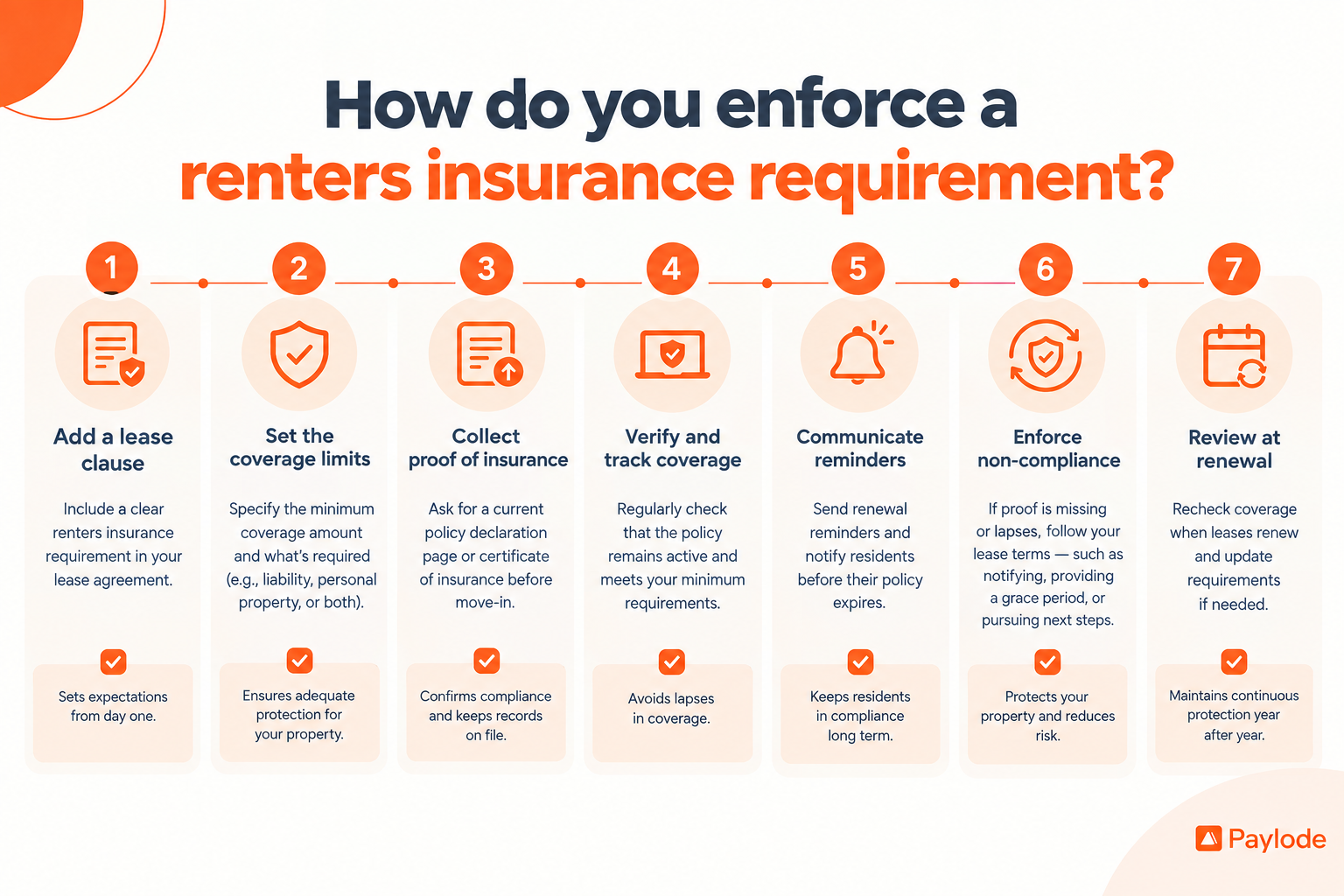
A lease clause is only as good as the tracking behind it. Policies get canceled after the first payment, residents forget to renew and proof lives in an email inbox. Use the steps below to keep coverage on file across the full resident lifecycle.
- Write the clause. Put the minimums, the interested party wording and the proof deadline in the lease.
- Explain it at application. Tell applicants about the requirement and the typical cost before they sign.
- Collect proof before keys. Make the declarations page part of the move-in and move-out checklist, so coverage is checked when the resident arrives and confirmed when they leave.
- Track expiration dates. Store the policy end date in your property management system or a verification tool.
- Remind before lapse. Send reminders 30 days and 7 days before a policy ends.
- Reward fast compliance. Offer a small gift card or perk to residents who upload proof by the deadline.
- Check at renewal. Add proof of coverage to the lease renewal letter and the renewal checklist.
Does A Reward For Proof Of Coverage Work?
Most compliance programs rely on penalties: a fee, a force-placed policy or a lease violation notice. Penalties work, but they cost goodwill at the start of a tenancy. A reward does the opposite. It turns a chore into a quick win, and it gives the leasing team a friendly reason to follow up.
Paylode has seen the same pattern in other resident actions. When FirstKey Homes used Paylode to reward residents for enrolling in auto-pay, it saw a 25% increase in auto-pay enrollments in the first campaign period and a 34% lift in click-to-sign-up conversion, with perks delivered only after enrollment. Proof of coverage works the same way: the reward is released only after the declarations page is uploaded and verified.
Illustrative math for a 10,000-unit portfolio (not a forecast):
Paylode's guide to renters insurance rewards and compliance covers the rules in more detail. One point matters most: if an insurer or insurance agent funds the reward, state anti-rebating rules apply, so keep insurer-funded offers separate from property-funded rewards and have counsel review both.
Paylode, now part of Moved, runs perks and rewards for operators that together with Moved serve over 1.2 million residential units and about 550 ancillary brands. With Paylode Boost, you can trigger a gift card when a resident uploads proof of coverage, enrolls in auto-pay or renews early, and pay only when the action happens.
What Happens If A Resident Does Not Get Renters Insurance?
That depends on your lease and state law. Common responses include a written notice with a deadline, enrollment in the property's master or default policy with the cost added to the ledger where state law allows, and, as a last step, treating it as a lease violation. Spell out the remedy in the lease so there are no surprises, and lead with a reminder and a reward before any penalty.
Frequently Asked Questions
Can a landlord require renters insurance?
Yes, in most states. The requirement must be in the lease and applied to all residents equally. Some states, local rules and subsidized housing programs limit or shape it, so confirm the rules for each property.
Can an apartment require renters insurance in the middle of a lease?
Usually not without the resident's agreement. Most operators add the requirement at the next lease or renewal.
How much liability coverage can a landlord require?
Any reasonable minimum stated in the lease. $100,000 is a common choice for apartment communities.
Can a landlord charge for renters insurance?
In some states, yes. Virginia, for example, lets a landlord charge the resident for premiums on a policy the landlord obtains, as long as the resident can choose a separate policy instead.
Is renters insurance the same as a security deposit?
No. A deposit is held by the landlord and capped by law in many states. Renters insurance is a policy the resident owns that pays for covered losses, often well above the deposit amount.
How do landlords verify renters insurance?
By collecting the declarations page, being listed as an interested party, and tracking the policy end date with reminders before it lapses.
Get Proof Of Coverage On File Faster
Paylode helps property managers reward residents for the actions that protect the property, from proof of coverage to auto-pay and early renewal. See how it works for residential real estate or book a demo.