Rent is rarely the only line item weighing on a resident's monthly budget. Electricity, water, gas, and internet bills add up fast, and property managers who ignore that reality are missing an easy opportunity to stand out. Utility perks for residents are quickly becoming one of the more practical ways multifamily operators can add real, tangible value without touching rent pricing at all. Instead of competing purely on square footage or finishes, communities that offer utility perks residents actually use are finding a new lever for satisfaction, retention, and word-of-mouth referrals.
This shift matters because household budgets have gotten tighter, and residents notice which communities are trying to help and which ones aren't. A well-designed utility perks program signals that a property management company understands the full cost of living somewhere, not just the cost of the lease. It also gives leasing and marketing teams a fresh story to tell prospective renters who are comparing multiple communities side by side.
Why do utility perks matter for residents today?
Utility costs have become a genuine pain point across the residential real estate industry, and residents are increasingly vocal about wanting help managing them. Energy prices fluctuate with the seasons, water and sewer fees keep climbing in many municipalities, and internet service is now considered a near-essential utility rather than an optional extra. When a resident opens a bill that's higher than expected, that frustration often gets associated with the property itself, even when the property manager has no control over utility rates.
Utility perks residents can redeem, such as discounts on energy providers, rebates on smart thermostats, or bundled internet deals, give property teams a way to soften that frustration. Rather than absorbing the blame for rising costs, a community that proactively offers savings positions itself as an ally. That distinction matters in a market where renewal decisions often come down to how supported a resident feels, not just how nice the amenities are.
There's also a competitive angle worth considering. Most communities already offer some combination of a fitness center, a pool, or a resident lounge, so those amenities no longer differentiate one property from another the way they once did. Utility perks are still a relatively underused differentiator, which means the property managers who adopt them early get a genuine edge in a crowded rental market.
What are utility perks and how do they work in a resident rewards program?
Utility perks are curated discounts, rebates, or bundled offers tied to the services residents already pay for every month, like electricity, gas, water, internet, and even streaming or mobile plans that residents count as household expenses. Rather than functioning as a one-time move-in gift, the strongest utility perks programs are woven into an ongoing resident perks strategy that keeps delivering value throughout the lease term.
In practice, this usually means giving residents access to a curated selection of vetted providers and offers, often through a branded digital hub they can browse whenever they want. A resident who wants to lower their internet bill, switch energy suppliers, or find a deal on a smart thermostat can see relevant utility perks alongside other community benefits like local restaurant discounts or moving services. The goal isn't to overwhelm residents with every possible offer; it's to surface a handful of genuinely useful ones tied to costs residents are already paying.
Utility perks residents redeem regularly tend to reinforce a habit. Once someone logs in to check a utility discount, they're also exposed to other perks that support renewals, referrals, or on-time payments, which compounds the value of the program well beyond the initial utility savings.
How can property managers use utility perks to improve resident retention?
Renewal decisions are rarely about a single factor. Residents weigh unit condition, management responsiveness, neighborhood convenience, and increasingly, whether staying feels like the financially smart choice compared to moving somewhere else. Utility perks give property managers a concrete answer to that last consideration without discounting rent, which protects revenue while still making residents feel like they're getting more for their money.
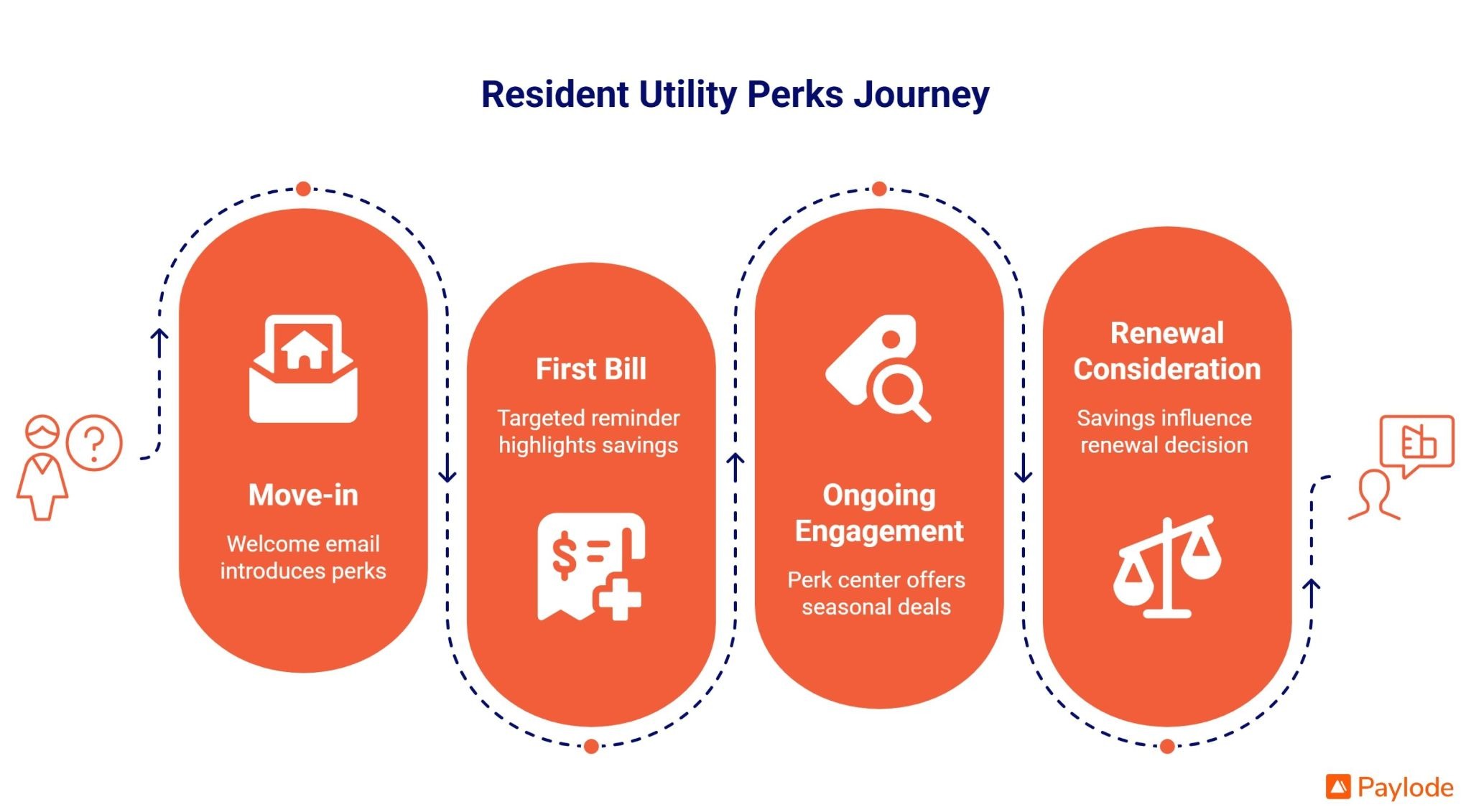
A resident who has saved money on their electric bill or gotten a free smart thermostat through the community's perks program has a tangible reason to associate their home with financial relief rather than financial strain. That association matters when renewal notices go out. Programs designed to increase resident retention tend to work best when they reward ongoing engagement rather than a single move-in action, and utility perks are naturally suited to that kind of recurring value because utility bills arrive every month.
There's a secondary retention benefit as well. Utility perks create more touchpoints between the property team and the resident. Every email, app notification, or portal visit tied to a utility offer is another chance to reinforce the relationship, which keeps the community top of mind in a way that a one-time welcome gift never could.
How do utility perks fit alongside automatic payments and paperless billing?
Utility perks don't have to operate in isolation. Some of the most effective programs pair utility savings with other resident actions that property managers want to encourage, like enrolling in automatic payments or agreeing to switch to paperless billing. A resident who signs up for autopay to avoid late fees might also appreciate a nudge toward a discounted internet plan at the same time, since both actions are about simplifying monthly costs.
This kind of pairing works because it treats the resident's full financial picture as connected, rather than addressing rent payments and utility costs as separate conversations. Property managers who bundle these offers together often see stronger participation than when each incentive is promoted on its own, simply because residents appreciate a single, cohesive message about saving money and reducing hassle.
Paperless billing campaigns in particular benefit from this pairing. Residents who are already comfortable managing bills digitally are natural candidates for utility perks delivered through the same portal, since they're already in the habit of checking their account online rather than waiting for a paper statement.
What role does a perk center play in delivering utility savings?
For utility perks to actually get used, residents need an easy, low-friction place to find them. This is where a dedicated perk center becomes valuable. Rather than emailing residents a static list of utility discounts that gets buried in an inbox, a perk center gives residents a persistent, always-available hub where utility offers sit alongside other community benefits.
A well-built perk center can be customized to match a property's branding, organized by category so utility perks are easy to browse, and updated regularly as new provider offers become available. Residents who are used to checking the perk center for local restaurant deals or move-in bundles are far more likely to notice a new utility offer than residents who only hear about it once through a single announcement.
This also solves a practical challenge for property managers: utility perks residents forget about are perks that never get redeemed. Housing the offers in a persistent, on-brand location dramatically increases the odds that residents actually take advantage of them, which in turn makes the program's ROI easier to justify internally.
How does Paylode Boost help property managers launch utility perk campaigns?
Getting residents to notice and act on a new utility perk often requires more than just listing it in a perk center. This is where a targeted action-based campaign, like Paylode Boost, can make a meaningful difference. Instead of hoping residents stumble across a utility discount, property managers can design a campaign that highlights the offer at the exact moment it's most relevant, such as right after a resident pays a utility-related fee or completes a move-in task.
Boost-style campaigns work by showing residents a clear teaser of what they'll get, prompting them to complete a specific action, and then delivering the reward once that action is verified. Applied to utility perks, this might mean rewarding a resident for switching to a recommended energy provider or completing an online enrollment form for a bundled internet and streaming deal. Because the incentive is tied to a specific, trackable action, property managers get much clearer visibility into which utility perks are actually driving resident behavior.
This approach also allows property teams to test different utility offers against each other. If a discount on a particular internet provider gets significantly more engagement than a smart thermostat rebate, that data can inform which utility perks get promoted more heavily in future campaigns.
How can property managers measure the ROI of utility perks?
Utility perks are only worth investing in if property managers can see whether they're actually moving the numbers that matter, like renewal rates, resident satisfaction scores, and program engagement. Tracking redemption rates for individual utility offers is a useful starting point, since it shows which perks residents are actually using rather than just seeing.
Beyond redemption, property managers should watch for changes in renewal rates among residents who have engaged with utility perks compared to those who haven't. If residents who redeem utility offers renew at a meaningfully higher rate, that's a strong signal the program is contributing to retention rather than just being a nice-to-have amenity. Survey data collected around lease renewal time can also help confirm whether residents perceive utility perks as a genuine part of their decision to stay.
It's worth noting that utility perks can also support a broader goal of helping raise customer lifetime value, since residents who stay longer and engage more consistently with community programs tend to generate more value over the life of their tenancy than residents who churn after a single lease term. Measuring utility perks in isolation is useful, but connecting that data back to lifetime value gives property managers a clearer picture of the program's full financial impact.
How does Paylode support utility perks for multifamily and residential real estate?
Property management companies operating across the real estate industry are increasingly looking for ways to differentiate their communities without relying solely on rent concessions or physical upgrades. Utility perks fit naturally into this shift because they address a cost residents feel every single month, not just a one-time move-in expense.
Paylode works specifically within residential real estate to help property managers build branded perks programs that combine utility savings with other resident-focused offers, all accessible through a single, easy-to-navigate hub. Because the Paylode platform integrates with the property management systems many operators already use, launching a utility perks program doesn't require rebuilding existing workflows from scratch.
For property managers exploring what a utility perks program could look like for their portfolio, reviewing the available perks options is a practical first step, since it shows the range of provider categories, including utilities, that can be curated into a resident-facing program. From there, most teams find it helpful to compare pricing plans to understand which tier fits their portfolio size and how quickly they could realistically get a program live.
Frequently asked questions about utility perks for residents
What are utility perks for residents?
Utility perks are discounts, rebates, or bundled offers tied to services residents already pay for, such as electricity, gas, water, and internet. Property managers curate these offers and make them available to residents as part of a broader resident perks program, giving residents a way to lower their monthly household costs without any change to their rent.
How do utility perks benefit property managers, not just residents?
Utility perks help property managers differentiate their communities, support resident retention, and build stronger engagement without discounting rent. Because utility costs are a recurring expense residents feel every month, offering savings in this category creates ongoing goodwill that a one-time move-in gift can't match.
Do utility perks cost property managers money to offer?
Utility perks are typically built on pre-negotiated partnerships with providers, so property managers aren't funding the discounts directly out of pocket. The value comes from curating and promoting relevant offers to residents, not from subsidizing utility bills themselves.
How can property managers get residents to actually use utility perks?
Visibility is the biggest factor in redemption. Housing utility perks in a persistent, branded perk center and reinforcing them through timely campaigns around key moments, like the first bill cycle or renewal season, significantly increases how often residents engage with the offers.
Can utility perks be combined with other resident incentives?
Yes. Utility perks often work well alongside incentives for automatic payments or paperless billing enrollment, since all three address different parts of a resident's monthly financial routine. Bundling these offers together tends to drive stronger participation than promoting each one separately.
Ready to add utility perks to your resident experience?
Utility perks are one of the more overlooked ways property managers can support resident budgets, strengthen renewal rates, and stand out in a competitive rental market, all without touching rent pricing. If your team is ready to see how a curated perks program could work for your portfolio, book a demo and we'll walk through what a utility perks program could look like for your communities.