Resident satisfaction is no longer something multifamily operators can afford to measure only once a year. Residents interact with leasing teams, maintenance staff, amenities, communication channels, and community services throughout their lease. Each interaction can influence how they feel about the property and whether they would recommend it to someone else.
That makes Net Promoter Score (NPS) a useful indicator for multifamily operators. It gives property teams a simple way to understand whether residents are likely to recommend their community and where the resident experience may need attention.
However, collecting NPS responses is only one part of the process. The bigger challenge is encouraging residents to participate and then turning what operators learn into meaningful improvements.
This is where rewards can play a role.
A thoughtfully designed rewards strategy can make resident feedback more engaging, encourage participation, and help operators build stronger relationships with residents. When combined with a broader resident engagement strategy, rewards can support resident NPS improvement without reducing NPS to a simple score-chasing exercise.
The objective should be clear: use rewards to encourage participation, use NPS to understand resident sentiment, and use the resulting insights to improve the resident experience.
What NPS means for multifamily communities
Net Promoter Score is commonly used to measure how likely customers are to recommend a business, product, or service.
For multifamily operators, the same principle can be applied to the resident experience.
A typical NPS question asks residents:
“On a scale of 0 to 10, how likely are you to recommend our community to a friend, colleague, or family member?”
Responses are generally grouped into three categories:
The NPS is calculated by subtracting the percentage of detractors from the percentage of promoters.
The resulting score gives operators a simple indicator of resident sentiment.
But the number itself is not the whole story.
A community with a lower NPS needs to understand why residents are dissatisfied. A community with a high NPS needs to understand what is creating that positive experience and how to maintain it.
Why resident NPS improvement matters
NPS can give multifamily operators a structured way to listen to residents.
A resident may be satisfied with their apartment but frustrated by slow maintenance communication. Another may love the amenities but feel that community communications are inconsistent.
Without structured feedback, these experiences can remain anecdotal.
NPS surveys can help operators identify patterns.
For example, if residents repeatedly identify:
- Maintenance response times
- Communication
- Cleanliness
- Amenity availability
- Parking
- Move-in experience
- Staff responsiveness
as areas of concern, property teams have a clearer starting point for improvement.
This makes NPS valuable not because it produces a number, but because it can create a feedback loop.
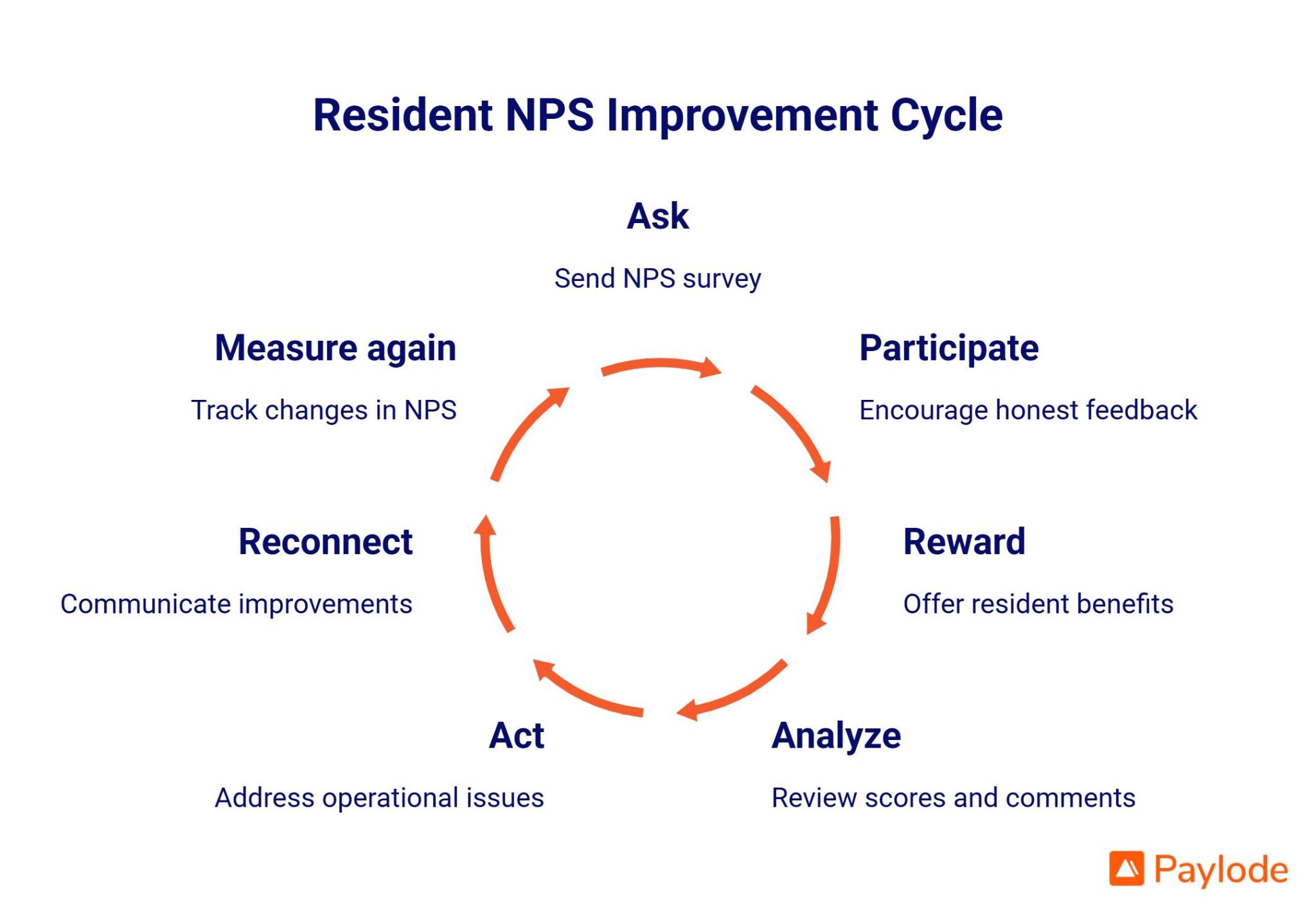
Ask → Listen → Improve → Measure again.
Rewards can help strengthen the first part of that loop by encouraging residents to participate.
Why rewards can increase survey participation
Residents have busy lives.
Even a resident who cares about their community may ignore a survey simply because it arrives at the wrong time or requires effort.
A reward provides an additional reason to act.
The reward does not need to be expensive.
It can be a useful perk that residents recognize as part of the community's broader value proposition.
The important distinction is that the reward should encourage survey participation, not a particular answer.
Residents should never feel that they need to provide a high NPS score to receive a benefit.
That would undermine the purpose of the feedback program.
Instead, the message should be simple:
Share your honest feedback and participate in the resident experience program.
How resident rewards can support NPS programs
A basic NPS campaign can be structured around five stages:
- Invite: Ask residents to complete an NPS survey.
- Participate: Make the survey short and easy to complete.
- Reward: Provide an eligible resident benefit for participation.
- Analyze: Review the score and resident comments.
- Improve: Address recurring experience issues.
The reward is therefore not the end goal.
It is a participation mechanism within a larger resident experience strategy.
This distinction matters because operators should not optimize for survey volume at the expense of meaningful feedback.
Rewards should not influence the NPS answer
This is one of the most important principles for any rewards-based NPS program.
The incentive should be offered for completing the survey, not for selecting a particular score.
For example, avoid messaging such as:
“Give us a 9 or 10 and receive a reward.”
Instead, use a structure such as:
“Complete our resident experience survey and receive an eligible resident benefit.”
The first approach can compromise the credibility of the feedback.
The second encourages participation while allowing residents to provide honest opinions.
For multifamily operators, authentic feedback is more valuable than artificially increasing the NPS number.
Build rewards into the resident experience
A rewards program can become more effective when it is not created solely around NPS.
Residents should have access to useful benefits throughout their relationship with the community.
This could include perks related to:
- Dining
- Shopping
- Entertainment
- Wellness
- Local businesses
- Everyday convenience
- Community experiences
The NPS survey then becomes one of several resident engagement touchpoints.
This creates a stronger relationship between the resident and the property.
Instead of:
Survey → Reward → Done
the operator creates:
Resident experience → Engagement → Feedback → Reward → Continued engagement
That model can support a broader resident engagement strategy.
The best moments to collect NPS feedback
Timing matters.
A resident who has just experienced a successful interaction with the property may be more engaged than someone receiving a generic survey months after their last meaningful interaction.
Operators can consider collecting feedback around important points in the resident lifecycle.
After move-in
The first few weeks can strongly influence a resident's perception of the community.
An early NPS or satisfaction check can identify problems before they become long-term frustrations.
After maintenance resolution
A maintenance interaction can significantly influence resident sentiment.
A short feedback request after resolution can help operators understand whether the process worked well.
After a resident event
Community events provide another opportunity to understand resident engagement and satisfaction.
During the resident lifecycle
Periodic NPS measurement can help operators identify whether sentiment is improving, declining, or remaining stable.
Before renewal
Residents approaching renewal have accumulated enough experience to provide meaningful feedback about the community.
The key is to avoid excessive surveying.
Residents should not feel that every interaction is followed by another questionnaire.
Segment NPS instead of relying on one property-wide score
A single community-wide NPS score can hide important differences.
For example, the overall score may appear stable while one building, resident segment, or lifecycle stage is experiencing problems.
Operators can consider analyzing NPS by:
This allows teams to move from:
“Our NPS is 42.”
to:
“New residents are satisfied, but residents who recently submitted maintenance requests are reporting significantly lower satisfaction.”
The second statement is much more actionable.
Use NPS comments to find the real problem
The numerical score provides direction.
Resident comments provide context.
Suppose a community's NPS declines from 45 to 30.
That change tells the operator something has happened.
But the score alone does not explain what happened.
Comments might reveal that:
- Maintenance response times increased.
- A frequently used amenity was unavailable.
- Residents experienced communication delays.
- Parking enforcement changed.
- Move-in coordination became inconsistent.
This is why operators should review qualitative feedback alongside the NPS score.
The reward encourages participation.
The feedback provides insight.
Operational action creates improvement.
Turn detractors into an improvement opportunity
Detractors should not simply be counted.
They should be understood.
A low NPS response can provide an opportunity for the property team to identify a specific resident concern.
For example:
Resident: “Maintenance took too long to resolve my issue.”
Property response: Review the maintenance workflow, identify the bottleneck, and communicate the resolution.
The goal is not to convince every detractor to change their score immediately.
The goal is to improve the underlying experience.
When that happens consistently, future NPS results can reflect the improvement.
Recognize promoters without manipulating the score
Promoters can also provide valuable insight.
Ask what they like.
Their responses can help operators identify the experiences that residents value most.
For example, promoters may repeatedly mention:
- Friendly staff
- Convenient location
- Fast maintenance
- Community events
- Useful amenities
- Resident perks
These themes can help property teams understand what should be protected and expanded.
A high NPS score is more useful when operators understand the behaviors and experiences behind it.
How perks can contribute to resident NPS improvement
Resident perks can improve the perceived value of living in a community.
A resident may already value their apartment, but additional benefits can make the overall experience feel more useful.
Consider two communities with similar apartments, rents, locations, and amenities.
Community A provides the standard resident experience.
Community B also gives residents access to relevant local and everyday perks.
The second community may create more opportunities for residents to engage with the property beyond traditional property management interactions.
That does not guarantee a higher NPS.
However, it creates another channel through which the operator can deliver resident value.
Make rewards relevant to residents
The quality of the reward matters.
A generic incentive that residents do not care about is unlikely to generate meaningful participation.
Instead, operators should consider what their residents actually value.
Potential categories include:
- Local dining
- Retail savings
- Entertainment
- Wellness
- Fitness
- Convenience services
- Experiences
- Community-specific benefits
The broader the resident audience, the more useful it can be to provide a range of options.
Choice can make the program more relevant without requiring the property team to determine one reward for everyone.
Create a clear resident NPS workflow
A practical workflow could look like this:
Step 1: Identify the survey moment
Choose a relevant resident interaction or lifecycle milestone.
Step 2: Send a concise NPS survey
Keep the question and instructions simple.
Step 3: Provide an optional feedback field
Give residents an opportunity to explain their score.
Step 4: Offer an eligible reward
Reward completion rather than the score.
Step 5: Categorize feedback
Group comments into themes such as maintenance, communication, amenities, and service.
Step 6: Assign ownership
Make sure someone is responsible for addressing recurring issues.
Step 7: Measure again
Track whether resident sentiment changes after improvements.
This makes the program operational rather than merely promotional.
Track the metrics that matter
NPS should sit within a broader resident engagement dashboard.
Useful metrics can include:
This creates a connection between feedback and business performance.
Do not chase the score
One of the biggest mistakes operators can make is treating NPS as a target that employees must simply increase.
That can encourage the wrong behavior.
Teams may become focused on asking for better scores rather than improving the resident experience.
Instead, use NPS as a diagnostic tool.
A healthy process asks:
- Why did the score change?
- What are residents telling us?
- Which issues appear repeatedly?
- What can we improve?
- Did the improvement change resident sentiment?
That approach makes NPS much more useful.
Automate repetitive engagement
Multifamily operators manage many communities and thousands of resident interactions.
Manually sending surveys, tracking participation, managing rewards, and compiling results can become difficult.
A centralized rewards and engagement platform can help reduce operational complexity.
The goal is to create consistent processes without requiring property teams to remember every individual campaign.
This can be especially valuable for operators managing multiple properties with different teams.
A standardized framework can help maintain consistency while still allowing communities to tailor engagement to their residents.
Connect NPS to resident retention
NPS should not replace retention metrics.
Instead, it can provide an additional signal.
If NPS declines before renewal rates decline, operators may have an opportunity to intervene.
For example:
NPS decline → Resident concerns identified → Operational intervention → Follow-up → Retention opportunity
This gives property teams a chance to address problems before they become renewal decisions.
A resident who feels heard and sees a genuine response to their feedback may have a different perception of the community than a resident whose concerns disappear into a survey database.
Common mistakes to avoid
Rewarding a specific NPS score
Never make the reward dependent on a high score.
The value comes from honest feedback.
Making surveys too long
A lengthy survey can reduce participation.
Start with the core NPS question and add only the feedback questions that property teams can actually use.
Ignoring detractors
A detractor is not simply a negative statistic.
Their feedback can identify an operational issue.
Failing to act on feedback
If residents repeatedly provide feedback and nothing changes, future survey participation may decline.
Choosing rewards residents do not value
The reward should feel relevant to everyday resident life.
Measuring only NPS
Track response rate, feedback themes, engagement, issue resolution, and retention alongside NPS.
How Paylode can support a resident engagement strategy
A rewards strategy works best when it is part of a broader resident experience program.
Paylode can help multifamily operators structure resident benefits and engagement rather than relying on disconnected promotions or manual processes.
Operators can explore the Paylode platform to understand how a centralized rewards approach can fit into their resident engagement strategy.
For communities looking to provide residents with useful ongoing benefits, Paylode Perks can support a broader resident value proposition.
For targeted resident engagement campaigns, operators can also explore Paylode Boost.
The objective is not simply to distribute rewards.
It is to create more opportunities for residents to engage, provide feedback, and experience value throughout the resident lifecycle.
A practical 30-day approach
Operators that want to test the concept can start with a focused pilot.
Week 1: Establish the baseline
Document:
- Current NPS
- Response rate
- Promoter percentage
- Passive percentage
- Detractor percentage
- Major feedback themes
Week 2: Design the reward experience
Select relevant resident benefits and establish clear participation rules.
Make sure the reward is connected to survey completion rather than a particular score.
Week 3: Launch the pilot
Choose one community or resident segment.
Keep communication simple and explain why resident feedback matters.
Week 4: Review the results
Compare:
- Survey participation
- Reward engagement
- Feedback volume
- NPS distribution
- Common issues
Then determine what should change before expanding the program.
The bigger opportunity for multifamily operators
Resident NPS improvement should not be treated as a survey project.
It should be treated as a resident experience strategy.
Rewards can help operators create a stronger participation mechanism. NPS can help them understand resident sentiment. Operational improvements can turn that feedback into meaningful change.
Together, these elements create a continuous loop:
Engage residents → Listen to residents → Improve the experience → Deliver more value → Measure again
That is a much stronger strategy than simply asking residents whether they are satisfied.
For multifamily operators, the long-term opportunity is to build communities where residents have clear reasons to engage and where their feedback leads to visible action.
Final thoughts
Rewards can play a useful role in resident NPS improvement, but they should never become a shortcut for improving resident satisfaction.
A reward may encourage a resident to complete a survey. It cannot fix slow maintenance, poor communication, inconsistent service, or an unresponsive property team.
Those issues require operational action.
The real value comes from combining three things:
Resident participation + honest feedback + meaningful improvement.
When multifamily operators use rewards to encourage feedback rather than manipulate scores, they can build a healthier feedback loop and create more opportunities to understand what residents actually value.
If your team is ready to build a more structured resident engagement strategy, explore Paylode's plans or book a demo to discuss how resident rewards can fit into your multifamily strategy.
Frequently asked questions
What is resident NPS improvement?
Resident NPS improvement refers to increasing the proportion of residents who are likely to recommend a multifamily community while reducing the proportion of residents reporting negative experiences. Sustainable improvement comes from addressing the underlying resident experience.
Can rewards increase resident NPS?
Rewards can encourage more residents to participate in NPS surveys, giving operators more feedback. They do not automatically increase resident satisfaction or NPS. Sustainable improvement depends on using feedback to identify and address resident experience issues.
Should residents receive a reward for giving a high NPS score?
No. Rewards should be connected to eligible survey participation rather than a specific score. Tying rewards to high scores can compromise the authenticity of the feedback.
What is the best reward for an NPS survey?
The best reward depends on the resident audience. Useful perks related to dining, shopping, entertainment, wellness, convenience, and local experiences can provide meaningful value.
How often should multifamily communities measure NPS?
There is no single frequency that works for every community. Operators should establish a cadence that provides useful trend data without overwhelming residents with repeated surveys.
Why are NPS comments important?
The numerical score indicates resident sentiment, while comments can explain the reasons behind that sentiment. Reviewing comments helps operators identify recurring issues and prioritize improvements.
How can NPS support resident retention?
NPS can act as an additional resident sentiment signal. If operators identify declining satisfaction early, they may have an opportunity to address concerns before they influence renewal decisions.
What should multifamily operators do with NPS detractors?
Operators should analyze the reasons behind low scores, identify recurring problems, and address issues where possible. Detractor feedback can provide valuable insight into areas of the resident experience that need improvement.
Can resident rewards support more than NPS surveys?
Yes. A broader resident rewards strategy can support multiple engagement activities throughout the resident lifecycle, including resident events, feedback, referrals, and other community engagement initiatives.
How can operators scale resident rewards across multiple properties?
A centralized rewards and engagement platform can help operators standardize campaigns, manage benefits, and create a consistent resident experience across communities while reducing manual administrative work.