Ask ten property managers to define "resident amenities" and ten more to define "resident perks," and you'll likely get overlapping, inconsistent answers. The two terms get used interchangeably in listing copy, leasing conversations, and even internal budget meetings, but they describe fundamentally different tools. Understanding the real difference between perks vs amenities in multifamily housing isn't just a semantic exercise. It shapes how a community allocates capital, how leasing teams position a property against competitors, and how operations teams measure return on a resident experience investment. This article walks through what separates the two, why the confusion persists, and how property managers can use both strategically without duplicating spend or diluting the resident experience.
What is the difference between perks and amenities in multifamily housing?
An amenity is a fixed, physical, or service-based feature attached to the property itself. A rooftop pool, a fitness center, covered parking, a package room, or a dog park are all amenities. They exist whether or not a resident ever uses them, they typically require capital investment to build and ongoing budget to maintain, and they're baked into the asking rent. A perk, by contrast, is a curated, often third-party benefit that a resident opts into or redeems, such as a discount on moving services, a cash-back offer on a streaming subscription, or a local restaurant deal delivered through the resident portal. Perks don't require construction or square footage, and they can rotate, expand, or personalize over time in ways a physical amenity never can. Communities that want to strengthen their positioning in the real estate market increasingly treat perks as a flexible complement to their fixed amenity package rather than a replacement for it.
Why do property managers confuse perks with amenities?
The confusion mostly comes from how both terms get marketed to prospective residents. Listing sites and leasing brochures often bundle "amenities" language around anything that adds value to the living experience, whether it's a clubhouse or a resident discount program. Property management software also doesn't always distinguish the two cleanly in its own feature sets, which blurs the line further for operators comparing platforms. On top of that, budget conversations tend to lump both under a general "resident experience" line item, even though amenities usually come out of capital expenditure and perks usually come out of operating expenditure. That distinction matters a great deal when a regional manager is deciding where next year's resident experience dollars should go, because the two categories have very different cost structures, timelines, and flexibility.
How do amenities function within a multifamily property?
Amenities are largely static once installed. A fitness center gets built once and then maintained, repaired, and occasionally renovated over a multi-year cycle. The same is true of a pool, a business center, or a package locker system. Because amenities require upfront capital and ongoing maintenance budget, they're planned years in advance as part of a property's overall capital improvement plan, and they're difficult to change quickly in response to what residents actually want. Amenities also tend to serve as a baseline expectation in competitive submarkets. Communities marketing themselves under a residential real estate positioning often list amenities first because they're visible during a tour and easy to photograph for a listing page. The tradeoff is that amenities are the same for every resident regardless of lifestyle, household size, or personal preference, and usage rates for many standard amenities, like a business center or a clubhouse, are often much lower than the capital investment would suggest.
How do resident perks work differently from amenities?
Perks operate on an entirely different model. Instead of being built into the property, they're delivered digitally through a resident portal, app, or communication channel, and they're typically sourced from a marketplace of pre-negotiated partner offers rather than built by the property itself. This means a resident perks program can launch in weeks rather than years, doesn't require any construction, and can be tailored to what residents in a specific community actually want, whether that's discounts on moving trucks, meal delivery, pet services, or local entertainment. Because perks are curated and updated regularly, they stay relevant even as resident preferences shift, something a fixed amenity simply can't do. Perks also give operators a way to personalize the resident experience by household type, life stage, or even by academic calendar in student housing, without any physical renovation.
Why does the perks vs amenities distinction matter for resident retention?
Retention strategy is where the difference becomes most practical. Amenities influence a prospect's decision to sign a lease, but they rarely influence a resident's decision to renew, since the pool and the gym were already priced into the original lease-up. Perks, on the other hand, can be introduced or refreshed at any point during a lease term, which gives property managers an active retention lever rather than a passive one. A community that wants to increase retention can layer perks onto the resident experience throughout the year, reminding residents of ongoing value well after move-in, rather than relying solely on amenities that residents stop noticing once they've settled in. This is part of why more operators are shifting resident experience budget toward programs that can be measured and adjusted quarter over quarter instead of only every few years during a capital planning cycle.
What role do perks play across the resident journey?
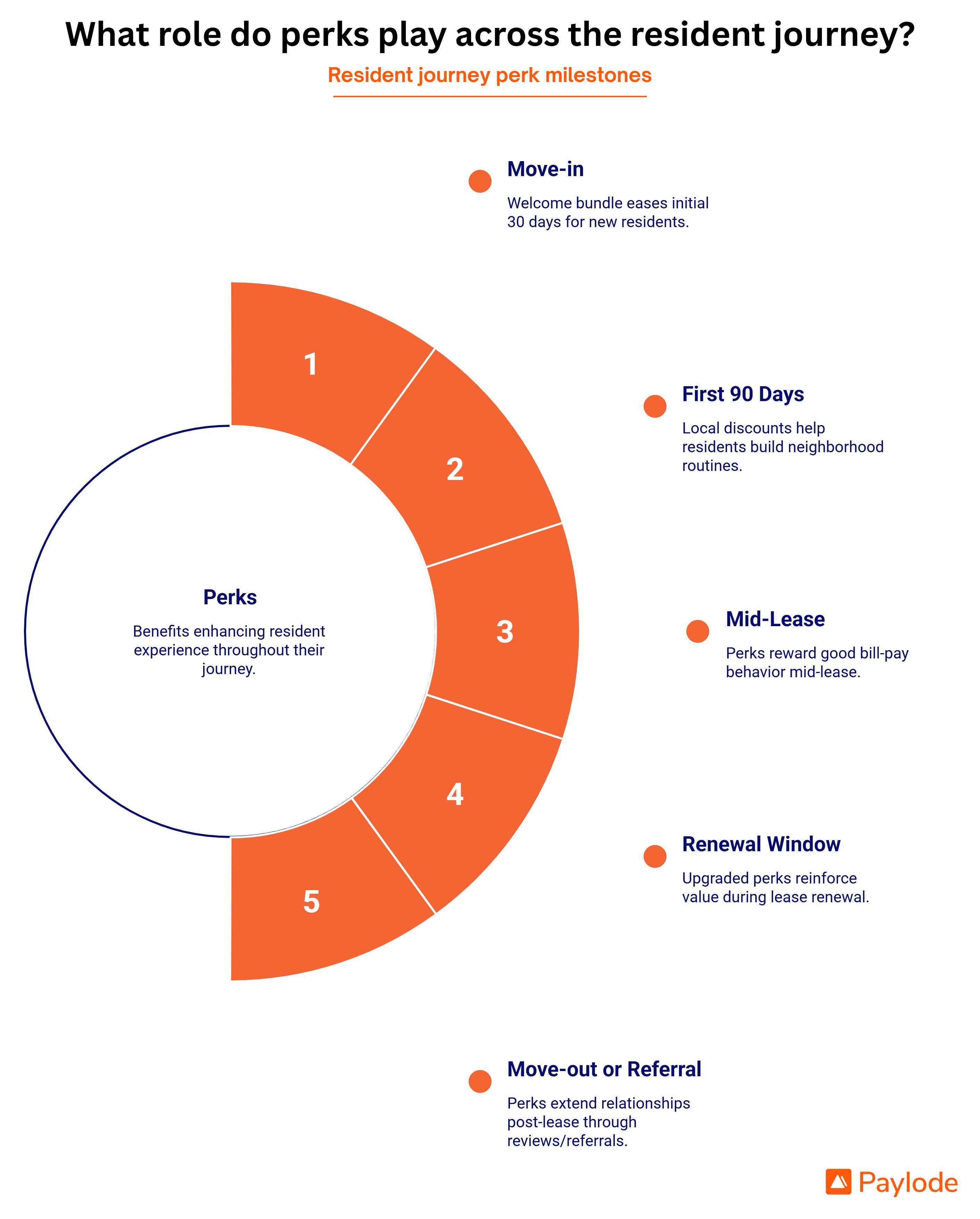
Perks aren't a single feature; they're most effective when mapped to specific moments in the resident lifecycle, from the day a lease is signed through renewal and referral. The infographic content below outlines where perks typically add the most value alongside a property's existing amenities, without requiring any change to the physical property itself.
Resident journey perk milestones
- Move-in: welcome bundle offers covering moving trucks, utility setup, and internet activation to ease the first 30 days
- First 90 days: local discounts on restaurants, gyms, and services to help new residents build routines in the neighborhood
- Mid-lease: recurring perks tied to bill-pay behavior, such as discounts for enrolling in autopay or going paperless
- Renewal window: refreshed or upgraded perks offered alongside the renewal conversation to reinforce ongoing value
- Move-out or referral: perks tied to leaving a review or referring a new resident, extending the relationship past the lease term
How can property managers use perks to complement amenities without added capital cost?
Because perks don't require construction, they're one of the few resident experience levers a property manager can adjust mid-year without a capital request. A community can pull curated offers from an existing perks marketplace rather than sourcing and negotiating partnerships on their own, which keeps the operating cost predictable. Local businesses near the property can also be surfaced through local perks, giving residents neighborhood-specific value that a standardized amenity package can't replicate across a multi-site portfolio. This approach lets operators keep their physical amenities focused on long-term differentiation, like a signature clubhouse or resort-style pool, while using perks to handle the more dynamic, personalized side of the resident experience.
What perks work best for multifamily communities?
The perks that perform best tend to be tied to behaviors property managers already want to encourage. Offering an incentive for enrolling in automatic payments reduces late payments and cuts down on collections work, while a reward for choosing to switch to paperless billing lowers administrative overhead and supports sustainability goals many owners now report on. Move-in and local lifestyle perks tend to have the highest early engagement, since they arrive at a moment when new residents are actively spending money to settle in. Renewal-timed perks, meanwhile, tend to perform well because they arrive right when a resident is weighing whether to stay or start apartment hunting again.
How do perks impact resident lifetime value and NOI?
Every renewed lease avoids the turnover costs of make-ready work, vacancy loss, and re-leasing marketing, all of which directly affect net operating income. Because perks are relatively low-cost to deliver compared to a capital amenity upgrade, they can produce an outsized return when they move the needle on renewals even modestly. Operators focused on customer lifetime value increasingly track perks redemption alongside renewal rates to see whether engaged residents are staying longer, since a resident who is actively using perks throughout their lease is also a resident who is regularly reminded of the value their community provides beyond square footage and finishes.
How do perk centers and perk widgets make perks delivery easy for operators?
Delivery matters as much as the offers themselves. A dedicated perk center gives residents a single, branded destination inside the resident portal or app where they can browse and redeem every available offer, which keeps the experience organized instead of scattered across emails and flyers. For properties that want perks visible in more places, a perks widget can be embedded directly into existing pages, like a payments screen or a maintenance request page, so residents encounter relevant offers without needing to seek them out. Both approaches remove the operational burden of building a perks experience from scratch, which is part of why perks programs can launch so much faster than any amenity renovation.
How do omnichannel links extend perks beyond the resident portal?
Not every resident checks the portal regularly, so reaching them requires more than a single delivery channel. Using omnichannel links, property managers can drop perks directly into welcome emails, lease renewal notices, text reminders, or even printed move-in packets, so the same curated offers residents would find in the portal are also reachable from wherever they already engage. This flexibility is particularly useful for communities with a large share of residents who primarily communicate by text or email rather than logging into an app, ensuring perks participation isn't limited by portal adoption rates.
How do engagement tools help operators promote both perks and amenities together?
Perks and amenities work best when they're marketed as a single, cohesive resident experience rather than two separate programs. Using engagement tools, property managers can create consistent touch points, like a monthly resident newsletter or a quarterly perks spotlight, that highlight both the physical amenities on-site and the digital perks available that month. This kind of ongoing communication keeps amenities top of mind for residents who might otherwise forget to use the gym or clubhouse, while reinforcing that the perks program is an active, evolving benefit rather than a one-time move-in bonus.
What should property managers consider when budgeting for perks vs amenities?
Amenities and perks should be budgeted differently because they behave differently. Amenity investment is capital-intensive, slow to change, and evaluated over a multi-year horizon, so it belongs in long-range capital planning alongside roof replacements and clubhouse renovations. Perks spend is operational, fast to adjust, and can be evaluated quarterly or even monthly based on redemption data and renewal impact. Property managers who separate these budgets tend to have an easier time justifying perks spend to ownership, since the cost is small relative to a single unit's turnover cost, and the results are visible far sooner than any capital project could deliver. Framing perks as a retention and engagement tool, distinct from the amenity package, also makes it easier to report results without conflating two very different investments in a single line item.
Frequently asked questions
Are perks a replacement for physical amenities?
No. Perks and amenities serve different purposes. Amenities are physical features that influence lease-up decisions, while perks are ongoing, flexible benefits that support ongoing engagement and retention throughout a resident's lease term.
Do perks require a capital budget approval process?
Generally no. Because perks are delivered digitally through a marketplace of pre-negotiated offers, most programs are funded through operating budget rather than capital expenditure, which allows them to launch faster than a typical amenity project.
Can a small property afford a perks program if it can't afford new amenities?
Yes. Perks programs don't require construction or square footage, so smaller communities with limited capital budgets can still offer meaningful resident value through curated discounts and local offers.
How do property managers measure whether perks are working?
Most operators track redemption rates alongside renewal rates and resident satisfaction scores, comparing engaged residents who actively use perks against those who don't to see whether the program is influencing retention.
Should perks be marketed the same way as amenities during leasing?
Perks and amenities can both be mentioned during leasing, but perks are generally more effective as an ongoing retention tool communicated throughout the lease term rather than a one-time leasing pitch.
Turning perks and amenities into one resident experience strategy
Amenities will always be part of how a community differentiates itself on a floor plan tour, but they're a fixed, slow-moving piece of the resident experience. Perks give property managers a flexible, fast-moving layer that can be adjusted, personalized, and measured throughout the entire resident lifecycle. Paylode's platform helps multifamily operators build and manage that layer without adding operational burden, from the initial perks offering residents redeem, to Boost campaigns that reward specific resident behaviors like autopay enrollment. Property managers can review plans to find the right fit for their portfolio size, or book a demo to see how a perks program can complement their existing amenities and support stronger renewal rates.