Moving day sets the tone for a new resident's entire experience at a community. A chaotic, expensive, or confusing move can color how a tenant feels about their home for months, while a smooth one builds trust before a resident ever unpacks a single box. For property managers trying to differentiate their communities in a crowded rental market, moving partnerships resident onboarding strategies have become one of the simplest ways to turn a stressful logistical task into a genuine first impression win. Instead of leaving new tenants to research movers, compare quotes, and coordinate schedules on their own, a growing number of multifamily operators are partnering with moving companies to offer pre-vetted, discounted, and easy-to-book services as part of the onboarding journey.
This shift matters because onboarding is no longer just a paperwork exercise. It is the first real test of whether a property lives up to its marketing promises. When a moving company partnership is layered into that process, property managers give new residents one less thing to worry about, and they signal that the community is invested in making the transition easy from day one.
Why does resident onboarding shape long-term retention?
Resident onboarding is the bridge between signing a lease and settling into a home, and how that bridge feels has a lasting effect on satisfaction. Research from the multifamily industry consistently shows that residents form strong impressions of a community within the first 30 to 60 days, and those early impressions are difficult to reverse later. A rocky move-in experience, even one caused by factors outside the property team's direct control, can still get associated with the community itself.
This is where curated resident perks come into play. Communities that offer resident perks during onboarding, rather than leaving new tenants to figure everything out alone, tend to see stronger early engagement. Perks that solve a real, immediate problem, like finding a reliable and affordable mover, carry more weight than generic welcome gifts because they address something every incoming resident actually needs. Onboarding, in other words, is not just an administrative milestone; it is a retention lever that property managers can influence long before a renewal conversation ever happens.
Property teams that treat the first few weeks of a lease as a relationship-building window, not just a logistics checklist, tend to see the payoff later in the lease cycle. A resident who felt genuinely supported during their move is more likely to engage with future community programming, more likely to renew, and more likely to leave a positive review. That connection between onboarding quality and long-term outcomes is why moving company partnerships deserve a dedicated place in a property's resident experience strategy rather than being treated as an afterthought.
What role do moving company partnerships play in resident onboarding?
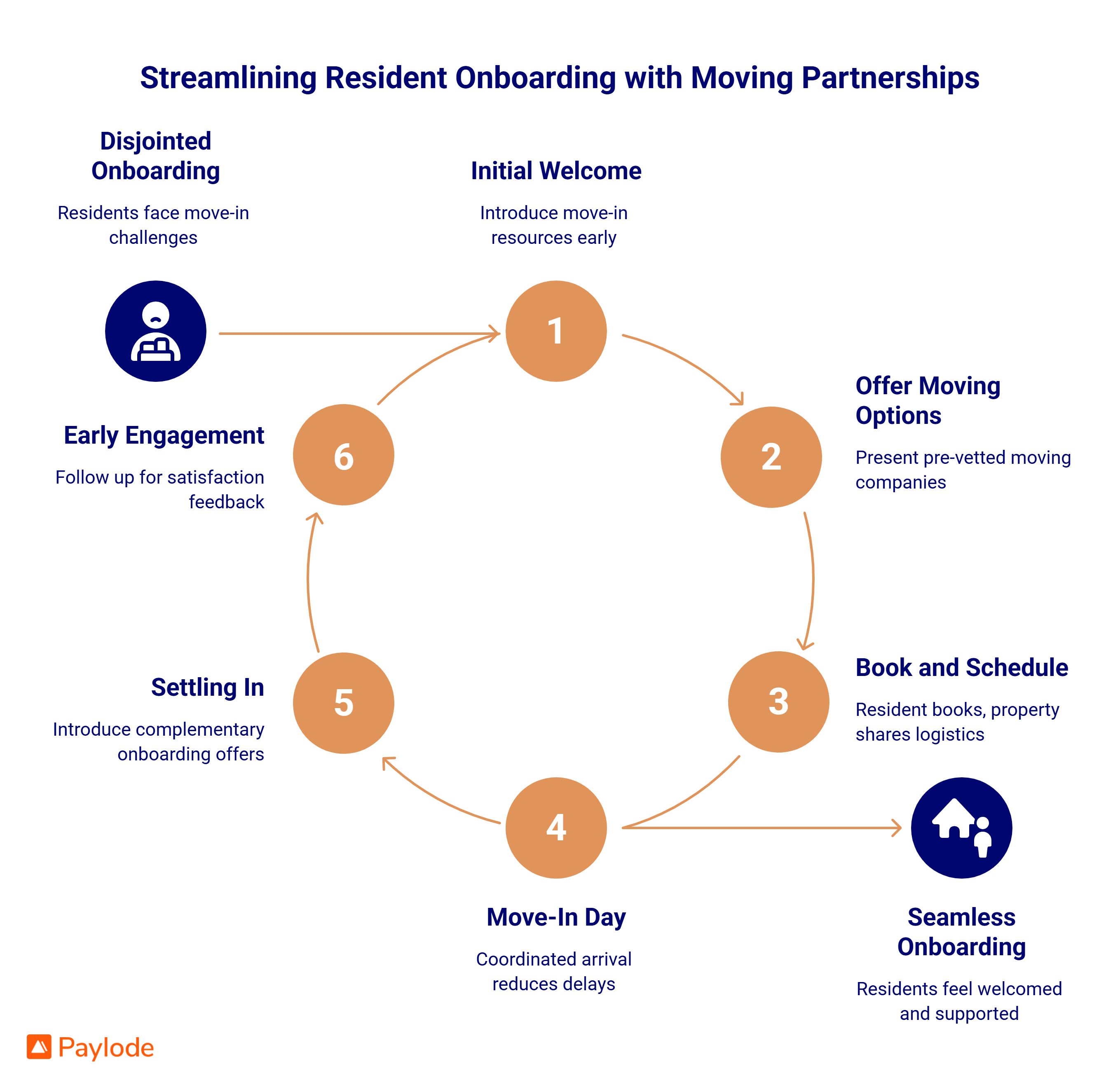
A moving company partnership gives property managers a way to embed a trusted, negotiated service directly into the resident onboarding flow instead of hoping new tenants stumble onto a good option themselves. Rather than a resident searching review sites under time pressure, often while also juggling a new job, a new neighborhood, or a family relocation, the community can present a small number of pre-vetted movers with transparent pricing and simple booking. This single change removes a significant amount of friction from what is often ranked as one of life's most stressful events.
For property managers, moving company partnerships also create a natural extension of the resident perks programs many communities already run. Rather than treating moving discounts as a one-off vendor negotiation handled manually by a leasing office, forward-thinking operators fold moving offers into a structured perks center alongside utilities setup, internet activation, and local discounts. This turns a single transactional benefit into part of a broader, branded onboarding experience that residents can browse and use at their convenience.
The relationship also benefits the moving companies themselves, since multifamily communities represent a steady, recurring stream of local move volume. That mutual incentive is part of why moving partnerships tend to be easier to negotiate and sustain than many other vendor relationships. Movers get consistent referral volume, and property managers get a dependable, community-branded resource they can point new residents toward with confidence.
How do moving partnerships reduce move-in day stress for new residents?
Move-in day involves a long list of small decisions, and each one adds a bit of friction to the resident's first experience with a new home. Choosing a mover, confirming availability, understanding pricing structures, and coordinating building logistics like elevator reservations or loading dock access are all tasks that fall on the resident unless the property team steps in. A moving company partnership addresses several of these friction points at once.
When a preferred mover already understands a property's building rules, parking layout, and freight elevator scheduling, the move itself tends to go faster and with fewer surprises. Property managers who work directly with a moving partner can share these logistical details in advance, so the moving crew arrives prepared rather than improvising on-site. That preparation reduces the odds of delays, property damage, or scheduling conflicts with other residents moving in or out on the same day.
There is also a financial angle. Movers participating in a formal community partnership frequently offer negotiated rates that are lower than what an individual resident would find on their own, since the moving company is trading a modest discount for a reliable pipeline of new customers. For a resident already absorbing security deposits, application fees, and the general cost of relocating, even a modest discount on moving services can meaningfully ease the financial pressure of move-in week.
What should property managers look for in a moving company partner?
Not every moving company makes a good onboarding partner, so property managers benefit from a short evaluation process before formalizing a relationship. Reliability should be the first filter. A mover who is difficult to schedule, prone to last-minute cancellations, or inconsistent in service quality can undo the very stress reduction the partnership is meant to create, so checking references and recent resident feedback matters more than chasing the lowest possible rate.
Licensing and insurance coverage deserve equal attention, since property managers are effectively vouching for the vendor when they recommend it to new residents. Verifying that a moving company carries appropriate liability coverage and, where applicable, state-level moving licenses, protects both the resident and the property from disputes over damaged belongings or missed appointments.
Communication style is another practical consideration. Moving companies that offer clear, upfront pricing and straightforward booking, ideally through a simple online interface rather than a lengthy phone negotiation, tend to create a smoother experience that matches the convenience residents expect from digital-first communities. Property managers should also confirm that a prospective partner can scale during peak leasing seasons, since a mover who performs well with occasional bookings may struggle during a high-turnover summer leasing push.
Finally, it helps to choose movers who already have experience working within multifamily buildings specifically, rather than movers whose primary business is single-family relocations. Multifamily moves involve unique variables, like elevator reservations, tight hallways, and shared loading zones, and a mover familiar with these constraints is far less likely to create friction with other residents or building staff on move-in day.
How can moving partnerships be bundled with other move-in perks?
Moving partnerships work best when they are not treated as an isolated benefit but as one piece of a coordinated move-in bundle. Property managers who combine a moving discount with complementary offers, like discounted internet setup or a fast path to automatic payments enrollment, give new residents a single, cohesive welcome package rather than a scattered set of individual vendor emails. This bundled approach mirrors how leading resident perks programs are structured across the residential real estate industry, where the goal is to consolidate everything a new tenant needs into one accessible hub.
What other services pair well with moving partnerships?
A well-designed move-in bundle typically pairs a moving discount with a handful of adjacent services that new residents also need to set up during their first week. Utility activation, renter's insurance sign-up, an early nudge to switch to paperless billing, and local service discounts, like grocery delivery or home goods retailers, are common companions because they address the same broad need: getting settled quickly without wasting time on research. Presenting these offers together in a branded perk centers experience, rather than as separate one-off emails, makes it easier for residents to find and use everything in one place, and it reinforces the sense that the community has thought through the entire onboarding journey on their behalf.
How do moving partnerships affect lease renewal and retention?
The connection between a strong move-in experience and eventual lease renewal is not always obvious, but it is measurable. Residents who feel supported from the very start of their lease tend to develop a more favorable baseline opinion of the property, and that baseline carries forward through the rest of the resident lifecycle. A moving partnership is a small but tangible signal that the property manager is thinking about the resident's actual experience, not just the transaction of signing a lease.
Communities that actively work to increase retention often find that the earliest touchpoints matter disproportionately, because they establish trust before a resident has any track record with the property team on maintenance requests, community events, or renewal conversations. A resident who had a smooth, well-supported move-in is more inclined to give the property the benefit of the doubt later, whether that means renewing at a modest rent increase or engaging with community programming rather than tuning it out.
Over time, this early trust also supports efforts to raise customer LTV, since residents who renew instead of turning over save the property the cost of vacancy, marketing, and re-leasing. A moving partnership will rarely be the single deciding factor in a renewal decision on its own, but as part of a broader onboarding strategy that consistently removes friction and adds value, it contributes to the cumulative sense of goodwill that keeps residents in place longer.
How should property managers measure the ROI of moving partnerships?
Measuring the return on a moving company partnership starts with tracking adoption. Property managers should monitor how many new residents actually use the moving offer relative to total move-ins, since low adoption usually points to a promotion or communication gap rather than a lack of interest in the underlying benefit. Comparing adoption rates across properties or leasing periods can also reveal whether certain onboarding emails, portal placements, or leasing agent scripts are more effective at driving usage than others.
Beyond adoption, property managers can look at downstream indicators like early resident satisfaction survey scores, the volume of maintenance or complaint tickets logged in the first 30 days, and renewal rates for residents who used the moving partnership compared with those who did not. While isolating the exact causal effect of a single perk is difficult, consistent gaps between these two groups over time offer a reasonable signal that the partnership is contributing to a better onboarding experience.
Cost savings are another useful metric, particularly when a moving partnership is bundled into a broader perks program rather than negotiated as a standalone deal. Centralizing vendor management through a single platform reduces the administrative burden on leasing staff, who would otherwise need to independently source, vet, and manage relationships with local movers across every property in a real estate portfolio.
What common mistakes should property managers avoid?
The most common mistake is treating a moving partnership as a one-time negotiation rather than an ongoing relationship that needs periodic review. Moving companies, like any vendor, can experience service quality shifts, staffing changes, or pricing adjustments, so property managers should revisit partnerships at least annually rather than assuming an agreement made at property launch will remain accurate indefinitely.
Another frequent misstep is under-promoting the benefit. A moving discount buried in a lengthy welcome packet or a rarely opened email is unlikely to get used, no matter how strong the underlying offer is. Property managers get the most value when moving partnerships are visible at the exact moment a resident is thinking about their move, such as within the lease signing flow, the welcome portal, or early onboarding communications.
Finally, some property managers try to manage too many moving vendors at once in an attempt to give residents maximum choice. In practice, a shorter list of two or three thoroughly vetted movers tends to perform better than a long list of loosely reviewed options, since it reduces decision fatigue for the resident and makes it easier for the property team to maintain quality oversight over each relationship.
Frequently asked questions
Do moving company partnerships cost property managers anything to set up?
Most moving partnerships are structured as referral agreements where the moving company offers discounted rates or a small resident incentive in exchange for a steady stream of referrals from the property, so there is typically little to no direct cost for the property manager to establish the relationship.
How many moving company options should a property offer residents?
A focused list of two or three thoroughly vetted movers generally works better than a longer list, since it simplifies the decision for residents while still giving the property team enough oversight to maintain consistent service quality.
Can moving partnerships work for both large multifamily communities and smaller properties?
Yes. Larger communities may negotiate more favorable rates due to higher move volume, but smaller properties can still form effective partnerships, particularly by grouping the offer with other move-in perks to make the overall onboarding package more attractive to a mover.
How do property managers promote a moving partnership so new residents actually use it?
The offer should appear at the moments residents are actively planning their move, such as in the lease signing confirmation, welcome portal, and early onboarding emails, rather than being buried in a general welcome packet that residents may not read closely.
Does a moving partnership replace the need for other move-in perks?
No. Moving partnerships work best as one component of a broader move-in bundle that also addresses needs like utility setup and local discounts, so residents experience a complete, coordinated onboarding process rather than a single isolated benefit.
Turn a stressful move into a strong first impression
A resident's first weeks in a new home say a lot about what the rest of their lease will feel like, and moving company partnerships give property managers a straightforward way to make that first impression a positive one. By pairing a trusted mover with the rest of a resident's onboarding journey, communities can reduce move-in stress, reinforce their commitment to resident experience, and lay the groundwork for stronger renewals down the line. Explore how the Paylode platform helps property managers combine moving partnerships with a full suite of resident perks, learn more about Perks and Boost for driving action-based engagement, compare plans to find the right fit for your portfolio, or book a demo to see how a coordinated onboarding experience can strengthen resident satisfaction from day one.