Google reviews have become an important part of how prospective residents evaluate an apartment community before scheduling a tour or submitting an application. For residential real estate operators, a strong review profile can reinforce trust, improve the perceived value of a community, and help prospective residents feel more confident about choosing a property.
But getting residents to leave reviews consistently can be difficult. Property teams may send review requests, add links to emails, or ask residents at the end of a positive interaction. Even with these efforts, response rates can remain inconsistent because reviewing a property is rarely urgent for residents.
This is where resident review rewards can create a more engaging approach.
Instead of treating Google review generation as a standalone marketing task, operators can connect review participation with a broader resident rewards strategy. A well-designed program can give residents an additional reason to engage while helping property teams build a repeatable process for generating feedback.
For residential real estate operators, the opportunity is not simply about getting more five-star reviews. It is about creating a better feedback loop between residents, property teams, and the community brand.
Important: Review incentives should never require a resident to leave a positive review. The reward should be tied to completing an eligible feedback action, if permitted by the applicable platform rules and local requirements, rather than the sentiment or rating of the review.
Why Google reviews matter to residential real estate operators
Apartment shopping is increasingly digital. Before visiting a property, prospects often look at the community website, photos, ratings, resident comments, amenities, location, and overall online reputation.
Google reviews can influence this research process because they provide a perspective that feels different from property-controlled marketing materials.
A community website can explain its amenities. A resident review can describe what living there actually feels like.
That distinction matters.
For operators, reviews can help communicate:
- Resident experience
- Responsiveness of the property team
- Maintenance experience
- Community atmosphere
- Amenity quality
- Location convenience
- Move-in experience
- Communication quality
- Overall satisfaction
Reviews can also surface recurring issues that internal teams may not immediately see.
A consistent review-generation process therefore has two potential benefits: reputation building and resident feedback.
What resident review rewards actually mean
The concept behind resident review rewards is straightforward.
A property operator creates a resident rewards program where residents can earn an eligible reward for completing a defined engagement action, such as providing feedback or participating in a review request.
The goal is not to purchase positive sentiment.
Instead, the operator creates a reason for residents to participate in an activity that benefits both sides.
For example, a community could structure a campaign around:
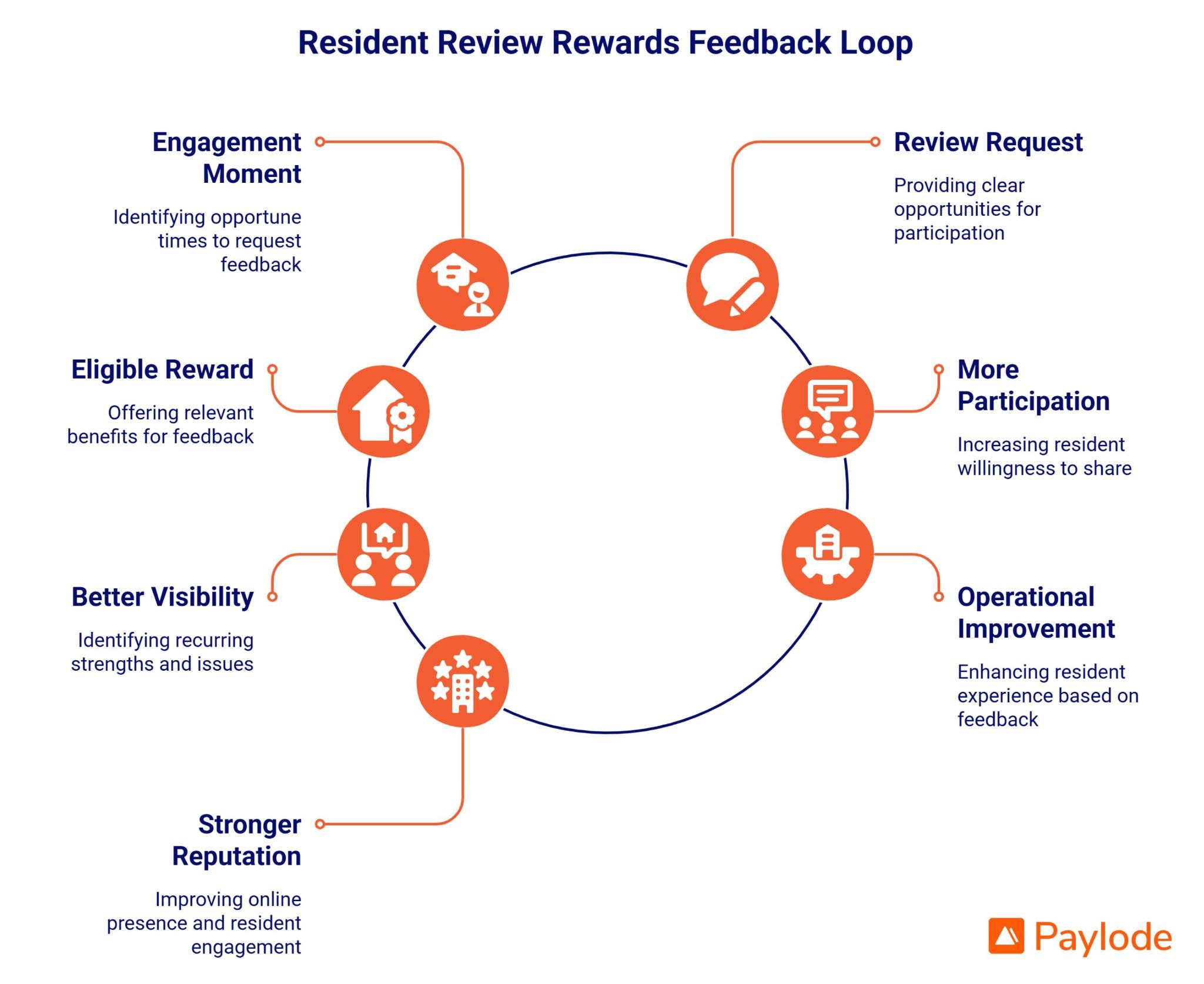
- Resident receives a review request.
- Resident chooses whether to participate.
- Resident completes the requested feedback action.
- Resident receives an eligible reward according to the program rules.
- Property team receives additional feedback and review participation.
- The community continues engaging residents through its broader rewards program.
This approach turns review generation from a one-time request into part of the resident engagement experience.
Why rewards can make review requests more actionable
A resident may genuinely like their apartment and still never leave a review.
Why?
Because satisfaction and action are different things.
A resident can have an excellent maintenance experience and think, "I should leave a review," but then move on with their day. There is no immediate reason to complete the action.
Rewards can reduce that gap.
A relevant incentive can make the request more noticeable and give residents a tangible reason to take action.
For operators, this creates a useful principle:
Do not rely only on goodwill when you can make participation part of a larger resident engagement strategy.
The reward does not need to be large. It needs to be relevant, easy to understand, and connected to a broader program that residents already recognize.
The resident review rewards model
A simple model can look like this:
The important point is that review generation should not exist in isolation.
It can become one engagement touchpoint within a broader resident rewards ecosystem.
How to build a resident review rewards strategy
A successful program requires more than adding a reward to a Google review request.
Operators should design the experience around timing, transparency, convenience, and compliance.
1. Define the engagement action
Start by deciding exactly what residents are being asked to do.
For example, the campaign might ask residents to:
- Share feedback about their resident experience
- Complete a resident satisfaction survey
- Participate in an eligible review request
- Provide feedback after a maintenance interaction
- Share community feedback after a resident event
The action should be simple.
If residents need to navigate multiple pages or complete a long form, participation can decline.
2. Separate the reward from review sentiment
This is one of the most important principles.
A reward should not depend on whether the resident leaves a five-star, four-star, or negative review.
The objective should be participation, not manufactured sentiment.
That distinction helps create a more credible feedback program.
It also means property teams should be prepared to receive negative feedback.
A resident who reports a problem is not necessarily a failed engagement outcome. That feedback can identify an opportunity for the operator to improve the resident experience.
3. Choose rewards residents actually value
The reward should feel useful rather than promotional.
Depending on the community and program structure, relevant rewards could include:
- Local merchant offers
- Dining discounts
- Shopping rewards
- Entertainment benefits
- Wellness-related offers
- Convenience-focused perks
- Digital gift card-style benefits
- Resident experience perks
The strongest rewards are usually easy to understand and relevant to everyday life.
That is one reason a broader resident perks strategy can complement review generation. Instead of creating a reward program exclusively for reviews, operators can give residents access to an ongoing collection of benefits.
Review generation should be part of resident engagement
A common mistake is to think of review generation as a marketing campaign.
For property operators, it can be more effective to treat it as part of the resident lifecycle.
Consider the number of interactions residents have with a community:
- Application
- Move-in
- Maintenance
- Amenity use
- Resident events
- Renewal
- Communication
- Payment
- Move-out
Each interaction can influence how residents perceive the property.
The review request should therefore arrive when the experience is relevant.
For example, after a successful maintenance resolution, the resident may be more engaged with the property than they were three months earlier.
After a community event, residents may also be more receptive to engagement.
The objective is to create a natural feedback moment rather than sending generic review requests repeatedly.
The best moments to request resident feedback
Timing can significantly affect participation.
Property teams can consider review or feedback requests after meaningful resident interactions such as:
After a maintenance issue is resolved
A resident who has just received a successful resolution has a fresh experience to share.
After move-in
The move-in experience can strongly influence a resident's early perception of the community.
After a resident event
Community events can create positive engagement moments and provide opportunities for feedback.
After a service interaction
A successful interaction with leasing, concierge, or property management teams can be an appropriate moment to request feedback.
Before renewal
Residents approaching renewal have already accumulated significant experience with the property.
However, operators should avoid overwhelming residents with repeated requests. A thoughtful cadence is more sustainable than constant reminders.
Connecting review generation to the resident lifecycle
A resident rewards program becomes more valuable when it supports multiple engagement moments.
For example:
This structure changes the role of rewards.
They are no longer simply an incentive for leaving a review.
They become part of the community's overall resident engagement strategy.
Why this matters for resident retention
Resident retention is influenced by more than rent and amenities.
Residents also consider whether they feel valued, recognized, and connected to their community.
A well-designed rewards program can reinforce those feelings.
When residents regularly receive useful benefits, they have more reasons to interact with the community beyond paying rent or submitting maintenance requests.
This can help operators build a stronger relationship throughout the lease.
For communities focused on retention, a resident rewards program can therefore support a broader strategy around resident experience rather than functioning solely as a marketing tool.
The role of a perks platform
Managing resident rewards manually can quickly become difficult.
A property team may need to:
- Identify available rewards
- Communicate offers
- Track participation
- Manage eligibility
- Coordinate campaigns
- Monitor engagement
- Report results
That creates operational work.
A centralized platform can make it easier to manage resident engagement programs and deliver benefits consistently across communities.
Paylode's Perks offering can be positioned within this type of resident engagement strategy, helping operators create a more structured rewards experience rather than relying on disconnected promotions.
For operators evaluating technology, the goal should be simple: make rewards easy for residents to discover and easy for property teams to manage.
How Google review generation can fit into a broader perks strategy
The strongest model does not make Google reviews the entire purpose of the rewards program.
Instead, review participation becomes one component.
Think of the model as:
Resident experience → Engagement → Feedback → Reward → Continued engagement
This creates a feedback loop.
A resident interacts with the property.
The operator provides an opportunity to share feedback.
The resident participates.
The resident receives an eligible reward.
The operator gains insight.
The resident remains connected to the community through additional benefits.
That is much more valuable than simply sending another automated "Please leave us a review" email.
A practical campaign example
Imagine a 300-unit apartment community launching a resident engagement campaign.
Instead of sending a generic email, the property team introduces a resident rewards initiative.
The communication might explain that residents can participate in selected community feedback activities and access useful perks through the program.
After an appropriate resident interaction, the community sends a simple request.
The resident chooses whether to participate.
If the resident completes the eligible action, the reward is issued according to the program's rules.
The property team then tracks:
- Participation rate
- Review volume
- Feedback volume
- Review sentiment
- Response rate
- Reward redemption
- Repeat engagement
The operator can then compare results against its previous review-generation process.
This makes the initiative measurable.
What metrics should property operators track?
The number of Google reviews is useful, but it should not be the only metric.
A stronger dashboard can include:
Operators should also track qualitative themes.
For example, if multiple reviews mention slow maintenance response, the answer may not be another review campaign.
The answer may be improving maintenance operations.
This is where reviews become more than a marketing asset. They become a source of operational intelligence.
Use negative reviews as an improvement signal
A resident rewards strategy should not create fear around negative feedback.
In fact, negative feedback can be valuable.
Suppose residents consistently mention:
- Slow maintenance
- Poor communication
- Move-in delays
- Amenity cleanliness
- Parking problems
Those themes can help management identify areas requiring attention.
A healthy review-generation program should therefore encourage authentic feedback.
The objective is not to make every review positive.
The objective is to make the resident experience better and make it easier for satisfied residents to share their experiences.
How operators can keep the process simple
The resident experience should require as few steps as possible.
A practical process might follow these principles:
Simple request → Clear action → Easy participation → Immediate reward → Ongoing engagement
Avoid:
- Long instructions
- Complicated forms
- Multiple logins
- Unclear reward conditions
- Excessive reminders
- Confusing eligibility rules
Residents should understand what is being requested and what they receive for participating.
Clarity builds trust.
Where automation can help
For operators managing multiple communities, manual review requests can become inconsistent.
Automation can help standardize the process.
For example, a resident engagement system could support campaigns based on defined events or resident interactions.
This can reduce dependence on property staff remembering to send individual requests.
Automation can also help operators maintain a consistent resident experience across communities.
The larger opportunity is to connect resident engagement activities with the systems operators already use rather than creating another disconnected workflow.
Resident review rewards vs. traditional review requests
The difference between the two approaches is mainly about engagement.
The rewards approach is not automatically better.
Its effectiveness depends on how thoughtfully the program is designed.
If the reward is irrelevant or the process is complicated, participation may remain low.
How resident rewards can support customer lifetime value
For residential operators, resident engagement ultimately connects to business outcomes.
A resident who stays longer can represent more lifetime value than a resident who leaves after one lease.
Rewards can support this broader strategy by giving residents more reasons to interact with the community.
A resident may initially participate because of a review-related incentive.
Over time, they may discover additional perks.
Those additional benefits can help strengthen the perceived value of the resident experience.
Operators can therefore think beyond:
"How do we get more reviews?"
A better question is:
"How can we turn review engagement into a stronger resident relationship?"
That shift can change how the program is designed.
How to avoid making rewards feel transactional
Residents should not feel that every interaction with their property is an exchange.
If every communication says "do this and get something," the relationship can start to feel overly transactional.
Instead, rewards should sit inside a larger value proposition.
For example, a community can combine:
- Useful resident perks
- Community events
- Helpful communications
- Feedback opportunities
- Recognition
- Referral programs
- Renewal engagement
The result is a more balanced resident experience.
Reviews become one part of that ecosystem.
How to measure whether the strategy is working
Before launching a campaign, establish a baseline.
Record the community's current:
- Monthly review volume
- Average rating
- Review response rate
- Resident engagement rate
- Existing rewards participation
- Feedback completion rate
Then introduce the new process and compare results.
A useful test period might examine performance before and after the program.
Operators should also compare communities where appropriate.
For example:
Community A: Traditional review requests
Community B: Review engagement connected to resident rewards
This can help management determine whether the additional engagement layer produces measurable improvement.
Common mistakes to avoid
Making the reward dependent on a positive rating
This can undermine trust and may conflict with platform policies or applicable rules.
Reward the eligible action, not the sentiment.
Making the reward too complicated
Residents should not have to read a long policy before understanding the benefit.
Keep the offer clear.
Asking too frequently
Repeated review requests can become annoying.
Use meaningful interaction points.
Ignoring negative feedback
Negative reviews can reveal operational problems.
Treat them as data.
Using irrelevant rewards
A reward that residents do not value will not create meaningful engagement.
Choose benefits that fit the resident audience.
Treating the program as a one-time campaign
The biggest opportunity comes from connecting review engagement with an ongoing resident rewards strategy.
A simple implementation framework for property operators
Operators can begin with five steps.
Step 1: Establish the baseline
Document current review volume, rating, engagement, and feedback processes.
Step 2: Identify resident touchpoints
Map the resident lifecycle and find appropriate moments for feedback requests.
Step 3: Design the reward
Select useful benefits and establish transparent eligibility rules.
Step 4: Automate the workflow
Where possible, connect requests and rewards to a centralized resident engagement system.
Step 5: Measure and optimize
Review participation, feedback, sentiment, redemption, and resident engagement regularly.
This approach allows operators to start small and expand based on results.
Why this strategy is bigger than Google reviews
Google reviews are only one visible outcome.
The deeper opportunity is creating a resident engagement system that makes residents feel there is ongoing value in interacting with the community.
That can support several goals at once:
- Stronger online reputation
- More resident feedback
- Better visibility into service issues
- Higher engagement
- More resident value
- Better communication
- Stronger retention opportunities
For residential real estate operators, this broader perspective is important.
The best resident rewards programs are not built around one transaction.
They create an ongoing relationship between the resident and the property.
How Paylode can support the resident rewards strategy
Property operators looking to connect resident engagement with meaningful benefits can use a centralized platform rather than managing individual rewards manually.
Paylode's platform is designed around rewards and engagement, giving operators a way to structure resident-facing benefits within a broader strategy.
Explore the Paylode platform to understand how a centralized rewards approach can support resident engagement.
Operators can also explore Paylode Perks as part of a strategy focused on giving residents useful benefits throughout their relationship with a community.
For campaigns where operators want to encourage specific resident actions, Paylode Boost can be considered as another component of the engagement strategy.
The goal is not simply to create more promotions.
It is to make resident engagement more consistent, measurable, and valuable.
Final thoughts
Google review generation does not have to be a disconnected marketing activity.
When designed carefully, resident review rewards can connect feedback requests with a broader resident engagement strategy.
The key is to reward participation rather than sentiment, keep the process simple, choose useful benefits, request feedback at relevant moments, and use resident feedback to improve the actual experience.
For property operators, that creates a more sustainable model:
Better engagement → More authentic feedback → Better resident experience → Stronger reputation
The opportunity is especially relevant in residential real estate, where online reputation and resident experience increasingly influence the leasing journey.
If your team is ready to explore a more structured approach to resident rewards, review Paylode's plans or book a demo to discuss how a rewards strategy can fit your resident engagement goals.
Frequently asked questions
What are resident review rewards?
Resident review rewards are incentives offered to residents for completing an eligible feedback or review-related action. The reward should be tied to participation rather than requiring a positive review or specific rating.
Can apartment communities reward residents for Google reviews?
Operators should carefully review Google's current policies and applicable laws before implementing any incentive program. A safer approach is to structure incentives around eligible feedback participation without conditioning the reward on a positive rating.
Why use resident rewards for review generation?
Rewards can give residents an additional reason to participate in a review or feedback request. When incorporated into a broader resident engagement program, they can also provide value beyond the individual review request.
Should residents receive a reward for a five-star review?
No. A reward should not be conditional on a particular rating or positive sentiment. Authentic feedback is more valuable than artificially encouraging a specific rating.
What rewards work well for apartment residents?
Useful everyday benefits tend to be more compelling than generic promotional offers. Depending on the resident audience, these can include dining, shopping, entertainment, wellness, and other practical perks.
When should property teams request reviews?
Good opportunities can occur after meaningful resident interactions, such as successful maintenance resolution, move-in, community events, or other service experiences. Operators should avoid excessive requests.
Can review feedback improve resident retention?
Indirectly, yes. Reviews can reveal recurring resident concerns and strengths. Using that information to improve operations can contribute to a better resident experience, which can support retention.
How can property operators automate review engagement?
Operators can use resident engagement or rewards technology to standardize campaigns, trigger appropriate communications, track participation, and manage eligible rewards. The exact workflow should depend on the property's systems and operational requirements.
What should operators measure?
Review volume, participation rate, review growth, sentiment, reward redemption, feedback themes, and ongoing resident engagement are useful metrics. Operators should also track whether feedback leads to operational improvements.
Is a resident rewards program only useful for Google reviews?
No. Reviews should be one component of a larger resident engagement strategy. The same rewards infrastructure can support other engagement opportunities throughout the resident lifecycle.