Rent is only one piece of a resident's financial picture, and property managers who treat it as the whole picture are leaving retention gains on the table. Financial wellness renter perks are emerging as a practical way for multifamily operators to support residents beyond the lease itself, addressing the everyday money stress that shapes whether someone renews or moves on. Instead of competing only on unit finishes or amenity lists, communities that offer financial wellness renter perks are giving residents a reason to associate their home with stability rather than strain.
This shift reflects something property teams already sense anecdotally: residents who feel financially squeezed are harder to retain, regardless of how much they like their apartment. A resident juggling credit card debt, inconsistent savings, or unpredictable expenses is more likely to view a move as a fresh start, even if the move itself is stressful and costly. Financial wellness perks for renters give property managers a way to interrupt that thinking by making the current lease feel like part of the solution rather than part of the problem.
Why does financial wellness matter for renters today?
Household finances have gotten harder to manage for a large share of renters, and that pressure shows up in ways property managers can actually see, like more late payments, more support tickets about billing, and more residents asking about payment flexibility. Financial wellness renter perks respond directly to this reality by giving residents tools and incentives that make managing money a little easier, not just a place to live.
The connection between financial stress and housing decisions is well documented in resident experience research: people under financial pressure tend to make housing decisions based on short-term relief rather than long-term fit, which works against renewal rates even when a resident otherwise likes their community. A property manager offering financial wellness renter perks, such as credit-building tools, budgeting resources, or savings-linked rewards, is positioned as a partner in that resident's financial life rather than just a landlord collecting a check every month.
There's also a market differentiation angle. Most communities already compete on similar amenities, so financial wellness renter perks represent one of the few remaining areas where a property management company can meaningfully stand apart. Residents comparing two similar buildings are increasingly likely to notice which one actually helps them save money and build financial stability, not just which one has the nicer gym.
What are financial wellness renter perks and how do they work?
Financial wellness renter perks are curated benefits designed to help residents manage, save, and build toward stronger personal finances, layered on top of the traditional discounts and local deals found in most resident perks programs. This can include credit-building services that report on-time rent payments to credit bureaus, discounted access to budgeting apps, cashback-style rewards tied to responsible financial behavior, or partnerships with financial institutions offering better savings rates.
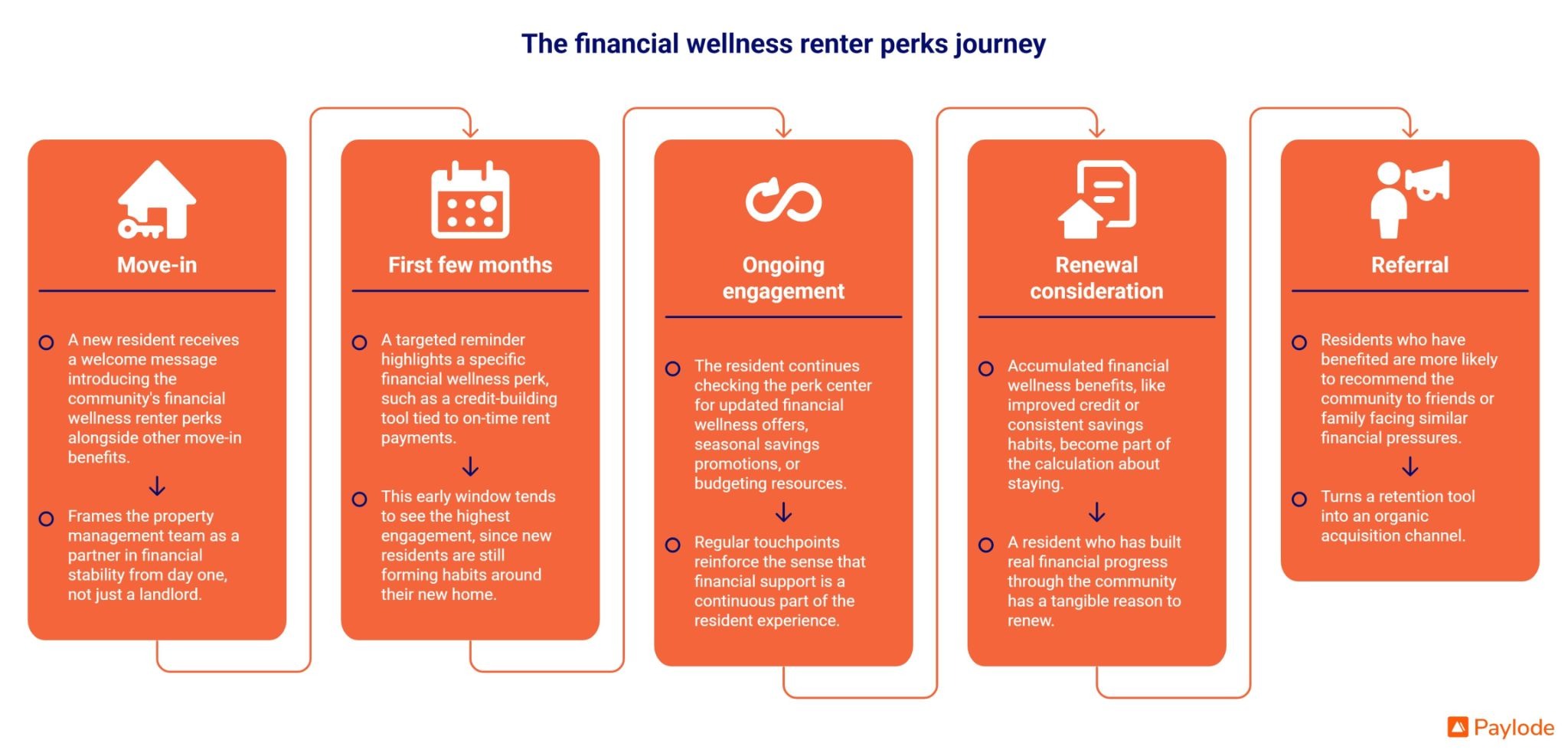
The strongest programs treat financial wellness as an ongoing part of a broader resident perks strategy rather than a standalone initiative bolted onto the leasing process. A resident who logs in to check a financial wellness offer is also exposed to other community benefits, which reinforces engagement across the entire program instead of limiting financial wellness to a single, forgettable announcement.
What makes financial wellness renter perks distinct from a typical discount is the ongoing relationship they create. A resident who builds credit through on-time rent reporting, or who consistently uses a savings-linked reward, develops a habit tied directly to their home. That habit is difficult to replicate elsewhere, which gives property managers a subtle but meaningful retention advantage that generic amenities cannot offer.
How can property managers use financial wellness perks to improve retention?
Renewal decisions rarely come down to a single factor, but financial stability plays an outsized role in how residents weigh their options. A resident who feels like their community actively supports their financial goals has a concrete, personal reason to renew that goes beyond convenience or habit. Financial wellness renter perks give property managers a way to build that reason deliberately, rather than hoping goodwill accumulates on its own.
Programs designed to increase resident retention tend to perform best when they reward consistent engagement rather than a single move-in action, and financial wellness perks are naturally suited to that model because financial habits, like saving or budgeting, are recurring by nature. A resident who has used financial wellness renter perks over multiple months has effectively built the current lease into their broader financial routine, which raises the emotional and practical cost of moving elsewhere.
There's a trust dimension here as well. Financial topics are personal, and residents notice when a property management company treats their financial wellbeing as a genuine priority rather than a marketing angle. That perception of care tends to translate into stronger word-of-mouth referrals and more forgiving relationships when normal friction points, like maintenance delays, come up during the lease term.
How do financial wellness perks fit alongside automatic payments and paperless billing?
Financial wellness renter perks work especially well when paired with other resident actions that support financial stability, like enrolling in automatic payments or agreeing to switch to paperless billing. A resident who sets up autopay to avoid late fees is already demonstrating an interest in better financial habits, making them a natural candidate for additional financial wellness offers like credit-building tools or budgeting resources.
This kind of pairing works because it treats a resident's financial life as connected rather than segmented into isolated transactions. Property managers who bundle financial wellness renter perks with autopay or paperless enrollment often see stronger participation across all three, since residents respond well to a single, coherent message about financial support rather than a scattered list of unrelated offers.
Paperless billing in particular creates a natural on-ramp to financial wellness perks. Residents who are comfortable managing their account digitally are already primed to explore other digital financial tools, which makes them more likely to notice and use a financial wellness benefit delivered through the same portal.
What role does a perk center play in delivering financial wellness benefits?
For financial wellness renter perks to actually get used, residents need a consistent, low-friction place to find them. A dedicated perk center solves this problem by giving residents a persistent, always-available hub where financial wellness offers sit alongside other community benefits rather than getting buried in a single email that's easy to miss.
A well-designed perk center can highlight financial wellness renter perks in their own category, making it easy for residents to browse credit-building tools, savings offers, or budgeting resources whenever it's relevant to them, not just during move-in week. Residents who are already in the habit of checking the perk center for local restaurant deals or utility discounts are far more likely to notice a financial wellness offer than residents who only hear about it once.
This visibility matters because financial wellness renter perks that residents forget about deliver no retention value at all. Housing these offers in a persistent, on-brand location significantly increases the odds that residents engage with them consistently, making the program's connection to renewal outcomes measurable and defensible internally.
How does Paylode Boost help property managers launch financial wellness campaigns?
Simply listing a financial wellness perk in a perk center often isn't enough to drive meaningful engagement. This is where a targeted, action-based campaign, like Paylode Boost, becomes useful. Rather than hoping residents stumble across a financial wellness offer, property managers can design a campaign that surfaces the benefit at the moment it's most relevant, such as right after a resident enrolls in autopay or completes a lease renewal.
Boost-style campaigns work by showing residents a clear preview of the reward, prompting a specific action, and delivering the benefit once that action is completed. Applied to financial wellness renter perks, this might mean rewarding a resident for signing up for a credit-building service or completing a short budgeting course through a partner platform. Because the incentive is tied to a trackable action, property managers gain much clearer visibility into which financial wellness perks residents actually value.
This structure also allows property teams to test different financial wellness offers against each other. If a credit-building tool consistently drives more engagement than a generic savings partnership, that data can guide which financial wellness renter perks get promoted more heavily in future campaigns and budget cycles.
How can property managers measure the ROI of financial wellness perks?
Financial wellness renter perks are worth the investment only if property managers can connect the program to measurable outcomes, like renewal rates, resident satisfaction, and engagement over time. Tracking how many residents actually enroll in or redeem financial wellness offers is a useful starting point, since it separates perks that residents notice from perks that quietly go unused.
Beyond enrollment, property managers should compare renewal rates among residents who engage with financial wellness perks against those who don't. If engaged residents renew at a meaningfully higher rate, that's a strong signal the program is doing more than just generating goodwill; it's actively influencing the decision to stay. Resident satisfaction surveys conducted around renewal time can add useful context by capturing whether residents perceive financial wellness perks as a genuine part of their experience.
Financial wellness renter perks also connect naturally to the broader goal of helping raise customer lifetime value, since residents who stay longer and engage consistently with financial wellness programs tend to generate more value over the full life of their tenancy than residents who churn quickly. Viewing financial wellness perks through this longer lens gives property managers a fuller picture of the program's actual return.
How does Paylode support financial wellness for multifamily and residential real estate?
Property management companies across the real estate industry are increasingly looking for ways to support residents that go beyond the physical unit, and financial wellness renter perks fit naturally into that shift because they address a concern nearly every renter shares, regardless of income level or property type.
Paylode works specifically within residential real estate to help property managers build branded perks programs that combine financial wellness benefits with other resident-focused offers, all accessible through a single, easy-to-navigate hub. Because the Paylode platform integrates with property management systems many operators already rely on, launching a financial wellness program doesn't require rebuilding existing resident-facing workflows.
For property managers exploring what a financial wellness program could look like for their portfolio, reviewing the available perks offerings is a useful first step, since it shows the range of partner categories, including financial wellness, that can be curated into a resident-facing experience. From there, most teams find it helpful to compare pricing plans to understand which tier fits their portfolio size and timeline for getting a program live.
Frequently asked questions about financial wellness renter perks
What are financial wellness renter perks?
Financial wellness renter perks are curated benefits designed to help residents manage, save, and build toward stronger personal finances, such as credit-building tools tied to rent payments, budgeting resources, or savings-linked rewards. Property managers offer these perks as part of a broader resident perks program to support residents beyond the physical unit.
How do financial wellness renter perks help with resident retention?
Financial wellness renter perks give residents a personal, ongoing reason to renew by helping them build financial stability during their lease. Residents who develop habits like credit-building or consistent saving through the program have a tangible incentive to stay rather than start over somewhere new.
Do financial wellness renter perks cost property managers money to offer?
Most financial wellness renter perks are built on pre-negotiated partnerships with financial service providers, so property managers aren't directly funding the benefits themselves. The value comes from curating and promoting relevant offers, not from subsidizing residents' finances out of pocket.
How can property managers encourage residents to use financial wellness perks?
Visibility and timing both matter. Housing financial wellness renter perks in a persistent, branded perk center and reinforcing them through campaigns tied to key moments, like move-in or autopay enrollment, significantly increases how often residents actually engage with the offers.
Can financial wellness perks be combined with other resident incentives?
Yes. Financial wellness renter perks often work well alongside incentives for automatic payments or paperless billing, since all three support a resident's broader financial routine. Bundling these offers together tends to drive stronger participation than promoting each incentive separately.
Ready to add financial wellness perks to your resident experience?
Financial wellness renter perks give property managers a genuine, differentiated way to support residents and strengthen retention, without discounting rent or adding operational complexity. If your team wants to see how a curated financial wellness program could work for your portfolio, book a demo and we'll walk through what it could look like for your communities.