Resident engagement has become one of the most important indicators of a healthy residential community. While occupancy rates and lease renewals remain essential business metrics, property managers are increasingly measuring how residents interact with their community throughout the lease lifecycle.
This shift reflects changing renter expectations. Today's residents want more than an apartment with attractive amenities. They expect an experience that provides convenience, ongoing value, and meaningful interactions from move-in through renewal.
For residential operators, creating that experience requires more than hosting occasional resident events or sending monthly newsletters. Engagement must become part of the everyday resident journey.
A resident perks program helps make that possible.
Instead of limiting resident interaction to maintenance requests or rent payments, a perks program creates regular opportunities for residents to engage with their community through valuable offers, lifestyle benefits, and everyday savings.
This continuous interaction creates what many operators describe as Engagement lift through perks - a measurable improvement in resident participation, communication, digital adoption, and overall satisfaction.
Unlike one-time incentives, resident perks remain relevant throughout the lease term. Every discount redeemed, every benefit explored, and every communication promoting resident value becomes another opportunity to strengthen the relationship between residents and property management.
For residential operators, this approach supports more than engagement metrics. It contributes to stronger resident experiences, improved retention strategies, and greater long-term resident value.
In this guide, we'll explore how a resident perks system can improve engagement at every stage of the resident lifecycle, as well as which metrics property managers should monitor to evaluate the program's success.
What is engagement lift through perks, and why does it matter?
Resident engagement is often misunderstood as simply attending community events.
In reality, engagement includes every meaningful interaction residents have with their community.
Opening resident emails, accessing resident portals, participating in community initiatives, using resident benefits, and interacting with management all contribute to overall engagement.
Engagement lift through perks refers to the measurable increase in these interactions that occurs when communities provide residents with continuous value.
What does resident engagement mean for property managers?
Resident engagement reflects the strength of the relationship between residents and their community.
Highly engaged residents are generally more likely to explore available resources, participate in community initiatives, communicate with management, and remain connected throughout their residency.
These interactions provide valuable indicators of resident satisfaction long before lease renewal discussions begin.
Instead of waiting until renewal season to understand resident sentiment, operators can monitor engagement year-round.
Why are engagement metrics becoming more important?
Modern property management increasingly relies on measurable indicators of resident experience.
Occupancy rates explain whether apartments are leased.
Engagement metrics reflect how residents feel while living there.
This distinction is important because satisfied residents often demonstrate higher levels of participation long before renewal conversations occur.
Property managers who monitor engagement gain earlier insight into resident relationships and opportunities for improvement.
How does engagement lift through perks improve the resident experience?
Resident perks foster positive interactions in everyday life.
Rather than communicating only about operational matters, communities provide residents with opportunities to discover savings, explore experiences, and enjoy additional value.
Programs such as Resident Perks help create these interactions throughout the lease lifecycle, giving residents additional reasons to engage with their community beyond routine administrative needs.
Over time, these recurring interactions contribute to stronger relationships and higher resident satisfaction.
How does a perks system create engagement lift through perks from move-in?
The move-in experience establishes the foundation for the resident relationship.
Residents begin forming opinions about their community immediately after receiving their keys.
Communities that create positive experiences during this period often encourage stronger long-term engagement.
Why is the move-in experience critical?
Moving into a new home involves excitement, uncertainty, and numerous responsibilities.
Residents are purchasing household items, learning their neighborhood, establishing routines, and becoming familiar with community services.
Providing immediate access to valuable benefits helps reduce some of these challenges while demonstrating that the community supports residents beyond providing housing.
That first impression often influences how residents perceive future interactions.
What perks encourage immediate participation?
The most effective move-in perks solve real problems.
Shopping discounts help furnish new homes.
Dining offers simplify meals during the transition.
Entertainment savings encourage residents to explore their local area.
Travel and lifestyle benefits add value that residents can enjoy year-round.
Because these benefits are useful immediately after move-in, residents quickly recognize the advantages of participating in the program.
How does early engagement influence long-term participation?
Residents who engage shortly after move-in often continue using available benefits throughout their lease.
Early participation builds familiarity with the resident platform and reinforces positive perceptions of the community.
Instead of waiting months to introduce resident benefits, communities begin building engagement from day one.
Why does ongoing value create engagement lift through perks?
Move-in is only one stage of the resident journey.
Most resident relationships develop during the months between move-in and renewal.
This extended period provides the greatest opportunity to strengthen engagement.
A resident perks system helps maintain interest by providing value that residents can use repeatedly.
Why do residents engage more with continuous benefits?
One-time incentives generate temporary excitement.
Ongoing benefits remain useful throughout the year.
Residents regularly shop, dine out, travel, attend entertainment events, and purchase everyday necessities.
When a community provides savings in these categories, residents have repeated reasons to return to the resident platform.
These repeated interactions naturally increase engagement over time.
What resident benefits generate the highest engagement?
Programs that focus on everyday value consistently encourage stronger participation.
Retail discounts, restaurant offers, travel savings, entertainment experiences, wellness opportunities, and local business partnerships align with activities residents already enjoy.
Because these benefits are practical and relevant, residents continue to engage with the program rather than viewing it as a short-term promotion.
How does ongoing engagement strengthen resident relationships?
Every interaction reinforces the relationship between residents and the community.
Each time residents access a new offer or redeem a benefit, they experience another reminder that their community provides value beyond the apartment itself.
Over time, these positive experiences contribute to stronger trust, increased satisfaction, and deeper resident loyalty.
A successful perks system transforms engagement from occasional participation into an ongoing part of residents' everyday lives.
How can perks improve communication engagement metrics?
Communication is one of the easiest engagement metrics for property managers to measure, but it is also one of the easiest to overlook.
Residents receive countless emails, app notifications, and digital messages every week. If every communication from a property focuses only on rent reminders, maintenance updates, or community policies, residents may gradually become less responsive.
A resident perks system changes that dynamic by giving communities valuable content to share throughout the year.
Instead of communicating only when action is required, property managers can consistently provide information that residents genuinely appreciate.
Why do value-driven communications perform better?
People naturally pay attention to information that benefits them.
Messages highlighting new resident discounts, seasonal savings, local experiences, or limited-time offers feel different from routine operational announcements.
They provide immediate value rather than requesting action.
As a result, residents are more likely to open communications, remain engaged with community updates, and develop positive associations with property management.
Over time, this contributes to stronger communication engagement metrics and an improved overall resident experience.
How can resident perks create opportunities for communication?
One of the biggest advantages of a resident perks program is that it provides ongoing reasons to communicate.
Communities can introduce new retail offers, promote seasonal travel savings, highlight local business partnerships, or remind residents about existing benefits.
Rather than sending repetitive operational updates, operators create a communication calendar centered around resident value.
Many residential operators enhance these campaigns with Boost, making it easier to promote benefits and encourage consistent resident participation year-round.
Why does communication frequency improve engagement?
Consistent communication helps residents remain connected to their community.
When messages consistently provide useful information, residents begin to expect valuable updates rather than simply administrative notices.
This ongoing interaction strengthens the relationship between residents and management while supporting higher participation across multiple engagement channels.
Why should payment experiences be included in engagement lift through perks?
Monthly rent payments are among the most consistent interactions residents have with their community.
Because every resident completes this process, payment experiences present a valuable opportunity to strengthen engagement.
Instead of viewing rent collection solely as an operational task, property managers can integrate it into a broader resident experience strategy.
How can perks encourage automatic payments?
Automatic payments create convenience for residents while simplifying operations for property managers.
Residents no longer need to remember monthly payment deadlines, while operators benefit from more predictable payment activity.
A resident perks system can reinforce this experience by connecting digital participation with ongoing resident value.
Many operators successfully support these initiatives through programs focused on Automatic Payments, which encourage residents to adopt more convenient payment methods and strengthen overall engagement.
Why do convenient payment experiences improve engagement?
Convenience plays a significant role in how residents evaluate their overall living experience.
Simple, reliable digital payment systems reduce unnecessary effort while making monthly responsibilities easier to manage.
Although rent payment may seem routine, removing friction from this recurring interaction contributes to stronger resident satisfaction and ongoing engagement.
How do payment experiences contribute to resident satisfaction?
Every positive interaction matters.
When payment systems are convenient, reliable, and supported by resident benefits, communities create another opportunity to reinforce their commitment to resident experience.
Rather than becoming a monthly inconvenience, payments become part of a seamless digital experience that supports stronger long-term relationships.
How do digital experiences increase engagement lift through perks?
Digital engagement has become one of the defining characteristics of modern residential communities.
Today's renters expect mobile-friendly services, convenient self-service options, and instant access to important information.
Resident perks complement these expectations by providing digital experiences residents can access whenever they choose.
Why do residents expect digital-first communities?
Consumers already manage much of their daily lives online.
They bank digitally, order groceries through mobile apps, schedule appointments electronically, and stream entertainment from multiple devices.
Housing is expected to provide similar convenience.
Communities that offer accessible digital experiences often create stronger resident satisfaction because they align with broader consumer expectations.
How can paperless initiatives improve engagement?
Paperless communication improves both convenience and efficiency.
Residents appreciate having statements, notices, and community updates available electronically, while property managers benefit from simplified administration.
A resident perks system can help encourage participation by reinforcing the value of digital engagement.
Many operators incorporate resident benefits into initiatives to help residents Switch to Paperless, creating a smoother, more rewarding resident experience.
Why do digital experiences encourage resident participation?
Convenience removes barriers to engagement.
When residents can quickly access benefits, review communications, and manage community interactions from their preferred device, they are more likely to participate regularly.
Digital experiences make engagement effortless, helping communities maintain stronger resident relationships throughout the lease lifecycle.
How can operators measure engagement lift through perks?
One of the greatest advantages of a resident perks program is that engagement can be measured and continuously improved.
Rather than relying on assumptions, property managers can evaluate resident participation using meaningful performance indicators.
Which engagement metrics matter most?
The most valuable engagement metrics include resident enrollment, active participation, benefit usage, communication interactions, and recurring platform visits.
Together, these metrics provide a clear picture of how residents interact with the program and whether the community is delivering ongoing value.
Instead of measuring only attendance at resident events, operators gain insight into everyday engagement across the entire lease lifecycle.
Why should operators monitor resident behavior?
Resident behavior provides valuable feedback.
Participation trends help identify which benefits residents value most and where additional communication may improve engagement.
Monitoring activity also enables property managers to make informed decisions that strengthen future resident experiences.
How can reporting improve engagement strategies?
Data becomes valuable when it leads to better decisions.
Platforms such as Perk Centers provide centralized access to resident engagement while helping operators evaluate participation trends, understand resident preferences, and continuously improve the overall resident experience.
Communities that regularly review engagement metrics are better positioned to adapt their strategies and maximize long-term program success.
Why does engagement lift through perks improve resident retention?
Engagement and retention are closely connected.
Residents who consistently interact with their community often develop stronger relationships with property management and a greater sense of belonging.
These positive experiences accumulate throughout the lease and influence how residents evaluate renewal opportunities.
How does engagement influence lease renewals?
Renewal decisions are rarely based on one interaction.
Instead, residents consider the complete experience they have received during their time in the community.
Consistent engagement, meaningful benefits, and positive communication all contribute to stronger resident satisfaction before renewal discussions begin.
Why do engaged residents stay longer?
Residents who regularly experience value are more likely to feel connected to their community.
That connection encourages loyalty while reducing the likelihood of exploring competing properties.
Many operators include resident perks within broader strategies designed to Increase Retention because continuous engagement supports stronger long-term resident relationships.
How do perks increase resident lifetime value?
Longer resident relationships create measurable business value.
Satisfied residents are more likely to renew leases, participate in community programs, and recommend the property to others.
For this reason, resident engagement initiatives often support broader objectives, such as increasing customer LTV by improving resident satisfaction and long-term loyalty.
What future trends will shape the lift in engagement through perks?
Resident engagement strategies will continue evolving as technology advances and renter expectations become more sophisticated. What residents consider an exceptional experience today may become a standard expectation in the near future.
For residential operators, this means engagement should be viewed as an ongoing strategy rather than a one-time initiative.
A resident perks program is well-positioned to support this evolution because it can continuously deliver new value throughout the resident lifecycle.
How will personalization improve engagement?
Residents increasingly expect experiences that feel relevant to their lifestyles.
Instead of receiving identical communications or offers, they appreciate recommendations that align with their interests and everyday habits.
Future resident perks platforms are expected to deliver more personalized benefit suggestions, helping residents discover offers they are more likely to use.
This increased relevance encourages greater participation and creates a stronger connection between residents and their community.
Why will AI-driven recommendations become more important?
Artificial intelligence is already improving customer experiences across many industries.
Residential real estate is expected to follow the same trend.
AI-powered recommendations can help surface relevant resident benefits, optimize communication timing, and improve engagement strategies based on participation patterns.
Rather than replacing property managers, these technologies help operators better understand resident behavior and deliver more meaningful experiences.
How will resident expectations continue evolving?
Modern renters increasingly compare residential experiences with the digital experiences they receive from retailers, banks, airlines, and subscription services.
Convenience, personalization, and continuous value are becoming standard expectations.
Communities that consistently deliver these experiences will be better positioned to strengthen engagement while differentiating themselves in competitive rental markets.
Key takeaway
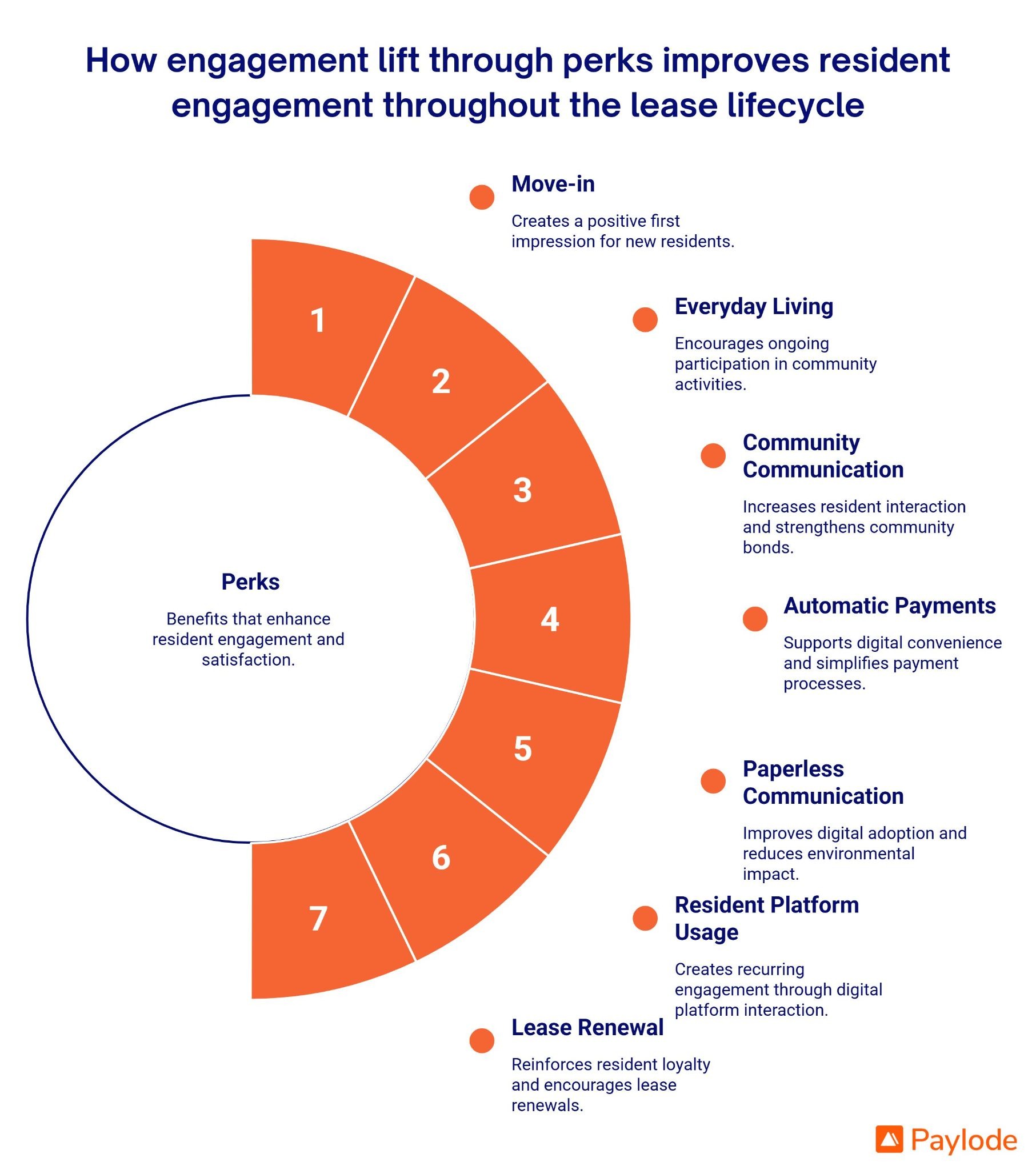
Engagement lift through perks helps residential operators create meaningful resident interactions at every stage of the lease lifecycle, improving participation, communication, satisfaction, and long-term retention.
Frequently asked questions
What is engagement lift through perks?
Engagement lift through perks refers to the measurable increase in resident participation, communication, platform usage, and overall engagement that results from providing ongoing resident benefits throughout the lease lifecycle.
How do resident perks improve engagement metrics?
Resident perks create regular opportunities for residents to interact with their community through everyday savings, lifestyle benefits, and digital experiences, leading to higher participation and stronger engagement.
Which engagement metrics should residential operators measure?
Property managers should monitor resident enrollment, active participation, benefit usage, communication engagement, recurring platform visits, and overall resident interaction trends.
Can resident perks improve communication engagement?
Yes. Resident perks provide valuable content for newsletters, emails, and digital updates, encouraging residents to engage more frequently with community communications.
How do perks encourage automatic payments?
Resident benefits reinforce digital participation by making convenient online payment experiences more attractive while supporting broader operational efficiency goals.
Why are digital resident experiences important?
Digital experiences improve convenience, reduce friction, and make it easier for residents to access benefits, receive communications, and interact with their community whenever they choose.
Can resident engagement improve lease renewals?
Yes. Residents who consistently experience value and maintain positive interactions with their community are generally more satisfied, strengthening long-term relationships and supporting renewal efforts.
How can property managers measure the success of a resident perks program?
Success can be measured through resident participation, engagement trends, communication performance, benefit usage, platform activity, and improvements in overall resident satisfaction.
Conclusion: Why should residential operators invest in engagement lift through perks today?
Resident engagement is no longer measured solely by attendance at community events or survey responses. Every interaction between a resident and their community contributes to the overall resident experience.
A well-designed resident perks system consistently creates those interactions. From the excitement of move-in to monthly payment experiences, community communications, digital engagement, and lease renewal, perks provide meaningful value that encourages residents to stay connected.
An effective engagement lift-through-perks strategy helps property managers improve measurable engagement while strengthening satisfaction and long-term resident relationships. Rather than relying on occasional initiatives, operators create a continuous experience that residents appreciate throughout their lease.
Communities across the residential housing market are increasingly adopting this approach because stronger engagement often leads to stronger business outcomes.
To build a modern resident engagement strategy, explore the Platform, deliver ongoing value through Perks, compare available Plans, or Book a Demo to see how a resident perks platform can improve engagement across your entire portfolio.
Property managers who consistently invest in resident relationships create communities where people are more engaged, more satisfied, and more likely to stay for the long term.