Property managers who run their communities on AppFolio already know the platform well. It handles maintenance requests, rent collection, lease tracking, and reporting in one place and, for many teams, is the operational backbone of the entire portfolio. What it was never designed to do is give residents a reason to feel good about where they live beyond the transactions themselves. That distinction matters more than it used to because resident expectations have shifted. Renters compare their experience to every other app on their phone, and a portal that only sends maintenance updates and rent reminders starts to feel one-dimensional. This is where AppFolio resident engagement, as a standalone concept, tends to plateau. The software keeps the property running smoothly, but it does not naturally build the emotional connection that keeps a resident from shopping around when their lease comes up for renewal.
This is not a criticism of AppFolio as a system. It was built to solve operational problems at scale, and it solves them well, which is exactly why so many portfolios depend on it. The issue is that property managers sometimes expect operational software to bear the weight of resident satisfaction, simply because it is the primary point of contact for residents with the property. When that expectation goes unmet, teams often assume engagement is a resident behavior problem, when in reality it is a tooling gap. Understanding that gap clearly is the first step toward closing it without ripping out the systems already in place.
What is the engagement gap in AppFolio-managed communities?
The engagement gap shows up in a fairly predictable pattern. A resident signs their lease, moves in, and interacts with AppFolio a handful of times a month, mostly to pay rent or submit a repair ticket. Those touch points are functional, not emotional. There is nothing in a typical maintenance confirmation or payment receipt that makes a resident feel appreciated or that reinforces why they chose this community over another. Over time, that absence adds up. Renewal decisions are rarely based on a single bad experience; the accumulation of small, forgettable interactions shapes them. Communities that rely solely on their property management software for resident communication tend to see engagement metrics flatten after the first ninety days of a lease, right around the point where the novelty of move-in wears off, and the relationship becomes purely transactional.
Why doesn't property management software solve engagement on its own?
Property management platforms like AppFolio are built around operations: rent, maintenance, leasing, accounting, and compliance. Those are essential functions, and they are executed well. But operations and engagement solve different problems. Operations software answers the question, "Did the task get done?" Engagement answers the very different question, "Does this resident feel like this is worth staying for?" Trying to stretch an operational system also to carry the weight of retention and loyalty usually results in generic, infrequent communication that residents tune out. A rent reminder is not a relationship. A maintenance ticket closed on time is expected, not memorable. Recognizing this distinction is the first step for any property manager trying to move past surface-level AppFolio resident engagement and toward something that actually influences renewal behavior.
How does a rewards layer change AppFolio resident engagement?
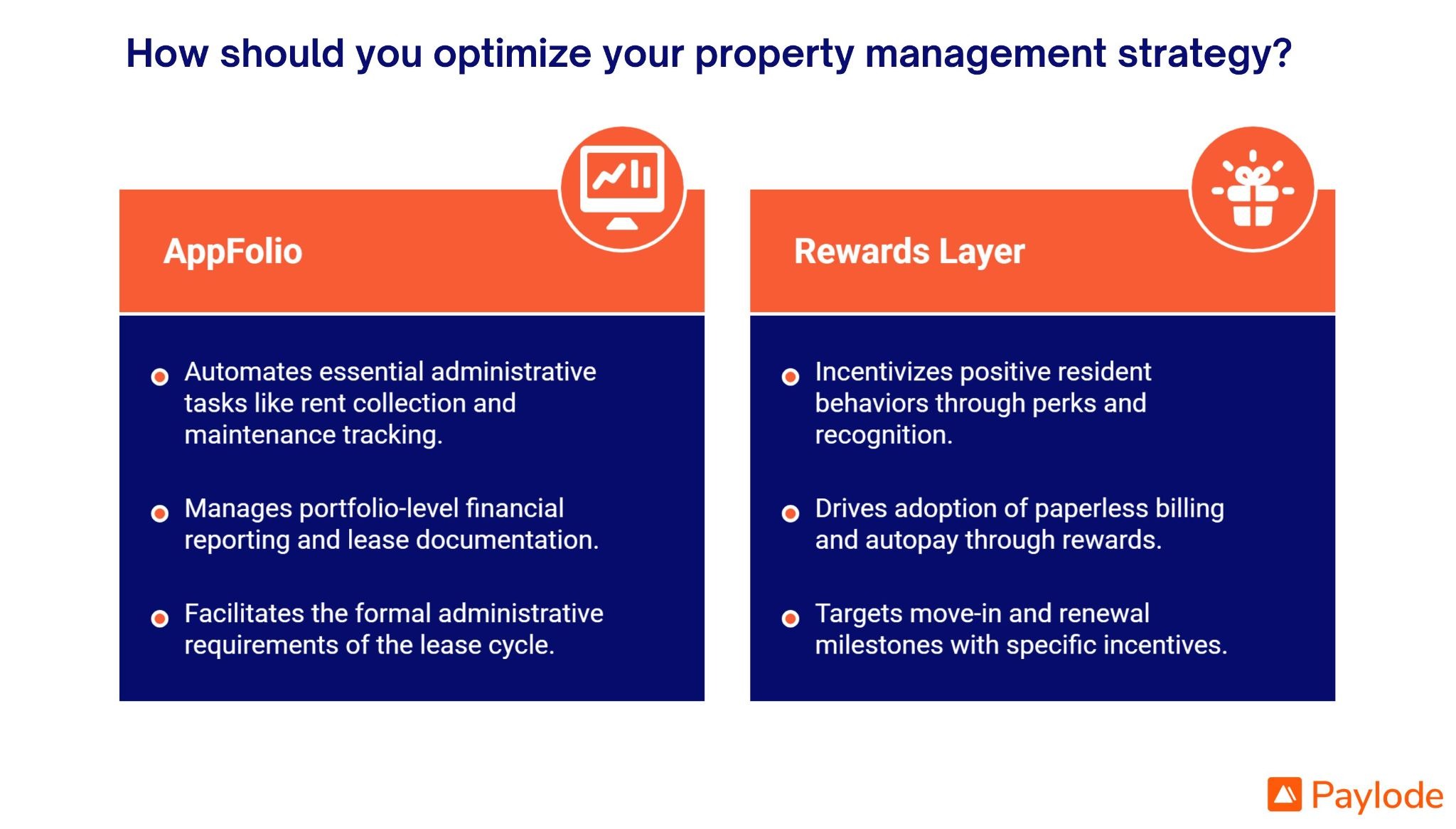
Adding a dedicated resident perks layer on top of AppFolio does not require replacing anything in the existing tech stack. Instead, it gives property managers a new communication channel that sits alongside the operational one, focused entirely on delivering value to residents rather than requesting anything from them. A resident perks center works well precisely because it flips the relationship's tone. Instead of every message being a request for rent or a notice about a work order, residents also start seeing messages that offer them something: a discount on moving services, a local restaurant deal, or a reward for paying on time. This shift changes how residents perceive the community, not just the software. It reframes routine interactions as ones with upside, which is a meaningfully different experience than what AppFolio delivers on its own.
What AppFolio does well
AppFolio is genuinely strong at the operational core of property management. Rent collection, work order tracking, lease renewals, and financial reporting all run efficiently through the platform, and most portfolio-level decisions depend on the data it generates. Property managers who have adopted AppFolio rarely want to move away from it, and they should not have to to close the engagement gap.
Where the gaps show up
The gaps appear specifically around motivation and recognition. AppFolio does not natively reward a resident for enrolling in autopay, does not curate local discounts for a specific community, and does not build a sense of belonging the way a branded perks experience can. Those are not failures of the software; they are simply outside its intended scope, which is why a layered approach tends to work better than trying to force the platform to do something it was not built for.
How can property managers use rewards to boost AppFolio resident engagement?
There are a handful of practical ways property managers are layering rewards into their existing AppFolio workflow, and most of them map directly to moments that already occur in the resident lifecycle.
Move-in and renewal incentives
The move-in period is the highest-attention window a property manager will ever get with a resident. Curating a bundle of local offers, moving discounts, or utility setup perks during that window builds goodwill before the relationship has a chance to go flat. The same logic applies at renewal time, when a small, well-timed reward can tip a resident who is on the fence toward signing again rather than shopping the market. Framing renewal incentives around real industry data helps here too, since residential real estate communities that lean into structured perks programs tend to see renewal conversations go more smoothly than those relying on rent concessions alone.
Autopay and paperless adoption incentives
Getting residents onto automatic payments reduces late payments and cuts down on manual collections work, but adoption rarely happens just because the option exists in the portal. A small reward tied to enrollment gives residents an immediate reason to switch, and it turns a back-office efficiency goal into something residents actually benefit from. The same applies to encouraging residents to switch to paperless billing and communication, which lowers the property's operating costs while giving residents one more reason to feel that the community is looking out for them, not just extracting rent.
Local perks and community building
Communities that curate a set of nearby discounts, from coffee shops to gyms to service providers, give residents a reason to check the resident portal for something other than a bill. This kind of ongoing, low-effort touchpoint keeps the community top of mind between the big lifecycle moments like move-in and renewal, and it is one of the more effective ways to prevent AppFolio resident engagement from going quiet in the middle of a lease term.
What results can property managers expect from combining AppFolio and resident rewards?
The clearest outcome property managers report is a lift in renewal rates, since residents who feel a sense of ongoing value are less likely to treat their lease as a purely transactional decision. Beyond renewals, teams also see a meaningful bump in autopay and paperless adoption when those actions are tied to a tangible reward, which directly reduces administrative overhead. There is also a longer-term effect on resident lifetime value. Communities that consistently give residents reasons to feel appreciated tend to raise customer LTV not through discounts on rent, but through the kind of loyalty that reduces turnover costs and vacancy periods. None of these outcomes requires abandoning AppFolio. They come from giving the platform a partner purpose-built for motivation, rather than trying to make operational software do a job it was never designed for.
It is also worth noting what these results are not. A rewards layer is not a discount strategy and is not a substitute for good property management fundamentals such as responsive maintenance or fair pricing. Residents will notice if a perks program is layered on top of a poorly run community, and no amount of local coffee shop discounts will offset slow work-order turnaround times or unresponsive staff. The programs that perform best are the ones added to communities that are already operationally sound, where the rewards layer amplifies a good experience rather than trying to compensate for a weak one. That is one more reason a layered approach, rather than a replacement approach, tends to hold up better over multiple lease cycles.
How do property managers get started integrating resident rewards with AppFolio?
Getting started is more straightforward than most property managers expect, since a rewards layer is designed to sit alongside existing software rather than replace it. The typical starting point is a perk center that can be embedded directly into the resident-facing experience, giving residents a single, branded place to discover offers without needing to learn a new system. From there, property managers usually connect a handful of specific triggers, such as move-in, autopay enrollment, or renewal, to relevant perks, so the rewards feel timely rather than random. Because the platform is built for the broader real estate sector, it is designed to plug into the workflows property managers already use, rather than asking teams to change how they operate day-to-day. Measuring the impact from there is a matter of tracking a few key metrics, such as renewal rate, autopay adoption, and time spent in the resident portal, over several full lease cycles to see the pattern take shape.
Frequently asked questions
Does resident rewards software replace AppFolio?
No. A rewards layer is designed to work alongside AppFolio, not in place of it. AppFolio continues to handle operations like rent collection and maintenance, while the rewards layer focuses specifically on resident motivation and recognition.
Will adding a rewards program create extra work for on-site teams?
Most rewards platforms are built to run with minimal day-to-day involvement from property staff. Perks are centrally curated and automatically delivered at key moments in the resident lifecycle, so on-site teams typically do not need to manage individual offers.
How quickly can a rewards program affect AppFolio resident engagement?
Early signals, like portal visits and autopay sign-ups, often shift within the first one to two months. Renewal-rate impact usually takes a full lease cycle to become clear, since renewal decisions are made months in advance.
Is this approach only useful for large portfolios?
No. Smaller communities benefit from the same lifecycle-based approach, since the goal is to make each resident touchpoint feel valuable rather than purely transactional, regardless of unit count.
Closing the gap starts with the right layer.
AppFolio resident engagement does not need to be reinvented; it needs to be supported. The platform already does the operational heavy lifting well, and pairing it with a rewards layer gives property managers a way to make every resident touch point feel a little more human, without adding complexity to the systems teams already rely on. The property managers who see the strongest results tend to start small, layering in one or two lifecycle moments, such as move-in or autopay enrollment, before expanding to a full program spanning renewals and ongoing local perks. That gradual approach makes it easier to measure what is actually moving the needle before committing to a portfolio-wide rollout. Explore the full platform overview to see how the pieces fit together, look at what is included in Perks, or see how Boost can reward specific resident actions like autopay enrollment. When you are ready to see pricing, check out the available plans, or go ahead and book a demo to see how it would work for your communities.